Therapists face increasing risks in the digital age, especially with the rise of telehealth. Protecting client data isn’t optional – it’s legally required under HIPAA. A single breach can lead to hefty fines, lawsuits, and loss of trust. Here’s how you can safeguard your practice:
- Multi-Factor Authentication (MFA): Adds an extra layer of security by requiring two forms of verification, like a password and a code.
- Role-Based Access Controls (RBAC): Limits data access to only those who need it for their job.
- Strong Password Practices: Use unique, complex passwords and update them regularly.
- Phishing Awareness Training: Teach staff to recognize and report suspicious emails.
- Encryption: Secure all data, whether stored or transmitted, to protect it from unauthorized access.
- Network Segmentation & Zero Trust: Isolate sensitive data and continuously verify all users and devices.
- Incident Reporting Procedures: Have a clear plan to handle breaches, including containment, mitigation, and notification.
Why it matters: In 2023, healthcare data breaches affected over 133 million people. Small practices are especially vulnerable, but these steps can help protect your clients and your reputation. Start by securing your systems, training your staff, and ensuring compliance with HIPAA regulations.
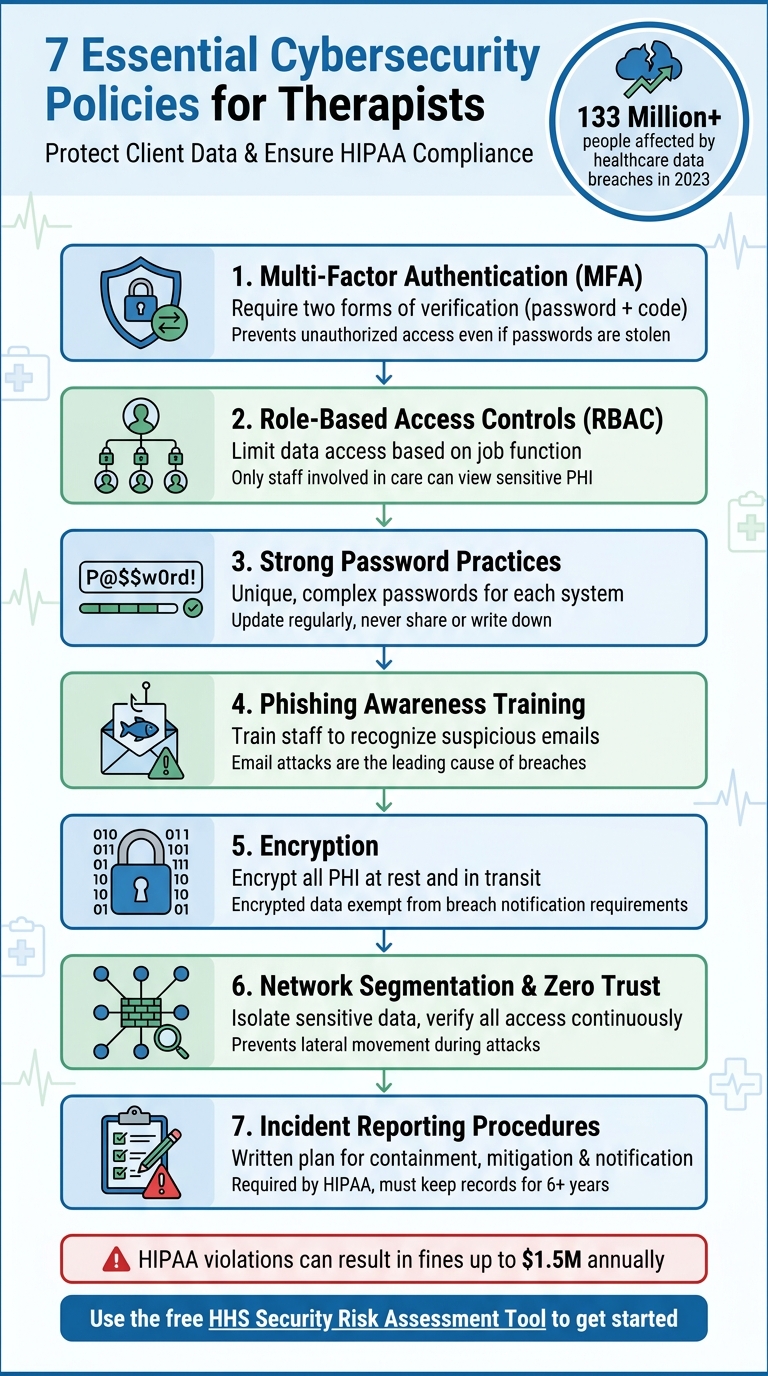
7 Essential Cybersecurity Policies for Therapists and Telehealth Practices
1. Use Multi-Factor Authentication (MFA)
Data Protection and HIPAA Compliance
Multi-factor authentication (MFA) adds an extra step to the login process by requiring two forms of verification – like a password and a code sent to your phone or email. This makes it much harder for attackers to access your systems, even if they manage to steal your password. For therapy practices, this can be a lifesaver when it comes to protecting Protected Health Information (PHI). Without access to the secondary device, intruders are effectively locked out. This extra security is especially important during telehealth sessions, where sensitive data is often shared.
A breach involving patient records isn’t just a technical issue – it can lead to serious consequences, including HIPAA violations, regulatory fines, and even lawsuits. Matt Grammer, Founder and CEO of Kentucky Counseling Center, puts it plainly:
A data breach like this would result in a HIPAA violation, and you can be sued.
[3] And here’s the kicker: standard malpractice insurance typically doesn’t cover these kinds of cyber incidents. That’s why MFA isn’t just about security – it’s a financial safeguard, too.
Ease of Implementation for Therapy Practices
The good news? Setting up MFA is usually straightforward. Most telehealth platforms, EHR systems, and patient portals offer MFA options under the "Settings" or "Security" sections. The U.S. Department of Health and Human Services advises:
Turn on two-step or multi-factor authentication… it makes it harder for someone else to use the app because they need access to your phone or email.
[4] To get the most out of MFA, pair it with strong, unique passwords. Together, they create a solid defense against unauthorized access.
Relevance to Telehealth and Remote Therapy
For remote therapy sessions, which rely heavily on web-based platforms, security is a top concern. These platforms are natural targets for cyberattacks, but MFA helps safeguard critical entry points like patient portals, telehealth apps, and EHR systems. Small practices are particularly vulnerable, as attackers often assume they have fewer defenses in place. Encouraging patients to enable MFA on their own accounts can further protect their sensitive health information.
While MFA is a powerful tool for securing access, it’s just one piece of the puzzle. The next step? Tightening control over system access with role-based permissions.
sbb-itb-596b85d
2. Set Up Role-Based Access Controls (RBAC)
Data Protection and HIPAA Compliance
Role-Based Access Controls (RBAC) help safeguard Protected Health Information (PHI) by limiting access to only those staff members directly involved in patient care. This approach aligns with HIPAA regulations, which require healthcare providers to have written policies outlining how PHI is protected [2]. For instance, an intake coordinator doesn’t need access to clinical session notes, just as billing staff shouldn’t see sensitive trauma histories. By restricting access based on job function, you reduce exposure risks and maintain compliance.
Effectiveness in Preventing Breaches
RBAC also plays a crucial role in minimizing the damage caused by breaches. By limiting access to data based on roles, even if an account is compromised, the exposed information is restricted to what that role can access. As one expert emphasizes, only staff directly involved in a patient’s care should have access to sensitive details [5]. This strategy not only reduces the risk of internal threats but also prevents attackers from accessing the entire database. These precautions are especially important for telehealth platforms, where digital access controls are essential.
Relevance to Telehealth and Remote Therapy
When combined with strong multi-factor authentication (MFA), RBAC adds another layer of security to telehealth interactions by managing internal access. The rise of telehealth has increased reliance on technology, making therapy practices a prime target for hackers who see medical records as a "goldmine" for ransom [3]. RBAC helps protect your digital environment by controlling access within tools like Electronic Health Records (EHR) systems and video platforms. For remote teams, where physical monitoring of screens isn’t feasible, digital restrictions are indispensable. Use built-in role settings in your management system to assign roles such as "Clinician", "Billing", and "Administrative", rather than granting universal administrative privileges. Additionally, ensure that any vendor handling PHI signs a Business Associate Agreement (BAA) to comply with HIPAA standards [5].
3. Require Strong Password Practices
Data Protection and HIPAA Compliance
HIPAA requires healthcare providers to have written policies for managing passwords. Healthcare attorney Erin K. Jackson explains:
"HIPAA requires that providers maintain written policies about how they will create, change, and safeguard passwords. Be sure that your HIPAA policies specifically identify your practice’s password requirements, the frequency with which they should be changed, and a prohibition against writing them down or sharing them." [2]
Failing to establish these policies is a direct HIPAA violation [2]. Your privacy manual should clearly outline password rules, such as the required complexity, how often they need to be updated, and strict guidelines against sharing or writing them down.
Effectiveness in Preventing Breaches
Using unique passwords for every application and device is a simple yet effective way to limit damage if one account is compromised. Combine this with automatic lock-screen features that activate after brief inactivity. According to HHS.gov:
"Use different passwords for each app, website, computer, or mobile device you use for your telehealth appointment to keep others from accessing all of your information if someone discovers your password." [4]
By isolating access to individual systems, you can prevent a single breach from spreading to other accounts. This is particularly important for therapy practices, which are often targeted due to weaker cybersecurity defenses [3]. Adopting these password protocols is essential, especially when you choose a HIPAA-compliant telehealth platform.
Relevance to Telehealth and Remote Therapy
Strong password practices are even more critical when conducting remote therapy sessions. Telehealth introduces unique challenges, as therapists may use personal devices or work from multiple locations. These scenarios increase the risk of password vulnerabilities. To safeguard protected health information (PHI), ensure devices lock automatically after short periods of inactivity. Additional steps include closing unnecessary applications, logging out after sessions, and avoiding public Wi-Fi networks [4] [5]. These measures help maintain security, even in less controlled environments.
4. Train Staff on Phishing Threats
Data Protection and HIPAA Compliance
While tools like MFA and RBAC are important for cybersecurity, training staff to recognize phishing threats is just as critical. The HIPAA Security Rule mandates "Security Awareness and Training" for all employees. This training must cover identifying malicious software and monitoring login attempts, and records of the training need to be kept for at least six years to meet compliance standards [1].
Failing to comply with HIPAA due to willful neglect can result in penalties as high as $1.5 million annually [1]. Teaching staff to identify phishing attempts is a key strategy for protecting electronic Protected Health Information (ePHI), such as session notes, treatment plans, and diagnoses, which are common targets for cybercriminals [1][7].
Effectiveness in Preventing Breaches
Email-related attacks, particularly those where hackers gain access to employee accounts, are a leading cause of data breaches in smaller healthcare practices [1]. Training employees to spot phishing attempts is vital for safeguarding patient data and ensuring compliance with both legal and ethical responsibilities.
Employees need to be familiar with common phishing red flags, such as urgent language, spelling or grammar mistakes, generic greetings like "Dear User", and unexpected requests for sensitive information [7]. They should also learn verification techniques, like hovering over links to check URLs and carefully inspecting email addresses for subtle discrepancies [7]. Small practices are often targeted because attackers assume their defenses are weaker [3].
Ease of Implementation for Therapy Practices
To put these strategies into action, therapy practices can hold regular training sessions that use real-world examples to highlight phishing risks for both clinical and administrative staff. Pair this training with Multi-Factor Authentication (MFA) for added protection in case a phishing attempt succeeds [1][7]. Small practices can also use the free HHS Security Risk Assessment Tool to pinpoint vulnerabilities and customize their training programs [1].
It’s equally important to set up a clear process for reporting suspicious emails to IT or a designated security officer [1][7]. Combining these efforts with other security measures creates a well-rounded defense against cyber threats.
Relevance to Telehealth and Remote Therapy
In telehealth and remote therapy settings, the risks of phishing attacks increase. Staff need to be alert to phishing attempts disguised as telehealth platform notifications or patient messages [4][6]. Remote employees should avoid public Wi-Fi networks and instead use a secure Virtual Private Network (VPN) when accessing patient data during online sessions [7]. As Digital Samba emphasizes:
A well-informed team is your first line of defense.
If an email seems suspicious, staff should verify its legitimacy through a trusted and known communication channel [4].
Training employees to recognize phishing threats is an essential element of cybersecurity. Practices like Growth and Change Counseling integrate these measures to protect client data during telehealth sessions, demonstrating their commitment to secure and reliable care.
5. Encrypt All Protected Health Information (PHI)
Data Protection and HIPAA Compliance
Encryption is a method that converts sensitive information into an unreadable format, which can only be accessed with the correct key. According to the HIPAA Security Rule, encryption is an "addressable" standard. This means practices must either implement encryption or document an alternative solution that achieves the same level of security. This applies to both data at rest (stored on hard drives, cloud servers, or USB drives) and data in transit (sent via email or during telehealth sessions).
When data is encrypted properly, it gains special legal protections. As Ease Health explains:
Properly encrypted data is not considered ‘unsecured PHI’ and is exempt from breach notification requirements if lost or stolen.
This "Safe Harbor" provision spares practices from the breach notification process. Without encryption, therapists face serious risks. For instance, healthcare data breaches impacted over 133 million people in 2023, with unencrypted devices and email transmissions of PHI among the most frequent HIPAA violations for therapists [1].
Practical Steps for Therapy Practices
Therapists can take several straightforward steps to implement encryption:
- Enable full-disk encryption on all work devices, including laptops, tablets, and smartphones.
- Use only encrypted USB drives for transferring or backing up data.
- Choose telehealth platforms that offer end-to-end encryption rather than just basic transport security. HIPAA-compliant platforms like Zoom for Healthcare, Doxy.me, SimplePractice, and TherapyNotes are excellent options because they also provide the necessary Business Associate Agreements (BAAs). However, standard versions of FaceTime, Skype, or free Zoom accounts do not meet HIPAA standards.
Additionally, avoid using standard SMS or free email services like Gmail for exchanging PHI. Instead, opt for HIPAA-compliant messaging platforms or encrypted email services that offer BAAs. If a client insists on using unencrypted email, obtain documented informed consent that acknowledges the associated privacy risks. These steps, combined with other security measures, create a robust defense against breaches.
How Encryption Prevents Breaches
Encryption plays a major role in protecting sensitive data, especially as cybercriminals increasingly target medical records with ransomware. The financial penalties for non-compliance are steep: HIPAA violations due to willful neglect can result in fines of up to $50,000 per violation, with an annual maximum of $1.5 million. Additionally, knowingly disclosing PHI can lead to criminal penalties, including fines of up to $50,000 and up to a year in prison [1].
Encryption in Telehealth and Remote Therapy
Encryption is especially important for telehealth and remote therapy because it ensures the privacy and integrity of online sessions. With proper encryption, video and audio streams are secure, accessible only to the therapist and client. This reinforces earlier measures like MFA (multi-factor authentication) and RBAC (role-based access control) by safeguarding the data itself, not just the access points.
Therapists should also configure devices to lock automatically after brief periods of inactivity to prevent unauthorized access. Encourage clients to use private Wi-Fi networks and avoid public USB charging stations to further protect their data.
For example, Growth and Change Counseling employs comprehensive encryption protocols for all telehealth services, ensuring client data remains secure during online therapy sessions across California.
6. Use Network Segmentation and Zero Trust Security
Data Protection and HIPAA Compliance
Network segmentation works by dividing your digital infrastructure into smaller, isolated sections, making it harder for attackers to move freely if they breach one part. On the other hand, Zero Trust Security focuses on continuously verifying every user and device trying to access your systems, no matter where they are located. While tools like MFA (Multi-Factor Authentication) and RBAC (Role-Based Access Control) secure entry points, Zero Trust ensures ongoing verification across all segments of your network.
According to HIPAA regulations, telehealth services must use technology that safeguards patient protected health information (PHI) [8]. Network segmentation aligns with these requirements by keeping sensitive client data separated from less critical systems. When combined with MFA and RBAC, segmentation and Zero Trust provide an additional layer of protection against breaches, making your practice more resistant to lateral attacks.
Effectiveness in Preventing Breaches
These strategies go beyond basic access controls by actively preventing attackers from navigating through your network. Medical record systems are a prime target for hackers because they store data that can be exploited or held for ransom [3]. Network segmentation acts as a barrier, stopping attackers from moving laterally once they’ve gained entry. When paired with Zero Trust principles – requiring verification at every step – these measures significantly lower the risk of ransomware attacks and data theft.
Matt Grammer, Founder and CEO of Kentucky Counseling Center, highlights the importance of proactive security measures:
Being proactive about your private practice’s security is a vital key to prevent ransomware attacks.
[3] Even a single compromised device or phishing email could jeopardize your entire client database, making strict access controls absolutely essential.
Relevance to Telehealth and Remote Therapy
The rise of telehealth has introduced new security challenges [3]. Remote therapy sessions often rely on a mix of networks – home Wi-Fi, internet service providers, and telehealth platforms – making network segmentation crucial for minimizing vulnerabilities and reducing the overall attack surface.
It’s also essential to ensure that all technology vendors supporting remote therapy comply with HIPAA and are willing to sign a Business Associate Agreement (BAA) [8]. Additionally, since standard provider liability insurance often excludes coverage for cyber-related damages or legal costs [3], investing in a dedicated cyber insurance policy can help protect your practice. This type of coverage can safeguard against network breaches, regulatory penalties, and the expenses tied to resolving security incidents. For example, Growth and Change Counseling has implemented these measures to secure its telehealth services across California.
7. Create Incident Reporting and Response Procedures
Data Protection and HIPAA Compliance
Strong incident reporting and response procedures are your safety net when things go wrong. Under HIPAA, therapists are required to establish formal Security Incident Procedures as part of their administrative safeguards [1]. This involves creating a written plan that specifies exactly how to handle breaches – whether it’s a stolen laptop, a phishing scam, or unauthorized access to sensitive client information. Healthcare attorney Erin K. Jackson underscores the importance of having this documentation:
The first thing that regulators will do if you’re audited is ask to review your privacy manual. Failing to produce these policies constitutes a HIPAA violation.
Your plan should cover containment, investigation, risk assessment (using the four-factor test), mitigation, and notification processes [1]. Additionally, all incident logs and response records must be kept for at least six years [1][2].
Ease of Implementation for Therapy Practices
To meet these compliance standards, focus on creating a plan that is both thorough and easy to follow. Solo practitioners, for example, must assign a Privacy and Security Officer to manage these procedures [1]. Start by using security assessment tools to identify potential vulnerabilities before an incident occurs [1]. Your written plan should include:
- Clearly defined roles and responsibilities
- A step-by-step response checklist
- Contact information for your cyber insurance provider, which can help cover costs like IT experts, legal fees, and fines [3]
Another key step is enabling full-disk encryption on all devices. If a device is lost or stolen, properly encrypted data is exempt from breach notification requirements [1]. Don’t forget to review and update your procedures annually or whenever there are changes to your practice [1].
Effectiveness in Preventing Breaches
A well-prepared response plan can stop a breach from spiraling out of control. In 2023, over 133 million individuals were impacted by healthcare data breaches [1], with small therapy practices often targeted through stolen devices or email scams [1]. HIPAA fines range from $100 to $50,000 per violation, with a maximum annual penalty of $1.5 million for uncorrected willful neglect [1]. The four-factor breach test is an essential tool for deciding whether an incident requires notification. It evaluates:
- The type and extent of protected health information (PHI) involved
- Who accessed the data
- Whether the information was actually viewed
- How much risk has been mitigated [1]
These steps not only help contain breaches but also provide clear guidelines for responding effectively.
| Breach Scale | Notification Deadline | Reporting Requirement |
|---|---|---|
| Fewer than 500 individuals | Within 60 days of discovery | Log and report to HHS annually [1] |
| 500 or more individuals | Within 60 days of discovery | Notify HHS and local media immediately [1] |
Relevance to Telehealth and Remote Therapy
For telehealth practices, your procedures must address the unique risks of remote care. Third-party platform breaches are a major concern, so your Business Associate Agreement (BAA) should require vendors to notify you of any security incidents [1]. It’s also smart to have a backup plan for technology failures, such as a secure phone line or rescheduling protocols, to maintain continuity of care if a platform is compromised [6].
Remote device management is another critical focus area since laptops and mobile devices are frequent targets [1]. Include telehealth-specific privacy risks in your informed consent documents to encourage clients to help maintain a secure environment [1]. Additionally, advise patients to report any suspicious links or messages immediately [4]. These steps ensure that both you and your clients are prepared to handle potential threats.
HIPAA Compliance for Therapists: Common Scenarios and What to Do
Prioritizing Cybersecurity at Growth and Change Counseling
Cybersecurity isn’t just a legal requirement; it’s a cornerstone of trust in telehealth. In 2023 alone, healthcare data breaches impacted over 133 million individuals, highlighting the pressing need for stringent security measures [1].
Smaller therapy practices face unique challenges. Without the extensive resources of larger organizations, they often lack strong security protocols, making them prime targets for cyberattacks and regulatory scrutiny [3]. The seven policies outlined earlier align with HIPAA safeguards to protect electronic protected health information (ePHI). Falling short of these standards could lead to hefty fines and tarnish your reputation and licensure [1].
Matt Grammer, Founder and CEO of Kentucky Counseling Center, puts it plainly:
Cyber policy insurance should be your top priority as you’re launching your telehealth practice. If not, your small practice may have a data breach, which could cost you a lot of money.
To get started, consider these actionable steps: perform a risk analysis using the free HHS Security Risk Assessment Tool, enable full-disk encryption on all devices, ensure every vendor has a signed Business Associate Agreement, and create a detailed privacy manual [1][2]. These measures form the bedrock of a secure telehealth practice.
As we’ve explored, confidentiality is the backbone of effective therapy. In a digital world, robust cybersecurity safeguards are non-negotiable. By adopting these seven policies, you not only meet compliance standards but also establish a secure and trustworthy environment for telehealth care.
At Growth and Change Counseling, we are committed to these practices to deliver safe, reliable, and confidential telehealth services.
FAQs
What should my written HIPAA cybersecurity policies include?
Your HIPAA cybersecurity policies need to outline how your practice protects patient health information in line with HIPAA requirements. These policies should address key areas like the Privacy Rule, Security Rule, breach notification procedures, Business Associate Agreements (BAAs), and proper documentation practices. Make sure all these guidelines are compiled into a written manual that details how your organization secures and manages patient data.
Do I need a Business Associate Agreement (BAA) for every vendor I use?
Absolutely. If you work with vendors who handle protected health information (PHI) on your behalf, having a Business Associate Agreement (BAA) in place is non-negotiable. This document ensures you’re compliant with HIPAA regulations and helps protect sensitive client data – whether you’re conducting telehealth sessions or engaging in other professional activities.
What should I do first if I suspect a PHI breach?
If you think a PHI breach has occurred, take action right away to address it and evaluate the situation. Start by following HIPAA compliance rules: identify the breach, work to limit its impact, inform affected individuals and any required authorities, and keep a detailed record of everything. Stick to your practice’s breach response plan to stay compliant and safeguard client information.
Related Blog Posts
- Managing Boundaries in Addiction Recovery Telehealth
- Best Practices for Multicultural Telehealth Counseling
- How to Choose a HIPAA-Compliant Telehealth Platform
- Telehealth Training for Addiction Counseling
