Codependency often stems from unresolved childhood trauma. Patterns like people-pleasing, self-sacrifice, and emotional dependence are rooted in early experiences of neglect, abuse, or inconsistent caregiving. These behaviors, while survival mechanisms in childhood, can lead to unhealthy relationships in adulthood.
EMDR therapy (Eye Movement Desensitization and Reprocessing) is a proven method to address these deep-seated issues. It helps reprocess traumatic memories, reducing their emotional intensity and replacing harmful beliefs like "I don’t matter" with healthier ones such as "My needs are important." EMDR uses an 8-phase approach, incorporating techniques like bilateral stimulation to create lasting change.
Key Points:
- Codependency origins: Childhood trauma, insecure attachment styles, and parentification.
- Common behaviors: People-pleasing, poor boundaries, low self-esteem, and difficulty expressing emotions.
- EMDR benefits: Faster results compared to talk therapy, reduced emotional triggers, and improved boundary-setting.
- Treatment options: Growth and Change Counseling offers in-person and telehealth EMDR therapy across California, starting at $100 per session.
If you struggle with codependency, EMDR therapy can help you process the past, regain emotional control, and build healthier relationships.
Recovering from Codependency | #trauma #ptsd #cptsd #traumarecovery #traumahealing #codependency
How Childhood Trauma Creates Codependency
Codependency often begins as a survival tool in families where neglect, abuse, or chaos are the norm. In such environments, children grow up internalizing blame for the dysfunction around them, a behavior that can persist into adulthood [5] [6].
"Codependency is an outgrowth of unmet childhood needs. Kids rely on their parents to nurture their physical and emotional development. When parents do not do this, the child doesn’t blame their parent. They might blame themselves, instead." – Michelle Halle, LISC [6]
In these situations, children frequently turn to external validation as a way to cope. Over time, this reliance on others for approval can solidify into deeply rooted codependent tendencies. According to the Substance Abuse and Mental Health Services Administration (SAMHSA), more than two-thirds of children experience at least one traumatic event by the age of 16 [6]. Studies, including research conducted with nursing students in 2006 and nurses in 2019, show that individuals who endured emotional, verbal, physical, or sexual abuse during childhood scored higher on measures of codependency [6]. These early patterns of behavior often lead to insecure attachment styles, which are explored in the next section.
Attachment Styles and Codependency
When caregiving is inconsistent or dismissive, it can lead to insecure attachment styles that fuel codependent behaviors [7]. Emotional neglect during childhood creates a lingering fear of rejection. Children in these circumstances may learn that love and acceptance are conditional, leading them to suppress their own needs to maintain relationships [7] [10]. This fear often follows them into adulthood, causing them to prioritize others’ needs over their own.
"The child would feel emotionally abandoned by the parent at times. This naturally produces a lot of anxiety around a fear of abandonment when this child becomes an adult." – Gabrielle Usatynski, MA, LPC [7]
The table below outlines how different attachment styles develop and how they present in adulthood:
| Attachment Style | Childhood Origin | Adult Manifestation |
|---|---|---|
| Dismissive-Avoidant | Caregivers were absent or dismissed emotions. | Distant; hides feelings to avoid rejection; withdraws during conflict. |
| Anxious-Preoccupied | Inconsistent emotional availability. | Insecure; becomes "clingy" when stressed; fears being alone. |
| Anxious-Avoidant | Unpredictable or chaotic caregiving. | Craves closeness but withdraws when intimacy deepens; tests loyalty. |
| Secure | Consistent, responsive caregiving. | Mutual support with healthy boundaries. |
These attachment patterns often translate into specific codependent behaviors, which are discussed in the next section.
Common Codependent Behaviors
The coping mechanisms children develop in response to trauma often carry over into adult relationships. One such mechanism is the "fawn" response – where individuals prioritize appeasing others over asserting their own needs [6] [9]. This can manifest as chronic people-pleasing and an inability to advocate for oneself.
Another dynamic, known as parentification, forces children into adult roles, such as acting as an emotional support system for a parent or taking care of siblings. This experience teaches children to ignore their own needs in favor of others. As adults, they may feel an overwhelming need to "fix" or care for others, often at their own expense [9] [10]. Additionally, children who are punished for standing up against abuse may learn that being assertive is dangerous, leading to a lifelong tendency to submit and a diminished sense of self-agency [8].
Some hallmark codependent behaviors include:
- Low self-esteem
- Poor boundaries
- Difficulty saying no
- Fear of expressing emotions
- Overreliance on others for decision-making
While these behaviors may have been essential for survival in a dysfunctional environment, they often create challenges in forming healthy, balanced relationships later in life [6] [10].
What Is EMDR Therapy
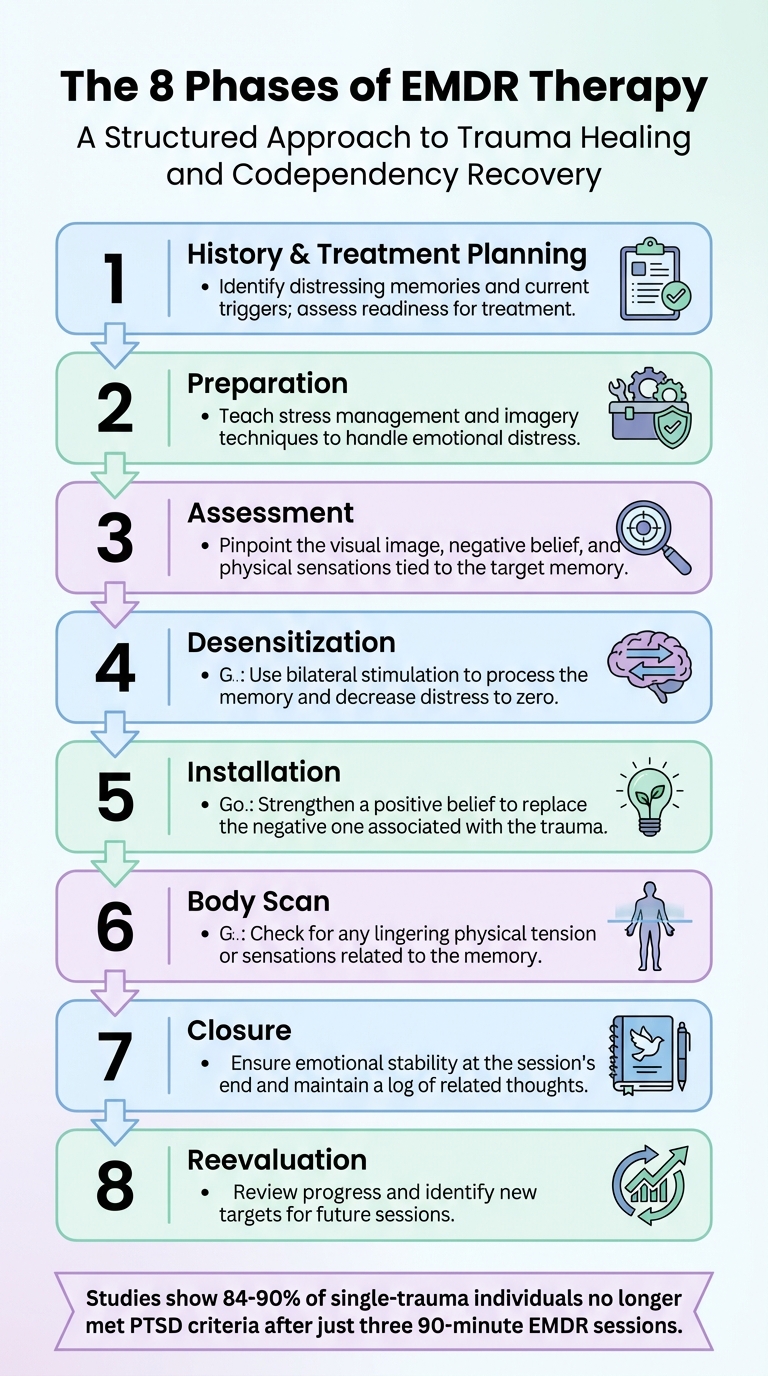
EMDR Therapy 8-Phase Treatment Process for Codependency Recovery
EMDR, or Eye Movement Desensitization and Reprocessing, is a form of psychotherapy designed to help the brain process traumatic memories without requiring a detailed recounting of the events [2] [4]. It operates on the Adaptive Information Processing model, addressing past traumas, present triggers, and building resilience for the future – all in a single, structured approach [4] [11] [13].
Studies highlight its effectiveness: between 84% and 90% of individuals dealing with a single trauma no longer met PTSD criteria after just three 90-minute sessions. A Kaiser Permanente study found that 100% of single-trauma cases and 77% of those with multiple traumas, including combat veterans, were free of PTSD symptoms after six to 12 sessions [2] [11]. These impressive results have led organizations like the World Health Organization, the American Psychiatric Association, and the U.S. Department of Defense to endorse EMDR as an effective trauma therapy [2] [12].
"The mind can in fact heal from psychological trauma much as the body recovers from physical trauma. When you cut your hand, your body works to close the wound. If a foreign object or repeated injury irritates the wound, it festers and causes pain. Once the block is removed, healing resumes."
These outcomes are rooted in how EMDR works on a neurological level.
How EMDR Works in the Brain
During an EMDR session, you focus on a distressing memory while engaging in bilateral stimulation (BLS). This might involve side-to-side eye movements, hand tapping, or alternating audio tones [2] [3]. This dual focus activates both sides of the brain, mimicking the natural processing that occurs during REM sleep [2] [11]. The stimulation helps the brain access traumatic memory networks and create new, healthier connections.
Trauma often disrupts the hippocampus, the brain’s "timekeeper", which can make memories feel as if they’re still happening in the present. EMDR helps reconnect emotional and sensory experiences with logical reasoning, reducing the emotional intensity of the memory [4] [17].
"Reprocessing takes place when dual attention on a past memory, combined with bilateral stimulation, activates an associative process that allows relevant connections to be made."
- Francine Shapiro, PhD [3]
For instance, someone who endured abuse might transition from feeling shame and helplessness to a sense of empowerment, adopting the belief, "I survived it and I am strong" [2].
This brain-centered reprocessing method forms the foundation for EMDR’s eight-phase treatment approach.
The 8 Phases of EMDR
EMDR therapy is structured into eight phases, each designed to ensure a secure and effective healing process:
| Phase | Name | Primary Goal |
|---|---|---|
| 1 | History & Treatment Planning | Identify distressing memories and current triggers; assess readiness for treatment [2] [4]. |
| 2 | Preparation | Teach stress management and imagery techniques to handle emotional distress [4] [15]. |
| 3 | Assessment | Pinpoint the visual image, negative belief, and physical sensations tied to the target memory [2] [15]. |
| 4 | Desensitization | Use bilateral stimulation to process the memory and decrease distress to zero [16] [17]. |
| 5 | Installation | Strengthen a positive belief to replace the negative one associated with the trauma [4] [15]. |
| 6 | Body Scan | Check for any lingering physical tension or sensations related to the memory [4] [16]. |
| 7 | Closure | Ensure emotional stability at the session’s end and maintain a log of related thoughts [2] [4]. |
| 8 | Reevaluation | Review progress and identify new targets for future sessions [2] [4]. |
Each phase is carefully designed to guide you through the healing process, offering tools like grounding techniques and progress reviews to ensure a steady and manageable recovery.
sbb-itb-596b85d
How EMDR Helps with Codependency Recovery
EMDR (Eye Movement Desensitization and Reprocessing) works by addressing traumatic childhood memories that often fuel codependency. These memories can create harmful beliefs like "I am not good enough" or "My needs don’t matter", which may dominate your relationships [1][21]. Instead of just talking about behaviors like people-pleasing, EMDR targets the root experiences that shaped these responses. For instance, if you took on caregiving roles early in life, EMDR can help "unfreeze" those memories so they stop influencing your current interactions [1][21]. Through bilateral stimulation, EMDR reduces the emotional intensity of these beliefs and helps replace them with healthier ones, such as "My needs are important" or "I am resilient." This process not only transforms core beliefs but also improves emotional regulation.
Better Emotional Control
People struggling with codependency often face overwhelming emotions, such as fear of abandonment, guilt when setting boundaries, or anxiety when not helping others. EMDR helps reduce the emotional weight of past memories and the physical reactions tied to them.
"In successful EMDR therapy, the meaning of painful events is transformed on an emotional level. For instance, a rape victim shifts from feeling horror and self-disgust to holding the firm belief that, ‘I survived it and I am strong.’"
- EMDR Institute [2]
This transformation happens because EMDR allows your brain to process traumatic memories that were previously "frozen", so they no longer disrupt your current relationships.
Setting Healthy Boundaries
As EMDR lessens the emotional charge of past experiences, it becomes easier to set and maintain healthy boundaries. Codependent behaviors often arise from a need to control situations – whether it’s avoiding conflict, feeling indispensable, or taking responsibility for others’ happiness. EMDR helps reprocess memories of neglect or manipulation, empowering you to regain autonomy and set boundaries without guilt.
The "Body Scan" phase of EMDR is particularly helpful here. It identifies areas of physical tension – like tightness in the chest, stomach, or shoulders – that may surface when you think about setting boundaries. Resolving this tension is essential for maintaining limits in the future. These changes are crucial for breaking free from codependency and advancing trauma recovery.
EMDR vs. Talk Therapy for Trauma
While traditional talk therapy helps you understand codependent patterns, EMDR often works faster by directly addressing the memories and emotions behind them. Here’s a comparison:
| Feature | EMDR | Talk Therapy |
|---|---|---|
| Speed of Healing | Often yields results in 3–12 sessions [2][4] | May take months or years for similar progress [2][20] |
| Level of Detail | No need for detailed recounting of trauma [4][19] | Often involves detailed verbal exploration of trauma [4][20] |
| Mechanism of Change | Uses bilateral stimulation to reprocess memories [2][20] | Relies on therapist dialogue and interpretation [2][20] |
| Homework | Minimal; usually involves noting new thoughts between sessions [4] | Often includes significant tasks like journaling [4] |
| Stress Level | Typically less stressful as it focuses on processing, not reliving [4][20] | Can be more stressful due to in-depth recounting of trauma [4][20] |
Many therapists combine both approaches, using talk therapy to explore codependent behaviors and EMDR to address the underlying traumatic memories. Together, they offer a well-rounded path to recovery.
EMDR Services at Growth and Change Counseling
Trauma and Codependency Treatment
At Growth and Change Counseling, addressing codependency goes beyond surface-level behaviors. Therapists use EMDR (Eye Movement Desensitization and Reprocessing) alongside CBT, attachment theory, and somatic techniques to tackle the root trauma behind codependent patterns. If you find yourself constantly people-pleasing, for example, therapy here isn’t just about understanding why – it’s about processing the childhood experiences that shaped those tendencies.
"In cases of PTSD, I will help you uncover the underlying defenses that protected you through a traumatic experience but now are interfering with your ability to move forward in intimacy."
- April Silva, LMFT, Growth and Change Counseling [22]
For couples navigating codependency, the therapy approach is equally comprehensive. By combining trauma-informed EMDR with frameworks like Emotion Focused Couples Therapy (EFT) and the Marriage Rescue Institute – a 12-week program tailored for strained relationships – partners can work through individual trauma while rebuilding their connection. Therapists also assign relational homework between sessions, giving couples practical tools to apply EMDR insights to their everyday interactions.
Therapy Locations and Telehealth Options
Growth and Change Counseling makes therapy accessible with both in-person and telehealth options. You can receive EMDR therapy at their locations in Campbell, San Jose, Los Angeles, and Roseville, or opt for online sessions if you’re anywhere in California. The virtual platform offers the same trauma-focused care, whether you’re in a remote area or simply prefer the convenience of at-home therapy.
Sessions are priced at $200 for 45 minutes with a licensed LMFT and $150 for 45 minutes with an AMFT, with sliding scale options starting at $100.
Telehealth EMDR uses the same bilateral stimulation techniques as in-person sessions – like guided eye movements, tapping, or audio tones. Whether you’re working through childhood trauma tied to codependency or tackling relationship challenges, these services are designed to help you heal at a pace that feels right for you.
Healing from Codependency at Growth and Change Counseling
Codependency often has its roots in childhood trauma, shaping negative beliefs like "I’m not good enough" or "I have to be perfect." EMDR therapy tackles these deeply ingrained issues using an 8-phase approach, helping the brain process traumatic experiences and replace harmful thought patterns with healthier ones, such as "I am worthy" or "My needs matter" [2][18].
Studies highlight EMDR’s ability to deliver lasting relief from trauma-related symptoms [2].
"EMDR therapy can be a direct, powerful way to address distress related to codependency and to ultimately start living life for yourself."
- Allie Kidd, Therapist [1]
If you’re ready to break free from codependency and create healthier boundaries, EMDR therapy provides a structured and effective path forward. A trained EMDR therapist will support you through the Preparation phase, teaching stress management techniques to keep you grounded as you confront and process unresolved trauma [2][19]. They can also help pinpoint the "targets" – specific past experiences, current triggers, or future stressors – that contribute to codependent patterns [14][23].
For those seeking professional help, Growth and Change Counseling in California offers both in-person and telehealth EMDR sessions. Whether you’re looking for individual therapy or couples counseling through the Marriage Rescue Institute, their trauma-informed care is tailored to guide you on your healing journey.
FAQs
How can EMDR therapy support recovery from codependency?
EMDR therapy offers a way to tackle codependency by addressing the unresolved trauma that often fuels behaviors like people-pleasing, over-controlling, or excessive caretaking. Using techniques such as bilateral eye movements or tapping, EMDR helps to ease the emotional weight of painful memories and shift negative beliefs into healthier, self-affirming ones.
This approach can improve emotional regulation, strengthen boundaries, and encourage more balanced, satisfying relationships. By reprocessing past experiences, EMDR enables individuals to break free from codependent patterns and develop a more solid and independent sense of self.
What are the common signs of codependency caused by childhood trauma?
Codependency tied to childhood trauma often manifests as putting others’ needs ahead of your own and finding it hard to maintain a sense of independence. Some common indicators include trouble setting boundaries, habitual people-pleasing, low self-worth, and constantly seeking validation. Many people in this situation also tend to suppress their feelings to avoid conflict or rejection.
These behaviors often trace back to early experiences of emotional neglect or inconsistent caregiving, where affection may have seemed conditional. In adulthood, this can translate into feeling overly responsible for others, a deep fear of abandonment, and heightened anxiety when alone. Identifying these patterns is a crucial step in the healing process. Approaches like EMDR therapy can help address the underlying trauma and pave the way for healthier, more balanced relationships.
How is EMDR different from traditional talk therapy for healing trauma?
EMDR takes a different approach compared to traditional talk therapy by focusing on the root of the problem – processing traumatic memories – rather than just the emotions or thoughts connected to them. It uses techniques like guided eye movements, tapping, or auditory tones (known as bilateral stimulation) to help reduce the emotional charge and vividness of these memories. Over time, this process allows the brain to reframe the trauma in a way that feels less overwhelming.
What sets EMDR apart is its efficiency. While talk therapy often involves lengthy verbal exploration to address deep-seated issues, EMDR typically delivers results in as few as 6 to 12 sessions. It’s particularly effective for addressing childhood trauma and codependent patterns, where unresolved past experiences continue to shape current emotions and relationships.
Related Blog Posts
- EFT for Addiction Recovery in Marriage
- Intergenerational Trauma and Addiction Recovery
- How Trauma Shapes Anger in Relationships
- Top Therapies for Trauma-Induced Sexual Addiction
