Rebuilding trust in a marriage after addiction is challenging but possible. It requires consistent effort, accountability, and open communication from both partners. Addiction often damages relationships through dishonesty, broken promises, financial strain, and emotional distance. Healing involves addressing these issues directly and taking actionable steps toward repair.
Here are key strategies to rebuild trust:
- Honesty and Accountability: The recovering partner must own their actions and commit to transparency.
- Specific Apologies: Apologies should be detailed and backed by consistent, trustworthy behavior.
- Open Communication: Daily check-ins and active listening help rebuild emotional connection.
- Clear Boundaries: Setting and respecting boundaries creates safety and trust.
- Consistency Over Time: Trust grows through reliable actions, not quick fixes.
Professional support, like couples therapy or structured programs, can provide tools and guidance to navigate this process effectively. With patience and dedication, couples can rebuild stronger connections over time.
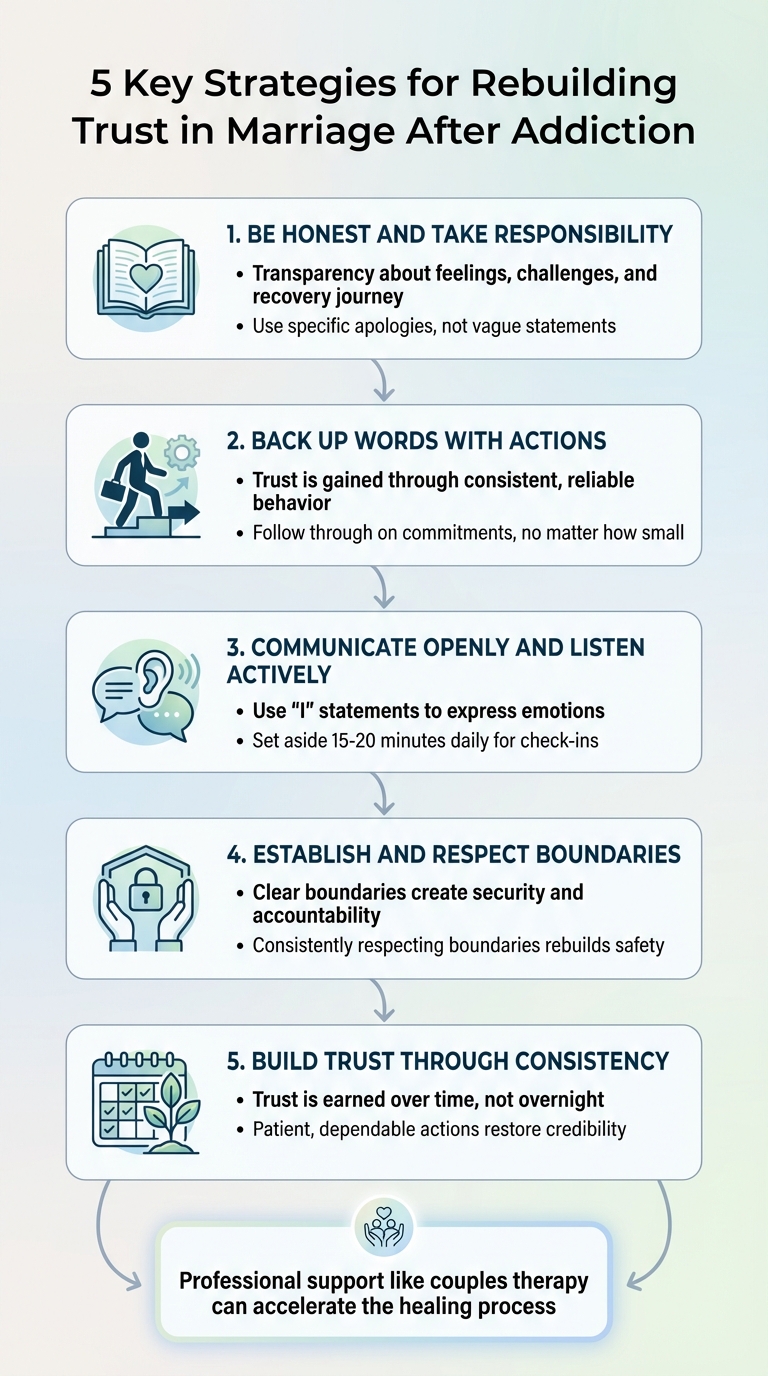
5 Key Strategies for Rebuilding Trust in Marriage After Addiction
How Addiction Damages Trust in Marriage
Why Trust Matters in Marriage
Trust is the cornerstone of any strong marriage. The Gottman Institute refers to trust and commitment as the "weight-bearing walls" of a healthy relationship [6]. When trust is present, couples feel secure enough to be vulnerable with one another. They can openly share their fears, admit to mistakes, and face challenges together without the fear of judgment or betrayal.
But when trust is broken, everything shifts. The spouse who feels betrayed no longer has that emotional safety net. This loss of security seeps into every part of the relationship – from the simplest daily interactions to long-term plans for the future. Matt Wenger, Clinical Director at Boulder Recovery, describes the impact of this breach:
"If a large part of your relationship is a lie, you wonder what other things in your life are lies too" [2].
Let’s explore how addiction specifically undermines these critical aspects of trust.
Ways Addiction Breaks Down Trust
Addiction doesn’t just create tension in a marriage – it systematically breaks down trust through repeated patterns of harmful behavior. The Compassion Recovery Center explains it well:
"Addiction introduces chaos, unpredictability, secrecy, and often, dishonesty into relationships. Promises are broken, responsibilities are neglected, and actions contradict words" [4].
One of the most damaging behaviors is habitual dishonesty. The spouse struggling with addiction often lies to cover up substance use, avoid consequences, or ensure continued access to their addiction. This dishonesty can spiral into manipulation and other deceptive actions [4].
Another major issue is financial betrayal. This might include stealing money, hiding the actual costs of the addiction, borrowing funds without repaying, or losing a job and leaving the spouse to shoulder all financial responsibilities [1]. These betrayals add another layer of strain, further weakening the emotional connection.
Emotional distance is another painful consequence. As addiction takes center stage, it often replaces the spouse and family as the primary focus. This shift creates a deep disconnect, where the addicted partner becomes less empathetic and increasingly detached from their spouse’s emotional needs [4].
Then there are the broken promises. The addicted spouse may repeatedly vow to quit or make changes, but their actions often fail to align with their words. Over time, these unfulfilled promises erode any remaining trust [4].
In some cases, addiction even leads to situations where the addicted spouse pressures their partner to cover up illegal activities, such as DUIs. This only deepens feelings of isolation and suspicion [1].
Before trust can be rebuilt, both partners must first confront the ways addiction has damaged the foundation of their relationship. Only then can they begin the work of repairing and restoring what’s been lost.
Marriage After Addiction: Can You Rebuild Trust?
Strategies for Rebuilding Trust After Addiction
Rebuilding trust after addiction is no small feat – it demands steady, intentional effort. For the partner in recovery, this means taking full ownership of their actions and committing to genuine change. As Dr. Angela Bisignano explains:
"Dismissing, deflecting, minimizing, or casting blame will not help you in your efforts to come to grips with what happened and work toward repair" [3].
The strategies below outline actionable steps to help mend the bond.
Be Honest and Take Responsibility
Honesty is the cornerstone of rebuilding trust. The recovering partner must be transparent about their feelings, challenges, whereabouts, and recovery journey. This includes sharing difficult truths, even when it feels uncomfortable. Apologies should also be specific and heartfelt. For example, instead of a vague "I’m sorry", say, "I regret lying to you about how I spent that money." This kind of specificity shows accountability and begins to dismantle the secrecy that often accompanies addiction.
Offer a Sincere Apology and Back It Up with Actions
Words alone won’t rebuild trust – actions must follow. Ellen Golding, MFT, emphasizes:
"Trust is gained through the mantra ‘actions speak louder than words’ and by apologizing to those you have physically or emotionally hurt" [1].
This means following through on commitments, no matter how small. Whether it’s being on time or completing a promised task, these consistent, reliable actions gradually rebuild credibility. Small gestures, like sticking to household responsibilities, can go a long way in proving that change is real.
Communicate Openly and Listen Actively
Open communication is essential for healing. Use "I" statements to express emotions, such as, "I feel hurt", rather than pointing fingers. Pair this with attentive listening – lean in, maintain eye contact, and acknowledge your partner’s feelings, even if you don’t fully agree.
To keep these conversations productive without overwhelming the relationship, consider setting aside 15–20 minutes daily to discuss challenges and progress. This structure allows for healing while giving space to enjoy other aspects of your relationship.
Establish and Respect Boundaries
Clear boundaries are a critical part of rebuilding trust. These boundaries create a sense of security and accountability for both partners. For example, sharing passwords or keeping devices accessible can build transparency. Similarly, mutual agreements – like avoiding one-on-one interactions with the opposite sex – can prevent misunderstandings. Dr. Henry Cloud and John Townsend explain:
"Boundaries define us. They define what is me and what is not me. A boundary shows where you end and someone else begins, leading to a sense of ownership" [9].
When the recovering partner consistently respects these boundaries, it reassures the betrayed partner and fosters a sense of safety.
Build Trust Through Consistency
Trust isn’t rebuilt overnight – it’s earned through consistent, dependable actions over time. The betrayed partner may still wrestle with doubt or hypervigilance, which is a natural response to past trauma. The recovering partner must understand this and remain patient, showing reliability day after day. Over time, these patterns of behavior help restore trust.
These steps create a foundation for repairing the relationship, paving the way for deeper healing and growth in the future sections.
sbb-itb-596b85d
How Professional Support Helps Rebuild Trust
Rebuilding trust is no small feat, and while personal effort is essential, professional guidance can speed up the process. Therapists bring a wealth of tools and techniques that couples might not have access to on their own. These methods work hand in hand with personal strategies, creating a stronger foundation for trust to grow again.
How Couples Therapy Helps Restore Trust
Therapy provides a safe, structured space for partners to share raw emotions – whether it’s anger, grief, or a sense of constant suspicion – without the conversation spiraling into blame [4]. It allows the betrayed partner to express their pain openly while the recovering partner learns to take genuine responsibility for their actions.
One of the standout benefits of therapy is mediation. A skilled therapist can reframe emotionally charged statements, helping partners communicate more effectively and break through the emotional barriers that often build up after trust is broken [1]. Therapists also guide couples in identifying emotional triggers that might lead to defensiveness, enabling healthier conflict resolution [6].
In addition to mediation, therapists use evidence-based models to guide the healing process. For instance, Gottman’s "Atone, Attune, Attach" model helps couples navigate key steps like taking accountability, rebuilding intimacy, and fostering a deeper connection [10]. Another practical tool is the ATTUNE approach, which focuses on Awareness, Turning toward each other, Tolerance, Understanding, Non-defensive responding, and Empathy. These skills are introduced in therapy sessions and can be practiced at home, creating a consistent path toward rebuilding trust [11].
For couples needing more intensive support, therapy often serves as a gateway to structured programs tailored to severe trust issues.
The Marriage Rescue Institute Program
For relationships on the brink, The Marriage Rescue Institute offers a focused 12-week program designed specifically for couples in crisis. This program, provided through Growth and Change Counseling, digs deep into the root causes of relationship damage, including trauma and mental health challenges often linked to addiction [4]. Unlike traditional weekly therapy, this intensive format delivers concentrated tools and insights, similar to how a 2-day workshop can equate to months of standard counseling [12].
One of the program’s core strengths is its emphasis on daily accountability, which helps partners build a consistent track record of reliability – an essential ingredient for restoring trust [4].
Growth and Change Counseling serves couples across California, with locations in Campbell, San Jose, Los Angeles, and Roseville, as well as telehealth options for remote support. Pricing is personalized based on each couple’s needs and is discussed during an initial strategy session.
Therapy Options Comparison
Different types of therapy cater to varying needs, offering flexibility and focus depending on the situation.
| Therapy Type | Session Length | Pricing | Best For |
|---|---|---|---|
| Individual Therapy (LMFT) | 45 mins | $200 per session | Personal healing and trauma processing |
| Individual Therapy (AMFT) | 45 mins | $150 per session (sliding scale $100+ available) | Budget-conscious individuals seeking financial flexibility |
| The Marriage Rescue Institute | 12-week program | Custom pricing | Couples in crisis requiring intensive intervention |
Individual therapy focuses on helping each partner address personal wounds and build emotional resilience. Meanwhile, programs like The Marriage Rescue Institute zero in on repairing the relationship itself. Many couples find that combining individual therapy with couples-focused work provides the most comprehensive path to healing and trust restoration.
How to Maintain Trust Over Time
Rebuilding trust is just the beginning – keeping it requires consistent effort. Instead of trying to recreate what you had before, focus on building something new, with stronger and healthier foundations [5][2]. Think of recovery as an ongoing, daily commitment.
Set Recovery Goals and Celebrate Progress
Establish clear goals to guide your recovery process. Consistency is key here. For example, you could commit to sharing one honest truth every day for a month. Over time, this creates a track record of 60+ shared truths that strengthen transparency and honesty [5]. These truths don’t have to be monumental; even simple admissions like, "I felt anxious when you came home late", or "I’m proud I attended my support meeting", make a difference.
Don’t underestimate the power of celebrating small wins. Did your partner stick to an agreed-upon plan, like coming home at the promised time? Acknowledge it. Did you both manage to have a tough conversation without shutting down? Recognize that progress. These moments, while small, add up to what experts call a "bedrock of reliability" [4]. The goal isn’t perfection – it’s about steady, consistent steps forward, no matter how small [5].
Make Time for Regular Conversations
Set aside dedicated time for open communication – 15–20 minutes daily and at least one longer, non-negotiable session each week. Use this time to share feelings, review progress, and address concerns. Stick to "I" statements, like "I feel worried when I don’t hear from you", instead of accusatory phrases like "You never communicate with me" [13][8][7]. This approach makes it easier to express emotions without putting your partner on the defensive.
Proactive transparency is another game-changer. Share details about your day, your plans, and your emotional state without waiting to be asked. This not only reduces suspicion and overthinking but also shows your commitment to honesty as a choice, not just a reaction to concerns [8].
Conclusion
Rebuilding trust is no small feat – it requires months, sometimes years, of consistent effort. As Ellen Golding, MFT, wisely notes:
"With mutual commitment and perseverance, relationships can be repaired. It demands patience from both partners" [1].
The journey forward demands complete commitment from both partners to stay engaged in the relationship and tackle the challenging work of healing [8].
To rebuild trust, focus on actions that speak louder than words. This means practicing radical honesty, offering heartfelt apologies, maintaining open communication, setting clear boundaries, and consistently aligning your actions with your promises. Over time, these behaviors form the foundation for repairing the bond. Your partner needs to witness a sustained pattern of reliability and integrity [1][4].
Understand that the process won’t happen overnight. The betrayed partner may grapple with lingering doubts or moments of hypervigilance, and that’s entirely normal [1][4]. Celebrate small milestones along the way, as even incremental progress can signal the rebuilding of trust [4].
Professional guidance can be a game-changer in this process. Growth and Change Counseling offers specialized support for couples navigating these challenges, including The Marriage Rescue Institute – a focused 12-week coaching program tailored for marriages in crisis. Their therapists provide a neutral, supportive space for both partners to work through difficult emotions, develop essential communication skills, and apply proven strategies to rebuild their relationship. Services are available in Campbell, San Jose, Los Angeles, and Roseville, CA, as well as through telehealth across California. This kind of professional support can strengthen your journey toward lasting change.
Though the road may be tough, the rewards are worth it. With mutual dedication, patience, and the right help, you can create a relationship that’s even stronger than before [8].
Lasting Relationship Healing with Growth and Change Counseling
What can couples do to maintain trust after rebuilding it?
Maintaining trust in a marriage takes consistent effort and dedication. Couples should prioritize essentials like honesty, reliability, empathy, open communication, and a mutual commitment to forgiveness and growth. Being transparent about things like schedules, finances, and emotions, along with consistently keeping promises, lays a solid groundwork for trust. Actions, more than just words, play a key role in reinforcing this bond.
Practical ways to nurture trust include setting aside time for daily check-ins to discuss concerns, using shared calendars to stay coordinated, and revisiting boundaries to ensure they align with both partners’ needs. Therapy can also be a valuable tool when challenges arise. Celebrating each other’s efforts and offering genuine positive feedback further strengthens the connection. When trust is treated as a collaborative, ongoing process, couples can navigate challenges together, prevent past issues from resurfacing, and maintain a healthy, secure relationship.
How can professional support help rebuild trust in a marriage?
Professional support plays a crucial role in helping couples rebuild trust after betrayal. It creates a safe, neutral environment where both partners can confront their pain, explore the root causes of the betrayal, and work on improving communication and accountability. A licensed counselor serves as a guide, assisting the hurt partner in processing intense emotions like anger and grief, while encouraging the other partner to show consistent, trustworthy actions – key to restoring confidence in the relationship.
Therapy also equips couples with practical tools, such as healthy conflict-resolution techniques and clear boundary-setting. It helps shift the focus from mere verbal reassurances to actionable steps that demonstrate commitment and rebuild trust over time. Growth and Change Counseling offers targeted support through its Marriage Rescue Institute, a 12-week intensive coaching program designed specifically for couples in crisis. With this structured program, couples can transform the daunting process of rebuilding trust into a manageable and guided path toward a more resilient partnership.
Why is consistency crucial when rebuilding trust in a marriage?
Consistency plays a crucial role in turning promises into reliable actions. When a partner consistently keeps their word, remains dependable, and steers clear of past harmful behaviors, it signals genuine growth and effort. This steady pattern of behavior allows the hurt partner to feel secure, laying the groundwork for rebuilding trust in the relationship.
Trust isn’t rebuilt with words alone – it’s earned through repeated, dependable actions over time. Consistency shows accountability and fosters emotional safety, which are both essential for healing after experiences like betrayal or addiction. By showing up consistently and proving their dedication to change, the partner who caused harm demonstrates their commitment, helping the relationship gradually move forward.
Related Blog Posts
- Marriage Coaching for Trust After Addiction
- Trust-Building Exercises for Couples in Recovery
- Building Trust After Relapse in Marriage
- Restoring Trust in Marriage After Addiction
