When deciding between parent coaching and family therapy, understanding their core differences is crucial. Parent coaching focuses on equipping parents with practical strategies for everyday challenges like discipline, routines, and communication. Family therapy, on the other hand, addresses deeper emotional and relational issues within the family unit, often involving multiple members.
Here’s a quick breakdown:
- Parent Coaching: Short-term, non-clinical, and goal-oriented. Sessions cost $50-$300 (average $100). Ideal for managing mild to moderate behavioral concerns like tantrums or screen-time struggles.
- Family Therapy: Clinical and explores deeper issues like trauma, addiction, or mental health. Involves diagnosing conditions and is often covered by insurance. Typically spans 12+ sessions.
Both approaches can complement each other, especially for families navigating addiction recovery or systemic challenges. Choose parent coaching for practical tools and family therapy for emotional healing and systemic change.
| Feature | Parent Coaching | Family Therapy |
|---|---|---|
| Focus | Parenting skills, immediate behaviors | Emotional healing, family dynamics |
| Participants | Parents/caregivers | Entire family or selected members |
| Diagnosis | Non-clinical | Often includes clinical diagnosis |
| Duration | 4–6 months | 12+ sessions, varies |
| Cost | $50–$300/session (avg. $100) | Insurance often covers |
For families juggling both behavioral concerns and deeper emotional wounds, combining these approaches can provide both immediate solutions and long-term progress.
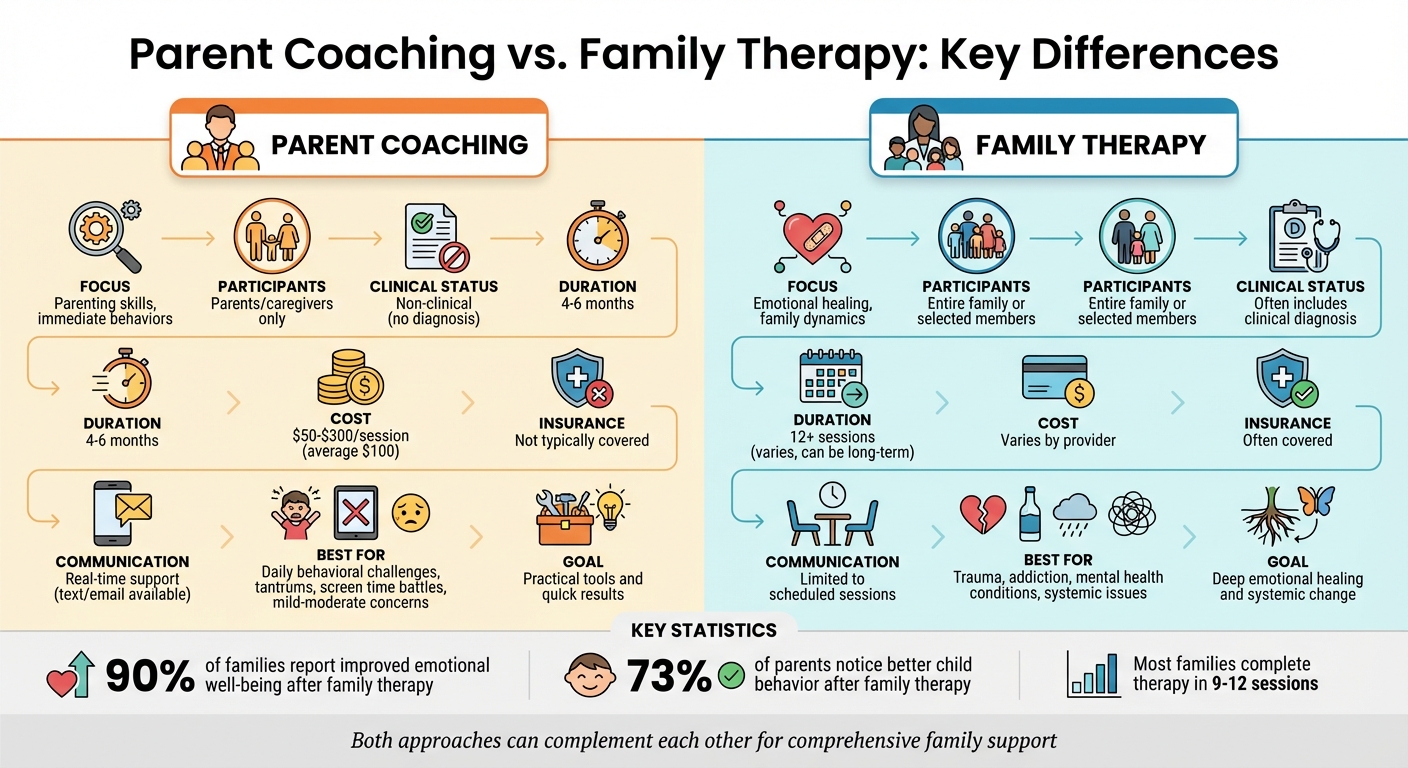
Parent Coaching vs Family Therapy: Key Differences Comparison Chart
Parent Coaching: Focus, Methods, and Benefits
What Parent Coaching Addresses
Parent coaching is all about giving you the tools to handle everyday parenting challenges. Whether it’s bedtime battles, kids ignoring directions, or constant sibling squabbles, coaching aims to provide practical solutions. It also helps break unhelpful patterns you might have picked up from your own upbringing. Coaches can guide you through tricky conversations on topics like adoption, sex, or divorce, making those discussions less daunting.
Techniques Used in Parent Coaching
The approach in parent coaching is hands-on and goal-focused. You’ll typically work on two or three specific behavioral goals, like creating a consistent bedtime routine or setting limits on screen time. Instead of jumping straight to lecturing or consequences, coaches encourage you to take a curious approach, helping your child feel understood. Techniques include mindfulness exercises, positive reinforcement, predictable routines, and setting compassionate but firm boundaries. Sessions usually last between 15 and 60 minutes, costing anywhere from $50 to $150 per hour, with an average of about $100 per session [1].
When to Choose Parent Coaching
Parent coaching works best when you’re looking for practical tools to handle mild to moderate behavioral concerns, rather than diving into deep emotional or crisis-related issues. It’s a great option if you’re feeling overwhelmed by everyday parenting struggles, dealing with differing parenting styles between you and your partner, or navigating your child’s difficulties with transitions or frustration. It can be especially helpful for families managing conditions like ADHD, autism spectrum disorder (ASD), or oppositional defiant disorder (ODD). Since your child spends much more time with you than with a therapist, parent coaching allows for consistent, real-world practice of new strategies [7]. However, if your family is dealing with significant trauma, systemic issues, or severe mental health concerns, family therapy might be a better fit [6]. Up next, we’ll look at how family therapy tackles deeper, systemic challenges.
Family Therapy: Focus, Methods, and Benefits
What Family Therapy Addresses
Family therapy views the family as a connected system where each member’s actions and emotions affect the whole group. It’s designed to tackle systemic issues – like patterns, roles, and dynamics – that may lead to unhealthy cycles. This approach is especially helpful when a family member is dealing with conditions like depression, addiction, eating disorders, or oppositional defiant disorder [8][3]. It also supports families in navigating past trauma, grief, or generational behaviors that influence how they communicate and relate to one another [8]. When families face serious challenges – such as unresolved conflict, communication breakdowns, or shared crises like divorce or sudden loss – family therapy offers professional guidance to mend those fractures [8][2]. Therapists use specialized approaches to address these complex dynamics effectively.
Techniques Used in Family Therapy
Family therapists rely on proven methods to help families function better. For instance, Structural Family Therapy examines the family’s structure, focusing on roles, boundaries, and hierarchies, and often works to restore parental authority when necessary [8]. Strategic Family Therapy takes a short-term, goal-driven approach to address specific behaviors and improve communication [3][8]. Bowenian Family Therapy explores intergenerational patterns, helping families recognize and break unhealthy cycles [8]. Alongside these frameworks, therapists teach practical techniques like active listening, using "I" statements, and role-playing exercises to improve interactions [8][5]. Sessions usually involve multiple family members working together to rebuild trust and strengthen relationships [8][3].
When to Choose Family Therapy
Family therapy is a strong choice when problems are deeply rooted – such as when a family member requires mental health care, conflicts have intensified, or safety within the home is a concern [8][2][6]. Unlike parent coaching, which focuses on future goals, family therapy digs into the underlying causes and historical factors contributing to current struggles [8][6]. Research shows that nearly 90% of families report improved emotional well-being, and 73% of parents notice better behavior in their children after therapy [3]. Most families complete the process in 9 to 12 sessions, and many health insurance plans, including Medicare Part B, cover the cost [8][3][6].
Main Differences Between Parent Coaching and Family Therapy
Side-by-Side Comparison
Parent coaching and family therapy both aim to strengthen families, but they differ significantly in their methods, participants, and goals. Parent coaching takes a focused, short-term approach – usually lasting 4 to 6 months – designed to equip parents with practical skills to manage everyday behavioral issues. In this setup, the parent is the primary client, and children are rarely involved in sessions [9]. On the other hand, family therapy is a more in-depth process that involves multiple family members working through emotional wounds and addressing systemic challenges. This type of therapy typically includes around 12 sessions but can extend for months or even years, depending on the situation’s complexity [3].
A key distinction lies in the clinical aspect. Parent coaching does not involve a mental health diagnosis and is generally not covered by insurance. Family therapy, however, often includes diagnosing conditions like depression, anxiety, or eating disorders, which can guide the treatment process and make it eligible for insurance coverage [3]. Another difference is how professionals communicate: parent coaches might provide real-time support, such as texting or emailing between sessions, while family therapists usually limit interactions to scheduled appointments [9]. These differences highlight the unique roles each approach plays, particularly when addressing addiction recovery.
| Feature | Parent Coaching | Family Therapy |
|---|---|---|
| Primary Focus | Practical parenting skills and immediate behaviors | Relational dynamics, emotional healing, and mental health |
| Participants | Typically the parent/caregiver | The entire family unit or selected family members |
| Emotional Depth | Focuses on immediate problem-solving | Explores deep-seated emotional wounds and systemic issues |
| Diagnosis | Non-clinical; no mental health diagnosis involved | Often includes a clinical diagnosis for treatment and insurance |
| Duration | Short-term (4–6 months) | Varies from approximately 12 sessions to long-term treatment |
| Communication | May include real-time support (e.g., text or email) | Generally limited to scheduled sessions |
| Cost | Approximately $50–$300 per session (average around $100) | Varies, with a higher likelihood of insurance coverage |
How Each Supports Addiction Recovery
When dealing with substance use disorder, the choice between parent coaching and family therapy often depends on the recovery stage. Family therapy is typically the first step during active addiction, as it tackles systemic issues and unresolved trauma that may fuel substance abuse [3]. Therapists work to break patterns of enabling behavior, mend emotional wounds, and restore open communication.
Once sobriety and safety are established, parent coaching becomes highly useful. It equips parents with actionable strategies – like setting routines, creating boundaries, and managing daily challenges – to support children or teens with behavioral difficulties. Often, these two approaches complement each other: family therapy addresses the underlying emotional issues, while parent coaching provides the tools to maintain progress.
How to Decide Which Approach You Need
Choosing between parent coaching and family therapy depends on your family’s specific needs and challenges. Parent coaching is ideal for parents seeking quick, practical solutions to everyday struggles and does not require a clinical diagnosis [9]. However, if your family is facing a significant crisis – like divorce, grief, or a mental health condition – family therapy offers the deeper emotional work necessary to heal and rebuild relationships [3].
"Parent coaching is best for parents struggling with daily battles like tantrums, screen-time fights, or backtalk, who want practical tools and quick results."
– Susan Morley, Certified Parenting Coach
In situations involving active domestic violence, sexual abuse, or substance abuse, family therapy or specialized intervention should be the first step. Once these critical issues are addressed, parent coaching can help reinforce progress and establish a healthier home environment [10]. The table below outlines when each approach might be most appropriate:
| If you are experiencing… | Recommended Approach |
|---|---|
| Daily battles over chores, screen time, or backtalk | Parent Coaching |
| A family member struggling with active substance abuse | Family Therapy |
| Disagreement between partners on discipline styles | Parent Coaching |
| Processing a recent divorce or the loss of a loved one | Family Therapy |
| Navigating a child’s new ADHD or Autism diagnosis | Parent Coaching (for strategies) |
| Healing from family-wide trauma or domestic violence | Family Therapy |
sbb-itb-596b85d
How Growth and Change Counseling Combines Both Approaches
Services Offered by Growth and Change Counseling
Growth and Change Counseling brings together parent coaching and family therapy, understanding that families often require both practical tools and emotional support. Founder John Mark Kane refers to this method as the "foundational approach" to fostering relational and emotional well-being. The practice serves families across California and also offers telehealth options [4][11].
Their family therapy focuses on addressing deep emotional wounds, improving communication, and navigating crises, while parent coaching emphasizes practical skills. This includes helping parents regain authority, manage challenging behaviors, and strengthen parent-child connections [4]. This dual strategy is particularly helpful for families dealing with ADHD, autism, addiction recovery, or adjusting to life in new cultural settings [4][5].
"We believe in addressing the needs of the whole person, and that requires blending different viewpoints and creating a unique approach to therapy for each individual, couple, family, or parent." – John Mark Kane, Founder, Growth and Change Counseling [4]
By combining actionable strategies with deeper emotional healing, this approach builds on the strengths discussed earlier.
Combined Approach to Support Families
Parent coaching provides parents with actionable steps, while family therapy dives into the emotional roots of conflict. Growth and Change Counseling integrates these methods for well-rounded support. Coaching equips parents with strategies and assignments to apply between sessions, while family therapy addresses the underlying emotional dynamics that perpetuate issues. This combination ensures both immediate and long-term progress [4].
For instance, consider a family dealing with a teenager’s substance abuse. Family therapy might begin the process by rebuilding trust and addressing enabling behaviors. Once stability is achieved, parent coaching can help establish routines, set boundaries, and maintain the progress made. Growth and Change Counseling also has expertise in supporting Silicon Valley parents managing high-pressure lifestyles and neurodiverse families dealing with ADHD or autism-related challenges. Services are offered both in-person and via telehealth [4][11].
"Our goal is to deliver timely, effective care that ideally eliminates the need for future sessions!" – Arione Capolupo, LMFT [4]
Coaching vs. Therapy in Parent Coaching
Conclusion: Choosing the Right Approach for Your Family
Deciding whether parent coaching or family therapy is the right fit comes down to your family’s specific needs. Parent coaching is ideal for tackling everyday parenting struggles, offering focused, actionable steps that are practical and centered on the parents’ role. It’s about finding solutions for challenges like discipline, routines, or communication.
On the other hand, family therapy is better suited for addressing deeper issues such as trauma, depression, anxiety, addiction recovery, or navigating major life changes. Therapy takes a broader look at the entire family dynamic, delving into past experiences and emotions to foster healing and stronger relationships. Many families report meaningful improvements after engaging in family therapy.
"If your child is emotionally safe and healthy but you’re stuck in daily battles over behavior, routines, or respect, parent coaching is likely the right next step." – Susan Morley, Certified Parenting Coach [9]
For families dealing with urgent issues like substance abuse, domestic violence, severe mental health concerns, or suicidal thoughts, family therapy or crisis intervention should be the immediate priority [10]. Coaching is not designed to address these clinical challenges but can be a valuable tool later on, once stability is restored, to build on progress with practical strategies.
Some families find that combining both approaches works best. After addressing immediate safety and emotional needs, integrating parent coaching with family therapy can provide a well-rounded solution. This combination offers immediate, skill-based support while also addressing deeper emotional and relational growth. For example, Growth and Change Counseling blends these methods to help families manage current behaviors while fostering long-term healing. Whether your goal is to improve day-to-day interactions or strengthen family bonds over time, choosing the right approach – or a mix of both – can set the foundation for lasting progress.
FAQs
What’s the difference between parent coaching and family therapy, and how do I choose the right one?
Choosing between parent coaching and family therapy comes down to understanding your family’s needs and what you’re hoping to achieve.
Parent coaching is designed to help one or both parents develop practical strategies to tackle specific parenting challenges. Whether it’s managing tantrums, improving communication, or navigating transitions like divorce, coaching provides parents with clear, actionable tools to create immediate, positive changes. It’s a focused, goal-driven process aimed at addressing specific behaviors or situations.
Family therapy, on the other hand, takes a broader approach, involving multiple family members to work through deeper relational issues, emotional patterns, or systemic challenges. It’s especially helpful when conflicts affect several people or when concerns like anxiety, addiction, or behavioral disorders impact the family dynamic.
To figure out what’s right for you, consider this: Are you looking to improve parenting techniques or address a specific behavior? If so, parent coaching may be the right fit. Are there bigger family conflicts or emotional issues that need addressing? In that case, family therapy could be the better option. Growth and Change Counseling offers both services, making it easy to start with coaching and transition to therapy if deeper challenges come to light – all within the same practice.
Can parent coaching and family therapy work well together?
Parent coaching and family therapy can work hand in hand to provide a comprehensive approach to family well-being. Parent coaching is all about equipping parents with practical tools, improving communication skills, and boosting their confidence in handling everyday parenting hurdles. Meanwhile, family therapy takes a broader look, focusing on the entire family unit to tackle relational challenges, resolve conflicts, and enhance overall dynamics.
When these two methods are combined, they offer a balanced and effective support system. Coaching empowers parents to put new strategies into practice, while therapy dives into deeper emotional patterns and family interactions. Together, they can help nurture stronger parent-child connections and create a more harmonious home environment.
What are the cost differences between parent coaching and family therapy?
The cost of parent coaching and family therapy can vary depending on factors like where you live, the format of the service, and the provider’s qualifications. Parent coaching is typically billed either hourly or as part of a package. Hourly rates usually fall between $65 and $150, while multi-session programs can range from $2,000 to $5,000. If you’re considering group coaching, it can be a more budget-friendly option, starting at around $40 per month.
When it comes to family therapy, pricing is often less straightforward. Rates can depend on your location and whether you’re using insurance. For private-pay sessions, you can expect to pay anywhere from $100 to $250 per hour, with costs often higher in states like California. Many therapists offer sliding-scale fees or accept insurance, which can help lower the financial burden.
At Growth and Change Counseling, we offer both parent coaching and family therapy with flexible pricing options. Whether you prefer hourly sessions, bundled packages, or need sliding-scale rates, we aim to provide professional support tailored to your budget and needs.
Common Questions for Growth and Change Counseling
- Parent Coaching for Better Boundaries
- 5 Family Therapy Techniques for Codependency
- Relational Intelligence in Parenting: Lessons from Trauma Recovery
- Mental Health and Co-Parenting: Problem-Solving Strategies
