When ADHD is part of a marriage, emotional regulation can become a major challenge. Partners often face misunderstandings, intense reactions, and recurring conflicts due to neurological differences. Here’s what you need to know:
- ADHD’s Impact on Emotions: People with ADHD may struggle to pause between feeling an emotion and acting on it, leading to impulsive reactions.
- Key Challenges: Rejection-sensitive dysphoria (RSD), impulsivity, and a "parent-child" dynamic in relationships can create tension.
- Strategies for ADHD Partners:
- Recognize physical signs of emotional escalation (e.g., racing heart, muscle tension).
- Use techniques like deep breathing or keeping an emotions diary.
- Practice labeling emotions to create mental distance.
- Strategies for Neurotypical Partners:
- Use "I-statements" to set boundaries without criticism.
- Stay calm during emotional spikes and avoid escalating the situation.
- Support with tools like shared calendars and reminders to reduce stress.
- Joint Techniques: Agree on code words to pause conflicts, create shared routines, and use visual reminders to stay connected.
If these strategies aren’t enough, ADHD-focused couples therapy can help address deeper issues and improve communication. Whether you’re the ADHD partner or not, understanding and adapting to each other’s needs can strengthen your relationship.
Navigating ADHD Emotional Regulation with Growth and Change Counseling
How ADHD Affects Emotional Regulation in Marriage
The ADHD brain often skips over what clinicians call a "stopgap" – that split second between feeling an emotion and acting on it [5]. Without this pause, frustration can escalate almost instantly. As Tom’s wife explains:
"Tom can go from zero to 100 in 10 seconds" [8].
This missing pause can trigger neurological "flooding," a state where logical thinking essentially shuts down [7][2]. For example, when someone’s heart rate surpasses 100 beats per minute during an argument, their ability to reason or problem-solve is severely impaired. In this state, no amount of talking or reasoning will help until the body naturally calms itself [6]. Without understanding this biological response, couples may try to resolve conflicts at a time when their brains simply aren’t ready to engage logically.
Impulsivity adds another layer of challenge, often leading the person with ADHD to blurt out hurtful comments without considering the impact [5][1]. For the non-ADHD partner, these moments can make even routine requests feel like personal attacks.
Over time, these dynamics can strain the relationship. The non-ADHD partner might start walking on eggshells, carefully choosing their words to avoid triggering emotional outbursts [7][1]. Meanwhile, the ADHD partner, who may struggle with memory or consistency, might notice their spouse slipping into a "parenting" role – offering constant reminders or taking charge of household responsibilities [2]. This shift can erode the sense of equality in the relationship, leaving both partners feeling frustrated or resentful.
To navigate these challenges, couples need strategies that work with the ADHD brain rather than expecting perfection [7]. Understanding these neurological tendencies is a vital first step toward breaking the cycle and fostering a healthier dynamic.
Emotional Regulation Techniques for the ADHD Partner
Managing emotions can be particularly tricky for partners with ADHD, but there are effective strategies to help you regain control. By understanding your body’s signals and practicing specific techniques, you can learn to manage emotional surges before they escalate.
Start by tuning into your body’s early warning signs. Pay attention to physical cues like muscle tension, a racing heart, shallow breathing, or a warming sensation in your face and neck. These signals often appear before you even recognize the emotion itself. Clinical psychologist Sharon Saline suggests practicing self-awareness during calm, neutral moments. This helps you establish a baseline for your reactions, making it easier to notice when emotions start to rise [3][4].
Once you’ve identified these physical signs, try labeling your emotions. Use straightforward categories like fear, sadness, joy, guilt, or anger. Tools like an emotion wheel or an emotions diary can be incredibly helpful for this. For example, simply saying, "I am experiencing anger", can create a mental buffer between you and the feeling. Jesse, an individual with ADHD, shares:
"I keep an ’emotions diary’ that’s separate from my regular diary… It helps to plan and compartmentalize." [10]
Because self-monitoring can be a challenge for the ADHD brain, external reminders can make a big difference. Setting phone alarms for emotional check-ins during the day can build awareness and help you catch escalating feelings before they spiral. Research shows that 34% to 70% of adults with ADHD face difficulties with emotional regulation, so these small habits can have a meaningful impact [3][4].
When emotions do spike, having a go-to reset routine is key. ADHD coach Caren Magill recommends:
"Take a few deep breaths, and you automatically start to change the nature of your nervous system, moving out of the limbic brain into the prefrontal cortex." [10]
Techniques like "7-11 breathing" – where you inhale for 7 counts and exhale for 11 – can help calm your nervous system [3]. Another helpful method is R.A.I.N.: Recognize the emotion, Allow it without judgment, Investigate its origin, and practice Non-identification. Some couples even use neutral code words like "aardvark" to signal the need for a break when emotions are running high [7]. These strategies don’t suppress emotions but instead create a pause, allowing for thoughtful responses rather than impulsive reactions.
How the Neurotypical Partner Can Help
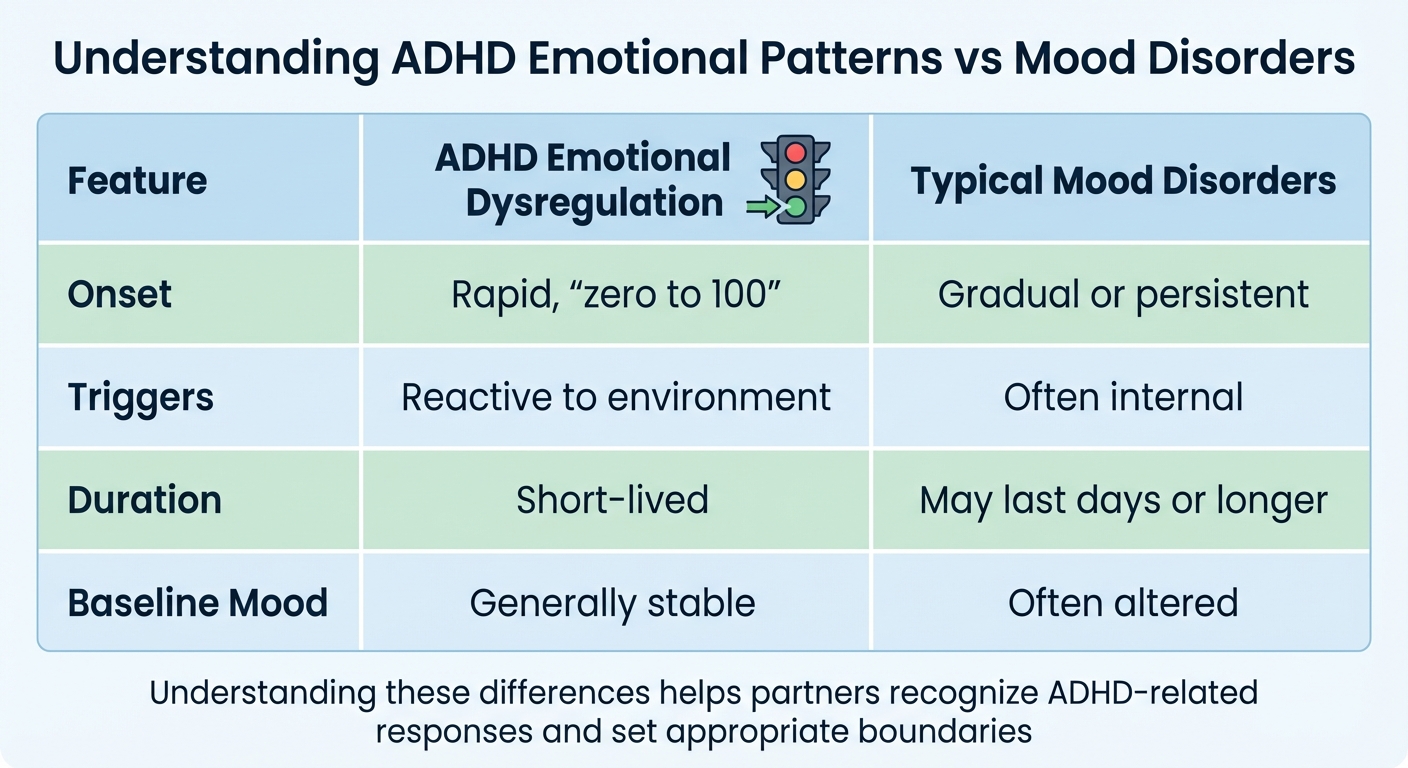
ADHD Emotional Dysregulation vs Typical Mood Disorders Comparison Chart
While the partner with ADHD focuses on self-regulation, you can play a key role by recognizing and understanding their unique emotional patterns. These differences are not personal shortcomings but stem from neurological factors. Acknowledging this can transform how conflicts are managed.
Recognizing ADHD-Related Emotional Patterns
Distinguishing ADHD-related emotional responses from deeper relationship issues is essential. Emotional dysregulation in ADHD often follows a "zero to 100" pattern – intense reactions that rise and fall quickly, driven by immediate circumstances rather than underlying mood states. Think of it like a traffic light abruptly switching from green to red.
Pay attention to physical signs that indicate your partner is becoming overwhelmed: clenched fists, crossed arms, flushed face, tense muscles, a tight jaw, or shifts in vocal tone. A heart rate exceeding 100 beats per minute often signals "flooding", a state where logical thinking is overridden by a fight-or-flight response [6][8]. During these moments, reasoned conversation becomes nearly impossible [7].
| Feature | ADHD Emotional Dysregulation | Typical Mood Disorders |
|---|---|---|
| Onset | Rapid, "zero to 100" | Gradual or persistent |
| Triggers | Reactive to environment | Often internal |
| Duration | Short-lived | May last days or longer |
| Baseline Mood | Generally stable | Often altered |
Understanding these quick shifts helps in setting boundaries that are respectful and effective.
Setting Boundaries with I-Statements
Establishing clear boundaries doesn’t mean being confrontational. The key lies in framing your concerns as complaints, not criticisms. As marriage consultant Melissa Orlov explains:
"Start with a complaint, not a criticism. ‘I’m concerned that the garbage isn’t getting taken out regularly’ is a complaint. ‘You never take out the garbage like you promise’ is a criticism." [7]
Use "soft starts" to ease into challenging conversations. For instance, instead of saying, "You never pay attention to me", try, "I really miss spending time with you" [7]. Restate your partner’s words before responding to ensure they feel understood and to avoid miscommunication [8][11].
To help manage tasks, use external tools like phone reminders, shared calendars, or sticky notes. Choose moments when both of you are alert – such as after ADHD medication has taken effect – for these discussions [2][8][11]. Avoid falling into a "parent-child" dynamic, where constant reminders create tension. Research shows that around 70% of recurring couple conflicts remain unresolved even after a decade, so finding practical solutions is often more effective than repeated arguments [7].
Practicing Patience and Active Listening
Remaining neutral during your partner’s emotional dysregulation is crucial. Clinical psychologist Sharon Saline advises:
"As tough as it may be, your job is to stay neutral while relying on a plan that you have mutually agreed to and committed to follow in distressing times." [2]
When your partner is overwhelmed, their brain shifts blood and oxygen away from logical areas toward fight-or-flight centers, making rational dialogue impossible [7]. The ADHD brain often lacks a "pause button" between emotion and reaction, leading to rapid, unfiltered responses [5]. Reacting emotionally in these moments only escalates the situation.
One helpful approach is the reflective listening exercise: Set a timer for five minutes. One partner speaks while the other listens and repeats their words verbatim, without adding opinions or judgments. Then, switch roles [2]. Continue the conversation only after the ADHD partner confirms they feel understood [8].
If tempers flare, pause the discussion immediately. It takes at least 20 minutes for the body to process the stress hormone norepinephrine after an emotional spike [6]. Take a 30-minute break to cool off before revisiting the topic [8]. Instead of lecturing, engage your partner with open-ended questions like, "Do you see it that way?" or "What’s your perspective?" [7].
sbb-itb-596b85d
Strategies Both Partners Can Use Together
When it comes to managing emotional regulation in a marriage affected by ADHD, teamwork is key. By committing to shared strategies, both partners can help prevent conflicts from spiraling out of control while strengthening their bond. These joint efforts work hand-in-hand with individual techniques to create a well-rounded approach to handling emotional challenges.
Create Pause Signals and Code Words
One useful strategy is agreeing on a neutral cue to signal when emotions are running high. For instance, you might choose an unexpected code word like "aardvark" to indicate that it’s time to take a step back. Marriage consultant Melissa Orlov shares:
"In the Orlov household, if one of us gets too emotional… we may use the pre-agreed-on verbal cue ‘aardvark’ to suggest we both need to take a break." [7]
Pick your code word during a calm moment, ensuring it feels neutral and non-threatening to both of you. Once the word is used, the conversation should pause immediately, giving each partner the chance to cool down. During this break, try calming techniques like paced breathing to reset your nervous system [6].
Use Visual Reminders of Your Commitment
Visual reminders can be a powerful way to stay grounded during stressful moments. Place meaningful quotes or sayings in areas you see often, like the bathroom mirror, refrigerator, or nightstand [9]. These small touches can help diffuse tension and remind you of your shared goals.
Photos can also work wonders. Display pictures of happy memories, loved ones, or even your pets in visible spots around your home. These images can serve as quick emotional resets, bringing you back to the foundation of your relationship [6].
Establish Shared Emotional Regulation Routines
Building shared routines can bridge the gap between personal emotional regulation and joint stability. For example, scheduling weekly check-ins at a consistent time – when emotions are calm – can help address frustrations before they escalate into conflict [2]. Using shared calendars or reminders to manage tasks can also reduce the need for repeated verbal prompts, which might otherwise trigger emotional reactions [2].
Co-regulation is another helpful tool. By staying calm, you can help soothe your partner’s nervous system. This might involve maintaining eye contact, using open body language, practicing synchronized deep breathing, or offering a comforting touch [12].
It’s also important to recognize that some marital conflicts – about 70%, according to research – are "perpetual", meaning they may never be fully resolved [7][13]. For these recurring issues, focus on finding practical compromises or agreeing to disagree rather than trying to change each other’s perspectives [7].
When to Seek Professional Help
If the emotional regulation techniques you and your partner have tried aren’t enough to restore balance, it might be time to consider professional help. When shared strategies fail to prevent emotional flooding or persistent parent–child dynamics, seeking support from a professional becomes a crucial next step [2][7].
How ADHD-Focused Couples Therapy Helps
Traditional therapy often misses the mark when it comes to the specific challenges of ADHD. ADHD-focused couples therapy, on the other hand, approaches emotional regulation as a physiological issue rather than a reflection of character. This type of therapy builds on the strategies you’ve already worked on individually and as a couple, while addressing the unique neurodevelopmental aspects of ADHD. Dr. Russell Barkley from SUNY Upstate Medical University explains:
"The emotions they [people with ADHD] experience are in fact normal. However, their ability to regulate them – i.e. knowing when and when not to express them – is flawed" [9].
A therapist experienced in neurodevelopmental conditions can help differentiate between ADHD-related executive functioning challenges and a partner’s personality traits. They often use objective tools to pinpoint when emotional dysregulation begins, providing clearer insight into the underlying issues [6].
Marriage Rescue Institute: A 12-Week Program for Couples in Crisis
For couples facing serious challenges, Growth and Change Counseling offers the Marriage Rescue Institute, an intensive 12-week program designed to rebuild and stabilize relationships. This structured coaching program focuses on implementing emotional regulation strategies and improving communication. Services are available in Campbell, CA; San Jose, CA; Los Angeles, CA; Roseville, CA; and through telehealth across California.
- Individual sessions with a Licensed Marriage and Family Therapist (LMFT): $200 for 45 minutes
- Sessions with an Associate Marriage and Family Therapist (AMFT): $150 per session, with sliding scale options starting at $100 for those with financial need.
This program provides couples with a clear roadmap to navigate their challenges and create a stronger partnership.
Combining Individual and Couples Therapy
The most effective approach often combines individual and couples therapy. Managing individual symptoms is a cornerstone for improving relationship dynamics. Individual therapy can help the ADHD partner address issues like working memory deficits and impulse control, while couples therapy focuses on strengthening communication and relationship patterns. As Melissa Orlov points out:
"The husband likely needs better control of symptoms to be more reliable, and his wife needs to be more respectful and empathetic while he’s trying to achieve that" [7].
Even if only one partner starts therapy, their improved approach to handling conflict can have a ripple effect on the entire relationship [2]. Growth and Change Counseling offers therapy options tailored to address both the biological and interpersonal aspects of ADHD. These integrated methods build on the strategies you’ve already been using at home, creating a stronger foundation for long-term emotional resilience.
Conclusion: Building Long-Term Emotional Strength
Managing ADHD in a marriage isn’t about erasing challenges – it’s about creating a partnership where both individuals can thrive. By applying the strategies outlined in this guide, you can build a relationship that stands strong over time. These approaches work best when paired with three essential principles that nurture emotional resilience and connection.
Assume Positive Intent
When your partner forgets an important event or reacts strongly to a casual remark, it’s tempting to think they don’t care. But behaviors like forgetfulness or emotional intensity often stem from ADHD-related neurological differences, not a lack of love. For instance, Rejection Sensitive Dysphoria (RSD) can lead someone with ADHD to interpret neutral comments as harsh criticism [17]. Before reacting to what feels like a slight, take a moment to consider other explanations. These behaviors are driven by brain chemistry, not intention [16].
Clear communication can help bridge this gap. If you’re the non-ADHD partner, try stating your needs explicitly and patiently. Understand that executive dysfunction – not neglect – is likely behind missed tasks [16]. On the flip side, ADHD partners can share their feelings in real time, saying things like, “I’m feeling criticized right now,” which invites reassurance from their partner [15][17]. Therapist Jen Paschall from Cascade Counseling explains:
"ADHD-related impulsivity doesn’t just affect decision-making – it can also influence emotional responses… causing misunderstandings and hurt feelings, even when there was no ill intent" [14].
Acknowledge Each Other’s Efforts
Success in a relationship isn’t about resolving every disagreement – it’s about how you navigate challenges together. Acknowledge your partner’s efforts with specific praise, such as, “Thanks for remembering to take out the trash today,” or “I love how consistent you’ve been with your workouts” [7]. These small gestures of recognition can build trust and motivation.
Set aside time for weekly check-ins to discuss new routines and express gratitude [2][1]. During conflicts, extend “olive branches” like a heartfelt apology, a willingness to see your partner’s perspective, or a reminder that you’re both on the same team [7]. Even in moments of disagreement, affirm your partner’s feelings with statements like, “I understand how you feel, and I hear your concerns” [7]. Marriage consultant Melissa Orlov highlights the importance of forgiveness in these moments:
"A partner should accept an apology from his mate wholeheartedly rather than building a wall and refusing to do so" [7].
Adjust Communication for ADHD
Effective communication in a marriage affected by ADHD requires thoughtful adjustments. Building on techniques like “soft starts,” you can reframe critical statements to be less confrontational. For example, instead of saying, “You never pay attention to me,” try, “I miss you. I feel like we haven’t spent much time together lately” [7]. This approach reduces defensiveness and encourages a more open dialogue.
Adopting a “Teflon” mindset – letting minor irritations slide – can also help ease tension [8]. Create ground rules for handling conflicts, such as scheduling specific times for difficult discussions or using a pre-agreed code word to de-escalate emotions when things get heated [8][2]. As Melissa Orlov advises:
"The goal for all couples (particularly those with ADHD) is not to stop fighting – it’s going to happen – but to learn how to have ‘good fights’" [7].
FAQs
What are the early signs of emotional escalation in a partner with ADHD, and how can I respond effectively?
Recognizing the early signs of emotional escalation in a partner with ADHD can be crucial for maintaining harmony in your relationship. These signs might include intense reactions to seemingly minor triggers, like a small disagreement spiraling quickly or frustration over a slight inconvenience. You might also observe rapid mood swings, frequent irritability, or a tone of voice that feels out of sync with the situation. Physically, there could be cues like clenched fists, a flushed face, or faster breathing – clear indicators of heightened emotional arousal.
Spotting these signs early gives you the chance to respond with calmness and empathy, which can prevent the situation from escalating further. Approaching your partner with a gentle, non-judgmental tone when addressing concerns can also help ease tension. If emotional dysregulation becomes a recurring issue, seeking professional guidance can be incredibly helpful. Growth and Change Counseling offers couples coaching and therapy tailored to neurodiverse relationships, helping partners work through challenges and strengthen emotional regulation as a team.
How can using code words help couples resolve conflicts effectively?
Using a pre-agreed code word can be an effective way for couples to navigate conflicts, especially in relationships where ADHD plays a role. A simple, neutral word or phrase – like "pause" or "reset" – acts as a gentle signal to momentarily step back when emotions start to escalate. This strategy helps curb impulsive reactions and allows both partners to cool off before resuming the conversation. To make it work, choose the code word together during a calm moment, agree on its purpose, and practice using it in low-stakes situations until it feels natural.
When the code word is used, having a clear plan for de-escalation is key. For instance, you might take a short break to practice deep breathing or grounding exercises, giving yourselves time to regain composure. Once both partners feel calmer, you can return to the discussion with a more constructive mindset. This method helps maintain productive communication and reduces the likelihood of emotional outbursts derailing the conversation.
For couples looking for deeper guidance, Growth and Change Counseling offers specialized coaching through The Marriage Rescue Institute. This program equips partners with tools to improve communication and emotional regulation, helping to build stronger and more supportive relationships.
When should couples seek therapy for ADHD-related challenges in their marriage?
Couples might want to consider therapy when ADHD symptoms start interfering with their emotional bond, communication, or daily routines. Key signs include frequent mood swings, impulsive anger, or intense reactions that make resolving conflicts feel like an uphill battle. These patterns can lead to misunderstandings, recurring arguments, and a gradual loss of intimacy if not addressed.
Therapy can also be helpful after an ADHD diagnosis. Understanding how the condition contributes to relationship challenges often inspires couples to seek practical solutions. If usual coping methods – like taking a timeout or using calming strategies – stop being effective, professional support can make a big difference. Therapy provides tools for managing emotions, resolving conflicts, and improving communication.
Growth and Change Counseling offers tailored support for couples dealing with ADHD-related struggles, including a focused 12-week Marriage Rescue Institute program. Tackling these issues early can pave the way for a healthier, more connected relationship.
Related Blog Posts
- Co-Regulation Techniques for Couples
- Emotional Intelligence for Neurodiverse Couples
- Understanding Emotional Cues in Neurodiverse Couples
- Ultimate Guide to Emotional Growth for Neurodiverse Couples
