Conflict in marriage is inevitable, but how you handle it can make or break your relationship. For Christian couples, resolving disagreements in a way that honors God is key. This guide outlines seven practical, scripture-based steps for addressing marital conflicts effectively:
- Pray for Guidance: Begin with prayer to invite God’s wisdom and calm your emotions.
- Identify the Real Issue: Look beyond surface arguments to uncover deeper concerns.
- Listen Without Interrupting: Focus on understanding your spouse’s perspective fully.
- Admit Your Mistakes: Take responsibility for your own actions before pointing fingers.
- Speak the Truth in Love: Use kind, constructive words to share your feelings.
- Take a Break if Needed: Step away briefly to cool off and reflect when emotions run high.
- Choose Forgiveness: Let go of past grievances to restore unity and trust.
These steps, rooted in scripture, emphasize teamwork and reconciliation rather than "winning" arguments. By applying these principles, couples can strengthen their bond and reflect Christ’s love in their marriage.
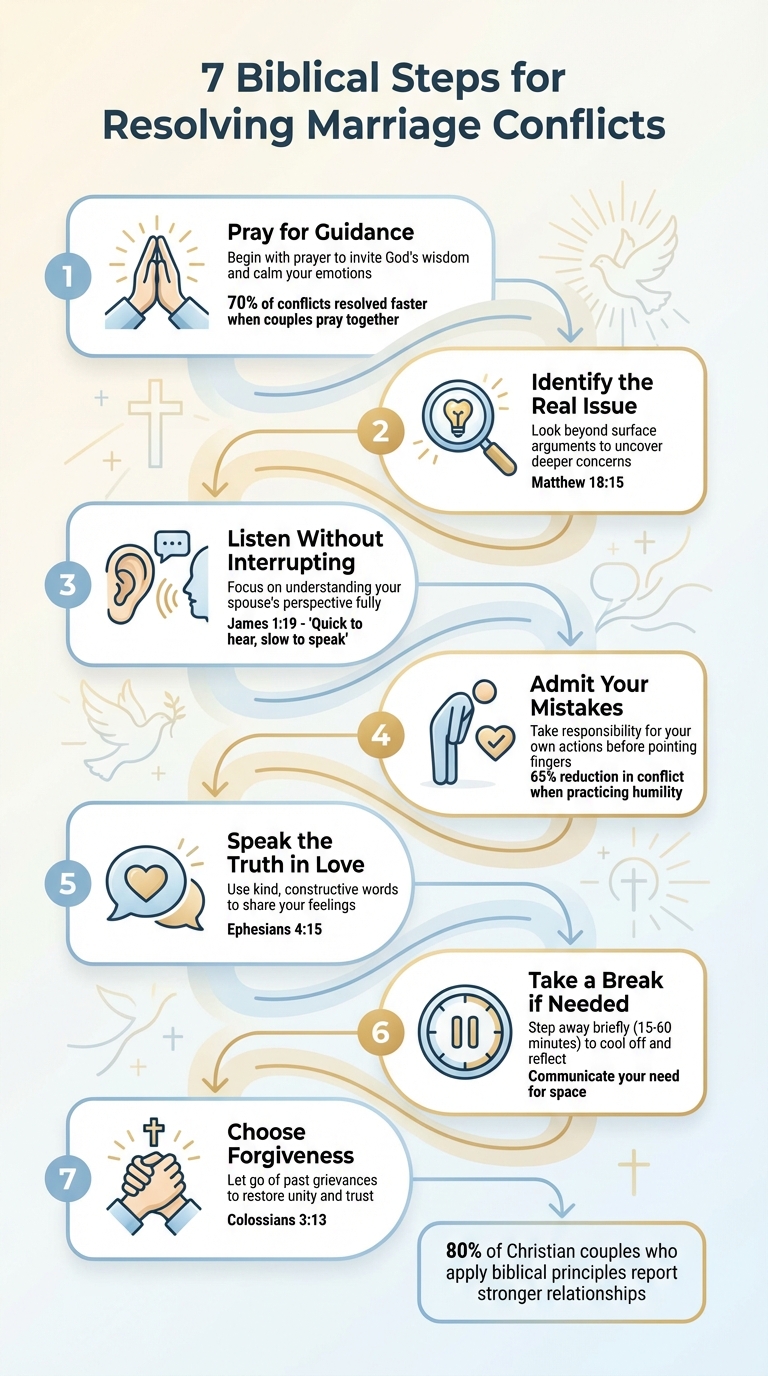
7 Biblical Steps for Resolving Marriage Conflicts
10 Biblical Ways to Resolve Conflict in Marriage
1. Pray for God’s Wisdom
Before diving into a disagreement with your spouse, take a moment to pause and pray. This simple act invites God’s presence into the situation and helps shift your perspective. Instead of seeing your spouse as the "problem", prayer reminds you that you’re both on the same team, working through a challenge together. It also acknowledges that your own understanding may not be enough to navigate the conflict.
Proverbs 3:5-6 provides timeless wisdom: "Trust in the Lord with all your heart and lean not on your own understanding; in all your ways submit to him, and he will make your paths straight" [4]. Similarly, James 1:5 encourages us to ask God for wisdom when we feel lost: "If any of you lacks wisdom, you should ask God, who gives generously to all without finding fault, and it will be given to you" [7][8]. Prayer creates space for the Holy Spirit to calm anger and selfishness, helping you resist the urge to "win" the argument.
The power of prayer in marriage is undeniable. Studies show that couples who pray together resolve 70% of conflicts faster than those who don’t. Additionally, the divorce rate among couples who pray together is estimated at just one in ten thousand, compared to nearly one in two for the general population [8][10]. Prayer fosters unity, allowing spouses to share their deepest concerns and feelings with God, strengthening their bond.
If emotions start to run high, consider taking a five-minute "prayer timeout" [3][9]. In this brief pause, calm your mind and ask God for the strength to manage your anger and self-focused tendencies. If you feel resistant to reconciliation, pray specifically for a "willing heart" – ask God to help you approach the conflict with humility and openness. This intentional step can soften your perspective, helping you see your spouse not as an adversary but as a beloved child of God.
Starting with prayer lays the foundation for addressing the real issues at the heart of the disagreement. It opens the door for clarity, understanding, and a spirit of cooperation.
2. Identify the Real Problem
Once you’ve sought God’s guidance through prayer, it’s time to pinpoint the real issue at hand. Often, the arguments on the surface are just symptoms of deeper concerns. The root cause might stem from feelings of being disrespected, financial stress, or emotional distance. If you only address the surface-level disagreements, you may find yourselves stuck in a frustrating cycle, revisiting the same conflicts over and over.
Matthew 18:15 offers practical wisdom: "If your brother sins against you, go and tell him his fault, between you and him alone. If he hears you, you have gained your brother" [3]. This encourages focusing on the specific actions or behaviors causing tension rather than venting broad frustrations. The goal here isn’t to win the argument but to rebuild and strengthen the relationship. This process also invites you to reflect on your own role in the conflict.
Speaking of self-reflection, Jesus’ teaching in Matthew 7:3-5 is a powerful reminder about addressing our own shortcomings before critiquing others: "Why do you look at the speck in your brother’s eye, but do not consider the plank in your own eye?" [11]. For example, Jennifer Slattery shared a personal story from her marriage. She once misread her husband’s habit of sitting on the couch with the remote as a sign of disinterest or rejection. After praying for clarity, she realized his behavior was rooted in physical exhaustion from work. Instead of criticizing, she shifted to offering support, like bringing him a drink, which met his need and eased her frustration.
It’s also crucial to avoid jumping to conclusions about your spouse’s motives. Rather than saying, "You don’t care about our family", try asking, "Can you help me understand why this matters to you?" This opens the door for dialogue instead of defensiveness. Similarly, use "I" statements to express how specific actions affect you. For instance, saying, "I feel anxious when bills aren’t paid on time" is far more constructive than labeling your spouse as "irresponsible." Words like "always" and "never" tend to escalate conflicts, making it harder to focus on solutions.
Dennis Rainey, co-founder of FamilyLife, offers this advice: "Focus on the problem, rather than the person… make the lack of budget the enemy, not your spouse" [6].
When you approach the issue as a team rather than adversaries, you create an environment where honest conversations can thrive, paving the way for real resolution.
3. Listen Without Interrupting
Once you’ve pinpointed the real issue, the next step is to listen – and that means resisting the urge to interrupt while your spouse is speaking. James 1:19 offers timeless advice: "Know this, my beloved brothers: let every person be quick to hear, slow to speak, slow to anger" [3][2]. This wisdom not only promotes healthier communication but also paves the way for resolving conflicts more effectively. By fully listening, you open the door to understanding the deeper layers of the problem.
Active listening requires effort, especially when emotions are running high. The goal here isn’t to "win" the argument – it’s to genuinely understand.
Steve Carr, Founder of Covenant Keepers, underscores this idea: "The more you listen, the slower you speak. The slower you speak, the easier it will be to restrain your wrath and anger" [3].
When you truly hear your spouse, conversations tend to become calmer and more productive.
A simple yet powerful way to practice active listening is to clarify before responding. Once your spouse has finished speaking, try saying, "Let me repeat back what I heard." This step ensures that you’re responding to what was actually said – not what you might have assumed. Also, pay attention to what’s left unsaid. External stressors, like work or personal pressures, could be amplifying the conflict. Asking thoughtful, clarifying questions can help uncover these hidden factors and prevent misunderstandings about intentions.
Your body language plays a big role, too. Maintain eye contact, lean in slightly, and avoid crossing your arms or other defensive gestures. These nonverbal cues show your spouse that you’re fully engaged and committed to understanding them. This level of attentiveness lays the groundwork for moving forward in resolving the conflict.
4. Admit Your Mistakes
After practicing active listening, it’s time to take a hard look at yourself and your role in the conflict. Reflect on your actions and consider the wisdom found in Matthew 7:3–5: "Why do you see the speck that is in your brother’s eye, but do not notice the log that is in your own eye?" This verse serves as a powerful reminder that we often overlook our own flaws while focusing on someone else’s. The "log" represents our own shortcomings or contributions to the conflict that we might fail to recognize.
Before pointing out your spouse’s role in the disagreement, take the first step by acknowledging your own faults. Doing so helps you shift from a place of judgment to one of love and understanding. This self-reflection not only aligns with Christ’s teachings but also fosters a healthier approach to resolving conflicts. In fact, research shows that practicing humility and admitting mistakes can de-escalate conflict by 65%. Moreover, 80% of Christian couples who apply biblical principles to conflict resolution report stronger, more connected relationships [10].
Steve Carr, Founder of Covenant Keepers, puts it clearly: "Honesty is the fastest way to resolve any conflict. Why? Because when you first humbly acknowledge your faults, your spouse doesn’t have to spend all that time trying to convince you what you’ve done wrong" [3].
Taking responsibility first can diffuse defensiveness and speed up the process of reconciliation. Be specific about what you’re apologizing for – don’t settle for a vague "I’m sorry." Instead, say something like, "I’m sorry I interrupted you and raised my voice while you were trying to explain." Pinpoint the exact behavior, whether it was a harsh comment, a dismissive tone, or a failure to listen. Avoid deflecting or blaming your partner; this moment is about owning your part.
Ask God to help you uncover any hidden pride that might be holding you back. A heartfelt apology opens the door for grace and paves the way for genuine reconciliation.
sbb-itb-596b85d
5. Speak the Truth in Love
Once you’ve acknowledged your mistakes, it’s time to share your feelings – gently and thoughtfully. How you express yourself is just as important as the words you choose. Ephesians 4:15 encourages us to speak "truth in love", blending honesty with kindness. The goal here isn’t to win an argument but to communicate your emotions in a way that fosters understanding.
One helpful approach is using "I" statements rather than "you" statements. For example, say, "I feel [emotion] when [behavior]" to describe your experience without placing blame. This shifts the focus to your feelings rather than accusing the other person. Keep in mind that your tone, body language, and posture also play a huge role in how your message is received [5].
This thoughtful way of speaking helps pave the way toward reconciliation. Your words should aim to heal, not harm.
Pastor Steven J. Cole wisely said, "The body will only be healthy when we speak the truth in love" [1].
Your conversations should always aim to uplift and support your partner.
Proverbs 15:1 offers timeless wisdom:
"A gentle answer turns away wrath, but a harsh word stirs up anger" [12].
Choosing kind, calming words can diffuse tension and prevent conflict from escalating.
Timing is just as crucial as tone. Avoid bringing up sensitive issues when your spouse is tired, overwhelmed, or in a public setting [6]. Instead, try starting these conversations with a "gentle start-up" – approach the topic calmly, with a soft voice and a cooperative attitude. Remember, you’re tackling the issue together as a team, not turning on each other.
6. Take a Break if Emotions Run High
Sometimes, the best thing you can do in a heated moment is to step back and take a breather. When emotions are running wild, it’s easy to react impulsively, which can cloud your judgment and make it harder to discern the right course of action [5][14]. Taking a brief pause allows you to regain your composure and approach the situation with a clearer mind.
This isn’t about avoiding the issue, but rather about giving yourself the space to cool off and think more clearly. Elicia Horton, co-author of Enter the Ring, puts it well:
"Walking away without an explanation will lead to greater offense, but walking away with fair warning and for a set amount of time is helpful" [14].
When you feel the need to step away, communicate it to your spouse. A simple, “I hear you. I need 10 minutes to think,” can go a long way. Agree on a specific amount of time – typically 15 to 60 minutes – to ensure both of you know when the conversation will resume [5][9].
Use this time wisely. Take a walk, try some deep breathing exercises, or listen to calming music. Most importantly, spend a moment in prayer. Instead of focusing on what your spouse might have done wrong, ask for insight into your own blind spots. As Steve Gallagher advises:
"Take a five minute time out for prayer so you can calm down. Remember, it’s not by your might or by your power, but by His Spirit" [3].
When you return, you’ll be in a better position to communicate with gentleness and clarity, helping to de-escalate the situation rather than fueling further conflict.
7. Choose to Forgive
Once emotions have settled and discussions have taken place, the next step is letting go of past grievances. Forgiveness, rooted in prayer, understanding, and humility, is essential for restoring unity in a relationship.
After taking time to cool off, make the choice to forgive – it’s not just a personal decision but a biblical directive. Colossians 3:13 reminds us: "Bear with each other and forgive one another if any of you has a grievance against someone. Forgive as the Lord forgave you." [15][16]
Forgiveness, as described in the Bible, is a conscious decision to release past offenses and the desire to hold onto resentment or revisit old wounds. As GotQuestions.org puts it:
"Forgiveness is not granted because a person deserves to be forgiven. No one deserves to be forgiven. Forgiveness is a deliberate act of love, mercy, and grace." – GotQuestions.org [16]
Take a moment to reflect on how Christ forgave you. The "paid in full" nature of your own sins through Jesus serves as a powerful reminder. Extending that same grace to your spouse becomes less about their worthiness and more about your obedience to God. Holding onto unforgiveness not only damages your marriage but also strains your spiritual relationship.
When you’ve made the decision to forgive, let your spouse know clearly. From there, make a deliberate effort to release past failures and avoid revisiting old mistakes. If forgiveness feels difficult, ask God to help soften your heart and guide you in this process. Choosing to forgive opens the door to true reconciliation and a stronger bond.
Conclusion
Disagreements in marriage are bound to happen, but how you respond to them makes all the difference. These seven biblical steps – praying for guidance, identifying the root issue, listening attentively, owning your mistakes, speaking truth with love, stepping back when emotions run high, and choosing forgiveness – provide a Christ-centered approach to resolving conflicts. Instead of focusing on individual victories, these steps emphasize unity, echoing the message of Matthew 19:5-6: "The two shall become one flesh." [2]
Conflict resolution isn’t a one-time fix; it’s an ongoing effort. By consistently applying these principles, you can prevent bitterness from taking root.
Ruth Graham once said, "A happy marriage is the union of two good forgivers" [13].
Small, intentional acts – like showing kindness and praying together – can strengthen your relationship over time. Weekly check-ins, where you ask, "Have I done anything to hurt you?" can also help address issues early on, fostering openness and trust [13].
If challenges persist despite your efforts, seeking professional Christian counseling may be the next step. Growth and Change Counseling offers support through The Marriage Rescue Institute, a 12-week intensive coaching program for couples. They serve locations in Campbell, San Jose, Los Angeles, and Roseville, CA, and provide telehealth services throughout California [12][17].
With God’s guidance and a commitment to these steps, conflicts can become opportunities to grow closer, deepen trust, and strengthen your spiritual bond.
Find Lasting Peace with Growth and Change Counseling
How does prayer help couples resolve conflicts in marriage?
Prayer can serve as a meaningful way to address marital conflicts by redirecting attention from individual frustrations to a shared spiritual journey. When couples pray together or for each other, they invite God into their relationship, opening the door to humility and a mindset focused on seeking His guidance instead of clinging to personal viewpoints. This shift can ease tension, reduce pride, and encourage mutual understanding.
It also creates an environment where forgiveness and reconciliation can flourish. Through prayer, couples can ask God to soften their hearts and guide their actions in alignment with biblical teachings. This approach allows them to tackle disagreements with a spirit of unity and compassion. Over time, such a practice can turn conflicts into opportunities for personal and relational growth, ultimately strengthening the bond between partners.
How can couples uncover the root cause of conflicts in their marriage?
Uncovering the root cause of marital conflicts often begins with a pause – a moment to reflect, pray, and seek God’s guidance. Prayer can offer clarity, helping to uncover hidden emotions or selfish attitudes that might be driving the disagreement. Approaching these moments with humility and a genuine willingness to listen can make all the difference.
One of the most powerful tools in resolving conflicts is active listening. This means giving your full attention to your spouse, reflecting back what you hear, and steering clear of interruptions or defensive reactions. When both partners feel heard, it creates a safe environment for honest conversations, allowing deeper emotions, fears, or even past wounds to surface and be addressed. Using “I” statements instead of placing blame can further ease tension, helping each person share their feelings without escalating the situation.
For those moments when the root of the issue remains unclear, journaling can be incredibly helpful. Keeping track of recurring triggers or emotions and comparing them to biblical wisdom – like the principle of being “quick to listen, slow to speak” (James 1:19) – can provide valuable insights. And for couples who feel they need extra guidance, Christian-focused counseling services, such as those offered by Growth and Change Counseling, can provide practical tools and scriptural support to help navigate challenges, bringing about healing and reconciliation.
Why is forgiveness so important in resolving conflicts in marriage?
Forgiveness plays a crucial role in marriage, acting as a safeguard against letting disagreements fester into lasting resentment. The Bible offers timeless wisdom on this, urging spouses to "forgive one another…as the Lord has forgiven you" (Colossians 3:13). This guidance highlights forgiveness as a cornerstone of restoring both peace and intimacy in a relationship. Clinging to past grievances only fuels conflict and creates emotional distance, making it harder to heal.
When couples choose to forgive, they mirror Christ’s love and break free from cycles of hurt and retaliation. This choice removes emotional walls, opening the door for honest and compassionate communication. Forgiveness not only helps mend what’s broken but also strengthens the foundation of unity and trust that marriage thrives on.
Related Blog Posts
- 5 Steps to Forgiveness in Christian Marriage
- How to Use Scripture for Conflict Resolution in Marriage
- What the Bible Says About Reconciliation in Marriage
- Prayer and Forgiveness in Marriage Restoration
