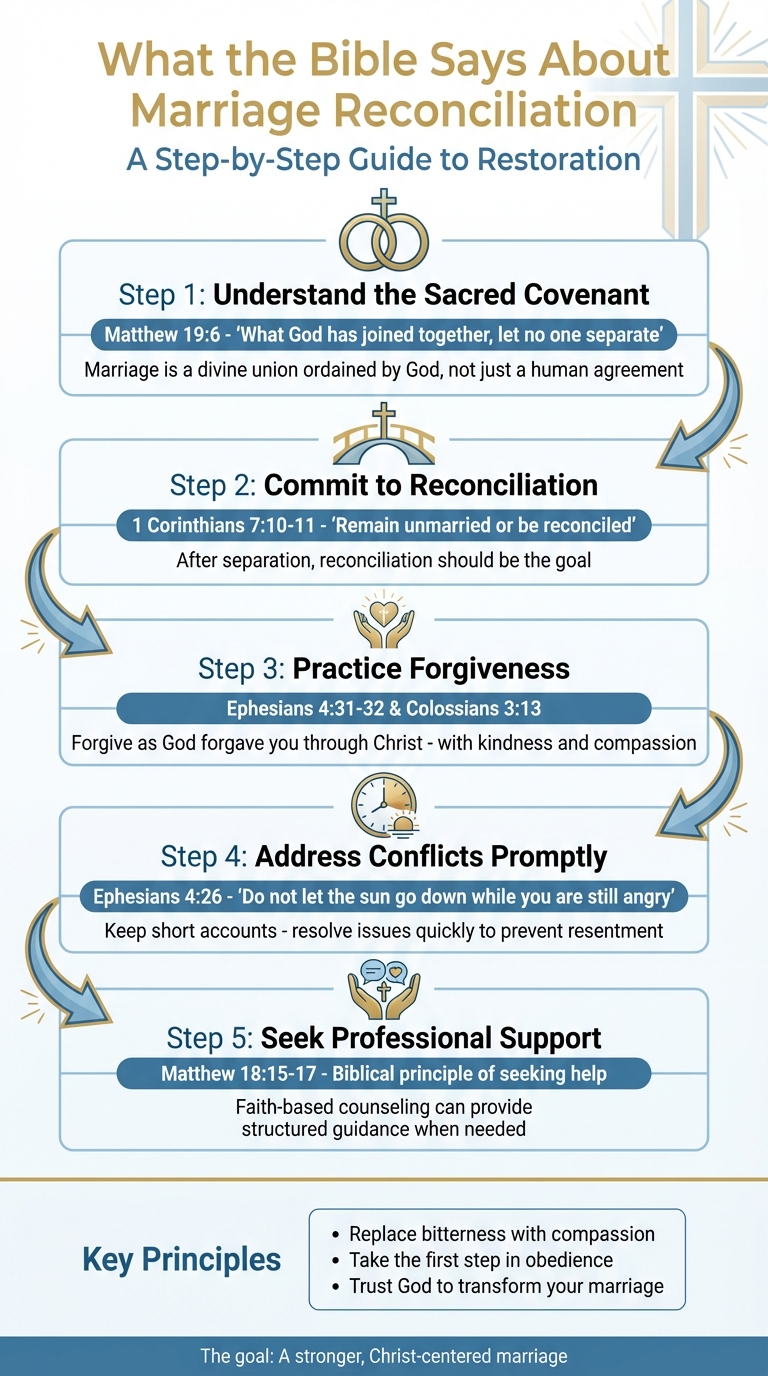
When a marriage faces challenges, reconciliation can feel overwhelming. But the Bible offers clear guidance, emphasizing restoration as a reflection of God’s love. Key takeaways include:
- Marriage is a sacred covenant: Matthew 19:6 reminds us that God joins couples together, calling for lifelong unity.
- Reconciliation is encouraged after separation: 1 Corinthians 7:10-11 advises couples to aim for restoration or remain unmarried.
- Forgiveness is essential: Ephesians 4:31-32 and Colossians 3:13 highlight the need for compassion and forgiveness, modeled after God’s grace.
- Address conflicts promptly: Ephesians 4:26 urges resolving anger quickly to prevent further harm.
- Seek professional support when needed: Faith-based counseling, like Growth and Change Counseling, can help rebuild trust and harmony.
Reconciliation isn’t just about fixing problems – it’s about creating a stronger, Christ-centered bond. With forgiveness, grace, and God’s guidance, healing is possible.
Biblical Steps to Marriage Reconciliation: A Faith-Based Guide
06 Marriage Devotional: The Power of Reconciliation in Marriage
What the Bible Commands About Marriage and Reconciliation
The Bible portrays marriage as a sacred covenant established by God – a lifelong bond where two individuals become "one flesh." This foundational understanding shapes the biblical perspective on reconciliation in marriage.
Jesus affirmed this divine union, saying, "What therefore God has joined together, let not man separate" (Matthew 19:6). This statement underscores that marriage is far more than a human agreement; it is a union ordained by God. Because of this, both spouses and society are called to honor and protect the marital bond. This principle sets the stage for understanding biblical teachings on reconciliation.
Does the Bible Require Reconciliation After Separation?
The Bible offers clear guidance for times of marital separation, rooted in the covenantal nature of marriage. In 1 Corinthians 7:10-11, the Apostle Paul writes, "A wife must not separate from her husband. But if she does, she must remain unmarried or else be reconciled to her husband. And a husband must not divorce his wife." This passage emphasizes that if separation occurs, reconciliation should be the goal, or the couple should remain apart without remarrying. This instruction reflects God’s design for marriage as a permanent relationship and His desire for broken bonds to be mended rather than abandoned.
There are, however, two exceptions outlined in Scripture. First, if an unbelieving spouse chooses to leave a believing partner, the believer is no longer bound to the marriage (1 Corinthians 7:15). Second, Jesus permits divorce in cases of sexual immorality. Even in such circumstances, reconciliation through repentance and forgiveness is presented as the ideal. Jim Newheiser, Director of the Christian Counseling Program at Reformed Theological Seminary, explains: "Sexual immorality doesn’t end the marriage; rather it gives the innocent spouse the right to divorce. In many cases, through repentance and forgiveness, such marriages can be saved or restored." The biblical standard, even in these challenging situations, remains focused on healing and restoration.
In cases of abuse – whether spousal or child – immediate separation is necessary to ensure safety. While reconciliation may not always be possible in such situations, protecting the vulnerable aligns with biblical principles of justice and care.
The Permanence of Marriage in Matthew 19:6
When Jesus declared that married couples are "no longer two but one flesh", He described a profound transformation – a union in which two individuals become a single, unified entity joined by God.
This teaching reflects God’s original design for marriage. Although Moses allowed divorce in the Old Testament due to human hardness of heart, Jesus clarified that this was never God’s true intention. The Creator’s plan has always been for marriage to be a lifelong commitment.
Understanding marriage as a divine union provides the theological foundation for pursuing reconciliation when challenges arise. If God has joined a couple together, then efforts to restore the relationship – through forgiveness, grace, and, when necessary, professional support – honor the sacred nature of the covenant. This commitment to restoration reflects God’s design and underscores the importance of healing and reconciliation in marriage.
Forgiveness as the Foundation for Reconciliation
Forgiveness is essential for healing in marriage. While forgiveness and reconciliation are closely connected, they are not the same. Forgiveness involves granting pardon for a wrong, while reconciliation is the broader process of restoring a broken relationship. Mark Brians, Rector of All Saints Anglican Church, clarifies this distinction:
"Forgiveness names the act of granting a pardon for a fault or trespass. Reconciliation names the whole operation of restoring two parties who have been estranged."
Forgiveness is the starting point – it lays the groundwork for reconciliation, even if the full restoration of the relationship is still a work in progress.
The biblical model for forgiveness in marriage is rooted in how God forgives believers through Christ. Couples are not called to forgive based on emotions or their spouse’s behavior but because they themselves have experienced divine forgiveness. This perspective turns forgiveness from a heavy demand into a meaningful choice. Scripture provides actionable steps to make this transformation possible.
Lessons from Ephesians 4:31-32 and Colossians 3:13
Key insights for rebuilding a marriage can be found in these passages. Ephesians 4:31-32 urges believers to "put away" bitterness, anger, and harsh words, replacing them with kindness, compassion, and forgiveness. Colossians 3:13 adds another layer by instructing couples to "bear with each other", encouraging patience and a willingness to tolerate a spouse’s flaws.
The motivation for this change is clear: forgiveness is modeled after how God forgives through Christ. As Ephesians 4:32 states, couples are to forgive "just as in Christ God forgave you." This makes forgiveness non-negotiable – it’s not based on conditions but on the reality of having been forgiven. Choosing grace over resentment creates the fertile ground needed for trust and intimacy to grow.
It’s also important to differentiate between unintentional mistakes and deliberate actions. Recognizing this difference helps couples extend apologies and forgiveness more freely, avoiding the tendency to assign harmful intent to every misstep. Additionally, addressing issues promptly – what Ephesians 4:26 refers to as keeping "short accounts" – prevents minor offenses from growing into deep resentment.
These scriptural principles naturally extend to the call for reconciliation, even in moments of worship.
Reconciliation Before Worship: Matthew 5:23-24
Jesus emphasized the importance of reconciliation for spiritual health. In Matthew 5:23-24, He taught that if someone remembers a conflict while offering a gift at the altar, they should pause their worship, reconcile with the other person, and then return to the altar. This teaching underscores that God values restored relationships more than outward religious rituals.
For married couples, this principle carries significant weight. Lingering conflict with a spouse affects both spiritual and relational well-being. Bitterness or unforgiveness doesn’t just create distance between partners – it also disrupts one’s connection with God. Pursuing reconciliation isn’t just about mending a marriage; it’s about renewing spiritual vitality and closeness with the Lord.
The ultimate goal of reconciliation isn’t simply to return to "how things used to be." As Mark Brians insightfully puts it:
"The goal of reconciliation is not resuscitation of ‘the way things were’ but the resurrection of the relationship, raising it to a new and more glorious state than before."
Through forgiveness and grace, a marriage can emerge from conflict stronger, healthier, and more deeply anchored in Christ than ever before.
sbb-itb-596b85d
Biblical Principles for Restoring Marriages
Forgiveness is a vital starting point, but biblical principles offer even more guidance for couples striving to rebuild their marriages. These teachings provide a framework for commitment, helping to protect the marital bond and navigate conflicts with grace.
Mark 10:9: Let No One Separate
In Mark 10:9, Jesus says, "Therefore what God has joined together, let no one separate" [6]. This verse reminds us that marriage is far more than a human agreement – it’s a divine union created by God. When two people are married, they become "one flesh", forming a bond that reflects God’s design.
The phrase "let no one separate" serves as a powerful reminder to guard the sanctity of marriage. It shifts the focus from personal preferences to honoring the sacred connection that God has established. For couples facing challenges, this perspective can transform reconciliation into an act of faith and devotion.
For those contemplating separation or divorce, Mark 10:9 offers a different way of thinking. Instead of seeing divorce as the only solution, this verse encourages couples to trust in God’s plan and view their struggles as opportunities for growth. As one marriage resource on YouVersion suggests, "At least for some of those who are considering divorce, there may be an alternative approach to resolving significant differences and difficulties" [6].
On a practical level, this means setting healthy boundaries to protect the marriage from external influences and harmful patterns within. It also requires a commitment to work through difficulties rather than seeking an easy way out. Remembering that God joined them together can inspire couples to persevere, even in the toughest seasons.
Conflict Resolution in Proverbs 24:29 and Ephesians 4:26
Resolving conflicts in a biblical way takes effort and intentionality. Proverbs 24:29 warns against the urge to "pay back" a spouse for their wrongs. This "eye-for-an-eye" mentality only fuels a cycle of hurt and retaliation. Breaking that cycle starts with choosing a response that honors God, regardless of how the other person acts.
Ephesians 4:26-27 emphasizes the importance of addressing anger quickly: "Do not let the sun go down while you are still angry." Letting anger linger creates space for sin to grow and can cause deeper harm to the relationship. Addressing issues promptly helps prevent resentment from taking root.
One of the most impactful steps in resolving conflict is taking the initiative. As GotQuestions.org explains, "Taking the first step in obedience, regardless of the actions of the other, goes a long way to breaking down the conflict and establishing new patterns of behavior" [4]. Waiting for the other person to act first often prolongs unresolved tension. By initiating reconciliation, even when it feels unfair, couples can shift the dynamic and align their actions with God’s will.
Managing emotions during conflict is equally critical. Christian counselor Benjamin Deu warns that "when we give ourselves over to fully venting our anger, we expose ourselves to thinking, speaking, and acting in quite a foolish manner" [5]. Approaching reconciliation with calm, clear communication is key. Using "I" statements and taking pauses when emotions run high can prevent escalation. Active listening – truly hearing your spouse’s perspective without interrupting – fosters understanding rather than fueling arguments.
Ultimately, lasting change begins within. As Deu notes, "God works at the level of the heart and only He can bring about the conflict resolution and healing that many of us (and our spouses) really need" [5]. Surrendering conflicts to God allows Him to work in ways human effort cannot. This reliance on divine intervention opens the door to genuine healing and restoration, laying a foundation for reconciliation that lasts. Taking the first step in resolving conflict can be a powerful act of faith that transforms a marriage.
Marriage Reconciliation and Professional Support
How Growth and Change Counseling Can Help
Biblical teachings emphasize the importance of direct restoration in relationships (Matthew 18:15–17). Yet, when personal efforts to mend a marriage fall short, professional counseling can provide a structured and effective path to healing. A prime example of this is the Marriage Rescue Institute program offered by Growth and Change Counseling.
This program, deeply rooted in the biblical principle of reconciliation, focuses on helping couples in crisis restore their marital bond. Through a 12-week coaching process, partners are guided to move past surface-level disagreements and address the deeper emotional obstacles that often lead to estrangement[1][3]. Sessions are available in locations such as Campbell, San Jose, Los Angeles, and Roseville, as well as through telehealth for couples across California. Fees for individual sessions start at $150 for Associate Marriage and Family Therapists (AMFT) and $200 for Licensed Marriage and Family Therapists (LMFT).
In alignment with scriptural guidance, counselors work to differentiate between unintentional mistakes and deliberate wrongdoings, fostering an atmosphere where genuine apologies and meaningful forgiveness can take place. As Mark Brians, Rector of All Saints Anglican Church, explains:
"The goal of reconciliation is not resuscitation of ‘the way things were’ but the resurrection of the relationship, raising it to a new and more glorious state than before"[2].
Faith-based counseling also encourages couples to practice "keeping short accounts" (Ephesians 4:26), which involves acknowledging and addressing wrongs promptly to maintain accountability. This approach stresses that reconciliation isn’t just about forgiveness – it’s about rebuilding a shared life marked by harmony and fellowship[2]. Growth and Change Counseling takes a gospel-centered perspective, viewing brokenness not as something to simply manage but as an opportunity for spiritual renewal and growth. This reflects the biblical themes of restoration and transformation woven throughout this discussion.
Central to this process is each partner’s personal relationship with Christ, which serves as the foundation for rebuilding their marriage. As GotQuestions.org aptly states:
"As born-again believers, the success of any relationship with others is in direct correlation with the quality of our personal relationship with the Lord Jesus Christ"[1].
Conclusion
The Bible emphasizes that forgiveness is not optional, and restoration should always be the goal. Scripture calls us to practice unconditional forgiveness, mirroring the grace God extends to us through Christ. But this doesn’t mean ignoring problems or returning to unhealthy patterns. Instead, it’s about trusting God to rebuild relationships into something stronger and more centered on Him.
To make these biblical principles a reality, practical action is key. Reconciliation takes daily effort. Addressing conflicts quickly can stop resentment from taking root. It’s also important to differentiate between unintentional mistakes and intentional harm, as this allows for sincere apologies and genuine forgiveness. And when couples hit a wall, seeking professional help isn’t a failure – it’s a wise, biblical step, as outlined in Matthew 18:15-17.
Whether the struggles involve communication gaps, broken trust, or deeper emotional wounds, guidance from Scripture offers a clear path forward. Verses like Ephesians 4:26-32, Colossians 3:13, and Matthew 5:23-24 provide timeless wisdom for healing and rebuilding. The focus isn’t on erasing the past but on creating a new, Christ-centered marriage that reflects the love between Christ and His Church.
When personal efforts alone aren’t enough, professional support can reinforce these biblical truths. Couples in California can turn to Growth and Change Counseling’s Marriage Rescue Institute for faith-based services. Individual sessions start at $150, with options available in Campbell, San Jose, Los Angeles, Roseville, and through telehealth across the state. Reconciliation is undoubtedly a challenging journey, but with God’s guidance and the right tools, restoration is within reach.
Taking the Next Steps with Growth and Change Counseling
How can couples practice forgiveness in marriage according to the Bible?
Forgiveness in marriage begins with a genuine choice to let go of pain and offer grace, aligning with biblical teachings. Both partners need to acknowledge the hurt and seek guidance from God, reflecting on scriptures like Colossians 3:13, which reminds us to “forgive as the Lord forgave you,” and Ephesians 4:32, which encourages kindness, compassion, and forgiveness. The spouse who caused the harm should offer a sincere apology and demonstrate repentance, while the one who was hurt works toward letting go of resentment, even if the memory of the event remains.
Praying together as a couple can be a powerful way to ask for God’s help in forgiving and healing. Verbal expressions of forgiveness, paired with a commitment to rebuild trust through consistent, loving actions, are essential steps in the process. This journey may also involve setting healthy boundaries and, when necessary, seeking professional support.
For couples dealing with deeper struggles, Growth and Change Counseling provides a 12-week intensive coaching program through The Marriage Rescue Institute. This program is designed to guide partners through forgiveness and reconciliation, helping them achieve emotional healing and build a stronger, grace-filled relationship.
How does faith-based counseling help couples reconcile in marriage?
Faith-based counseling offers a unique path to marriage reconciliation by centering the healing process on biblical principles. It focuses on God’s intentions for unity, forgiveness, and grace, encouraging couples to rebuild their bond through the lens of Christ’s love. By incorporating Scripture, prayer, and spiritual guidance, this approach nurtures humility, fosters repentance, and strengthens a commitment to restoring the relationship.
Counselors integrate practical strategies grounded in biblical teachings to help couples navigate conflict, embrace forgiveness, and take meaningful steps toward rebuilding trust and connection. Programs such as the Marriage Rescue Institute at Growth and Change Counseling blend professional counseling methods with faith-driven values, guiding couples from a place of brokenness to renewed unity that mirrors God’s covenant love.
Does the Bible allow exceptions to reconciliation after separation?
Yes, the Bible acknowledges situations where reconciliation may not be required. For instance, it permits divorce in cases of sexual immorality (adultery), as outlined in Matthew 5:32, or abandonment by an unbelieving spouse, as described in 1 Corinthians 7:15. These teachings are consistent with the Old Testament’s allowance for divorce in Deuteronomy 24:1-4.
That said, the Bible also highlights the value of forgiveness and restoration whenever possible. Couples dealing with difficulties might find it helpful to seek guidance through counseling, which can provide support as they navigate these sensitive and complex circumstances, fostering opportunities for healing and understanding.
Related Blog Posts
- 5 Ways Faith Supports Emotional Healing in Marriage
- 5 Steps to Forgiveness in Christian Marriage
- How to Use Scripture for Conflict Resolution in Marriage
- Why Long-Suffering Matters in Christian Marriage
