Faith and Scripture offer powerful support for couples navigating addiction recovery. These Bible verses provide guidance, hope, and tools to rebuild trust, manage challenges, and find strength together. Key themes include forgiveness, humility, unity, and reliance on God. Here’s a quick summary:
- Ecclesiastes 4:9-12: Highlights teamwork and spiritual bonds for overcoming challenges.
- Ephesians 4:31-32: Encourages kindness, compassion, and forgiveness to heal relationships.
- 1 Peter 5:6-8: Calls for humility and trust in God’s timing, while staying vigilant against temptation.
- Philippians 4:13: Reminds couples to rely on God’s strength during difficult moments.
- James 5:16: Stresses the power of confession and prayer to foster healing and accountability.
- Proverbs 3:5-6: Urges trust in God’s guidance over self-reliance.
- Romans 5:3-5: Reframes suffering as an opportunity to build endurance, character, and hope.
- Jeremiah 17:14: A prayer for healing and restoration through faith.
- Psalm 55:22: Encourages casting burdens on God for daily strength and stability.
- 1 Corinthians 10:13: Offers reassurance that God provides a way out of temptation.
Combining these scriptures with professional counseling, such as Cognitive Behavioral Therapy (CBT) or Emotionally Focused Therapy (EFT), can address both spiritual and emotional needs. Programs like Growth and Change Counseling‘s Marriage Rescue Institute integrate faith with therapy, helping couples rebuild trust, manage triggers, and sustain recovery. Recovery is a journey of perseverance, accountability, and grace, strengthened by both spiritual and practical support.
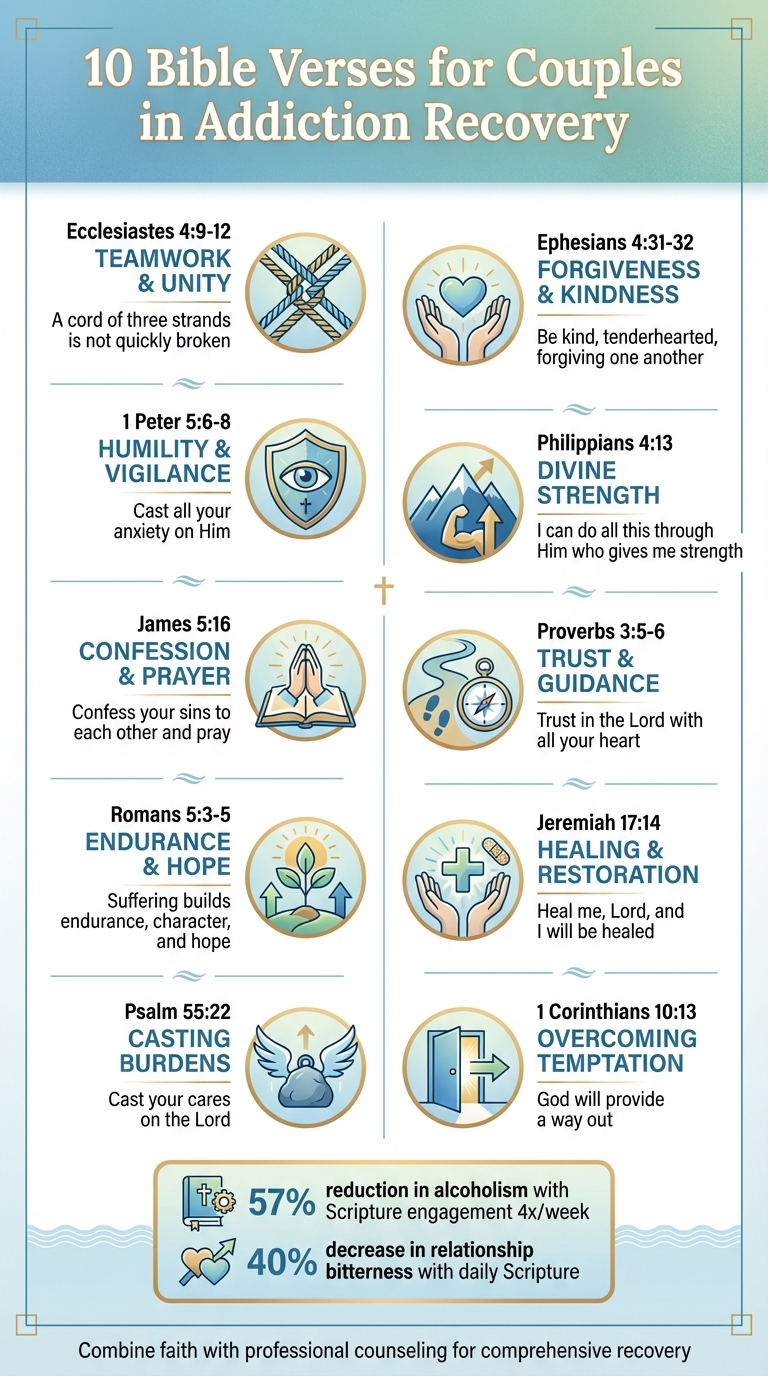
10 Bible Verses for Couples in Addiction Recovery with Key Themes
Bible Verses To Help With Addiction and Recovery | Scriptures On Overcoming Addiction (POWERFUL)
1. Ecclesiastes 4:9-12
"Two are better than one, because they have a good return for their labor. For if either of them falls, the other will help the one up. But pity anyone who falls and has no one to help them up… Though one may be overpowered, two can defend themselves. A cord of three strands is not quickly broken."
This passage highlights the power of partnership, especially when facing the challenges of addiction recovery. Addiction often isolates individuals, breaking down the very relationships that could provide strength. But here, the message is clear: when one partner stumbles, the other can step in to offer support, encouragement, and accountability – key elements in resisting triggers and avoiding relapse.
The phrase "good return for their labor" reminds us that recovery is more effective when approached as a team. By working together – whether it’s attending therapy sessions or establishing healthy boundaries – couples can build a foundation for lasting sobriety. Interestingly, studies reveal that engaging with Scripture at least four times a week is linked to a 57% reduction in alcoholism and a 38% drop in feelings of loneliness [7]. These practices strengthen not only the individual but also the relationship.
The "cord of three strands" goes even deeper, symbolizing the inclusion of God in the partnership. Through prayer and Scripture, couples create a spiritual bond that reinforces their unity and resilience. Facing addiction alone can feel overwhelming, but together – with mutual confession, godly boundaries, and accountability – couples can stand firm against the "prowling lion" of addiction [5].
This blend of mutual support and spiritual connection lays a strong foundation for the journey toward recovery, preparing couples for the guidance found in other scriptures.
2. Ephesians 4:31-32
"Let all bitterness and wrath and anger and clamor and slander be put away from you, along with all malice. Be kind to one another, tenderhearted, forgiving one another, as God in Christ forgave you."
Addiction doesn’t just affect the individual – it can deeply harm relationships too. This verse encourages couples to let go of harmful emotions like bitterness, anger, and malice, and instead embrace kindness, compassion, and forgiveness. The call to forgive as God forgave us is a powerful reminder, especially when recovery is filled with challenges and setbacks. Choosing kindness over toxicity strengthens the spiritual connection that recovery often nurtures.
As Dee Dunn insightfully put it:
"Unforgiveness traps us in pain, hindering true healing."
In practical terms, addressing conflicts early – before they grow into larger issues – can help prevent temporary frustrations from turning into lasting bitterness. This bitterness can create emotional gaps that might even lead to relapse. Techniques like using "I-statements", taking cooling-off periods, and practicing empathetic listening can foster a sense of safety and understanding.
Licensed Marriage and Family Therapist John Mark Kane sheds light on the emotional toll of unresolved anger:
"Depression often stems from unresolved anger or rage, which in turn results from dysfunctional relationships."
3. 1 Peter 5:6-8
"Humble yourselves, therefore, under God’s mighty hand, that He may lift you up in due time. Cast all your anxiety on Him because he cares for you. Be alert and of sober mind. Your enemy the devil prowls around like a roaring lion looking for someone to devour."
This passage resonates deeply with couples navigating addiction recovery. It begins with a call to humility – acknowledging the grip of addiction and surrendering to God’s timing. For couples, this means letting go of the urge to control every aspect of the recovery process and instead trusting in God’s plan as a team.
The instruction to "cast all anxiety on Him" offers comfort amidst the daily challenges of recovery. Whether it’s financial stress, the fear of relapse, or emotional triggers, this verse reminds couples to hand over their worries to God. As Robert Jones, Professor and Chair of Biblical Counseling at The Southern Baptist Theological Seminary, insightfully points out:
"Worry is a form of pride because when believers are filled with anxiety, they are convinced that they must solve all the problems in their lives in their own strength. The only god they trust in is themselves."
This perspective encourages a spiritual release that translates into actionable steps. Through prayer, couples can bring their concerns to God, identifying moments where they’re clinging to control and choosing instead to lay those burdens at His feet.
The reminder to be "alert and of sober mind" is a powerful daily safeguard. Staying vigilant not only shields against spiritual attacks but also helps couples remain aware of potential triggers. This awareness is essential for protecting both sobriety and the strength of their relationship.
4. Philippians 4:13
"I can do all this through him who gives me strength."
For couples navigating the challenges of recovery, this verse offers a profound reminder: true strength comes from relying on something greater than ourselves. When Paul wrote these words, he wasn’t talking about achieving extraordinary feats but about finding contentment and resilience in every situation – no matter how difficult. For those battling addiction, this message resonates deeply.
Recovery often feels overwhelming, especially when sheer willpower seems to run out. This verse points to a strength beyond human limits. Dr. Tyler Collins from Covenant Hills Treatment explains it beautifully:
"When you feel that you’re ready to give up and you can’t find additional strength, there is always the Almighty God who will listen, understand, and guide you back to your sobriety goals." [2]
In practice, this means learning to find peace and stability even in the chaos of recovery. Instead of waiting for circumstances to magically improve, Philippians 4:13 encourages couples to lean on Christ’s strength in the here and now – whether facing cravings, tense moments, or the daily grind of rebuilding. This promise of divine support pairs naturally with other scriptures that offer hope and guidance for couples on this journey.
Consider making this verse a shared affirmation in your daily routine. When one partner feels overwhelmed, recite it together as a way to shift focus from personal limitations to God’s limitless strength. As The Message Bible paraphrases: "Whatever I have, wherever I am, I can make it through anything in the One who makes me who I am." Recovery isn’t just about individual determination; it’s about drawing from shared faith and Christ’s strength to move forward together.
5. James 5:16
"Make this your common practice: Confess your sins to each other and pray for each other so that you can live together whole and healed." (The Message) [9]
Addiction often thrives in secrecy, feeding on the shame and isolation that come with hidden struggles. When couples choose to keep their challenges in the dark, it creates a divide that can be hard to bridge. James 5:16 offers a way forward by encouraging openness – confessing struggles to one another and praying together. This simple yet profound act disrupts the secrecy that addiction relies on.
Confession isn’t just about admitting wrongs; it’s a moment of humility and agreement with God and your partner. The verse promises healing – not only spiritual renewal but also a sense of wholeness that can repair the damage caused by addiction. It connects the spiritual act of confession with the practical need for accountability, which is essential for recovery. Licensed Marriage and Family Therapist John Mark Kane puts it this way:
"It is in this place of vulnerability that we can acknowledge struggles and grow stronger!" [4]
Make confession and prayer a regular part of your relationship. Set aside time to be honest with each other, to listen, and to pray together. This habit creates a foundation for the transformative power of prayer.
The verse also emphasizes that "the prayer of a righteous person is powerful and effective." [8] This doesn’t mean perfection is required. Instead, it calls for genuine, heartfelt prayer. When you pray with sincerity, you invite God’s grace into your life, opening the door to healing and a deeper sense of connection and peace.
6. Proverbs 3:5-6
"Trust in the Lord with all your heart and lean not on your own understanding; in all your ways submit to him, and he will make your paths straight." [5]
Depending solely on yourself often leads to stumbling. This verse encourages letting go of self-reliance, which can be particularly powerful for those whose judgment has been clouded by addiction. [10] By surrendering control, you open the door to experiencing God’s presence and guidance more deeply.
Acknowledging God goes beyond mere belief – it involves recognizing His active role in your daily life. In the original Hebrew, this idea carries the weight of truly knowing Him – being aware of His power, wisdom, and goodness in action. [10] John Gill, in his Exposition of the Entire Bible, explains it beautifully:
"Set him before thee; have him always in view; consider him as ever present with thee, observing every step thou takest; and take not one step without his leave, and without his advice; ask wisdom of him who gives liberally; consult his word, and make the Scriptures thy counselors." [10]
When you entrust your recovery journey to God, He promises to guide you. [5] The road may still be difficult, but it becomes clearer. This verse, much like earlier scriptures focusing on unity and forgiveness, emphasizes the strength found in shared spiritual guidance. Couples navigating recovery can find solace by turning to Scripture together, seeking wisdom before making decisions. Be honest with God about your struggles, and when self-reliance falls short, ask for His direction to help you find your way back. [10]
sbb-itb-596b85d
7. Romans 5:3-5
"Not only that, but we rejoice in our sufferings, knowing that suffering builds endurance, character, and ultimately, hope, and hope does not put us to shame…" [3]
Addiction recovery is a journey, not a quick fix. The early stages can feel overwhelming, filled with withdrawal symptoms, temptations, and the weight of past mistakes. Romans 5:3-5 offers a fresh perspective, reminding us that suffering isn’t the end – it’s the beginning of a process that leads to endurance, shapes character, and brings hope. For couples navigating recovery together, these struggles can become the foundation for stronger endurance and a shared sense of hope.
This verse also challenges the fear many couples face – that past missteps have permanently damaged their relationship. Instead, it reassures them that mistakes don’t define who they are. God’s mercy offers redemption and a chance to rebuild.
John Kane, a relationship therapist at Growth and Change Counseling, captures this sentiment well:
"Meaninglessness comes from being tired of pleasure, not pain."
Jamula Taylor, LMFT at Growth and Change Counseling, adds:
"It’s in our discomfort that we find the strength for profound growth in our lives!"
This growth is crucial for building the resilience needed in recovery. Therapy sessions and difficult conversations, while uncomfortable, are opportunities to develop relational skills – like turning conflict into deeper intimacy. When triggers or setbacks arise, remember that how you respond is more important than the challenge itself. Each time you choose honesty over secrecy or lean on support instead of isolating, you’re building the endurance and character described in this verse. These choices bring you closer to a hope that will not disappoint, reinforcing earlier themes of unity and forgiveness.
8. Jeremiah 17:14
"Heal me, Lord, and I will be healed; save me and I will be saved, for you are the one I praise." [1]
This verse beautifully captures the essence of surrender and faith, offering a powerful reminder of God’s ability to heal and restore. For couples navigating the challenges of addiction recovery, Jeremiah 17:14 can serve as a cornerstone prayer, shifting the focus from self-reliance to trusting in God’s restorative power. Reciting this prayer together can strengthen their bond, fostering a shared commitment to healing and inviting God into the process of mending what feels broken.
Jeremiah 17:14 also mirrors the humility found in the principles of the 12-step recovery process. It encourages partners to acknowledge their limitations and open themselves to divine intervention. Praying this verse together creates a space where struggles can be safely acknowledged, laying the foundation for resilience and long-term recovery. This act of spiritual surrender not only transforms hearts but has also been shown to produce tangible benefits in recovery journeys.
Engaging with scripture regularly can have a profound impact. Research indicates that reading the Bible at least four times a week can lead to a 57% reduction in alcohol abuse. Additionally, daily scripture engagement is linked to a 40% decrease in bitterness within relationships [7].
On a practical level, this verse can serve as a lifeline during moments of intense craving or when old habits resurface. It offers reassurance that God sees your struggles, understands your pain, and has the power to heal. The closing words – "for you are the one I praise" – shift focus away from past mistakes, anchoring hope in God’s transformative power. This aligns with the themes of endurance and character-building found in Romans 5:3-5, reminding us that even in trials, there is hope and renewal.
9. Psalm 55:22
"Cast your cares on the LORD and he will sustain you; he will never let the righteous be shaken."
This verse offers a reassuring promise for couples navigating the challenges of addiction recovery. The word "cast" encourages deliberate action – letting go of control and entrusting your worries to God. For partners on this difficult journey, it’s a call to release burdens rather than trying to carry them alone.
The promise that God will "sustain" you speaks to His ongoing support, providing daily strength and hope during the uphill battle of recovery. When willpower weakens or cravings grow strong, this verse reminds couples that God provides stability and strength. In those moments when addiction drains your energy, God becomes the steady foundation you can rely on.
"Pile your troubles on GOD’s shoulders – he’ll carry your load, he’ll help you out. He’ll never let good people topple into ruin."
- Psalm 55:22 (The Message)
Couples can take this assurance to heart by actively casting their burdens through shared practices like prayer, reading Scripture together, and seeking guidance from trusted spiritual mentors. Even taking a moment to pause during conflicts can pave the way for healthier communication. Instead of being overwhelmed by the long-term challenges of recovery, focus on God’s sustaining power to provide strength for the present moment. The promise that the righteous will "never be shaken" reminds us that while hardships may rattle us, they won’t lead to complete collapse when faith remains firm.
Written by David during a time of personal struggle, this verse acknowledges the reality of life’s burdens. Faith doesn’t ignore hardship; it redirects those burdens to the One who can handle them. For couples working to rebuild trust after addiction’s impact, Psalm 55:22 serves as a powerful reminder that God is a refuge even in the stormiest seasons. It’s a promise that strengthens the shared journey of recovery, where faith and mutual support bring renewed hope each day.
10. 1 Corinthians 10:13
"No temptation has overtaken you except what is common to mankind. And God is faithful; he will not let you be tempted beyond what you can bear. But when you are tempted, he will also provide a way out so that you can endure it."
This verse speaks directly to the challenge of overcoming temptation, offering reassurance and guidance. It highlights three key truths: temptation is a universal experience, God sets limits on it, and He always provides a way to overcome it.
First, it reminds us that the struggles we face are "common to mankind." Knowing that others have faced similar battles can lessen feelings of isolation and shame, which often feed addictive behaviors. Second, the verse reassures us that God never allows us to face more than we can handle with His help. Lastly, it promises that God provides a specific "way out" during moments of weakness – a lifeline to help us endure and overcome.
Biblical counselor Wendy Wood offers this perspective: "God provides a way to remain faithful and respond with love when tempted." [11] For couples, this could mean recognizing God’s escape route together – whether it’s making a supportive phone call, adopting a calming strategy, or stepping away from a tense situation. In recovery, it might involve reaching out to a sponsor, finding a healthy distraction, or avoiding environments that trigger cravings.
Covenant Hills Addiction Treatment Center emphasizes how this verse can clear the fog of temptation and strengthen the resolve to stay on the path of sobriety. [6] Memorizing and reciting it during tough moments can serve as a powerful tool to refocus your mind and make better choices when willpower feels stretched thin.
Ultimately, this promise rests on God’s faithfulness, not human strength. When temptation feels overwhelming, trust that God has set boundaries and provided a way forward. This assurance can deepen trust in His provision and reinforce the shared journey of recovery, especially for couples navigating these challenges together.
Combining Faith with Professional Counseling
Faith can be a powerful source of strength during addiction recovery, but overcoming addiction – especially for couples – often requires more than spiritual guidance alone. The most effective path to healing combines biblical principles with professional counseling to address the psychological and relational aspects of addiction. Scripture provides hope and spiritual direction, while therapies like Cognitive Behavioral Therapy (CBT) and Emotionally Focused Therapy (EFT) equip couples with tools to manage behaviors, emotions, and past trauma. Together, these approaches build on the earlier emphasis of mutual support in recovery.
One program embracing this integration is Growth and Change Counseling‘s Marriage Rescue Institute. Led by John Mark Kane, LMFT, this 12-week program helps couples facing addiction develop "relational intelligence." The goal? To show couples how fostering healthy intimacy and connection can diminish the urge to turn to addictive substances or behaviors as a way to escape pain.
This program takes a holistic approach, blending science, psychology, and Christian faith to address the root causes of addiction rather than just its symptoms. While traditional therapy often focuses on surface-level issues, integrating faith allows couples to confront deeper struggles like unresolved anger, shame, and trauma. By weaving together clinical tools and scriptural teachings, the program helps couples heal emotional wounds while pursuing spiritual renewal. As Karin Dumont explains:
"Treatment rooted in a biblical worldview can provide healing. By recognizing individuals as image bearers of God, treatment approaches can nurture spiritual growth, accountability, and purpose." [12]
Couples also engage in practical exercises that merge faith and therapy. Relationship-building techniques like using "softened startups" and "I-statements" are paired with spiritual practices such as shared prayer and confession. This dual accountability – both to God and to a licensed therapist – creates a safety net that helps rebuild trust and reduce the risk of relapse. The program is accessible to couples across California, with in-person locations in Campbell, San Jose, Los Angeles, and Roseville, as well as telehealth options.
The Marriage Rescue Institute’s 12-week framework is designed to deliver meaningful results quickly, transitioning couples from a place of isolation to one of recovery. By combining the hope and comfort found in scripture with evidence-based counseling, couples gain the spiritual foundation and practical tools necessary to rebuild their relationship and sustain long-term recovery.
Conclusion
Recovery often requires a strength that feels out of reach for many couples. The Bible verses shared here act as spiritual lifelines – offering daily reassurance that God’s power is present when human effort falls short. These scriptures don’t just address the surface struggles; they speak to the deeper voids and feelings of purposelessness that can fuel substance use, offering a path to transform pain into hope.
Combining faith with professional therapy can lead to genuine healing. By integrating biblical teachings with evidence-based approaches like Cognitive Behavioral Therapy (CBT) and Emotionally Focused Therapy (EFT), couples can tackle not just the visible symptoms of addiction but also its underlying causes. This blend of spiritual wisdom and therapeutic tools creates a pathway toward meaningful and lasting recovery.
Healing begins when couples take the courageous step of confessing and praying together, breaking the secrecy in which addiction often thrives. By fostering relational health and using practical strategies – like softened communication approaches – alongside spiritual growth, couples can rebuild trust and lower the chances of relapse. As John Kane, a Marriage Therapist at Growth and Change Counseling, explains:
"The more relationally healthy people are, the less anxious, addicted, and depressed they are." [4]
Pairing Scripture with professional support doesn’t just restore trust; it builds resilience. Recovery is a journey of perseverance, accountability, and grace. When couples anchor their efforts in God’s Word while seeking expert guidance, they lay the groundwork for a relationship that can withstand future challenges. By combining spiritual practices with effective counseling, couples create a partnership that not only endures but thrives well beyond recovery.
FAQs
How can couples combine faith and therapy during addiction recovery?
Combining faith with therapy in addiction recovery offers couples a unique way to find strength in Scripture while benefiting from practical counseling techniques. Biblical passages such as Romans 7:18, which acknowledges human powerlessness, Philippians 2:13, which emphasizes trusting in a higher power, and James 5:16, which encourages confession, can serve as spiritual anchors for couples on their recovery journey. Setting aside moments for prayer, engaging in Bible study, or reflecting on comforting verses like Matthew 11:28-29 can nurture both hope and emotional intimacy.
On the therapy side, couples can learn essential tools like effective communication, coping mechanisms, and ways to build a supportive home environment. Counseling sessions help bridge spiritual insights with actionable plans, allowing couples to set shared recovery goals and address any harmful patterns that may stand in the way. Growth and Change Counseling offers a tailored 12-week couples coaching program that blends faith-based principles with evidence-based therapy techniques. Available in California or via telehealth, this program is designed to help couples strengthen their relationships and work toward lasting sobriety.
How does forgiveness help couples heal from addiction’s impact on their relationship?
Forgiveness is a powerful element in mending relationships strained by addiction. It helps couples let go of lingering resentment, rebuild trust, and take meaningful steps forward together. From a biblical perspective, forgiveness mirrors Christ’s love and grace, enabling both partners to release past hurts and focus on the journey of recovery. Verses like Matthew 18:21-22 and Ephesians 4:29 highlight how forgiveness can bring peace and renewal to relationships.
For couples navigating addiction recovery, forgiveness creates an environment of emotional safety and strengthens their connection. At Growth and Change Counseling, this concept is woven into our couples counseling approach, guiding partners toward rebuilding their relationship and laying a stronger, faith-centered foundation for the future.
Why is a spiritual connection important for couples in addiction recovery?
A deep spiritual bond can be a lifeline for couples navigating the difficult path of addiction recovery. It often brings a sense of hope, purpose, and grace, serving as a steady foundation when dealing with cravings, setbacks, and emotional challenges. This shared strength can help partners support one another and build resilience together.
For many couples, faith or belief in a higher power becomes a source of comfort and direction. It can play a crucial role in rebuilding trust and fostering a deeper connection as they work toward healing. Walking this spiritual path together can be a transformative part of overcoming addiction and mending their relationship.
Related Blog Posts
- Faith-Based Tools for Couples in Recovery
- How Faith Helps Couples Overcome Addiction Together
- Christian Counseling for Addiction Recovery
- Biblical Solutions for Addiction in Marriage
