Helping neurodiverse kids develop independence means focusing on their strengths and providing the right support for their developmental needs. Whether it’s toddlers learning self-care, school-age kids managing routines, or teens mastering life skills, the goal is to guide them toward meaningful participation in daily life without overwhelming them. Key takeaways include:
- Toddlers (1-3 years): Focus on routines for neurodiverse families, visual aids, and simple choices to build self-care skills like dressing and handwashing.
- Preschoolers (4-6 years): Introduce multi-step tasks, hygiene habits, and visual schedules for smoother transitions.
- School-age kids (7-12 years): Support time management, organization, and social skills like asking for help in community settings.
- Teens (13+ years): Teach life skills like budgeting, household chores, and job readiness while encouraging self-advocacy.
Parent coaching plays a big role in this process, helping families reduce stress, build confidence, and support their child’s growth in practical ways. The focus isn’t on fitting neurodiverse kids into neurotypical expectations but on equipping them to thrive in their own way.
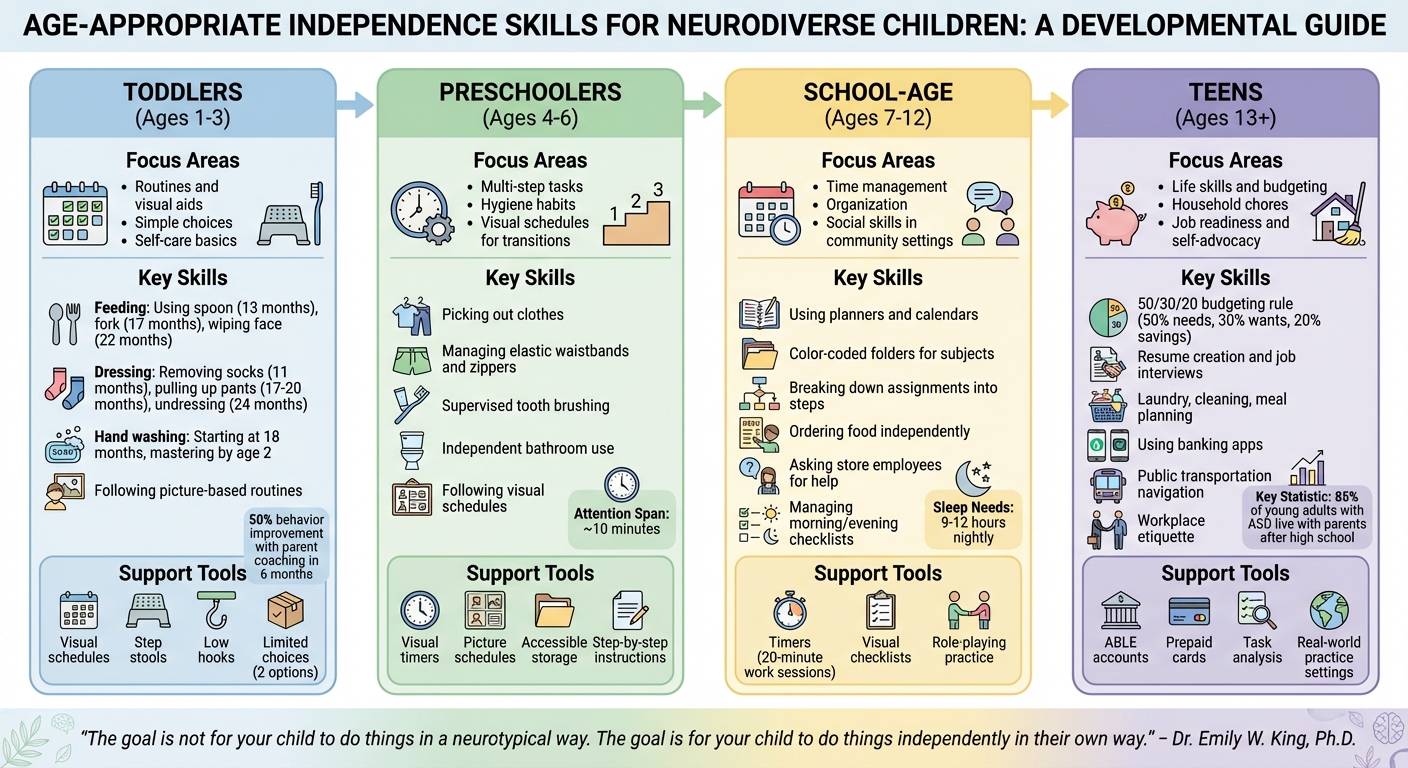
Age-Appropriate Independence Skills for Neurodiverse Children by Developmental Stage
Building Confidence, Connection, and Independence in Your Neurodiverse Child
sbb-itb-596b85d
Early Skills for Toddlers (Ages 1-3)
Between 18 and 36 months – often referred to as the "autonomy stage" – toddlers naturally begin to explore their independence. For neurodiverse toddlers, providing extra structure and visual supports can make this process smoother [8].
Self-Care Basics: Feeding and Dressing
Toddlers’ growing independence often shines through in self-care tasks like feeding and dressing. Around 13 months, many toddlers start experimenting with a spoon, and by 17 months, they may try using a fork [9]. By 22 months, some can wipe their faces with a napkin and peel simple fruits like bananas [9]. Using child-sized utensils and embracing the inevitable spills can turn mealtime into a learning experience [9].
Dressing follows a similar progression. By 11 months, toddlers may start removing their socks, and between 17 and 20 months, they can pull up elastic-waist pants. By 24 months, many can undress completely on their own [9]. Opting for loose, elastic-waist clothing helps simplify the process, and breaking tasks into small, clear steps (e.g., "arm, then arm, then pull down") can minimize frustration [9].
Hand washing is another milestone, with many toddlers beginning to wash independently around 18 months and mastering both washing and drying by age two [9]. A step stool in the bathroom and soap within reach can encourage this skill. Visual aids, like picture cards or simple drawings, can also guide them through the steps of hand washing and other daily routines [6][10].
Building Predictability with Routines
Routines are powerful tools for reducing anxiety and fostering independence. When toddlers know what to expect, it can help prevent surprises, struggles, and tantrums. Laurel Bongiorno, PhD, Dean for the Division of Education and Human Studies at Champlain College, emphasizes:
"Having a predictable routine fosters children’s independence because they know what’s happening next, which helps avoid surprises, struggles, and tantrums" [7].
For neurodiverse toddlers, predictable routines provide a sense of security. Visual schedules, such as picture cards for bedtime or mealtime routines, can be especially helpful [4][10].
Creating an environment that supports independence is another key step. Install low hooks for jackets, set up accessible toy shelves, and use a "toddler tower" in the kitchen so your child can join in simple meal prep activities [5][8]. When items are within their reach, children are more likely to try things on their own instead of relying on constant help. Offering limited choices – like two options for clothing, snacks, or activities – can also build decision-making skills without overwhelming them [7][8]. For example, instead of asking, "What do you want to wear?" you might say, "Do you want the red shirt or the blue shirt?"
Research backs up the importance of encouraging independence. A National Institutes of Health study found that toddlers who showed persistence with tasks at 12 months performed better on cognitive tests at 30 months [8]. Another study, which tracked 422 children from age two to ten, revealed that kids who were allowed to "fumble and figure things out" managed their emotions better and faced fewer challenges in school compared to those who were overly assisted by parents [8]. Allowing toddlers time to navigate challenges helps them develop problem-solving skills and resilience – abilities that lay the groundwork for self-advocacy later in life.
These early routines and skills create a foundation for greater independence as toddlers grow into preschoolers.
Independence Skills for Preschoolers (Ages 4-6)
As preschoolers grow, their routines naturally evolve into more complex tasks, building on the habits formed during toddlerhood. At this stage, kids start managing activities that require multiple steps, thanks to their increasing attention span – typically around ten minutes[12]. The trick is to break tasks into smaller, manageable steps while offering the right level of support. These growing abilities lay the groundwork for better self-care and smoother transitions between activities.
Dressing Independently and Hygiene Habits
Preschoolers are ready to take on more responsibility for dressing and hygiene routines. They might pick out their clothes the night before, choose garments that are easy to manage (like elastic waistbands), unzip their coats, or put on their shoes. Hygiene tasks, such as applying toothpaste, supervised brushing, washing hands, and using the bathroom, also become part of their daily routine.
Breaking these tasks into smaller steps can make them less overwhelming. Instead of saying, "get dressed", guide them step-by-step: put on your shirt, then your pants, then your socks. This approach reduces frustration and helps them stay focused. Loris Malaguzzi, founder of the Reggio Emilia Approach, once said:
"The wider the range of possibilities we offer children, the more intense will be their motivations and the richer their experiences"[11].
Creating a supportive environment also makes a big difference. Use accessible storage, like low drawers or bins, and keep a step stool in the bathroom so they can reach the sink or mirror. Practice these skills during calm times – avoiding the morning rush – and give them limited choices to encourage decision-making without overwhelming them. Celebrate their persistence by focusing on their effort. For instance, as the Child Mind Institute suggests:
"I’m so proud of you for sticking with that even when it got hard"[10].
This kind of praise not only motivates but also helps build resilience. While these self-care milestones are essential, visual supports can make daily transitions even smoother.
Using Visual Schedules to Transition Between Activities
As daily routines grow more intricate, visual tools become a game-changer for managing transitions. Shifting from playtime to lunch or outdoor activities to bath time can be particularly tricky for neurodiverse children. These challenges often persist into adulthood, requiring emotional growth for neurodiverse couples to navigate shared routines and communication. Visual schedules act as a guide, offering predictability that reduces anxiety and helps prevent meltdowns. Many neurodiverse kids process visual cues more effectively than verbal instructions, which makes these tools especially helpful.
Choose a format that works best for your child. Some might prefer real photos, while others respond better to icons or simple drawings. Start with major events like meals or outdoor play, then add smaller steps. Use consistent signals – like a specific icon or card with your child’s name – to indicate when it’s time to move on. Dr. Kim Van Dusen, a parenting expert and therapist, highlights the benefits:
"Once they can master their schedule, they feel more secure, competent, confident, and less anxious"[14].
Enhance the schedule with visual timers that show time passing, and make it interactive. Let your child move a completed task to an "all done" box or carry a picture card to the next activity. For unexpected changes, include a "question mark" icon to teach flexibility. As Kara Hume from the Indiana Resource Center for Autism points out:
"Shifting from verbal prompts to visual prompts can increase student independence and engagement, as well as decrease the need for adult supports"[13].
These tools not only support transitions but also empower kids to take ownership of their routines, boosting their confidence and independence.
Skills for School-Age Children (Ages 7-12)
Between the ages of 7 and 12, neurodiverse children often face a noticeable increase in expectations, both academically and at home. This stage builds on earlier skills, moving from basic routines to more complex self-management. It’s a crucial time for developing executive function skills like time management, organization, and emotional regulation. Many neurodiverse kids have "spiky" developmental profiles – for example, a 12-year-old might excel in reading at a high school level but still need organizational support typical of a younger child. Recognizing these uneven abilities helps parents set appropriate goals and provide the right kind of support.
Managing Schoolwork and Personal Schedules
As children grow, school and home routines become more demanding, requiring a stronger focus on organization and time management. Tools that help make abstract concepts like time and deadlines more concrete can be incredibly useful. A combination of a paper planner for hands-on tracking and a digital calendar for assignments and activities works well for many kids. Simple tools like color-coded folders for different subjects can also reduce the time spent searching for materials. Golden Care Therapy emphasizes the importance of teaching these skills:
"Time management should be taught, modeled, and practiced rather than expected automatically" [15].
Breaking down large assignments into smaller, more manageable steps can help prevent feelings of overwhelm. For example, set a due date, divide the project into smaller tasks, and assign each to specific days. Using a timer for focused 20-minute work sessions, followed by short breaks, can also help maintain attention without increasing stress. Posting a visible morning and evening checklist in a common area can reinforce routines like packing a school bag or brushing teeth. The aim, as Creating Order from Chaos highlights, is progress, not perfection:
"The goal isn’t perfection but awareness" [1].
Adequate sleep is another essential factor, as most children in this age group need 9 to 12 hours of rest each night. Without enough sleep, focus and organizational skills can suffer [15]. When mistakes happen – like forgotten homework or misplaced items – use these moments to guide your child through problem-solving. This approach not only builds resilience but also reduces the risk of learned helplessness.
Practicing Social Independence in Community Settings
Community outings provide a great chance to practice social skills that are hard to develop at home. Familiar public spaces, like a local restaurant or library, can serve as practice grounds for tasks such as ordering food or asking for help. The goal is to encourage independence, not conformity. As Dr. Emily W. King, Ph.D., explains:
"The goal is not for your child to do things in a neurotypical way. The goal is for your child to do things independently in their own way" [16].
Starting small can make a big difference. For example, let your child hand money or a card to a cashier or ask a store employee where to find an item. Role-playing these interactions at home can build confidence before trying them in the real world. Encouraging participation in activities like martial arts, swimming, or music can also help your child develop independence while pursuing their interests.
Independence also means knowing when and how to ask for help. For instance, carrying an ID card with your child’s name and emergency contact information can provide extra security during outings. Planning these experiences during calm moments and allowing for low-risk challenges can help your child build problem-solving skills and confidence. These small steps lay the foundation for more advanced independence as they approach their teenage years.
Advanced Independence Skills for Teens (Ages 13+)
For neurodiverse teens, building practical life skills is a crucial step toward independence. Every year in the United States, about 50,000 young adults with autism spectrum disorder turn 18, yet research shows that 85% of them still live with their parents after high school [18]. This highlights the need for structured, hands-on practice during adolescence. As Michael Mohan puts it:
"Adulthood begins in preschool." – Michael Mohan [18]
During these transitional years, the focus shifts to mastering more complex tasks, such as managing finances, holding a job, and running a household. By age 14 – or age 16 in some states – vocational goals and transition assessments should be integrated into a teen’s Individualized Education Program (IEP) to ensure they are prepared for adulthood [18]. Below, we’ll cover vocational readiness and life skills that are essential for teens to gain independence.
Vocational and Time Management Skills
Pre-vocational skills are the foundation for future employment. These skills extend beyond specific job tasks and include "soft skills" that help teens thrive in the workplace. Time management – using planners or digital calendars – following multi-step directions, initiating tasks, staying persistent, and understanding workplace etiquette (like punctuality and dressing appropriately) all contribute to strong work habits [17]. Special education advocate Lisa Lightner explains:
"Pre-vocational skills are the building blocks that prepare our kids for the real world, making them an essential part of IEP transition planning" [17].
Teens can practice job readiness through activities like creating resumes, searching for jobs online, and role-playing interviews. Executive functioning skills, such as problem-solving (e.g., figuring out what to do if transportation is delayed), attention to detail, and managing stress, are equally important. Breaking down complex tasks into smaller, manageable steps – using methods like task analysis or backward chaining (teaching the last step first) – can help teens gain confidence through quick successes.
Real-world experiences, like volunteering or part-time jobs, provide a safe space for teens to practice workplace interactions. A 12-week program called "Surviving and Thriving in the Real World" (STRW) demonstrated in October 2025 that neurodiverse teens significantly improved their daily living skills when taught in real-life settings. For example, they practiced money management at a store or navigated public transportation, rather than learning solely in a classroom [18].
Communication and self-advocacy are also critical. Teens benefit from learning how to ask for help, express their needs clearly, and pick up on social cues in professional environments. Basic computer skills – like email, word processing, spreadsheets, and internet safety – are now essential for many jobs.
Learning Life Skills: Money Management and Household Chores
Mastering everyday routines, like managing money, is another step toward greater independence. Financial literacy can be especially challenging for neurodiverse teens, as difficulties with "time blindness" or impulsivity can make saving and budgeting feel overwhelming [21]. Only 14% of adults with autism live independently, with financial struggles often playing a role [20]. Simplifying these concepts into step-by-step routines can help.
Start with real currency rather than play money [19]. As Andrew Komarow, MSFS, CFP, explains:
"Money is a tool that allows us to negotiate our welfare and independence in the world and has an incredible influence on anyone’s life" [19].
A visual system can help teens understand budgeting. Create a color-coded chart to categorize spending into "Essential Needs" (e.g., rent, food), "Important Wants" (e.g., internet, phone), and "Optional Wants" (e.g., hobbies, dining out) [20]. The 50/30/20 budgeting rule – allocating 50% for needs, 30% for wants, and 20% for savings – is a helpful starting point, though ratios can be adjusted based on individual circumstances [20]. Scheduling a weekly "Money Day" to review accounts, track spending, and plan bills can reduce stress and build positive habits [20].
Technology can make this process easier. Apps like Mint, YNAB, or PocketGuard provide visual tools to track spending and categorize expenses automatically [20]. Prepaid cards or virtual banking systems can offer teens a controlled way to practice managing transactions and bills. For eligible individuals, Achieving a Better Life Experience (ABLE) accounts allow them to save for the future without impacting government benefits [20].
Household chores are another key area for developing independence. Tasks like laundry (sorting, washing, folding), cleaning, meal planning, grocery shopping, and basic repairs (like changing a lightbulb or sewing a button) are all valuable life skills. Using task analysis and visual aids can simplify these activities. Practicing in real settings, like doing laundry at a laundromat, reinforces learning. Incorporating a teen’s interests – such as gamifying chores or using apps for budgeting – can boost engagement. For teens who struggle with transitions, simple verbal cues like "we’ll switch tasks in two minutes" can help them prepare mentally.
It’s also important to focus on internal skills, like emotional regulation and recognizing burnout. Teens should learn to identify changes in energy or sleep patterns that might signal the need for self-care [22]. Encouraging them to make decisions – like choosing weekly meals or setting daily goals – fosters self-determination. As they gain competence, gradually reducing parental involvement ensures they are ready to manage tasks independently over time.
The Role of Parent Coaching in Building Independence
Parent coaching goes beyond traditional parenting advice, offering a hands-on approach to help parents support their neurodiverse child’s path to independence. Instead of focusing solely on the child’s therapy, parent coaching equips parents with practical tools they can use daily. This shift is essential because many conventional methods prioritize compliance and correction, while coaching encourages collaboration that respects a child’s unique neurological makeup [1][23].
The results can be transformative. Studies show that when parents are trained to understand neurodivergent traits, a child’s behavior can improve by up to 50% in just six months [24]. Additionally, 65% of parents who engaged in neurodiversity-focused coaching reported feeling more confident in supporting their child, and 80% observed noticeable improvements in their child’s behavior [24]. Sara Morse, a postpartum doula and sleep coach, highlights this approach:
"Coaching centers the parent. It equips you with tools to apply what you learn, day in and day out" [23].
But the benefits go beyond behavior. Coaching helps families adopt a new perspective on neurodiversity, seeing it as a difference rather than a deficit. Shannon Beaver, LCSW, emphasizes:
"One of the most important steps a counselor can take with parents is to help them understand that neurodivergent traits are not deficits – they are simply different ways of thinking and interacting with the world" [24].
This mindset encourages parents to focus on their child’s strengths within their neurotype rather than trying to enforce neurotypical standards. For instance, instead of giving direct instructions like "Go pack your bag", parents learn to ask guiding questions such as "What do you think you need first?" This approach nurtures a child’s ability to think through tasks step by step [26].
Parental stress management is another critical component. Research shows that children with highly anxious parents are three times more likely to develop anxiety themselves [24]. Coaching addresses this by helping parents regulate their own emotions, creating a calmer household. Techniques like "micro-presence" – focusing on the immediate moment during a child’s meltdown – help parents stay grounded and responsive, rather than overwhelmed by long-term concerns [25].
For families looking for personalized strategies, Growth and Change Counseling offers parent coaching services in Campbell, San Jose, Los Angeles, Roseville, and throughout California via telehealth. These services provide neurodiversity-affirming support, helping parents guide their children toward independence while reducing stress and boosting confidence in their parenting skills. Combined with the age-specific strategies discussed earlier, these coaching methods lay the foundation for lasting growth and independence in neurodiverse children.
Supporting Neurodiverse Growth at Growth and Change Counseling
Helping neurodiverse children develop independence is a journey that spans from early self-care in toddlerhood to mastering complex skills like financial management and career preparation during adolescence. Each stage of this journey calls for a customized approach. For toddlers, predictable routines and simple choices are key. Preschoolers benefit from visual schedules and consistent hygiene practices. School-age children need help organizing tasks and managing school responsibilities, while teenagers thrive when practicing skills like budgeting and self-advocacy.
Research highlights that building self-management and self-advocacy skills not only leads to greater independence in adulthood but also boosts self-esteem, reduces anxiety, and fosters a sense of belonging within the community [1][2][3].
"Independence is not about doing everything alone; it’s about doing what you can, with the support you need." – Behavioral Innovations [2]
It’s important to align expectations with your child’s developmental abilities rather than their age [1]. A systematic approach to building skills can reduce long-term reliance on external support [6] and equip children with the resilience needed to navigate a world that may not always provide accommodations [1].
As the focus shifts from hands-on guidance during early childhood to collaborative problem-solving in adolescence, children gain confidence and competence in handling age-appropriate tasks [2]. By implementing these strategies, you can empower your neurodiverse child to grow into a self-reliant, confident individual who advocates for their own needs.
FAQs
How do I choose the right independence goal for my child?
When setting independence goals for your child, align them with their developmental stage, abilities, and specific needs. Choose tasks that are age-appropriate and achievable, offering just enough challenge to encourage growth without causing frustration. If a task feels too big, break it down into smaller, more manageable steps. Visual aids can also help simplify the process. As your child gains confidence and skill, you can gradually introduce more complex tasks, always ensuring the goals remain realistic and suited to their individual progress.
What can I do when routines or transitions trigger meltdowns?
Preparing your child for routines or transitions can help reduce meltdowns and create a smoother experience. Start by giving clear, visual cues or warnings ahead of time, so they know what to expect. Practicing transitions gradually in a calm and supportive manner can also build their confidence. Tools like predictable routines and visual schedules can make these moments feel less overwhelming and more structured for them.
When should we start IEP transition planning for teen life skills?
By law, IEP transition planning for developing teen life skills must begin by age 16. This process is designed to help students gear up for life after high school, emphasizing the skills they’ll need to navigate adulthood. Key areas of focus include further education, employment opportunities, and managing daily living tasks independently.
Related Blog Posts
- Ultimate Guide to Routines for Neurodiverse Families
- Trauma and Advocacy: Supporting Neurodiverse Families
- Parenting Stress: Solutions for Neurodiverse Families
- Trauma and Self-Esteem in Neurodiverse Kids
