Managing emotions is tough for kids with ADHD, but parents can play a key role in teaching these skills. Emotional regulation challenges stem from neurological differences, with up to 70% of ADHD kids struggling in this area. Parents can help by modeling calm behavior, teaching kids to label emotions, and using practical tools like mindfulness and calming kits. Clear routines and rewards also support progress. If home strategies aren’t enough, parent coaching offers tailored guidance to navigate these challenges effectively. Small, consistent steps can create a calmer, more supportive environment for your child.
The Neuroscience of ADHD and Emotional Dysregulation
How Parents Can Model Emotional Awareness and Self-Control
Kids are always paying attention, especially to how you handle tough situations like stress or frustration. Research from 53 studies highlights that a parent’s ability to regulate their emotions directly influences a child’s ability to do the same [5]. When you manage to stay calm during challenging moments, you’re not just diffusing the tension – you’re showing your child a lifelong skill.
This is where co-regulation comes into play. Your calmness can help ease your child’s stress. On the flip side, if you’re visibly upset, their stress levels can spike. Simple actions like speaking softly and taking deep breaths can help settle their nervous system [3].
One way to teach this is by talking through your emotions out loud. For instance, if you’re stuck in traffic and feeling stressed, you might say: "I’m frustrated because we’re running late, but I’ll take three deep breaths to calm down" [6]. This not only labels your emotions but also shows your child how to handle them. Interestingly, brain studies reveal that naming an emotion can help calm the brain’s reactive areas [3]. By narrating your feelings, you’re giving your child a live demonstration of emotional awareness.
And don’t worry about being perfect. If you lose your temper, use it as a teaching moment later. Saying something like, "I got frustrated and lost my temper earlier. I’ll try to do better next time", shows your child that even adults struggle with emotions – and that it’s okay to make amends [6].
Teaching Children to Label Their Emotions
Helping your child expand their emotional vocabulary can be a game-changer. Instead of relying on generic terms like "mad" or "sad", encourage them to use more specific words like "disappointed", "anxious", "annoyed", or "overwhelmed" [4][3]. The more precise they are, the better they’ll understand and manage their feelings.
"Using an emotion word helps expand your child’s emotional vocabulary and sets the stage for a learning opportunity." – Justin Mabee, Writer and Designer, Growing Minds Psychology [6]
Make this part of your daily routine. If your child’s face turns red or their fists clench, you can gently guide them by asking: "Are you frustrated because your brother took your toy, or are you disappointed because you wanted more screen time?" This helps them connect their physical reactions to specific emotions. Over time, they’ll start identifying these feelings on their own.
Another way to reinforce this is by labeling your own emotions throughout the day. For example, you might say: "I’m nervous about my big meeting today" or "I’m annoyed that the grocery store didn’t have what I needed" [6]. Hearing you use emotion words regularly helps them learn how to do the same.
Reassuring Children That All Emotions Are Normal
Once your child starts naming their emotions, it’s essential to reassure them that these feelings are okay. Kids need to understand that all emotions are valid, even the difficult ones. Anger, sadness, jealousy, and fear are just part of being human – they’re not flaws. However, it’s equally important to teach them that while emotions are acceptable, certain behaviors are not.
You can say things like: "I see you’re angry, but hitting is not okay" [4]. This makes it clear that while their feelings are understood, their actions need boundaries. By validating their emotions but not condoning harmful behaviors, you help them feel safe expressing themselves without guilt.
For children with ADHD, emotions can feel especially intense. Let them know that their big feelings don’t make them "bad" or "broken." Try saying: "Your brain feels things very strongly, and that’s just part of who you are. We’ll work together to manage those big emotions." This approach normalizes their experience and reassures them that you’re on their side.
Also, keep in mind that most strong emotions only last a few minutes. It’s often the overthinking about those feelings that drags things out [5]. When your child is overwhelmed, remind yourself – and eventually them – that this moment will pass. Your calm and steady presence during these episodes teaches them that emotions, no matter how big, are temporary and manageable.
Practical Techniques for Developing Emotional Regulation
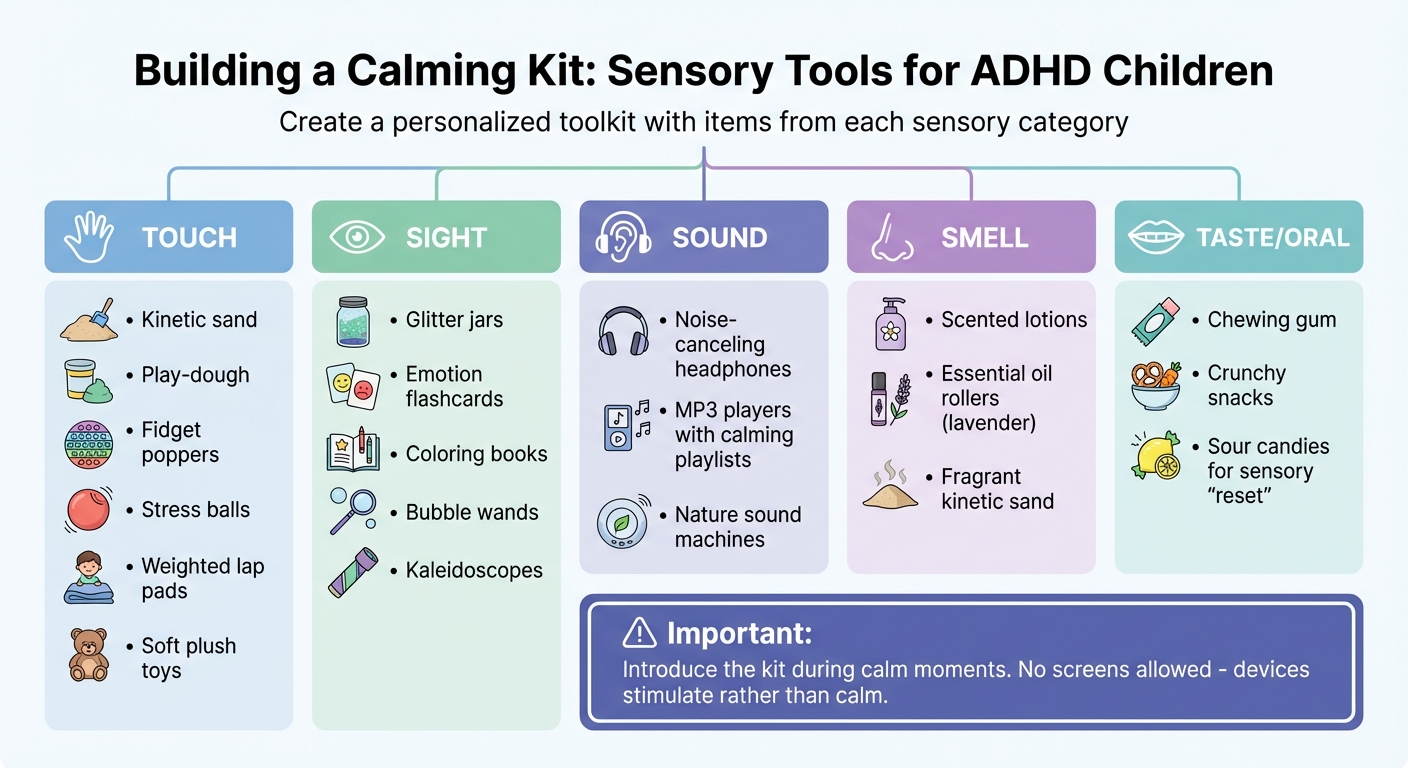
Sensory Calming Kit Items for ADHD Children by Category
Helping your child learn to manage their emotions is a gradual process, but it starts with practical, hands-on strategies. Once they understand that emotions are a normal part of life, the next step is teaching them how to handle those feelings. The best time to introduce these techniques? During calm, stress-free moments.
Using Rewards and Consequences to Shape Behavior
Children with ADHD often respond well to clear feedback. When your child successfully navigates a challenging situation – like waiting their turn without interrupting – acknowledge it immediately. For example, you could say, "I noticed you took a deep breath instead of yelling. That was great self-control!" This kind of positive reinforcement works best when the moment is still fresh in their mind [4].
Set specific, measurable goals they can track daily. Instead of saying, "Be good", try something more concrete, like "Start homework at 4:00 p.m." or "Play quietly while your sister naps" [3]. A simple chart on the fridge can help them mark their successes, providing a visual cue to celebrate their progress.
When setting boundaries, validate their emotions while being clear about acceptable behavior. For instance: "I see you’re angry, but hitting is not OK" [4]. This approach shows them their feelings are acknowledged, while also teaching that actions have consequences. It’s a balance – firm limits paired with understanding. Alongside rewards and boundaries, calming techniques can further support emotional control.
Teaching Mindfulness and Breathing Techniques
Breathing exercises might seem simple, but they’re rooted in neuroscience. Controlled breathing teaches kids to observe their discomfort without reacting impulsively [4]. Over time, this helps build emotional resilience.
One fun exercise for younger kids is Hot Chocolate Breathing. Ask them to imagine holding a cup of hot cocoa. They inhale deeply through their nose to "smell" the chocolate, then exhale slowly through their mouth to "blow" on it and cool it down [7]. This easy-to-remember technique can be practiced anywhere – whether in the car, at school, or during bedtime.
For children who prefer something more physical, try the Turtle Technique. When they feel overwhelmed, they can "retreat into their shell" by crossing their arms over their chest, taking deep breaths, and thinking through a solution [1]. Another option is Balloon Breathing, where they imagine their belly inflating like a balloon on the inhale and deflating on the exhale [1].
"Mindfulness means paying more unbiased, moment-to-moment attention to how things are right now, for better or worse." – Mark Bertin, M.D. [4]
Introduce these exercises during calm times, like part of a bedtime routine or a quiet morning moment. When practiced regularly, these tools become second nature, ready to use when emotions run high.
Building Self-Calming Kits and Daily Routines
A calming kit is a collection of sensory tools designed to help kids self-soothe. The key is creating the kit together so your child feels invested in using it [9]. Include items that engage their senses, such as stress balls or kinetic sand for touch, glitter jars for sight, noise-canceling headphones for sound, scented lotions for smell, and chewing gum for taste [9][11].
Store the kit in a consistent spot, like a "Peace Corner" or a designated basket [9][11]. When your child knows exactly where to find their tools, they’re more likely to use them independently. Just one rule: no screens. Devices like iPads or gaming systems stimulate rather than calm [9].
| Sensory Category | Suggested Items for Calming Kits |
|---|---|
| Touch | Kinetic sand, play-dough, fidget poppers, stress balls, weighted lap pads, soft plush toys [9][10][11] |
| Sight | Glitter jars, emotion flashcards, coloring books, bubble wands, kaleidoscopes [9][11][8] |
| Sound | Noise-canceling headphones, MP3 players with calming playlists, nature sound machines [9][10][11] |
| Smell | Scented lotions, essential oil rollers (lavender), fragrant kinetic sand [9][11] |
| Taste/Oral | Chewing gum, crunchy snacks, sour candies for sensory "reset" [9][11] |
"It is important to introduce and practice using the calm down box when calm. Ask your child to notice any changes in their body after using an item." – Anita Robertson, LCSW, ADHD & Relationship Therapist [11]
Pair the calming kit with predictable daily routines. Children with ADHD often thrive on structure because it reduces uncertainty, which can trigger anxiety [1][2]. Use visual schedules to outline the day’s activities, and create designated spaces for specific tasks – like a quiet corner for reading or a table for homework. When your child knows what to expect and where things happen, it’s easier for them to stay calm and focused.
sbb-itb-596b85d
How Parent Coaching Supports Families with ADHD
Parenting a child with ADHD can feel overwhelming, especially when generic advice doesn’t quite fit the unique challenges of your child’s needs. That’s where parent coaching steps in. It provides a tailored approach, helping you understand what’s really driving your child’s behavior – whether it’s actual defiance or a response to neurological overwhelm [12]. This kind of support helps bridge the gap between feeling emotionally drained and responding effectively.
Personalized Coaching for Emotional Regulation
One of the key focuses of parent coaching is helping parents manage their own emotions first. Research highlights that a parent’s ability to stay calm directly impacts a child’s ability to self-regulate [5]. Coaches often teach the 3 Rs: Regulate, Reflect, and Respond [5]. As Viktor Frankl famously said, "Between a stimulus and response, there can be a pause. And in that pause, we have the freedom to choose" [5]. That pause is where meaningful change begins. These strategies work hand-in-hand with practical techniques to help parents remain steady during emotional storms.
It’s also worth noting that about 66% of children with ADHD deal with additional challenges, such as anxiety or sleep issues, which can intensify emotional struggles [4]. Personalized coaching adapts to these complexities, offering real-time solutions that prevent parents from feeling stuck or burned out. As Dr. Karen Pavlidis explains, "The less helpless parents feel, the less likely they are to become dysregulated in the face of a difficult interaction with their child" [12].
Parent Coaching Services at Growth and Change Counseling

At Growth and Change Counseling, these coaching methods are put into action through sessions designed to address the specific needs of neurodiverse families. Their team specializes in ADHD, ODD, Autism Spectrum Disorder, and trauma-informed care, ensuring that parents work with professionals who truly understand the challenges they face [13]. The approach focuses on relational intelligence and skill-building interventions, empowering parents with tools that create lasting change [13].
Services are offered both in-person at locations across California and via telehealth. Individual therapy sessions with a Licensed Marriage and Family Therapist (LMFT) cost $200 for 45 minutes, while sessions with an Associate Marriage and Family Therapist (AMFT) are $150, with sliding scale options starting at $100 [13]. By focusing on empowering parents as the primary figures in their child’s life, this approach aims to create long-term improvements rather than short-term fixes [13].
Finding Support at Growth and Change Counseling
Helping a child with ADHD build emotional regulation skills takes patience, consistency, and the right tools. The strategies shared here – like teaching emotion labeling, using mindfulness exercises, and creating predictable routines – can help create a supportive environment where your child can gradually improve their ability to manage emotions. It’s important to keep in mind that emotional regulation systems don’t fully mature until the mid-to-late 20s, and for kids with ADHD, this process might take even longer [5].
Start by focusing on your own emotional regulation. Studies show that a parent’s ability to remain calm significantly influences a child’s capacity to self-regulate and adapt [5]. By modeling emotional awareness and practicing pausing before reacting, you can teach your child valuable self-regulation skills.
Progress will come slowly, with ups and downs along the way. Emotional dysregulation is a common challenge for children with ADHD, affecting up to 70% of them [14]. You’re not alone in navigating these difficulties, and small, consistent efforts can lead to meaningful improvements over time.
If home strategies aren’t enough, seeking professional support can provide additional guidance. Parent coaching, in particular, offers tailored advice to address your family’s specific needs, helping you refine behavioral plans and set achievable goals. Growth and Change Counseling specializes in working with neurodiverse families, offering both in-person services across California and telehealth options to make support accessible when you need it most.
FAQs
How do I stay calm when my child is melting down?
To keep your cool during your child’s meltdown, it’s all about managing your own emotions first. Start with deep breaths to steady yourself, and remind yourself not to take their behavior personally – it’s not a reflection of you. When frustration starts creeping in, pause and use calming techniques like counting to ten or grounding exercises to regain your balance.
After things settle down, take a moment to acknowledge what your child is feeling. This not only helps them feel understood but also opens the door for a reflective conversation. Together, you can explore what happened and gently guide them toward building better emotional regulation skills over time.
What should I do if my child won’t use a calming kit?
If your child seems hesitant to use a calming kit, try tailoring it to include items they truly enjoy and find comforting. This can make the kit feel more personal and inviting. Help them identify their emotional triggers and practice calming strategies during calm moments, rather than in the middle of a meltdown. Remember, consistency and patience are essential – showing calm behavior yourself can inspire them to embrace the kit over time.
When should you consider parent coaching for ADHD?
If managing your child’s ADHD feels overwhelming – whether it’s due to emotional outbursts, losing your temper, or struggling to stay connected – parent coaching might be worth considering. Signs that coaching could help include frequent frustration, feeling emotionally distant from your child, or difficulty maintaining a calm, supportive presence. Through parent coaching, you can learn personalized strategies to create a more peaceful home and nurture your child’s emotional development.
Related Blog Posts
- ADHD and Marriage: Emotional Regulation Strategies
- Parenting Stress: Solutions for Neurodiverse Families
- ADHD Parenting Tips for Neurodiverse Families
- Parenting with ADHD: Sensory Overload Solutions
