Emotional regulation is key to healthy relationships, but ADHD and autism can make it more challenging. These conditions influence how emotions are processed, leading to misunderstandings and conflicts. ADHD often causes quick emotional reactions and sensitivity to rejection, while autism can lead to slower emotional processing and sensory overload. When both conditions overlap, challenges can intensify.
Here’s what you need to know:
- ADHD impacts impulse control, often leading to rapid mood swings or intense reactions.
- Autism can cause difficulty identifying emotions and managing sensory sensitivities.
- Misunderstandings arise when neurotypical partners misread neurodivergent behaviors.
- Strategies like TIPP (Temperature, Intense Exercise, Paced Breathing, Progressive Muscle Relaxation), soft starts, and co-regulation can help.
- Professional neurodiversity-informed therapy can provide tailored support.
Understanding these differences helps partners work together, reducing conflict and improving connection.
ADHD and Emotional Dysregulation: What You Need to Know
How ADHD and Autism Affect Emotional Regulation
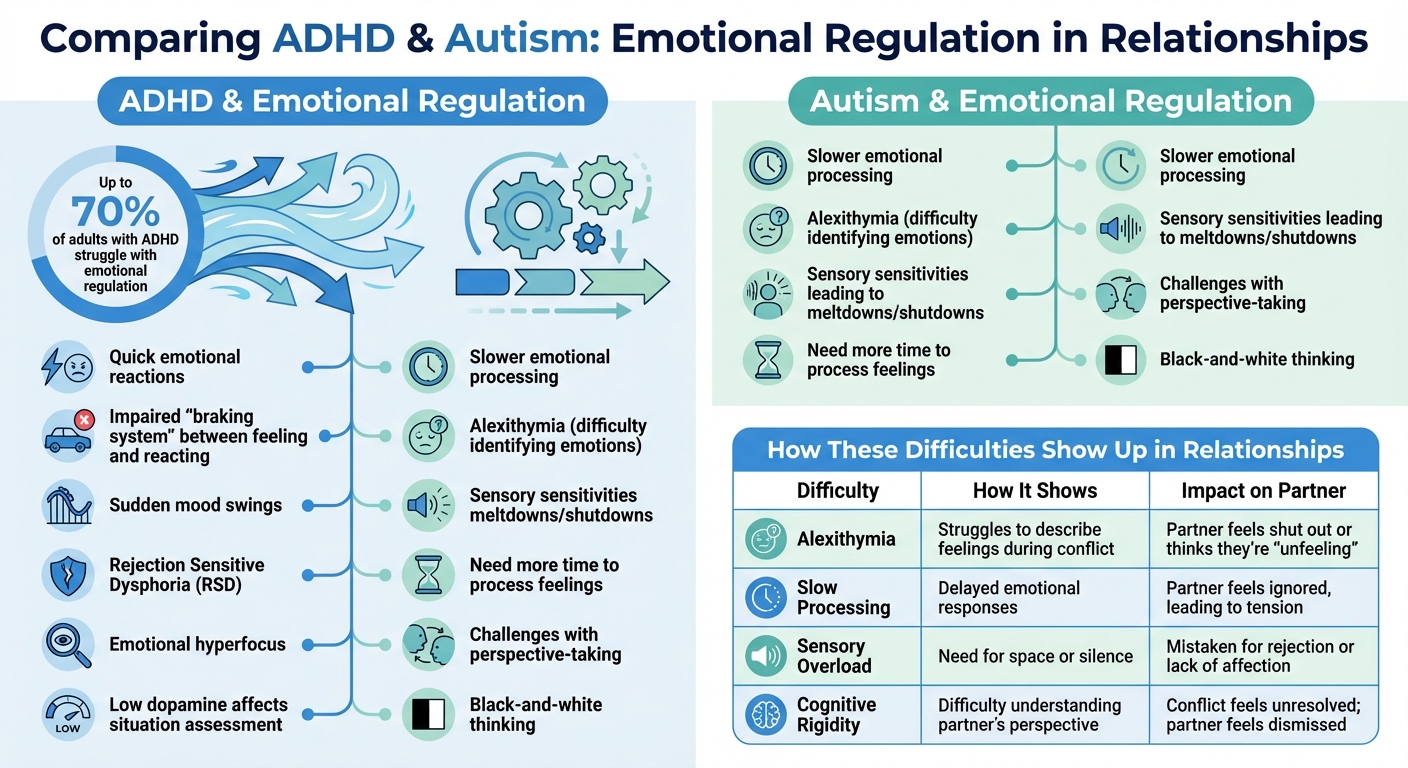
How ADHD and Autism Affect Emotional Regulation in Relationships
ADHD and Emotional Regulation Difficulties
ADHD creates a unique neurological setup where the brain’s "braking system" doesn’t always function effectively. This makes it harder to pause between feeling an emotion and reacting to it. Michael Manos, PhD, a Pediatric Behavioral Health Specialist, explains:
"We manage emotions using directed attention. Emotions are brought out by automatic attention, but most people can manage their feelings effectively using directed attention." [7]
For someone with ADHD, impaired directed attention means it’s tough to shift focus away from a frustrating moment. In relationships, this might show up as sudden mood swings – one minute, they’re furious, and the next, they’re calm, leaving their partner confused or hurt [4]. Research suggests that up to 70% of adults with ADHD struggle significantly with emotional regulation [6].
Another complicating factor is Rejection Sensitive Dysphoria (RSD). A neutral comment or even a tired look from a partner can feel like deep disapproval, triggering intense emotional pain [4]. Emotional hyperfocus can also be a double-edged sword: while someone with ADHD might fixate passionately on their partner, they may also forget their partner’s emotional needs when distracted. Add to this low dopamine levels, which can skew the brain’s ability to assess the seriousness of a situation, and minor issues may suddenly feel like major crises [4].
While ADHD often leads to quick emotional reactions, autism presents its own, very different challenges with emotional awareness and sensory responses.
Autism and Emotional Regulation Difficulties
Unlike ADHD, where emotions can flare up instantly, autism affects emotional regulation through challenges in self-awareness and sensory processing. Many autistic individuals experience alexithymia – a difficulty in identifying and describing their own emotions. This can make it hard to communicate feelings during moments of conflict, leaving their partner feeling isolated [8].
Sensory sensitivities add another layer of complexity. Reactions to noise, light, or touch can heighten stress, sometimes resulting in meltdowns (outward emotional outbursts) or shutdowns (withdrawing inward to cope with overwhelm) [8]. Carla A. Mazefsky, Assistant Professor at the University of Pittsburgh School of Medicine, highlights:
"Recognizing and understanding your own emotions is necessary for effortful ER [Emotion Regulation]." [8]
In social-emotional situations, autistic individuals often need more time to process their feelings. This delay can be misinterpreted by neurotypical partners as disinterest or withdrawal [3]. Challenges with perspective-taking (theory of mind) and a tendency toward black-and-white thinking can further complicate matters, creating misunderstandings that leave both partners feeling stuck.
Here’s how some of these difficulties might show up in relationships:
| Difficulty | How It Shows in Relationships | Impact on Partner |
|---|---|---|
| Alexithymia | Struggles to describe feelings during conflict | Partner may feel shut out or think they’re "unfeeling" |
| Slow Processing | Delayed emotional responses | Partner may feel ignored, leading to tension |
| Sensory Overload | Need for space or silence | Often mistaken for rejection or lack of affection |
| Cognitive Rigidity | Difficulty understanding the partner’s perspective | Conflict feels unresolved; partner feels dismissed |
When ADHD and Autism Occur Together
When ADHD and autism co-exist – often called AuDHD – the challenges of both conditions can overlap and amplify each other. For example, the autistic need for routine and predictability can clash with the ADHD craving for novelty and spontaneity [3]. Sensory overload may become even more intense, draining emotional reserves and sometimes being misread as intentional withdrawal.
Masking behaviors – where someone hides their struggles to fit in – can become more pronounced in AuDHD. This might involve suppressing autistic sensory overwhelm or ADHD-related emotional outbursts, leaving the individual feeling unseen in their relationship [3]. The combination of ADHD’s quick emotional reactions and autism’s slower processing speed can create internal frustration and external misunderstandings.
Co-occurring conditions like anxiety, depression, or C-PTSD can add even more layers to these challenges. Past experiences may amplify current emotional responses, making them seem disproportionate to the situation [3].
In relationships, emotional object permanence – remembering a partner’s emotional needs when they’re not immediately present – can be particularly tricky. This can be especially hard for an autistic partner who thrives on consistency and predictability [3]. The "flipped lid" model, where the amygdala reacts strongly while the prefrontal cortex struggles to regain control, often worsens these dynamics. Together, these challenges highlight the importance of finding strategies tailored to neurodiverse relationships.
How Emotional Regulation Differences Show Up in Relationships
As mentioned earlier, the unique neurological traits of ADHD and autism shape emotional responses, which often play out in distinct ways within relationships.
Common Relationship Patterns in Neurodiverse Couples
The dynamics between partners with different neurotypes can bring unique emotional challenges. For example, in neurotypical–ADHD relationships, the neurotypical partner might struggle to make sense of rapid emotional changes. What may seem like an overreaction is often the ADHD partner’s emotions shifting so quickly that their thoughts can’t fully catch up, leaving their partner unsure of what triggered such a strong response.
In neurotypical–autistic relationships, a common pattern is the pursuit-withdrawal cycle. Here, the neurotypical partner may push for immediate resolution during conflicts, while the autistic partner might need more time to process their emotions and find the right words. This delay can sometimes be misinterpreted as rejection or emotional distance [3].
When ADHD and autism coexist in a partnership, a push-pull dynamic often emerges. The autistic partner’s preference for routine and predictability can clash with the ADHD partner’s desire for variety and spontaneity [3]. These differences can lead to tension in everyday decision-making, as each partner seeks stability in their own way.
Misunderstandings and Emotional Triggers
These neurological differences can also lead to frequent misinterpretations. In neurodiverse relationships, partners may unintentionally view each other’s behaviors as personal flaws rather than expressions of their neurodivergence. For instance, an ADHD partner engrossed in hyperfocus might unintentionally neglect their partner’s emotional needs, which can come across as indifference [3]. Similarly, an autistic partner withdrawing during sensory overload – a necessary self-care response – might be seen as a lack of affection rather than a way to cope with overwhelm [3].
Rejection Sensitivity Dysphoria (RSD) can add another layer of complexity. For ADHD partners, even neutral comments or actions can trigger intense emotional pain, often resulting in defensiveness or emotional shutdown [1].
Differences in processing speed can also fuel conflict. When an autistic partner needs extra time to navigate complex emotions, their neurotypical or ADHD partner might misread the silence as disinterest. This can leave one partner feeling ignored while the other feels overwhelmed by pressure [3].
Repeating Conflict Patterns
These misunderstandings often lead to recurring conflicts. Neurodiverse couples may find themselves stuck in these patterns – not because they lack love, but because their nervous systems react differently under stress.
For ADHD partners, stress can cause the prefrontal cortex to shut down, allowing the amygdala – the brain’s emotional center – to take over. This can result in impulsive remarks or emotional withdrawal. Once the stress subsides, lingering feelings of shame may reignite tensions.
Physiological flooding adds another challenge. When heart rates exceed 100 beats per minute, effective communication becomes nearly impossible [2]. Dr. John Gottman, co-founder of The Gottman Institute, explains:
"The major sympathetic neurotransmitter norepinephrine doesn’t have an enzyme to degrade it so it has to be diffused through blood… this takes twenty minutes or more in the cardiovascular system." [2]
In this heightened state, trying to resolve conflicts often backfires. One partner might shut down completely, while the other’s escalating emotions deepen the sense of being unheard and misunderstood. These cycles can be difficult to break without understanding the underlying neurological differences at play.
sbb-itb-596b85d
Practical Strategies for Managing Emotions Together
Managing emotions as a couple becomes much more effective when grounded in an understanding of neurodiverse emotional processing. While knowing the science behind emotional regulation is crucial, couples also need actionable tools to handle daily challenges and avoid falling into repetitive conflict patterns. Below are practical strategies and resources that connect neurological insights with everyday relationship dynamics.
Learning About Each Other’s Neurodiversity
A good starting point is building a shared vocabulary to discuss emotions and triggers. By documenting sensory sensitivities and calming techniques, couples can reduce misunderstandings. Instead of phrases like, "You’re overreacting" or "Why won’t you talk to me?", try using terms such as, "My lid is flipping", "I’m getting flooded", or "My amygdala is loud right now" [1]. This approach shifts the focus to neurobiology, emphasizing that reactions stem from how the brain processes emotions – not from a lack of care.
For instance, a partner with ADHD might explain that criticism triggers Rejection Sensitivity Dysphoria, while an autistic partner might highlight how sudden schedule changes can lead to sensory overload [9].
Tools for Individual and Couple Emotional Regulation
When emotional dysregulation occurs, having tools to reset the nervous system is key. The TIPP skill – which involves Temperature (like splashing cold water on the face), Intense exercise (such as a 60-second wall sit), Paced breathing, and Progressive muscle relaxation – can quickly help regulate emotions [2]. If a conflict break is needed, ensure it lasts at least 20 minutes for the body to fully calm down [2].
Soft starts can also make a big difference by reducing the chance of triggering the amygdala at the start of a tough conversation. For example, instead of diving into a complaint, you might begin with: "I love you, and we’re okay. Can we check in about something?" [1]. For couples where one partner thrives on routine while the other enjoys spontaneity, setting up predictable communication routines – like weekly planning meetings – can reduce stress and strengthen the relationship.
In shared spaces, adjusting lighting, sound, and textures can help lower sensory triggers [3]. During conflicts, if one partner stays calm, they can practice co-regulation by softening their tone, slowing their breathing, and offering reassuring phrases like "We’re okay." These actions can help the other partner regain emotional balance [1].
| Strategy Category | Specific Technique | Purpose |
|---|---|---|
| Physiological | TIPP (Temperature, Intense Exercise, Paced Breathing, Muscle Relaxation) | Quickly calms a "flipped lid" or elevated heart rate [2] |
| Communication | Soft Starts & Code Words | Reduces perceived threats during difficult conversations [1] |
| Environmental | Sensory-Friendly Spaces | Lowers stress levels that contribute to dysregulation [3] |
| Cognitive | Pause and Name | Helps identify emotions before reacting impulsively [3] |
Getting Professional Help for Neurodiverse Relationships
If self-regulation techniques aren’t resolving recurring issues, professional support can make a significant difference. Persistent conflicts, feelings of failure, or ongoing anger can block connection, but therapists trained in neurodiversity-informed couples counseling can help [5][9].
These specialists act as "translators", helping partners articulate their neurological experiences in ways that foster mutual understanding [3][9]. Effective methods include the Gottman Method, Emotionally Focused Therapy (EFT), and Imago Relationship Therapy [5][2]. Therapist Adela Stone explains:
"In a neurodiverse relationship, anger is often a signal, not a threat. It may be pointing to sensory overload, unmet needs, or misunderstood intentions" [9].
For couples in crisis, programs like Growth and Change Counseling offer specialized support. Their Marriage Rescue Institute provides a 12-week intensive coaching program tailored to the needs of ADHD and autistic partners. With offices in Campbell, San Jose, Los Angeles, and Roseville, and telehealth options across California, their solutions-focused therapy helps couples navigate emotional regulation challenges together. Learn more at Growth and Change Counseling.
Conclusion
Emotional regulation challenges in neurodiverse relationships aren’t about a lack of love or effort – they stem from how ADHD and autism influence the brain’s ability to process emotions, criticism, and sensory input. By understanding these neurological differences, partners can stop taking behaviors personally and start working together as a team. Studies reveal that 30% to 70% of adults with ADHD face significant struggles with emotional regulation [10]. While these challenges are common, they can be addressed with the right strategies.
Recognizing these patterns allows you to adopt tools that help manage overwhelming emotions. Techniques like TIPP, soft starts, and co-regulation can de-escalate conflicts before they spiral. Psychologist Brittany Carswell emphasizes this crucial point:
"You cannot talk someone out of dysregulation. You can only help regulate the nervous system first" [1].
When personal efforts aren’t enough, seeking professional support can make a difference. Therapists trained in neurodiversity can help couples understand each other’s emotional worlds and develop routines that work for both partners. Growth and Change Counseling, through their Marriage Rescue Institute, offers a focused 12-week program for neurodiverse couples. With locations across California and telehealth options, they provide practical solutions to help couples transition from conflict to connection. For more information, visit Growth and Change Counseling.
FAQs
How can partners support each other in managing emotional regulation challenges in neurodiverse relationships?
Partners can strengthen their relationship by developing a shared approach that honors each other’s unique needs. Start by pinpointing triggers for emotional dysregulation. For example, a loud environment might overwhelm an autistic partner, while fast-paced conversations could be challenging for someone with ADHD. Together, agree on strategies to handle these situations – like taking short breaks, practicing calming techniques, or using a simple hand signal to pause the interaction.
Clear, direct communication is equally important. Using tools like "I" statements or visual aids can help both partners articulate their feelings without confusion or misinterpretation. This fosters understanding and reduces the chances of emotional missteps.
Setting boundaries and routines can also make a big difference. Agree on ways to signal when a timeout is needed, such as a specific code word or designating a quiet space at home. Tracking emotional patterns over time can help both partners anticipate potential challenges and adjust their daily routines to better support each other.
For those seeking extra guidance, working with a professional can be incredibly helpful. Growth and Change Counseling, for instance, offers neurodiverse couples counseling to help partners deepen empathy, enhance communication, and create emotional balance. With patience and the right strategies, couples can overcome challenges and build a stronger, more connected relationship.
How can neurodiverse couples reduce misunderstandings in their relationships?
Misunderstandings in neurodiverse relationships often stem from differences in how partners interpret emotions, process sensory experiences, and pick up on social cues. To navigate these challenges, the first step is building self-awareness – recognizing your own emotional triggers and understanding how traits like rejection sensitivity or alexithymia influence your reactions. This creates a strong starting point for clearer and more effective communication.
Another key to bridging the gap is practicing empathy and learning to meet each other’s unique needs. Simple tools like using "I" statements, sticking to literal language, and summarizing conversations in writing can go a long way in avoiding miscommunication. Couples might also find it helpful to schedule regular emotional check-ins, give each other extra time to process and respond, and develop a shared vocabulary to express feelings more clearly.
For those seeking additional guidance, professional support through specialized neurodiverse couples counseling – such as the services provided by Growth and Change Counseling – can offer tailored strategies and a supportive environment to improve communication and emotional connection.
When should couples seek help for emotional regulation challenges?
Couples might want to think about seeking professional support when struggles with emotional regulation start to consistently impact their relationship, rather than being occasional bumps in the road. Some red flags to keep an eye on include frequent misunderstandings, minor disagreements spiraling into heated arguments, difficulty calming down after a conflict, or when one partner’s sensory overload, rapid emotional shifts (often linked to ADHD), or slower emotional processing (commonly associated with autism) leave the other feeling frustrated or ignored.
If self-help efforts – like scheduling emotional check-ins, using pause signals during conflicts, or setting up sensory-friendly spaces – don’t seem to be making a difference, it could be time to reach out to a therapist. Professional counseling can be particularly beneficial if emotional challenges are straining intimacy, causing miscommunication, or making conflict resolution feel impossible. Therapists who specialize in neurodiverse relationships can guide couples in creating personalized strategies for emotional regulation, fostering a deeper understanding of each other’s needs, and rebuilding trust and connection.
Related Blog Posts
- Understanding Emotional Cues in Neurodiverse Couples
- ADHD and Marriage: Emotional Regulation Strategies
- ADHD and Autism: Conflict Resolution Strategies
- Top Strategies for Emotional Regulation in Neurodiverse Couples
