Addiction often damages a marriage before either spouse can fully name what changed. From what I see in the research summarized here, the first hits usually land on trust, honesty, communication, affection, sex, money, parenting, and conflict repair.
Here’s the short version:
- Trust often breaks down first because of secrecy, hiding, and broken promises.
- Emotional distance grows when couples stop having hard but honest talks.
- Sexual and physical closeness can drop due to substance effects, stress, and disconnection.
- Daily life gets harder when addiction affects parenting, routines, and finances.
- Sobriety alone is not enough. Recovery may stop the substance use, but it does not, by itself, fix the marriage.
- Early recovery can feel worse at first because anger, pain, and old patterns come to the surface.
- Couple-based treatment, including Behavioral Couples Therapy (BCT), has been linked to lower substance use and better relationship satisfaction.
- Safety comes first. If there is coercion, threats, or violence, couple work should wait until a safety plan is in place.
One point stands out: intimacy is more than sex. In this article, it includes emotional safety, shared responsibility, open communication, affection, and repair after conflict. When addiction weakens those parts, spouses may feel alone even while living in the same house.
I’d sum it up this way: recovery starts with sobriety, but intimacy comes back through steady repair, honesty, and time.
Sex Addiction Recovery Success Story (Counseling Intensive Testimony)
sbb-itb-596b85d
Quick Comparison
| Area | How addiction affects it | Common result |
|---|---|---|
| Trust & emotions | Secrecy, withdrawal, broken promises | Less safety, more distance |
| Communication | Avoiding hard talks, shutting down | Conflict stays stuck |
| Sex & affection | Lower desire, less warmth, less contact | Reduced physical closeness |
| Daily life | Money strain, parenting conflict, unstable roles | More stress at home |
| Recovery phase | Old hurt comes to the surface | Tension may rise before things improve |
| Treatment | Individual, couple-based, or combined care | Different paths for substance use and relationship repair |
If you want the main takeaway in one line, it’s this: addiction can strain nearly every part of marital intimacy, and healing usually takes direct work from both people, not abstinence alone.
How Substance Use Affects Intimacy in Marriage
Research ties substance use to withdrawal, secrecy, and broken trust in marriage[1][2]. Over time, many couples stop having the kinds of hard, honest talks that help repair intimacy[2][3]. The harm usually hits trust in the marriage first. Then it starts to show up in everyday closeness.
Trust, Communication, and Emotional Distance
Addiction wears down trust and emotional openness. Secrecy, hiding, and broken promises make it much harder for spouses to stay close[1]. Money problems and conflict over parenting can add even more strain[2].
The harm gets worse when couples stop repairing conflict. Instead of talking through disagreements, many pull away or shut down. That creates more emotional distance and leaves both people feeling alone, even in the same home[2].
Affection, Sexual Connection, and Daily Functioning
Substance use can also affect physical closeness. Its physical effects may lower desire and dull affection[2][3]. And when addiction is in the picture, finances and parenting duties can become unstable, which puts pressure on daily life and shared responsibilities[2].
These losses are connected. They don’t happen in neat boxes. When trust slips, affection often follows. When daily life feels shaky, emotional and physical closeness usually take a hit too.
Areas of Intimacy Most Commonly Affected: A Comparison
The pattern isn’t random. Substance use often disrupts the same core parts of intimacy first.
| Area of Intimacy | Possible Addiction-Related Disruption | Common Outcome |
|---|---|---|
| Emotional/Relational | Emotional withdrawal, secrecy, and broken trust[1][2] | Reduced ability to resolve disagreements; loss of trust and detachment[1][2] |
| Sexual/Physical | Physical effects on desire and interference with affection[2][3] | Reduced intimacy and difficulty rebuilding physical closeness[2][3] |
| Practical | Financial strain, parenting conflict, and role instability[2] | Strained daily functioning and shared routines[2] |
These patterns often continue into early recovery, when couples have to rebuild trust while substance use is changing.
What Research Shows About Intimacy During Recovery
When Closeness Supports Recovery
Research ties strong relationship support to lower isolation and better follow-through in recovery [2][3][5]. Spousal support can help ease the loneliness that often comes with addiction, and many people lean on that support as they try to stay on track [2][3].
That said, even a caring relationship doesn’t do the work for you. Recovery still takes effort, honesty, and time.
Why Recovery Can Initially Increase Tension
Early recovery often brings relationship damage into plain view. The substance use may stop, but that alone doesn’t bring closeness back. Old anger can surface, and coping defenses that once helped a person get through hard moments may now get in the way of open connection, especially when trauma is part of the picture [2][4].
Those defenses can block the very things a relationship needs most: trust, communication, and closeness. And those are often the first parts of a relationship addiction harms.
Abstinence is the start of recovery. Rebuilding trust after addiction and intimacy takes honesty, consistency, and repeated repair.
When that progress stalls, couples often need structured support to rebuild trust and closeness.
Couple-Based Treatments With Research Support
How Addiction Affects Marital Intimacy & Treatment Options
How Behavioral Couples Therapy Works
Early recovery often brings relationship damage to the surface. That’s when structured couples work can make a big difference. Behavioral Couples Therapy (BCT) involves both partners in treatment and treats the relationship as part of the recovery process.
In practice, couples use shared recovery agreements, communication training, and problem-solving tools to support sobriety. The goal isn’t just to stop substance use. It’s also to rebuild trust and create a relationship that helps recovery instead of working against it. BCT has been linked to reduced substance use, fewer related problems, better relationship satisfaction, and a lower risk of separation [1].
Individual Treatment, Couple-Based Treatment, and Integrated Care: A Comparison
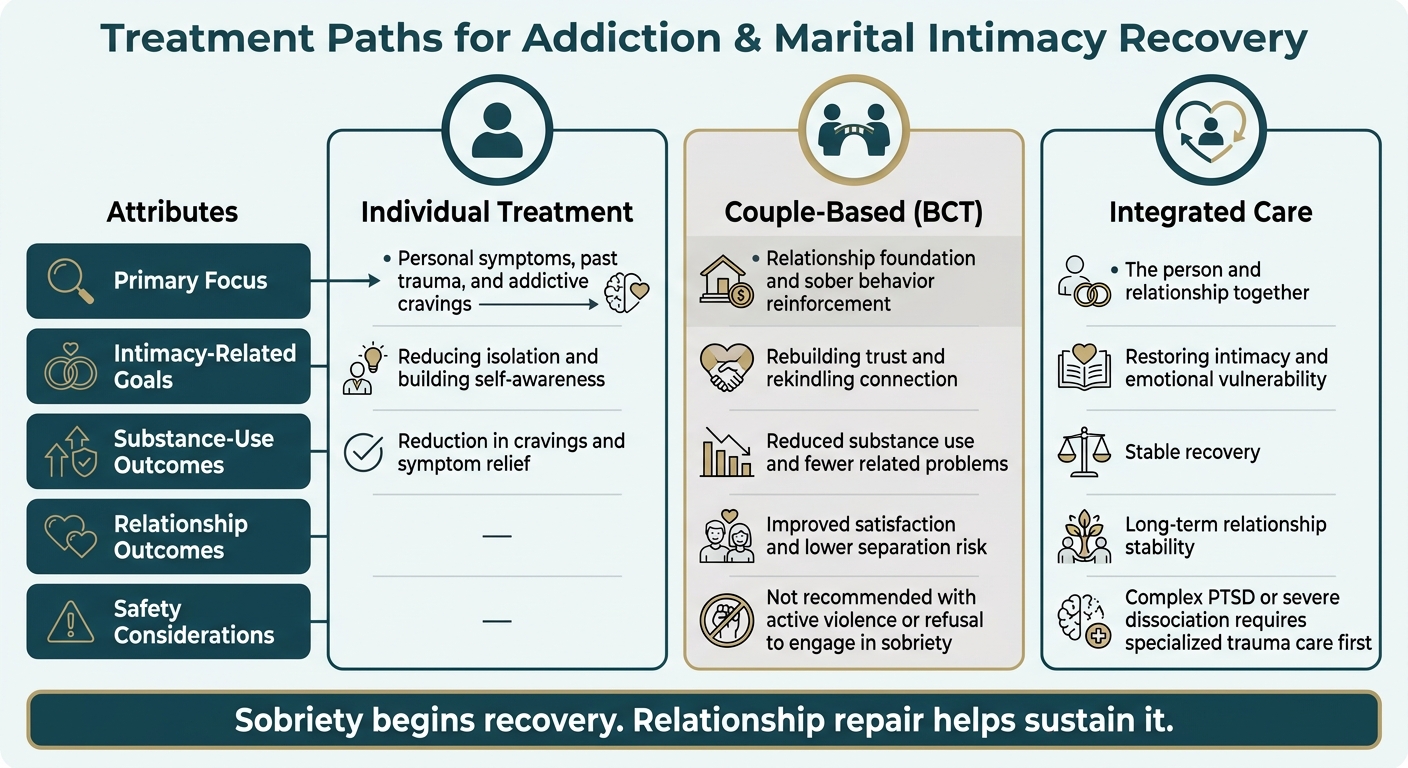
These treatment paths focus on different parts of recovery. Some center on the individual. Others bring the relationship into the work. The table below shows how each model supports recovery and intimacy in its own way.
| Treatment Type | Primary Focus | Intimacy-Related Goals | Substance-Use Outcomes | Relationship Outcomes | Situations Requiring Safeguards |
|---|---|---|---|---|---|
| Individual Treatment | Personal symptoms, past trauma, and addictive cravings [2] | Reducing isolation and building self-awareness [2] | Reduction in addictive cravings and symptom relief [3] | – | – |
| Couple-Based (BCT) | Relationship foundation and sober behavior reinforcement [1] | Rebuilding trust and rekindling connection [1] | Reduced substance use and fewer related problems [1] | Improved satisfaction and lower separation risk [1] | Active violence or refusal to engage in sobriety [2] |
| Integrated Care | The person and relationship together [2] | Restoring intimacy and emotional vulnerability [3] | Stable recovery [3] | Long-term relationship stability [2] | Complex PTSD or severe dissociation requiring specialized trauma care [2] |
When Professional Support Should Be More Structured
Some couples need more than a weekly therapy session to steady recovery and repair the marriage. If addiction has pushed the relationship into serious distress, a coordinated plan with individual, medical, and couple-focused care is often needed [3].
Growth and Change Counseling provides this type of integrated support, including The Marriage Rescue Institute, a directive 12-week couples coaching process for marriages in serious distress [1][2].
If there are safety risks, severe trauma, or major instability, individual and medical care should come first. Couples work can be added later, once things are more stable [2][3].
Conclusion: What Couples Can Reasonably Take From the Evidence
Taken together, the research points to a clear pattern: substance use wears down trust, communication, emotional closeness, and physical connection. That said, the effect isn’t the same in every relationship. It shifts based on the substance involved, how severe the use is, whether safety is a concern, and whether both partners take part in treatment.
Short-term studies show something painful but easy to recognize: people often pull away because, in the moment, connection feels harder than being alone.
Sobriety begins the recovery process. Relationship repair helps keep it going. That’s where structured couples work can make a difference.
structured couple-based work can help some couples rebuild trust, communication, and closeness.
Key Takeaways
For couples, intimacy comes back through steady repair, not sobriety by itself. Addiction can wear down the emotional, communicative, and relational parts of a marriage long before either partner fully sees it. And recovery doesn’t automatically fix that damage. Trust, communication, and closeness need direct effort. When both partners are willing to do the work, structured couple-based support can help.
FAQs
Can a marriage heal after addiction?
Yes. A marriage can heal after addiction. But addiction often hits trust, emotional closeness, and day-to-day communication hard. Repair takes time, patience, shared effort, and help from a trained professional.
Growth and Change Counseling helps couples in crisis through The Marriage Rescue Institute, a directive 12-week process built to restore and rebuild a marriage.
How long does it take to rebuild trust?
Rebuilding trust takes time. There’s no one-size-fits-all schedule, and no couple moves through it at the exact same pace.
What matters most is patience, steady effort, and complete transparency. Trust usually comes back bit by bit, not all at once.
Growth and Change Counseling offers a structured 12-week Marriage Rescue Institute program built to help couples reconnect and rebuild trust.
Research also suggests that 3 to 9 months of individual therapy before starting recovery work together can help. That time can give each person space to heal, set healthy boundaries, and work through the root causes of addiction.
When is couples therapy not appropriate?
Couples therapy may be a poor fit when a marriage is in crisis, especially if it depends only on standard weekly sessions. Research suggests those sessions have a success rate of about 7%.
In tougher cases, the usual once-a-week model often isn’t enough. That can include situations like separation, betrayal, addiction, or toxic conflict. In those moments, a more structured, intensive approach may make more sense.
Growth and Change Counseling offers that kind of support through the Marriage Rescue Institute, a 12-week coaching program.
Related Blog Posts
- How Addiction Impacts Marital Stability
- Addiction Recovery and Emotional Connection in Marriage
- Study: Effects of Porn Addiction on Marriage and Recovery
- How Addiction Impacts Communication in Marriage
