Addiction often changes a marriage long before a couple talks about treatment. In many cases, it shows up as silence, repeated fights, broken trust, checking behaviors, and less emotional presence at home.
Here’s the short version:
- Some couples shut down: one or both spouses stop sharing, avoid hard talks, or go quiet.
- Some couples fight more: trust drops, anger builds, and the same arguments repeat.
- Home life can affect recovery: research linked lower conflict and better communication with a better setting for recovery, even though one spouse cannot control the other’s sobriety.
- Words alone usually don’t fix it: couples often also need to deal with anger, trauma, betrayal, or fear.
- Couples therapy can help: studies in the article point to approaches like Behavioral Couples Therapy, EFT, and 12-week couple programs.
- Safety comes first: if there is violence, coercion, acute withdrawal, severe intoxication, or psychiatric crisis, joint sessions may need to wait.
One clear theme runs through the research: addiction often pulls marriage communication toward either withdrawal or conflict. Instead of calm, open talks, couples may end up with avoidance, mistrust, and constant tension. No conflict is not always a good sign; sometimes it means the relationship has gone emotionally quiet.
A few key facts from the article stand out:
- Studies reviewed reported gains in relationship skills, closeness, and trust repair in couple-based treatment programs.[1][2]
- The article also notes that unresolved anger, trauma, and broken trust can slow recovery and strain the marriage.[2][3]
- For some couples, a structured 12-week process may fit better than unplanned talks at home.[2]
Bottom line: if addiction is hurting the way you and your spouse talk, listen, or react, the issue is usually bigger than “poor communication.” It often involves fear, betrayal, and disconnection too. This article explains how those patterns show up, what research says about recovery at home, and when couple work should start only after safety and stability are in place.
Couples Therapy for Addictions: A Cognitive-Behavioral Approach
sbb-itb-596b85d
How Addiction Changes Communication in Marriage
In marriage, addiction often shows up in one of two ways: withdrawal or escalation. It changes how both spouses talk, listen, and react to each other. And it usually doesn’t happen all at once. These patterns tend to build little by little as the relationship gets harder to carry.
Avoidance, Withdrawal, and Reduced Emotional Availability
A common pattern is withdrawal. As addiction takes hold, the person struggling may start pulling back from the relationship because closeness can feel too painful. That distance creates a gap between spouses. Instead of open conversation, the marriage starts to run on detachment. After a while, hard topics may get avoided altogether.
No conflict can point to emotional shutdown, not peace. When concerns stay unspoken, honesty and closeness begin to wear down.
Escalating Conflict, Distrust, and Monitoring Behaviors
If withdrawal isn’t the main pattern, conflict often is. In some marriages, addiction leads to more frequent arguments and defensive exchanges. Repeated betrayal, broken promises, and fear of being hurt again can push the non-addicted spouse into checking behaviors. That response makes sense, but it often adds more tension instead of easing it. It doesn’t fix the deeper issue.
Betrayal and repeated broken promises also leave anger sitting just under the surface. When that anger isn’t dealt with, couples can get stuck in the same fights again and again instead of moving toward repair.
Common patterns include:
- Withdrawal
- Avoidance
- Betrayal
- Defensiveness
- Anger
- Intrusive focus on the addiction
That’s why communication becomes a main focus in recovery.
What Studies Show About Marriage, Recovery, and Relapse Risk
The way a couple talks at home can shape what recovery feels like day to day. Withdrawal and conflict don’t just wear down closeness. They can also make recovery harder to maintain. Research links healthier communication and less conflict at home with better conditions for recovery, though sobriety still belongs to the person in treatment. That matters because communication skills aren’t only for moments of crisis. In marriage, communication becomes part of the recovery setting itself. A spouse can’t control sobriety, but the marriage does shape the home life around it.
Relationship Strain and Treatment Outcomes
When communication starts to fall apart, couples often report lower relationship satisfaction. That can make recovery harder, especially when home feels more stressful than supportive.[3] And when isolation takes the place of connection, unresolved anger, trauma, or broken trust can slow recovery down.[3]
Why Communication Matters During Recovery
Constructive communication can help rebuild trust and intimacy, but it tends to work best when couples also deal with unresolved anger, trauma, or broken trust.[2] Put simply, better words alone usually aren’t enough. Lasting recovery often means dealing with the deeper sources of strain, not just the way strain shows up in conversation. When trust, safety, and honesty start to come back, communication gains a firmer place to land.
The next section looks at couple-based interventions that teach those skills.
Couples Interventions Studied for Addiction-Affected Marriages
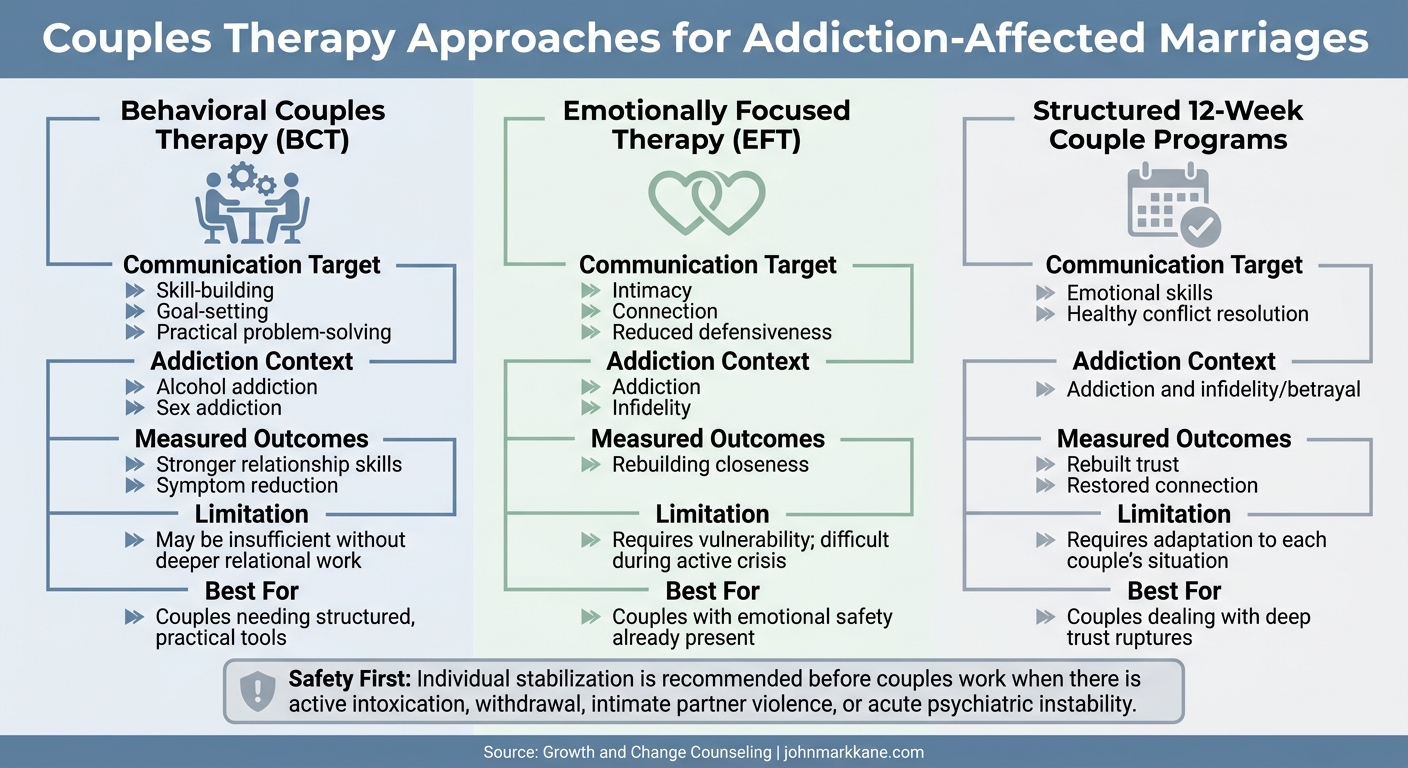
Couples Therapy Approaches for Addiction-Affected Marriages
When communication habits are deeply set, studies often look at structured therapy models that help couples learn new ways to talk and handle conflict while repairing trust.
Behavioral Couples Therapy and Communication Skills Training
Behavioral couples therapy focuses on communication, goal-setting, and day-to-day problem-solving. Put simply, it helps couples work as a team instead of getting stuck in the same painful loop.
In the studies summarized here, these programs were used with couples dealing with alcohol addiction and sex addiction. Reported outcomes included stronger relationship skills and a drop in symptoms. [1]
Other Couple-Based Approaches and Their Evidence Limits
Emotionally Focused Therapy (EFT) is aimed at increasing intimacy and connection while reducing the defensiveness that gets in the way of closeness. In the studies summarized here, EFT was used with couples facing addiction and infidelity, and outcomes included rebuilding closeness. [1]
That said, EFT asks a lot from both people emotionally. If a couple is still in active crisis, that level of openness can be tough to reach, which may limit how well the approach fits at that stage. [1]
Structured 12-week couple programs blend emotional skills with conflict-resolution training to help rebuild trust after addiction and betrayal. These programs go straight at defensiveness, distrust, and repeated conflict – the kinds of communication problems that keep couples stuck for months or even years. The evidence suggests they can help restore connection when the treatment matches the couple’s specific situation. [2]
The main approaches differ in what they aim to change and how much emotional safety they need before the work can begin.
| Intervention | Communication Target | Addiction Context Studied | Measured Outcomes | Limitations |
|---|---|---|---|---|
| Behavioral Couples Therapy and Communication Skills Training | Skill-building, goal-setting, and practical problem-solving | Alcohol addiction, sex addiction [1] | Stronger relationship skills and symptom reduction [1] | May be insufficient without deeper relational work |
| Emotionally Focused Therapy (EFT) | Intimacy, connection, and reduced defensiveness | Addiction, infidelity [1] | Rebuilding closeness [1] | Requires vulnerability; difficult during active crisis |
| Structured 12-Week Couple Programs | Emotional skills and healthy conflict resolution | Addiction and infidelity/betrayal [2] | Rebuilt trust and restored connection [2] | Requires adaptation to each couple’s situation |
When trust is shaky or conflict is still active, timing and structure can matter just as much as the therapy model itself.
Safety, Clinical Guidance, and Next Steps for California Couples
Research points to real gains from couples communication work. But safety and stability come first. If a couple starts this kind of work too early, conflict can get worse instead of better.
When to Delay or Carefully Structure Couples Work
Some cases need individual stabilization before any couples sessions begin. If one partner is severely intoxicated, in acute withdrawal, or dealing with acute psychiatric instability, joint sessions usually aren’t a safe or useful starting point. The same goes for a history of intimate partner violence, coercive control, or a real risk of retaliation. In those cases, safety planning and individual support need to come first.
The same principle applies when trauma or rage is active. Joint communication work only helps when both people are steady enough to listen, respond, and repair. If trauma, rage, or compulsive behavior is still driving the relationship, treat that first. Trauma-focused or anger-focused care may need to happen before couples work begins.
A clinical assessment helps sort this out. It can show whether individual therapy, couples work, or both should start first.
Clinical Support Through Growth and Change Counseling
When a couple needs more structure, the next move is a clear clinical plan.
Growth and Change Counseling provides couples, family, and individual therapy for addiction and trauma in Campbell, San Jose, Los Angeles, and Roseville, with telehealth across California. [1] For marriages under strain from addiction or infidelity, the practice’s Marriage Rescue Institute offers a directive 12-week couples coaching process focused on repairing communication and trust. [2]
"Healing isn’t just about addressing symptoms – it’s about changing the relationship’s foundation." – Marriage Rescue Institute | Growth and Change Counseling [2]
Couples can begin with a consultation to figure out the safest next step.
FAQs
How can I tell if our marriage is in withdrawal or conflict mode?
You may start to see the same unhelpful patterns pop up again and again. Over time, they can create emotional distance and make even small issues feel heavy.
Some of the most common signs are criticism, contempt, stonewalling, and blame. These often show up as circular arguments, tense silence, or one person shutting down while the other keeps pushing.
Secrecy, emotional distance, or a sense of betrayal can also signal a pattern of pulling away. Growth and Change Counseling can help couples spot these cycles and start rebuilding intimacy.
Can couples therapy help if trust has been broken by addiction?
Yes. Couples therapy can help rebuild trust after addiction. It gives both partners a safe, nonjudgmental space to talk through deeper issues, like trauma, anger, and unhealthy patterns that may have built up over time.
With structured support, couples can work on active listening, empathy, transparency, accountability, and clearer communication. Those skills matter because they help restore emotional safety and create more stability in the relationship over time.
When is it unsafe to start couples counseling for addiction?
The available materials don’t point to specific cases where starting couples counseling for addiction would be unsafe.
What they do stress is the role of professional support. A trained provider can help couples move through recovery, rebuild trust, and talk more openly without the conversation going off the rails.
In severe or crisis situations, getting professional guidance is encouraged to help create a safe setting for healing.
Related Blog Posts
- Addiction Recovery and Marriage Communication
- How Addiction Impacts Marital Stability
- Ultimate Guide to Couples Communication in Addiction Recovery
- Addiction Recovery and Marriage: What Works
