Porn use can damage a marriage fast – especially when ADHD or autism is part of the picture. In this article, I explain the core issue in plain language: porn use can break trust, weaken attachment, and make sex feel distant or scripted. Neurodivergent traits may increase risk, but they do not remove the harm.
Here’s the short version:
- Porn can shift intimacy from shared connection to private escape
- Secrecy often hurts as much as the sexual behavior itself
- ADHD and autism can increase risk through impulsivity, reward-seeking, sensory overload, and a need for control
- Mixed-neurology couples often feel the damage in different ways
- Recovery must deal with 3 parts at once: porn use, betrayal, and the relationship
- Structure helps: written agreements, simple check-ins, and low-pressure touch routines
A few points stand out:
- Research cited in the article notes that nearly one-third of spouses report major concern or conflict over a partner’s pornography use
- Compulsive porn use is linked to lower relationship satisfaction, loneliness, and less emotional and physical closeness
- In many couples, the damage follows a clear path: trust breaks first, then attachment, then sexual connection
Porn & Sex Addiction, Sexuality & Autism with Candice Christiansen
sbb-itb-596b85d
Quick Comparison
| Area | Healthy Intimacy | Porn-Driven Pattern |
|---|---|---|
| Focus | Shared and partner-centered | Private and self-focused |
| Emotional tone | Open and present | Hidden and shut down (often due to missed emotional cues) |
| Sexual pattern | Flexible and mutual | Scripted and controlled |
| Effect on marriage | Builds closeness | Adds distance, shame, and hurt |
If you want the plain answer, it’s this: porn is not neutral in marriage. In neurodiverse couples, it can be harder to spot, harder to talk about, and harder to repair without clear support for mental health issues. I wrote this guide to show what the damage looks like, why it can hit these couples harder, and what steps can help them reconnect.
What Porn Addiction Looks Like Inside a Committed Relationship
In a committed relationship, porn can turn into a private stand-in for closeness with a partner. When use moves from occasional to compulsive, a few signs usually show up: loss of control, secrecy, escalation, and continued use even when it harms the marriage.
Loss of control can be simple to spot. A person means to watch for a few minutes, then an hour or more disappears, and stopping feels hard[2]. Secrecy often comes next. The person using porn may pull back emotionally and start choosing solo sexual activity instead of shared intimacy. As time goes on, tolerance can build. Material that once felt stimulating no longer has the same effect, so use shifts toward more intense or more novel content. Shame can keep the loop going: stress leads to porn use, porn use brings shame, and shame pushes the person back to porn again[2]. For a spouse, this often feels like being replaced, pushed aside, or left alone in the relationship[2][1].
Compulsive porn use is linked to lower relationship satisfaction, emotional insecurity, loneliness, and withheld emotional and physical closeness[1][7]. In plain terms, it doesn’t stay a private habit for long. It spills into the marriage.
How Porn-Driven Behavior Differs from Healthy Sexual Intimacy
Healthy sexual intimacy is mutual, emotionally present, and centered on both partners. Porn-driven behavior tends to be self-focused, hidden, and shaped by performance. The contrast is easier to see side by side.
| Feature | Healthy Sexual Intimacy | Porn-Driven Behavior |
|---|---|---|
| Focus | Partner-centered and mutual | Self-focused and solitary |
| Emotional state | Vulnerable and emotionally safe | Secretive and emotionally shut down |
| Pattern | Dynamic and unpredictable | Scripted, controlled, and predictable |
| Role | Active, attuned participant | Detached observer |
| Goal | Emotional bonding and connection | Performance-driven or dopamine-seeking |
| Expectation | Realistic, based on the actual partner | Distorted by unrealistic sexual scripts |
One of the hardest changes is the shift from participant to observer[1]. That learned pattern doesn’t stay locked away in private use. It can follow a person into the marriage bed, where real intimacy may start to feel less stimulating or more anxiety-provoking[2].
Why Pornography Is Harmful, Not Neutral
Repeated exposure to high-intensity digital stimulation trains the brain to react to narrow, scripted visual cues. Real-life intimacy is different. It’s messy, human, and not fully under anyone’s control. Because of that, it can start to feel less stimulating or even anxiety-provoking[2].
"Pornography, in contrast, is scripted, controlled, and predictable… This conditioning can make real-life sexual intimacy feel comparatively less stimulating or more anxiety-provoking." [2]
Pornography can train objectification, reduce empathy, and swap partner-centered intimacy for unrealistic sexual scripts. In neurodiverse relationships, those patterns may be even harder to spot and harder to repair.
Why Neurodiverse Couples Face Greater Risk and Deeper Pain
Neurodiverse couples include marriages in which one or both partners are autistic, have ADHD, or share another neurodevelopmental profile [6]. These conditions affect how a person handles sensory input, reads emotional signals, and communicates needs. That doesn’t make porn less harmful. If anything, it can make the damage to intimacy hit harder. It can also make porn feel simpler and more manageable than sex, closeness, or emotional openness with a spouse.
Real intimacy asks a lot from anyone. For a neurodiverse partner, it can ask even more: reading nonverbal cues, handling touch that may feel unpredictable, dealing with performance pressure, and staying emotionally present at the same time. When porn turns into the go-to coping habit, the marriage starts to lose honesty, shared desire, and emotional safety.
How Autism and ADHD Can Increase Vulnerability to Compulsive Porn Use
Differences in dopamine regulation matter here. Autistic and ADHD brains often handle reward in a different way, and pornography offers instant access, endless novelty, and a fast reward loop that can strengthen compulsive use [2][3]. Sensory processing can add to the problem. Some autistic people experience a partner’s touch or emotional intensity as overwhelming [3][1], and porn can become a controlled outlet that avoids that discomfort. ADHD-related executive function struggles can push the risk higher, too. Impulsivity and time blindness can turn a short check-in into hours of use before the person even notices what happened [2].
| Vulnerability Factor | How It Can Increase Porn Use |
|---|---|
| Reward-seeking and reduced stopping control | High-stimulation novelty is immediately reinforcing, and impulsivity makes sessions hard to end once started |
| Avoidance of overwhelm and exposure | Porn offers a controlled sensory outlet and removes the risk of unpredictable touch, rejection, or performance pressure |
| Rigid routines / predictability preference | Porn is private and easier to control than partnered sex |
Explanation isn’t excuse. Neurology may help explain the pull toward porn, but it does not justify the harm.
How Mixed-Neurology Marriages Experience Porn-Related Betrayal
The pain often gets worse when one spouse sees the behavior as betrayal and the other sees it as a private coping habit.
In a mixed-neurology marriage – where one partner is neurotypical (NT) and the other is neurodivergent (ND) – the NT partner often feels porn use as abandonment or rejection. The ND partner, meanwhile, may honestly not grasp the emotional weight of what happened. Traits such as alexithymia and concrete thinking can make it hard to see how devastating secrecy feels to a spouse [1]. That doesn’t mean the ND partner doesn’t care. But the effect on the NT partner is still the same: hurt, rejection, and distance, while the ND partner struggles to fully register why.
Nearly one-third of spouses report major concern or conflict over a partner’s pornography use [8]. In neurodiverse marriages, that conflict is made worse by the communication gap itself: the NT partner is in pain, the ND partner underreads the impact, and both keep drifting farther apart. That’s why recovery has to deal with both the addiction and the breakdown in communication it creates.
How Porn Addiction Breaks Trust, Attachment, and Sexual Connection
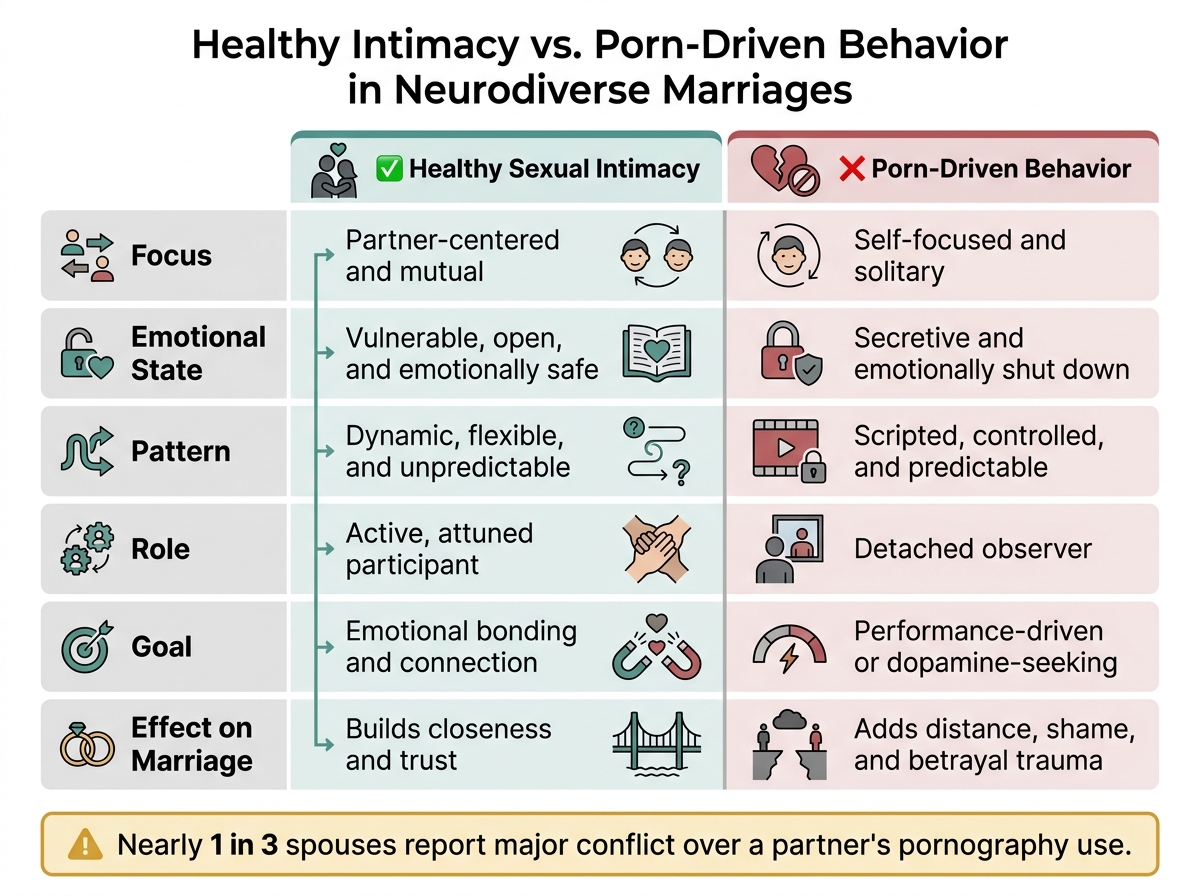
Healthy Intimacy vs. Porn-Driven Behavior in Neurodiverse Marriages
Porn addiction doesn’t just affect one person. It hits the marriage itself. Trust starts to wear down, safety feels shaky, and closeness gets thinner. It often starts with secrecy and turns into withdrawal. In many marriages, the first signs are hidden behavior and then a slow drift into emotional distance.
Secrecy, Betrayal Trauma, and Emotional Distance
Hidden browser history, broken promises to stop, and excuses for avoiding intimacy all make the gap between spouses bigger. After a while, the spouse on the other end may no longer feel like a partner. They may feel pushed outside the marriage.
For the partner who finds the porn use, the shock can feel like betrayal trauma. Hypervigilance and a deep loss of safety are common responses.
In neurodiverse marriages, sensory discomfort or blunt communication can land like rejection, even when that wasn’t the intent.
Porn stops being “private” once it enters a marriage. It becomes a shared problem. And when trust breaks, sexual expectations often change with it.
Distorted Sexual Expectations and Intimacy Problems
The same pattern that keeps porn hidden can also reshape desire. Frequent porn use can train the brain to respond to high-intensity, novel, and fully controlled stimulation. Real intimacy is slower, less predictable, and more emotionally demanding. Because of that, it can start to feel harder to enter into.
That shift can move one partner into observer mode instead of shared intimacy. It’s a bit like watching life through glass instead of stepping into it. In neurodiverse relationships, where attachment signals may already be harder to send and read, that observer mindset can make an already painful gap feel even bigger.
The table below shows how mutual intimacy and compulsive porn use differ in practice:
| Feature | Mutual Intimacy | Porn-Driven Behavior |
|---|---|---|
| Role | Active participant in a shared experience | Detached observer of a scripted scene |
| Emotional State | Vulnerable, present, and attuned to partner | Numb |
| Relational Impact | Builds trust and security | Increases secrecy, shame, and betrayal |
The result is emotional distance: one partner stays present, while the other checks out. Recovery through couples therapy or self-healing has to address both sides of the problem – the secrecy and the sexual conditioning.
Recovery and Reconnection for Neurodiverse Couples
Recovery in a neurodiverse marriage has to deal with three things at once: addiction, betrayal, and the relationship itself. If one part gets ignored, the others stay exposed [2][6]. In plain terms, recovery isn’t just about stopping porn use. It also has to rebuild trust and physical closeness.
Treatment Steps That Address Addiction and Betrayal Together
The addicted partner needs individual therapy that goes past sheer willpower. For many neurodiverse people, compulsive porn use can act like a form of regulation because it feels scripted, predictable, and under control. So treatment has to work on dopamine regulation and reward pathways, not just the outward behavior. A time-limited break from pornography can help reset reward pathways and improve responsiveness to real intimacy [2][3][4].
The betrayed partner needs trauma-informed support too. Betrayal trauma is real. It needs to be named clearly and validated without downplaying it [2][1].
For couples in crisis, Growth and Change Counseling offers The Marriage Rescue Institute, a directive 12-week couples coaching process for marriage repair [5]. That kind of structure and accountability can help when trust has been badly damaged.
Neurodiversity-Tailored Tools for Rebuilding Porn-Free Intimacy
Neurodiverse couples often do better with structure. That means recovery should be concrete, sensory-aware, and predictable. Generic recovery talk can fall flat here. Practical tools tend to work better.
| Treatment Element | Generic Treatment | Neurodiversity-Tailored Treatment |
|---|---|---|
| Core Focus | Willpower and sobriety [2][5] | Nervous system regulation and dopamine management [2][3] |
| Communication | Abstract emotional sharing [6] | Concrete scripts, visual aids, and "I" statements [6] |
| Intimacy Goal | Spontaneous reconnection [6] | Structured, sensory-aware routines [6][9] |
| Accountability | Shame-based or rigid rules [2] | Executive function supports and nonpunitive agreements [6] |
| Sensory Needs | Often ignored [6] | Explicitly mapped (lighting, texture, scent) [6][1] |
The aim is not abstinence alone. The aim is a marriage that can reconnect sexually in a way that feels safe.
That usually means putting recovery in writing. Written agreements with collaborative, non-punitive language help both partners stay out of a parent-child dynamic. Visual schedules and shared checklists can support accountability without nonstop verbal reminders.
It also helps to replace vague intimacy goals with scheduled, low-pressure touch sessions. A simple example is 30–60 minutes of low-pressure touch with no performance goal. Sensate Focus exercises fit well here because they use structured, mindful touch without goal-driven pressure [2][6].
Communication needs structure too. Daily check-ins built around simple "I" statements can lower the mental strain of emotional talks. Pleasure maps and yes/no/maybe lists can make boundaries clearer and reduce anxiety for both partners [6].
Conclusion: What Healing Requires Now
Once the addiction and betrayal are named, the next step is restoring safety, then intimacy. Healing takes full honesty, steady accountability, and support shaped for neurodiverse couples. Porn use is toxic in marriage, and secrecy damages trust. Couples who commit to that work, with the right structure behind them, can rebuild trust and real intimacy. The damage is real, and so is the ability to heal.
Understanding Porn’s Impact with Growth and Change Counseling
How do I know if porn use is compulsive?
Compulsive porn use often comes down to loss of control. You try to stop or cut back, but keep falling into the same pattern, even when it hurts your relationship, affects your work, or chips away at your self-esteem.
It can also show up in other ways. You may feel pulled to watch more often, or seek out more intense material over time. Some people feel upset, restless, or on edge when they can’t engage. Others use porn as an escape hatch for stress, loneliness, or emotional pain, only to end up feeling shame afterward, which can feed the cycle and make things harder to regulate.
Why can porn hurt neurodiverse couples more deeply?
In neurodiverse couples, pornography can hit even harder. It can turn into an unhealthy coping habit for sensory differences, social anxiety, or trouble managing emotions. For an autistic partner, it may feel more predictable and easier to control than intimacy with a real person.
Over time, that pullback can start a cycle of disconnection. It gets harder to notice and respond to a spouse’s actual emotional and physical cues. And for the neurotypical partner, the hurt often cuts deep, bringing a sense of betrayal and the feeling of being replaced.
What should recovery focus on first?
Recovery should begin with two separate injuries in view.
The first is the addiction itself: the brain-based habits and repeated behaviors that keep the cycle going.
The second is the partner’s trauma: the damage to trust, safety, and attachment inside the relationship.
That’s why recovery has to work on two tracks at once. One track is personal healing. The other is repairing the bond between partners.
It also needs to deal with the emotional and sensory needs that can set off compulsive use.
Related Blog Posts
- OCD and Emotional Intimacy in Neurodiverse Couples
- Trauma, Addiction, and Neurodiverse Relationships
- Study: Trust Dynamics in Neurodiverse Relationships
- Study: Effects of Porn Addiction on Marriage and Recovery
