Codependency relapse often starts small: more anxiety, weaker boundaries, less self-care, and pulling away from support. If I notice 3 or more signs at once, that’s my cue to stop, name the pattern, and take one small step before it grows.
Here’s the short version:
- Emotional signs: guilt, fear of rejection, low self-worth, feeling okay only when someone else is okay
- Relationship signs: people-pleasing, saying yes when I mean no, fixing, rescuing, avoiding conflict
- Daily life signs: skipped meals, poor sleep, lost hobbies, missed therapy, isolation
- Body signs: tight chest, clenched jaw, dropped stomach before I respond
- Next step: pause, reset one boundary, and reconnect with support
About 1 in 3 U.S. adults say they have trouble setting healthy boundaries in close relationships in some form, and stress tends to make that worse. That’s why a simple checklist can help: it gives me a fast way to catch old habits early.
| Area | Common warning signs | What I can do right away |
|---|---|---|
| Emotions | Anxiety, guilt, fear, over-responsibility | Name the feeling out loud |
| Boundaries | Saying yes, apologizing too much, resentment | Use: “Let me get back to you.” |
| Behavior | Fixing, rescuing, mood-tracking | Ask: “Is this my job?” |
| Self-care | Missed meals, poor sleep, no downtime | Do a H.A.L.T. check |
| Support | Canceled plans, missed meetings, hiding stress | Text or call one safe person |
Bottom line: this checklist is not for labeling myself. It’s for catching drift early and getting back on track with clearer limits, better self-care, and support.
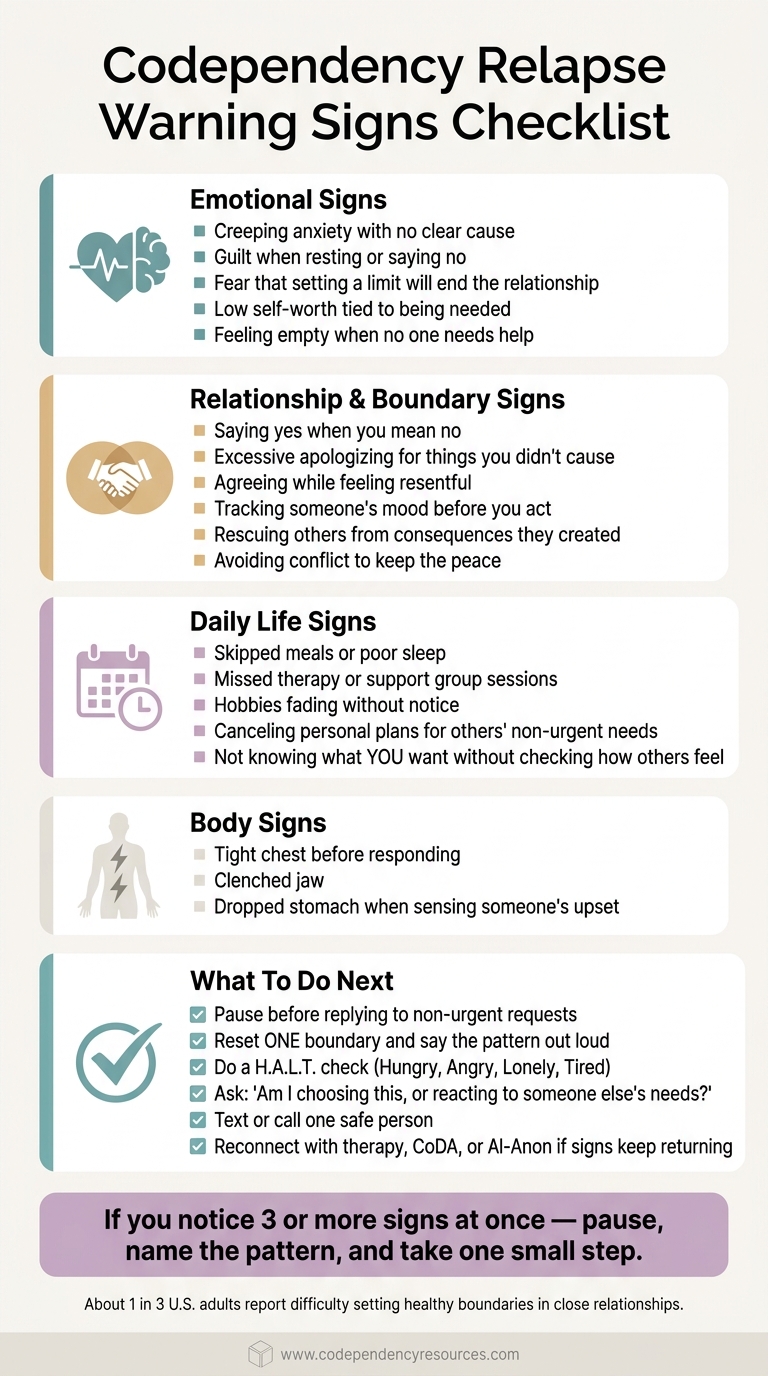
Codependency Relapse Warning Signs Checklist
10 Tips to Prevent Codependency Relapse - Growth and Change Counseling
sbb-itb-596b85d
Emotional Warning Signs to Check First
Start here. This section helps you spot the inner shifts that often show up before boundaries start to slip. In many cases, these signals appear before anyone else sees a change in how you act.
Anxiety, Guilt, and Fear of Rejection
One of the first signs is often a low, creeping anxiety that doesn’t seem tied to one clear reason. You may feel on edge when you haven’t heard from someone. Or tense up the second you sense they’re upset. That points to emotional dependence, not plain everyday worry. And it often comes right before people-pleasing or over-functioning.
Check in with yourself and see if any of these fit:
- Feeling anxious when you can’t reach or check on someone you’re worried about
- Guilt when you rest, take time for yourself, or say no to a request
- Fear that setting a limit will cost you the relationship entirely
If saying no feels impossible, don’t brush it off as “just how I am.” Treat it like a warning light on the dashboard. Once that fear starts steering your choices, over-responsibility usually isn’t far behind.
Low Self-Worth and Over-Responsibility
This pattern often looks quiet on the outside. Inside, though, it can feel like your worth depends on being useful, available, or the one who holds it together. If nobody needs help, you may feel empty or restless. If someone is struggling, you may feel like it’s on you to fix it.
A simple responsibility check can help bring this into focus. Write down what you’re doing for other people, then ask yourself, "Is this actually my job, or am I doing it out of fear?" If fear is driving most of those choices, that’s a clear warning sign to pay attention to before it starts shaping your behavior even more.
These feelings often show up next as people-pleasing and weak boundaries.
Relationship and Boundary Warning Signs
These warning signs tend to show up in your closest relationships first. When another person’s comfort keeps coming before your own needs, your boundaries can start to wear down.
People-Pleasing and Difficulty Saying No
This isn’t just about saying yes. It’s about saying yes because you want to avoid discomfort, tension, or disapproval.
A few patterns to watch for:
- Agreeing while resentful – saying yes when you’re already stretched thin, then quietly resenting the person for asking
- Excessive apologizing – saying "I’m sorry" for things you didn’t cause or couldn’t control
- Defaulting to someone else’s view rather than holding your own
- Canceling personal plans to accommodate someone else’s non-urgent needs
One simple way to slow this down is to pause before you agree. Try: "Let me check and get back to you."
When this pattern gets stronger, it can move past approval-seeking and turn into control, rescue, or silence.
Controlling, Fixing, and Avoiding Conflict
Healthy support respects another person’s ability to choose. Codependent fixing tries to manage the outcome.
Relapse here often looks like:
- Tracking someone’s mood before you act
- Rescuing them from consequences they created
- Avoiding needed conflict to keep the peace
Healthy care leaves room for another person’s choices. Codependency tries to control the result.
And this doesn’t just happen in big fights or high-stakes moments. It often shows up in the small stuff, in the day-to-day exchanges that slowly shape a relationship.
Weak Boundaries in Daily Interactions
Weak boundaries don’t always look dramatic. More often, they show up in ordinary moments: dropping what you’re doing to reply to a non-urgent text right away, feeling pulled to answer every call or message at once, or getting uneasy when someone feels disappointed by a completely reasonable limit.
Tracking someone’s mood so you can decide how to feel or act is another quiet sign that your boundaries may be slipping.
Weak boundaries often come with no clear opinion, no clear limit, and no ability to say no without distress.
Pay attention to your body. A tight chest, a dropped stomach, or a clenched jaw before you respond to someone can signal a codependent impulse before your mind even catches it. That physical cue is a stop signal.
When these patterns start showing up across more than one relationship, they often spill into self-neglect and a shrinking support system.
Next, watch for the signs that codependency is spilling into your routines, energy, and support system.
Life-Pattern Warning Signs Outside the Relationship
Codependency relapse doesn’t stay neatly inside a relationship. It can start leaking into the rest of life too. And when emotional stress turns into missed basics and daily self-neglect, that’s a sign the pattern is spreading.
Self-Neglect and Loss of Personal Identity
Sleep slips. Meals get skipped. Appointments get missed. Hobbies fade out without much notice because someone else’s needs are taking up all the room.
One warning sign stands out: you stop knowing what you want unless you first check how someone else might feel about it. Another is making everyday choices based on their possible reaction instead of your own needs or wishes.
Use H.A.L.T. to check whether you are Hungry, Angry, Lonely, or Tired [5]. These four states can make codependent habits much easier to fall back into.
When your own preferences get quieter, your support system often starts getting smaller too.
Isolation and a Shrinking Support System
Isolation usually doesn’t arrive all at once. It builds in small steps. One canceled plan turns into two. Then therapy or support meetings start slipping. Therapy sessions get missed. The people who knew you before this relationship – or before this relapse – slowly drift out of contact.
"When we become increasingly enmeshed in our relationship, we’re no longer connecting with others outside of the relationship." – Dr. Coda Derrig, Clinical Psychologist, Cleveland Clinic [7]
Pay attention if you start hiding stress from the very people who could help. If you’re downplaying how worn out you feel, or dodging honest talks because you don’t want to seem like a burden, your support circle may already be shrinking.
A simple weekly audit can help. Check whether you’ve:
- Canceled personal plans
- Skipped a therapy or support group session
- Avoided an honest conversation with someone you trust
If several of these signs are showing up, it’s time to pause, restore healthy boundaries, and reconnect with support.
What to Do When Several Warning Signs Are Present
When several warning signs show up at the same time, don’t try to fix everything in one shot. Slow down first. The goal is to get honest about what’s happening and take one small step.
Pause, Review Patterns, and Reset Boundaries
Start by resetting one boundary. Say the pattern out loud, then follow it with action. For example: "I agreed too quickly because I was afraid of conflict." [3]
Then give yourself a little space before replying to non-urgent requests. A simple pause phrase can help. Those small delays matter because they rebuild the habit of checking in with yourself first [3][8].
Once a day, ask: "Am I choosing this, or reacting to someone else’s needs?" [8] It sounds simple, but used often, that question can change a lot.
Reconnect with Support and Professional Help
If the pattern keeps coming back, bring in outside support early. Don’t wait until things feel hard to handle. When warning signs start piling up – especially sleep disturbances, losing track of your own needs, or panic attacks – it’s time to reach out [1][6].
Peer support groups like CoDA or Al-Anon offer free support you can return to over time [4]. If the issue runs deeper – especially when childhood dynamics, trauma, or relationship crisis are part of the picture – therapy centered on relationship patterns and attachment can help in a meaningful way [6]. If you need added support, reach out to a therapist trained in relationship patterns and attachment.
Conclusion: Catching Warning Signs Early Makes a Difference
These warning signs often come back quietly, one compromise at a time. Spotting them early – before they slip back into daily life – can be the difference between a short setback and a return to old patterns. Use this checklist on a regular basis, not only during a crisis.
"Responsibility for relationships with others needs to coexist with responsibility to self." – Dr. Renee Exelbert, Licensed Psychologist [2]
FAQs
How do I know if this is codependency or just stress?
It often comes down to your sense of self and your boundaries. Stress is a response to pressure. Codependency is a relationship pattern where your emotional balance and even your identity get wrapped up in another person.
When you’re stressed, you might feel overloaded but still have a clear sense of what you need. With codependency, it’s different. You may feel responsible for someone else’s emotions, panic when you can’t control what happens, and measure your worth by how well you can fix or manage them.
What should I do first if I notice several warning signs?
Start with self-awareness. Notice the pattern without judging yourself. Put a name to it. For example, you might see that you’re setting aside your own needs just to avoid conflict.
From there, look inward and ask what you need. Professional support, such as therapy, can help you work through these patterns too. Growth and Change Counseling offers integrative, solutions-focused support for emotional well-being and relational health.
When should I get professional help for codependency relapse?
Seek professional help if you notice signs of an acute codependent crisis or feel unable to function day to day.
Warning signs can include:
- Stopping therapy or support meetings
- Pulling away from other people for long stretches
- Mood swings that feel out of control
- Using alcohol or medication to get through the day
- Feeling despair, having suicidal thoughts, or going through a major emotional or physical collapse
Growth and Change Counseling offers individual therapy to support emotional well-being across California.
Related Blog Posts
- Boundaries for Addiction Recovery and Healthy Love
- 7 Tips for Supporting a Partner After Relapse
- Codependency Recovery: Steps to Build Healthy Boundaries
- Codependency vs. Healthy Support in Relationships
