Setting boundaries is key to breaking free from codependency. Without clear limits, relationships can become draining, leading to exhaustion and frustration. Boundaries help you protect your well-being, avoid enabling behaviors, and foster mutual respect. Here’s how to start:
- Identify your boundaries: Reflect on your needs and limits in areas like responsibilities, emotions, self-care, and communication. Pay attention to feelings like resentment or anxiety – they’re signs your boundaries might be crossed.
- Communicate clearly: Use “I statements” to express your feelings and set limits without blame. For example, “I feel overwhelmed when plans change last minute.”
- Enforce consistently: Stick to your boundaries even when faced with pushback. Use calm repetition and follow through with outlined consequences.
- Manage guilt and fear: Prioritize self-care and remind yourself that setting boundaries isn’t selfish – it’s necessary for your health.
- Seek support: Therapy can provide tools and guidance to navigate codependency and strengthen your relationships. Working with a marriage therapist can help you apply these principles within your partnership.
Boundaries redefine how you interact with others, ensuring healthier, more balanced connections. Start small, stay consistent, and remember – it’s okay to say “no.”
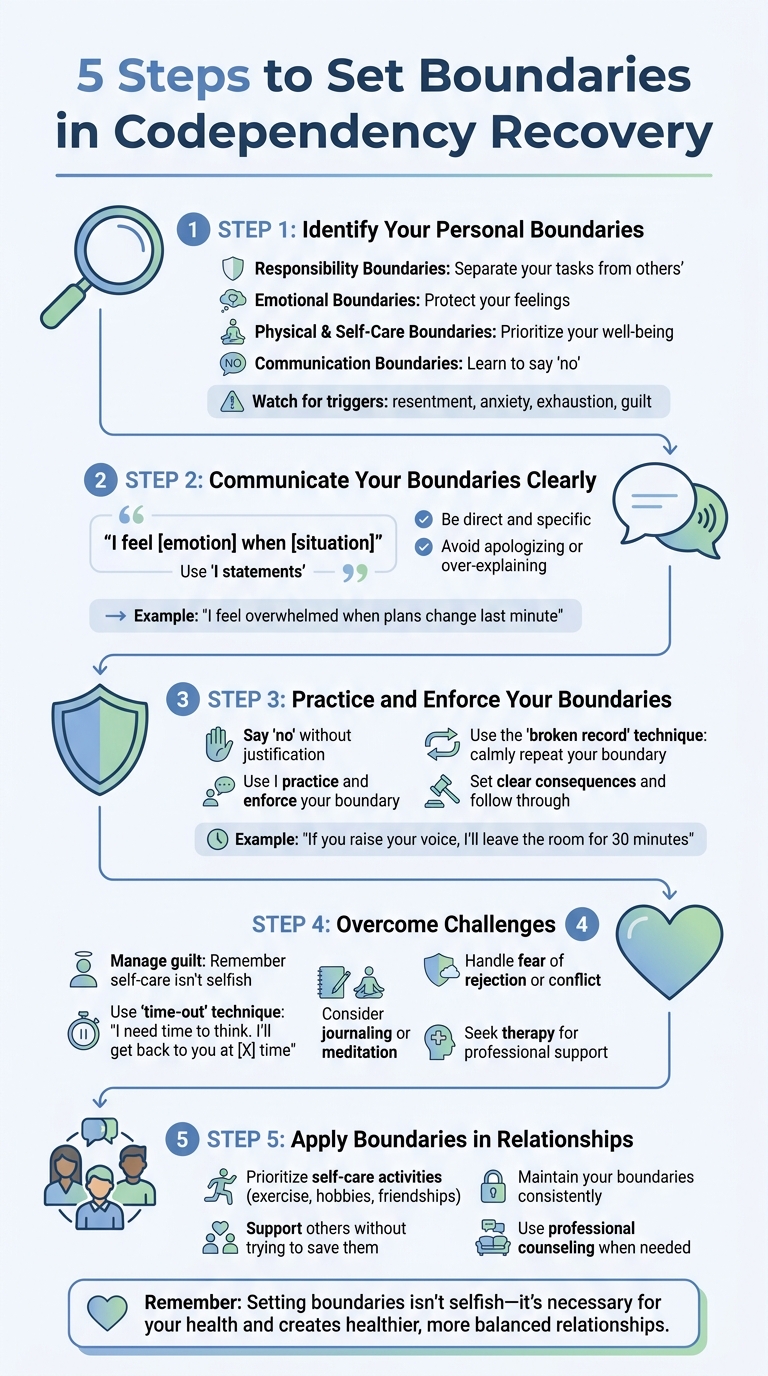
5 Steps to Set Boundaries in Codependency Recovery
7 Boundaries You Need to Feel Safe in Codependency Recovery
sbb-itb-596b85d
Step 1: Identify Your Personal Boundaries
Before you can communicate or enforce boundaries, it’s essential to take a step back and reflect on where your own identity ends and someone else’s begins. In codependent relationships, this line often becomes so blurry that it can be hard to recognize your own needs, preferences, or limits.
Types of Boundaries to Consider
Boundaries exist in many areas of life, and understanding these different types can help you figure out where you need to establish limits:
- Responsibility Boundaries: Separate your responsibilities from others’ so they can deal with the outcomes of their own actions.
- Emotional Boundaries: Protect your feelings and opinions while avoiding the burden of carrying other people’s emotions.
- Physical and Self-Care Boundaries: Dedicate time and energy to your own well-being, whether that’s through exercise, hobbies, rest, or nurturing friendships outside of the codependent dynamic.
- Communication Boundaries: Learn to say "no" firmly and express your true feelings without worrying about jeopardizing the relationship.
Recognize Your Triggers and Needs
Your emotions can act as indicators when boundaries are being crossed. Feelings like resentment, anxiety, exhaustion, or guilt often suggest that you’ve been giving too much or operating in an unbalanced dynamic. Meaghan Rice, PsyD, LPC, suggests that when attachment-related anxiety arises, it’s crucial to focus on your physical health, engage in activities that inspire you, and find comfort in spending time alone.
Take a moment to assess your behavior: Are you overextending yourself by handling tasks that another capable adult should manage? Are you making excuses for someone’s harmful habits or emotional immaturity? A marriage therapist in Roseville CA can help you navigate these complex dynamics. These patterns often point to the need for stronger boundaries.
A helpful tool for this reflection is the "Fruit Test." If your efforts leave you feeling drained or if the other person becomes more entitled, it’s a clear sign that the relationship lacks balance. Reconnect with your personal interests and examine situations that bring dissatisfaction. This process will help you identify where boundaries are being crossed, setting the stage for clearer communication in the next step.
Step 2: Communicate Your Boundaries Clearly
Once you’ve figured out where your boundaries need to be, the next step is expressing them in a way that’s firm yet respectful. This part can feel tricky, especially if you’re worried about conflict or rejection – something that’s common in codependent relationships. But clear communication is what turns your internal awareness into meaningful change.
The trick? Focus on your own feelings and needs instead of pointing fingers or placing blame. Being direct helps reduce misunderstandings and keeps the conversation on track.
Use ‘I Statements’ for Clear Communication
"I statements" are a great way to center the conversation on your experience. For instance, instead of saying, "You always ignore my needs", you could say, "I feel overwhelmed when plans change at the last minute." This approach avoids sounding accusatory and makes it easier for the other person to truly hear you.
Before starting the conversation, take a moment to identify what’s bothering you and what kind of support you need. Then, frame your thoughts using the "I feel" formula: "I feel [emotion] when [situation/behavior]." Follow that with a clear boundary, like, "I am not comfortable with this" or "I need to step away from this situation."
"Setting boundaries is not selfish – it’s an act of self-love and self-care." – Gateway Rehab [5]
Avoid apologizing or overexplaining – just state your boundary. If someone pushes back, stay calm and simply repeat your statement without getting drawn into an argument. Remember, saying "no" is an important way to protect your well-being, and it doesn’t make you a bad person.
Examples of Healthy Boundary Conversations
Putting boundaries into practice means being clear and direct in everyday situations. For example, if you’re too tired to give someone a ride, you might say, "I’m exhausted tonight and can’t drive you. You’ll need to find another way." This shifts the responsibility back to them instead of you stepping in to solve the problem.
Similarly, when someone shares an issue expecting you to fix it, focus on listening instead of jumping in to solve things. You could respond with, "I hear that you’re struggling with this, but I don’t have all the answers. What do you think you might do?" This shows empathy without taking on their responsibilities.
For ongoing behaviors, a structured response can help. Try something like, "If you [behavior], I’ll share my feelings with you. If it continues, I’ll [action] to take care of myself." For instance, "If you raise your voice at me, I’ll let you know it’s not okay. If it continues, I’ll leave the room for 30 minutes to take care of myself" [7]. Adding "to take care of myself" emphasizes that your response is about self-care, not punishment.
The goal here isn’t to control how the other person reacts. Instead, you’re setting clear limits to protect your time, energy, and well-being. Communicating your boundaries this way helps lay the groundwork for consistently enforcing them as you move forward in recovery.
Step 3: Practice and Enforce Your Boundaries
Communicating your boundaries is just the starting point – the real challenge lies in consistently upholding them. For many working through codependency recovery, enforcing boundaries can feel uncomfortable, especially when faced with pushback or guilt. But sticking to your boundaries is what turns them into meaningful safeguards for your well-being. Now that you’ve clarified your limits, it’s time to focus on maintaining them.
Say No and Set Limits
Learning to say "no" is one of the most effective ways to protect your energy and avoid resentment. If you’re feeling drained, a simple "I’m too tired today" is enough. There’s no need to over-explain, justify, or apologize for setting a boundary. It’s important to remember that you are not responsible for how others react – those emotions are theirs to manage [1]. In fact, research shows that couples who communicate their needs openly tend to enjoy greater relationship satisfaction [4].
If you need more time to make a decision, try saying, "I need time to think; I’ll get back to you at [specific time]" [3]. This not only gives you space but also reinforces your control over your choices.
Handle Pushback and Boundary Violations
Once you’ve set boundaries, the next hurdle is standing firm when they’re tested. If someone resists or tries to challenge your limits, stay composed and use the "broken record" technique. This means calmly repeating your boundary until it’s acknowledged [6]. The Hazelden Betty Ford Foundation emphasizes:
"Boundaries only work when you stick to them. You don’t need to explain or apologize" [6].
Clear consequences are key to reinforcing boundaries. When setting a limit, let the other person know what will happen if it’s crossed. For instance, if someone raises their voice during a conversation, you might say, "If this continues, I’ll leave the room for 30 minutes to take care of myself." Following through on these consequences every time is essential [4]. Meaghan Rice, PsyD, LPC, from Talkspace, advises:
"Trust in your decision, and follow through with repercussions" [4].
If resistance continues, consider limiting the time you spend with that person. Rice also suggests exploring new hobbies, diversifying your social circle, or seeking professional support if enforcing boundaries feels overwhelming [4]. These steps can help redirect your focus and strengthen your resolve.
Step 4: Overcome Challenges in Setting Boundaries
Once you’ve started practicing and enforcing boundaries, the next hurdle is dealing with the emotional challenges that come with it. Feelings of guilt and fear often surface, especially during codependency recovery, and they can make sticking to your boundaries feel like an uphill battle. Tackling these emotions head-on is crucial for making progress and maintaining healthier relationships. Let’s dive into how to manage these inner struggles.
Overcome Guilt and Fear
It’s common to feel guilty when prioritizing your own needs, especially if you’ve been conditioned to believe self-care is selfish. The truth? Protecting your well-being is essential for building balanced and healthy relationships [5]. Fear can also creep in – whether it’s fear of rejection, conflict, or losing someone’s approval. In codependent relationships, your sense of worth may have been tied to "fixing" others or avoiding tension at all costs [3]. Setting boundaries disrupts that cycle, which can feel unsettling at first.
Ann Krajewski, PsyD, from Everbe Therapy, offers this perspective:
"Allow yourself to grieve the loss of safety you once got from your codependent patterns. This is part of your growing process" [3].
Practicing self-compassion can help ease these feelings. Remind yourself that saying "no" doesn’t make you a bad person – it’s a step toward reclaiming your emotional health [5]. One practical tool to manage guilt is the "time-out" technique: when someone makes a request, say, "I need some time to think about that. I’ll get back to you at [X] time" [3]. This gives you space to process your feelings without rushing into a decision. Journaling or meditating can also help you identify your emotions and separate them from the reactions of others, making it easier to navigate guilt and fear [3].
Get Support Through Therapy
Sometimes, managing these emotions on your own isn’t enough. That’s where therapy can be a game-changer. Working with a professional who understands codependency can help you identify triggers, set boundaries more effectively, and avoid falling into patterns like over-apologizing or over-explaining [5][6].
Growth and Change Counseling offers therapy services tailored to challenges like addiction, trauma, and relationship struggles. Their support is available in Campbell, San Jose, Los Angeles, and Roseville, CA, as well as through telehealth across California. Whether you’re navigating recovery individually or within a relationship, regular sessions with a therapist provide structure, accountability, and a safe space to adjust your boundaries as your needs evolve. Professional guidance can make all the difference in building the confidence and skills needed for lasting change.
Step 5: Apply Boundaries in Codependent Relationships
After addressing guilt and fear in Step 4, it’s time to put those boundaries into action. This is where understanding shifts into practice, transforming your relationships and daily interactions. In healthy relationships, boundaries protect individuality and prevent one person’s identity from overshadowing the other.
Prioritize Self-Care in Codependent Dynamics
Once your boundaries are clear and communicated, the focus turns to maintaining your well-being. Self-care becomes essential in breaking free from the cycle of over-giving that often defines codependent relationships. When you constantly prioritize others, it’s easy to neglect your own mental and physical health, leading to burnout, resentment, or even depression. Recognizing your own limits is key – no one can solve every problem or be everything to everyone. Sometimes, simply listening without the urge to fix things is enough.
Make time for activities that nourish you, whether it’s exercising, spending time with friends, pursuing hobbies, or simply relaxing. These practices help sustain healthier interactions and reinforce your boundaries.
It’s also crucial to understand the difference between supporting someone and trying to save them. As Growth and Change Counseling explains: “There is a difference between supporting people on their journey and trying to save them.” For example, if a loved one is dealing with addiction, their recovery is ultimately their responsibility. Your role is to offer support while safeguarding your own well-being.
In addition to self-care, seeking professional help can provide valuable reinforcement for your boundary-setting efforts.
Use Professional Support to Strengthen Relationships
Professional guidance can be a game-changer when codependency affects your relationships. Therapists or counselors bring structure and accountability, helping couples or individuals navigate challenges like codependency or addiction recovery. Growth and Change Counseling, for instance, offers a 12-week couples coaching program through The Marriage Rescue Institute, designed to help partners address these issues and rebuild their connection.
Working with a therapist experienced in codependency can uncover underlying patterns, improve self-esteem, and foster better communication. Whether you’re in individual therapy to focus on personal growth or couples counseling to work through shared struggles, professional support can provide customized strategies for maintaining boundaries.
With services available in Campbell, San Jose, Los Angeles, and Roseville, CA, as well as telehealth options throughout California, accessing professional help has never been easier. Whether you’re looking to strengthen your relationship or focus on your own recovery, professional guidance can help make boundary-setting a lasting part of your journey.
Conclusion
Setting boundaries during codependency recovery isn’t a one-and-done task – it’s a continuous effort that reshapes how you interact with yourself and others. This guide’s five steps offer a straightforward path: identify your personal limits, communicate them clearly, enforce them consistently, work through guilt and fear, and maintain boundaries in your relationships. Each step builds on the previous one, laying the groundwork for healthier, more balanced connections.
The impact goes beyond just individual relationships. Clear boundaries help you avoid burnout and resentment, creating room for authentic connections. As psychotherapist Nedra Glover Tawwab puts it, "Setting limits won’t disrupt a healthy relationship" [2]. Instead, healthy boundaries encourage mutual respect and allow both individuals in a relationship to be their true selves.
It’s important to emphasize that setting boundaries isn’t selfish – it’s a vital form of self-care that benefits everyone involved. You can’t give your best to others if you’re constantly drained. Trying to meet every need or solve every problem only reinforces the cycle of codependency. By separating your responsibilities from those of others, you allow them to handle their own choices while safeguarding your emotional and mental health.
If you find it challenging to make these changes on your own, seeking professional help can be a game-changer. Therapy offers the tools, guidance, and safe environment you need to break old patterns and create lasting change. Growth and Change Counseling provides tailored support for individuals and couples dealing with codependency and addiction recovery, with services available across California both in-person and online.
Building healthier boundaries requires time, courage, and persistence. But the payoff – stronger relationships, a greater sense of self-worth, and true emotional freedom – makes the effort more than worthwhile.
Start Your Journey With Growth and Change Counseling
How do I know if I’m being supportive or enabling?
To figure out whether you’re being supportive or enabling, consider this: Are your actions helping someone grow and become more independent, or are they reinforcing harmful habits? True support respects a person’s autonomy and encourages them to take responsibility for their own actions. On the other hand, enabling often looks like excessive assistance, making excuses, or stepping in to solve problems they should manage themselves. Support helps with recovery and progress, while enabling keeps someone stuck in dependency. Understanding this distinction is crucial for setting healthy boundaries, especially when someone is working through recovery.
What consequences should I set if someone keeps crossing my boundary?
If someone keeps crossing your boundaries, it’s essential to establish clear and consistent consequences to safeguard your well-being. For instance, you might choose to limit or end contact with them or remove yourself from the situation altogether when necessary. By setting firm boundaries and sticking to these consequences, you reinforce your limits and promote respect within the relationship.
How can therapy help me stick to boundaries without guilt?
Therapy can play a big role in helping you establish and stick to boundaries. It equips you with tools to recognize your own needs, boost your self-esteem, and develop better communication skills. In a safe and supportive environment, you can work through feelings like guilt or low self-worth that might make setting boundaries difficult. By building confidence and emotional strength, therapy empowers you to assert your limits, prioritize self-care, and improve your relationships without carrying unnecessary guilt.
Related Blog Posts
- Boundaries for Addiction Recovery and Healthy Love
- Managing Boundaries in Addiction Recovery Telehealth
- Codependency Recovery: Steps to Build Healthy Boundaries
- Codependency vs. Healthy Support in Relationships
