Christian counseling blends emotional support with faith-based practices to help couples rebuild their marriages. By integrating psychotherapy techniques like cognitive-behavioral therapy (CBT) with prayer, scripture study, and biblical principles, this approach addresses both relational and spiritual challenges. Key tools include:
- Prayer and Scripture Study: Strengthen bonds through shared prayer routines and applying biblical teachings like forgiveness and kindness.
- Forgiveness Practices: Release past grievances using exercises such as the "Three Promises" approach and scripture memorization.
- Faith-Based Communication: Improve connection through active listening, gentle speech, and creating safe spaces for honest conversations.
Programs like the 12-week Marriage Rescue Institute offer structured guidance for couples in crisis, combining practical skills with spiritual insights to rebuild trust and connection. These methods emphasize love, understanding, and growth, reflecting the sacred commitment of marriage.
7 Boundaries That Save Marriages | Dr. John Townsend
Prayer and Scripture Study in Counseling Sessions
At Growth and Change Counseling, integrating prayer and scripture study into sessions brings a spiritual dimension to marital healing by inviting God into the process. This shared faith perspective helps couples reframe their challenges, fostering unity, forgiveness, and deeper understanding. Below are ways prayer and scripture can guide couples toward reconciliation and stronger bonds.
How Prayer Strengthens Marital Bonds
Praying together creates a unique connection that goes beyond ordinary conversations. It softens hearts, making room for compassion and forgiveness. Starting a prayer routine doesn’t need to be complicated – just a minute or two of heartfelt prayer at the same time each day can make a difference. This could be in the morning, during a quiet evening walk, or right before bed. Small gestures like holding hands and asking, “What can I pray for you today?” can bring couples closer. Keeping a prayer journal to track requests and answered prayers also serves as a powerful reminder of God’s hand in their marriage.
Using Scripture to Address Marriage Problems
In addition to prayer, scripture provides practical wisdom for navigating marital challenges. Certain passages offer timeless advice for building stronger relationships. For example, 1 Corinthians 13 teaches that love is patient, kind, and does not keep a record of wrongs – a vital reminder to release past hurts. Ephesians 4:29 encourages spouses to speak words that uplift, while Colossians 3 emphasizes the importance of forgiving one another as God forgives us. Ephesians 6:12 shifts the focus by reminding couples that their struggles often stem from external pressures or spiritual influences, not just each other.
Many Christian counselors recommend "relational homework", where couples actively apply these scriptural teachings to their daily lives. This practice helps them move past current conflicts and build a hopeful, united future.
John Mark Kane, LMFT, explains, "Conflict is a pathway to intimacy. If there’s no conflict in a relationship, at least one person isn’t being genuine."
Forgiveness Practices Based on Biblical Principles
Understanding Biblical Forgiveness
In Christian marriage, forgiveness means letting go of the "debt" your spouse owes you, creating space for healing and restoration[2]. This concept reflects the heart of the Gospel: believers are called to forgive because Christ forgave us, even when we didn’t deserve it[2].
Dave Jenkins, Executive Director of Servants of Grace Ministries, explains: "Forgiveness in marriage means releasing the offense, refusing to keep score, and choosing restoration over resentment."[3]
Holding onto unforgiveness can strain your relationship with God and may even lead to physical stress or lingering bitterness[3]. Rudy Hagood captures this beautifully: "Marry the person you want to spend the rest of your life forgiving."[5]
With these principles in mind, the exercises below provide practical ways to practice forgiveness in everyday life.
Exercises for Practicing Forgiveness
Growth and Change Counseling suggests several helpful techniques for couples working through past wounds. One method is the "Three Promises" approach. This involves committing to three key actions: not bringing up past offenses, not using them as leverage in new arguments, and not dwelling on them internally[6]. This practice helps couples avoid turning old mistakes into new conflicts.
Another valuable exercise is the "Compost Pile Exercise." Imagine your marriage as a field, and recurring frustrations or flaws as a compost pile. Instead of fixating on these negatives, focus on nurturing and celebrating the positive aspects of your relationship. As John Piper puts it, this shift in perspective can help you appreciate the "sweet parts" of your marriage[4].
Finally, when specific triggers – like a song, date, or phrase – stir up old pain, reaffirm your commitment to forgiveness. Speak it out loud, declaring your decision to let go of the hurt. Memorizing Scripture, such as Ephesians 4:32 or Psalm 103:12, can serve as a powerful reminder of this choice[7]. These practices can help reinforce your journey toward healing and peace.
sbb-itb-596b85d
Faith-Based Communication and Active Listening
Active Listening for Better Communication
In Christian marriages, communication is about connecting hearts, not just exchanging words [13]. The Bible offers clear wisdom on this, as seen in James 1:19: "Be quick to listen, slow to speak, and slow to become angry" [10]. This verse underscores the essence of active listening, a cornerstone in faith-based counseling.
Active listening means slowing down conversations to avoid unproductive debates where partners simply talk past each other [12].
John Maxwell puts it beautifully: "There is a difference between hearing and listening. Listening is wanting to hear" [12].
Truly listening is about understanding the emotions and intentions behind your spouse’s words, not preparing a counterargument [13].
Growth and Change Counseling suggests these practical ways to improve active listening:
- Remove distractions: Put away phones, turn off the TV, make eye contact, and use open body language to show you’re fully present [12].
- Focus on key words: Listen for words that reveal emotions, then ask your spouse to expand on them [12].
- Ask open-ended questions: Use phrases like "Can you tell me more about why you feel that way?" or "What was that experience like for you?" [10].
- Reflect before responding: Summarize what you’ve heard to confirm understanding and show that their feelings are valued [10].
- Acknowledge emotions: Even if you don’t agree, validate their feelings. Proverbs 18:13 warns, "To answer before listening – that is folly and shame" [8].
- Use gentle touch: Holding hands during tough conversations can reinforce emotional connection and support [12].
These strategies, rooted in biblical teachings like James 1:19 and Proverbs 15:1, help foster a marital bond that aligns with God’s vision for unity. By practicing active listening, couples can create a space where both partners feel safe to share their deepest emotions, paving the way for healing and growth.
Creating a Safe Space for Honest Conversations
For true healing to occur, couples need a safe space for vulnerability.
As John Mark Kane, LMFT, explains: "Therapy is a safe space for people to be whoever they are right now, no matter how bad they feel about themselves or their lives. This vulnerability lets us admit struggles, embrace our true selves, and grow" [9].
While active listening builds understanding, a safe environment encourages honest and healing dialogue. This starts with how you communicate. Use "I" statements to express feelings without placing blame – say "I felt hurt when…" instead of "You always…" [10]. Ephesians 4:15 reminds believers to speak "the truth in love", blending honesty with kindness [10].
Proverbs 15:1 offers timeless advice: "A gentle answer turns away wrath, but a harsh word stirs up anger" [10].
Tone is just as crucial as the words you choose.
Make a habit of scheduling regular, interruption-free check-ins each week to discuss feelings and needs [10]. Before addressing sensitive topics, pray together for unity and softened hearts [10]. Understanding your Family of Origin (FOO) patterns is another key step. When couples recognize how past experiences shape their current expectations and fears, they can replace judgment with empathy [11].
Seattle Christian Counseling emphasizes: "If we can clarify what is heard before getting defensive or hurt, we can avoid hours of arguments and misunderstanding" [11].
Conflict itself isn’t the problem; avoiding conflict altogether may signal that one partner isn’t being genuine [9].
Fred Jacoby, MA, sums it up perfectly: "Communication is more than an exchange of words; it’s an exchange of the heart" [13].
The Marriage Rescue Institute‘s 12-Week Program
Marriage Rescue Institute 12-Week Program Structure and Phases
12-Week Program Overview
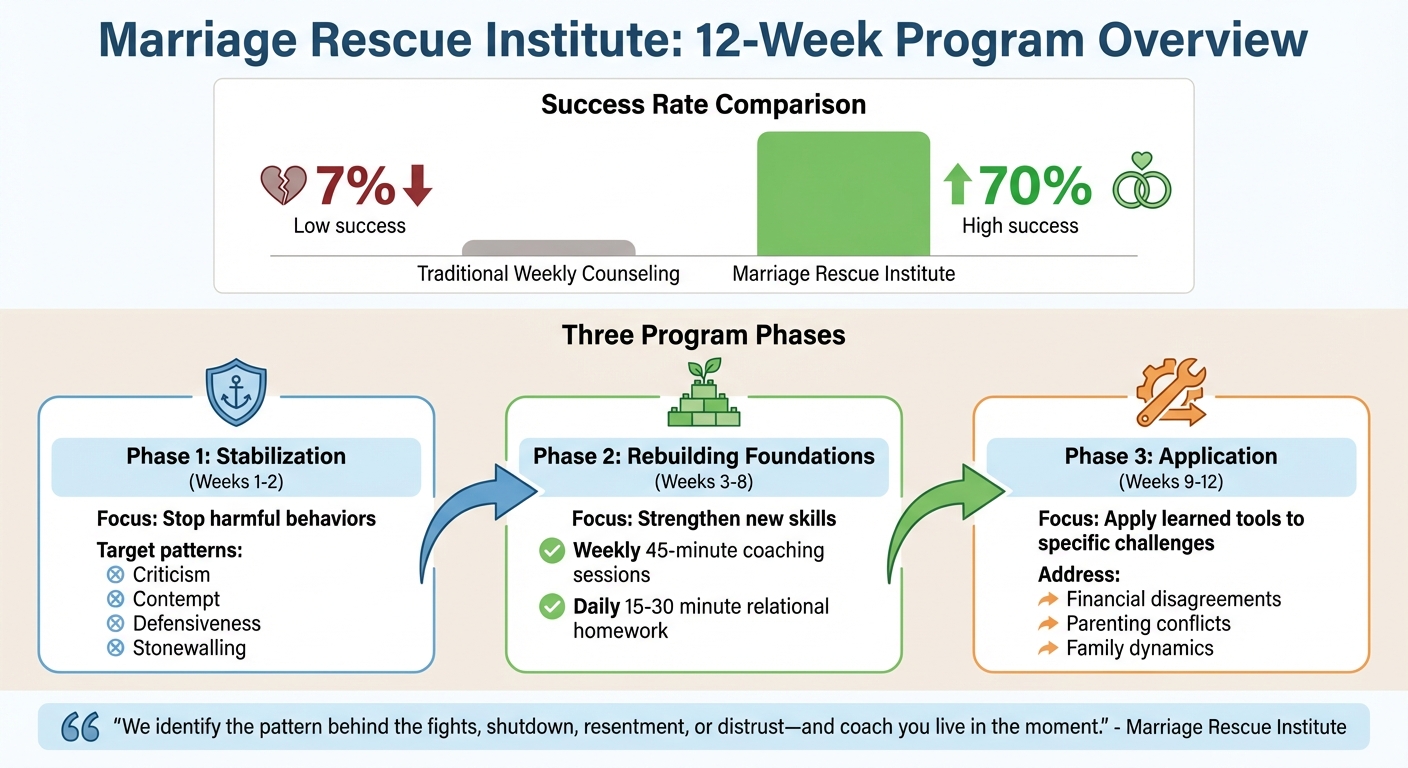
This program offers a focused, hands-on approach for couples in crisis, building on spiritual and relational techniques to create a practical, results-driven roadmap. Traditional weekly counseling often struggles to make an impact during marital crises, with studies showing a success rate of just 7% [14]. In contrast, the Marriage Rescue Institute provides a structured 12-week plan aimed at couples needing urgent, targeted support.
The program is divided into three phases:
- Weeks 1–2 (Stabilization): Couples work on stopping harmful behaviors like criticism, contempt, defensiveness, and stonewalling – patterns that can destroy relationships.
- Weeks 3–8 (Rebuilding Foundations): Couples participate in weekly 45-minute coaching sessions and complete daily 15–30 minute "relational homework" to strengthen new skills.
- Weeks 9–12 (Application): Using their newly learned tools, couples address specific challenges, such as financial disagreements, parenting conflicts, or family dynamics.
This step-by-step method ensures couples make steady progress, focusing on their unique needs before tackling deeper issues. As the Marriage Rescue Institute puts it:
"We identify the pattern behind the fights, shutdown, resentment, or distrust – and coach you live in the moment."
The program’s effectiveness speaks for itself – approximately 70% of participants report improvements in their relationships. All sessions are conducted through secure, HIPAA-compliant telehealth video calls, making the program accessible to couples throughout California.
Customized Solutions for Each Couple
The program isn’t one-size-fits-all; it’s tailored to the specific needs of each couple. It begins with a detailed assessment of the relationship’s history, current struggles, and future goals. Based on this, therapists create personalized tracks to address issues such as infidelity, addiction, or betrayal. Couples facing unique circumstances, such as neurodiverse relationships (e.g., one or both partners having Asperger’s or High-Functioning ASD) or those in cross-cultural marriages, receive specialized support. For those who request it, Christian psychological principles and biblical teachings can also be incorporated.
Karin Wiese, Licensed Marriage & Family Therapist at Growth and Change Counseling, highlights the program’s approach:
"This process is tailored to the situation that you are dealing with and helps you develop the relational intelligence to put your relationships and mental health back together."
Rather than getting stuck on surface-level arguments, the program dives into the emotional patterns driving conflict, helping couples build stronger, more resilient connections.
Program Pricing and Availability
Growth and Change Counseling offers flexible options, including individual therapy and the Marriage Rescue Institute’s 12-week program, with pricing customized during a strategy session. They accept major insurance providers like Anthem Blue Cross, Aetna, United Health Care, Oxford, and Oscar Health. For those with out-of-network plans (e.g., Cigna or Blue Shield of California), superbills are available for reimbursement. Couples are encouraged to confirm their insurance details and schedule a free consultation to see if the program is a good fit.
| Feature | Individual Therapy | Marriage Rescue Institute (12-Week) | Sliding Scale Options |
|---|---|---|---|
| Primary Focus | Personal growth and addressing anxiety or depression | Relationship stabilization and skill-building | Accessibility and affordability |
| Structure | Open-ended, traditional talk therapy | Structured 12-week roadmap with three phases | Varies based on provider and financial need |
| Session Fee | $200 per 45-minute session (LMFT) or $150 (AMFT) | Custom pricing (discussed during strategy session) | Starting at $100 per 45-minute session |
| Approach | Traditional talk therapy | Targeted coaching with relational homework | Adjusted pricing with foundational care |
| Key Benefit | Addresses individual root causes | Provides immediate crisis intervention and trust rebuilding | Expert care at reduced out-of-pocket cost |
Take the first step toward healing your marriage by scheduling a free 15-minute consultation through our online calendar.
Begin Your Path to Healing with Growth and Change Counseling
Christian counseling tools anchor marriage recovery in the sacred bond of love. This perspective shifts the focus from individual needs to sacrificial love and mutual submission, creating a foundation for enduring commitment, even in tough times.
The core marital healing methods – prayer, Scripture study, biblical forgiveness, and faith-based communication – work together to reflect the wisdom of Ecclesiastes 4:12: "A cord of three strands is not quickly broken." By weaving faith into the process, couples invite divine support, enabling them to address both immediate conflicts and deeper spiritual gaps.
Christian counseling also redefines how couples view conflict. Instead of seeing disagreements as threats, it frames them as opportunities for growth. As Kalie Moore puts it:
"Conflict is not the enemy! Rather conflict is an opportunity to deepen intimacy and create purpose in your marriage."
This approach encourages couples to move from disconnection to healing, turning challenges into moments of Christ-like transformation.
Faith-based guidance also provides practical steps for daily healing. Techniques like active listening, as highlighted in James 1:19, and practicing daily forgiveness offer couples tangible ways to rebuild trust. Research from Dr. John Gottman emphasizes that stable marriages maintain a ratio of five positive interactions for every negative one[1]. These tools help couples cultivate that balance, strengthening their bond over time.
For those facing serious marital struggles, Growth and Change Counseling’s 12-week Marriage Rescue Institute program demonstrates how combining faith-based principles with professional support can guide couples from crisis to restoration.
FAQs
How can we start praying together without it feeling awkward?
Praying together can feel a bit daunting at first, so it’s a good idea to start small and ease into it. For example, you could begin by simply holding hands and praying silently. This can help lower any pressure and create a sense of connection.
To make it a regular practice, try setting a specific time and place for prayer. Establishing a routine helps it become a natural part of your day. Keep your prayers short and heartfelt – whether you’re expressing gratitude or asking for guidance on specific needs. The key is to keep it simple and genuine. It’s not about saying the "perfect" prayer; it’s about the intention behind it.
What’s the difference between forgiving and rebuilding trust?
Forgiveness is about releasing bitterness and prioritizing your own healing. It doesn’t mean excusing or justifying the hurt caused by someone else. Rebuilding trust, on the other hand, is a gradual process. It requires consistent honesty, open communication, and accountability to rebuild confidence and repair the relationship over time.
Is the 12-week Marriage Rescue Institute suitable for severe crises like betrayal?
The 12-week Marriage Rescue Institute program is tailored for couples dealing with serious issues like betrayal, broken trust, separation, or ongoing toxic conflict. This intensive program follows a structured process that has consistently helped couples in crisis rebuild and repair their relationships.
Related Blog Posts
- 5 Steps to Forgiveness in Christian Marriage
- How Christian Counseling Supports Family Healing
- Prayer and Forgiveness in Marriage Restoration
- Christian Counseling for Addiction Recovery
