Betrayal in marriage can feel devastating, but forgiveness offers a path to healing. Infidelity damages trust, self-worth, and emotional connection, leaving deep scars. However, forgiveness – rooted in biblical principles – can help couples rebuild their relationship, even after severe breaches of trust.
Key takeaways:
- Forgiveness is not excusing the betrayal but releasing bitterness and focusing on healing.
- Emotional wounds from betrayal often resemble PTSD, with feelings of anger, sadness, and confusion.
- Biblical guidance emphasizes forgiveness as a command and a step toward personal and spiritual renewal.
- Rebuilding trust requires honesty, accountability, and consistent actions over time.
- Professional counseling, especially faith-based, provides tools to address emotional, relational, and spiritual damage.
With effort, honesty, and support, couples can move forward, creating a stronger, more trusting relationship.
7 Steps to Heal After an Affair. Can You Forgive Infidelity?
How Betrayal Damages Marriage
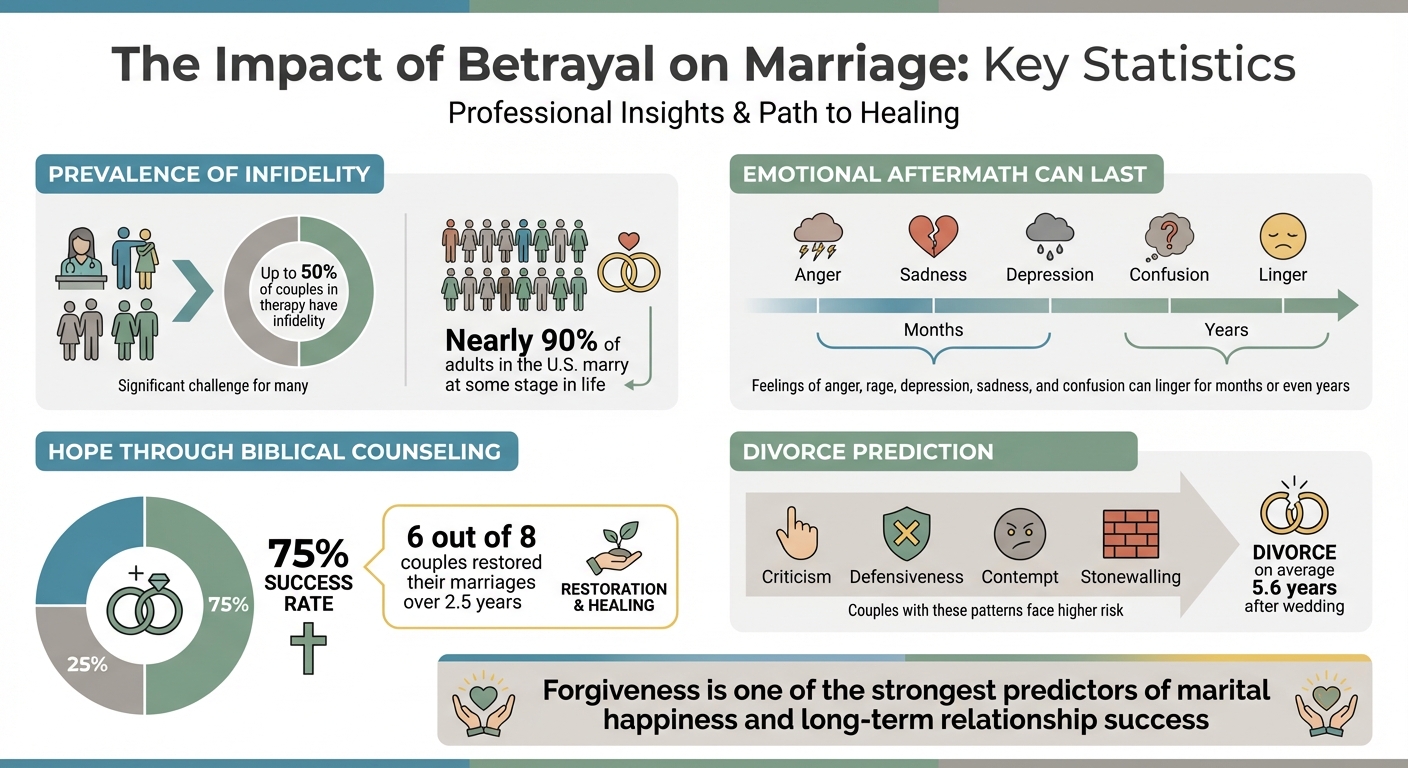
Marital Betrayal Statistics and Healing Outcomes
Betrayal strikes at the core of a marriage, dismantling its emotional, relational, and spiritual foundation. In many cases, the lies and secrecy that accompany betrayal can be even more devastating than the act of infidelity itself [8]. This breach of trust leaves the injured spouse grappling with uncertainty, unable to distinguish truth from deception [6].
The numbers tell a grim story. Studies show that up to 50% of couples in therapy have faced infidelity at some point [3]. With nearly 90% of adults in the U.S. marrying at some stage in life, the potential for this kind of pain is widespread [3]. When betrayal occurs, it fundamentally shifts the dynamics of the relationship. Couples often find that moving forward means creating a "Marriage 2.0" – a new version of their relationship – rather than trying to recapture what once was [6][9]. These wounds, layered with emotional and spiritual challenges, set the stage for a profound crisis.
The Emotional Impact of Betrayal
The emotional aftermath of betrayal can resemble symptoms of PTSD. Feelings like anger, rage, depression, sadness, and confusion can linger for months or even years [9][10][3]. These are not fleeting emotions but deep psychological scars.
Resentment often creeps in, eroding the goodwill that is essential for a marriage to thrive [1]. Emotional pain can lead to withdrawal, creating barriers in vulnerability, intimacy, and communication. This distance can feel insurmountable.
On a personal level, betrayal shakes a person’s sense of self-worth. The injured partner may question their value and lose confidence, often feeling abandoned or humiliated [9][3]. They may wrestle with the painful thought of not being "enough" for their spouse [3][2]. Mac Stanley Cazeau, LMHC, explains this dynamic:
"Betrayal can make you doubt your value, but it’s not about you; it’s about the other person’s choices" [9].
Consider the case of Kim, a wife who discovered her husband Scott’s affair with someone they both knew. Her initial reaction was a whirlwind of misplaced guilt, fear for the future, and even a desire for revenge. This emotional storm illustrates the "nightmare" state that betrayal creates, particularly for families with young children [2].
Understanding these emotional wounds is critical as we delve into biblical approaches to forgiveness.
How Betrayal Affects Your Spiritual Life
Betrayal doesn’t just wound the heart – it also disrupts spiritual trust. In Christian theology, marriage is seen as a reflection of Christ’s relationship with His church [7]. When betrayal occurs, it damages this sacred representation and the couple’s ability to embody Christ-like love [6][7].
The spiritual effects of betrayal run deep. It can harden hearts, leading individuals to distance themselves from God because of the deceitfulness of sin [4]. The injured spouse may wrestle with misplaced guilt, wrongly blaming themselves for their partner’s actions, or they may feel anger toward God [2][6]. This spiritual "earthquake" can shake a person’s faith, making them question God’s presence. Reclaiming trust often requires turning to Scripture to rediscover God as a source of refuge and strength [2].
Heath Lambert, Senior Pastor, cautions against this spiritual danger:
"Take care, brothers, lest there be in any of you an evil, unbelieving heart, leading you to fall away from the living God. But exhort one another every day… that none of you may be hardened by the deceitfulness of sin" [4].
The Biblical Counseling Center offers this stark perspective:
"The marriage affected by adultery is in a sense dead and gone… the covenant was broken and the vows of fidelity were sacrificed" [6].
Even amidst such devastation, there is room for hope. Betrayal can become a “life-transforming opportunity,” where couples learn to see God’s ability to redeem brokenness and bring beauty from ashes [2]. This path of restoration calls for both partners to seek spiritual healing through prayer, scripture, and pastoral support, allowing their reconciliation to reflect God’s redemptive power [5]. These spiritual dimensions highlight the importance of the restoration process, which will be explored further in the sections ahead.
What the Bible Says About Forgiveness
When betrayal shakes the foundation of a marriage, many wonder if forgiveness is even possible. According to Scripture, forgiveness isn’t just encouraged – it’s a command for believers [13][16]. The Bible describes forgiveness as a defining characteristic of God, one that Christians are called to reflect in their own lives, even when the pain feels overwhelming [13][14].
Forgiveness doesn’t come easily or overnight, but biblical teachings offer a clear path to healing. It’s important to understand that forgiving someone doesn’t mean excusing their actions, forgetting what happened, or immediately rebuilding trust [1][14]. As Julie Ganschow, Founder and Director of Reigning Grace Counseling Center, explains:
"By forgiving her husband she chooses to release him from the sense of debt she believes she is owed because of the hurt he caused. It signifies releasing any claim for retribution" [16].
This act of forgiveness allows the wounded spouse to step away from a victim mindset, handing over the weight of revenge to God and reclaiming their life.
Bible Verses on Forgiveness
The Bible provides clear and direct guidance on forgiveness. In Matthew 6:14-15, Jesus teaches: "For if you forgive other people when they sin against you, your heavenly Father will also forgive you. But if you do not forgive others their sins, your Father will not forgive your sins" [13][14]. This verse emphasizes the reciprocal nature of forgiveness – our willingness to forgive others directly impacts our experience of God’s forgiveness.
Other passages echo this teaching. Ephesians 4:32 urges believers to "be kind and compassionate to one another, forgiving each other, just as in Christ God forgave you" [13]. Similarly, Colossians 3:13 reminds us to "bear with each other and forgive one another if any of you has a grievance against someone. Forgive as the Lord forgave you" [13].
The ultimate example of forgiveness is found in Luke 23:34, where Jesus, in the midst of His crucifixion, prays, "Father, forgive them, for they do not know what they are doing" [14][15]. Another powerful teaching on forgiveness comes from Romans 12:19, which calls believers to avoid seeking revenge, leaving justice in God’s hands: "Do not take revenge, my dear friends, but leave room for God’s wrath."
When Peter asked Jesus if forgiving someone seven times was sufficient, Jesus responded, "I tell you, not seven times, but seventy times seven" (Matthew 18:21-22) [12][13][15]. This underscores the boundless nature of forgiveness, presenting it as a choice rooted in faith rather than fleeting emotions.
Forgiveness as a Decision and Commandment
In the Bible, forgiveness is not portrayed as a feeling that comes and goes but as a conscious decision and a commandment [14][15][16]. Choosing forgiveness doesn’t require feeling it first. As Julie Ganschow explains:
"Forgiving her spouse is not an option for the Christian; it is required" [16].
This might feel like a heavy burden, but it reflects the truth that believers themselves have been forgiven much more. The idea of standing "on level ground at the foot of the cross" reminds Christians that everyone is in need of grace, which can soften the heart toward forgiving even deep betrayals.
That said, forgiveness doesn’t mean an immediate restoration of trust or the removal of healthy boundaries. While forgiveness is a spiritual obligation, trust must be rebuilt gradually through consistent, trustworthy behavior. A betrayed spouse can forgive while still protecting themselves from further harm.
Unforgiveness, on the other hand, can trap someone in their pain. As church member Dee Dunn warns:
"Unforgiveness will imprison us in our past. It will keep the pain alive and never let that wound heal" [13].
Interestingly, research aligns with these biblical principles. Studies show that the ability to give and receive forgiveness is one of the strongest predictors of marital happiness and long-term relationship success [1].
sbb-itb-596b85d
How to Forgive and Heal After Betrayal
Understanding forgiveness from a biblical perspective is one thing; living it out is a whole different challenge. Moving from the pain of betrayal to a place of healing takes more than just good intentions. It calls for honesty, professional help, and consistent effort over time. Forgiveness might be a choice, but healing is a journey – one that both partners must walk together. Let’s dive into how honesty and professional counseling can set the stage for true restoration.
Honesty and Confession
Healing begins with total honesty. The partner who caused the betrayal must come clean – completely. Partial truths or staggered confessions only deepen the pain and reopen old wounds, often causing more harm than the initial betrayal itself [8][17]. Transparency is key to moving forward.
But honesty isn’t enough by itself. True healing requires remorse, not just regret. Regret is feeling bad about getting caught, while remorse means truly understanding the pain caused and taking responsibility for it. The offending partner must own their actions fully, without blaming the marriage or the other spouse. As Dr. John Gottman explains:
Atonement cannot occur if the cheater insists that the victim take partial blame for the affair [18].
This level of accountability is essential for rebuilding trust and setting the stage for healing.
Getting Professional Counseling
Trying to navigate betrayal without professional help is like trying to sail through a storm without a compass. A trained counselor offers a well-rounded perspective, as biblical counselor Robert Jones describes: one that includes the husband, wife, counselor, and God [2]. Research shows that couples therapy is far more effective than individual counseling when it comes to rebuilding trust after betrayal [17]. Individual sessions can sometimes allow secrets to linger, but joint sessions promote openness and help the betrayed partner regain their role as the primary confidante.
Structured counseling provides a roadmap for healing, often aligning with biblical principles of restoration. Programs like Growth and Change Counseling‘s Marriage Rescue Institute offer a structured 12-week coaching process designed specifically for couples dealing with betrayal. Available in locations like Campbell, San Jose, Los Angeles, Roseville, and even via telehealth throughout California, this program helps couples navigate the complex challenges of rebuilding their relationship.
The effectiveness of such counseling is supported by research. In one study that followed eight couples over 2.5 years, biblical counseling helped restore six of those marriages – a 75% success rate [2]. As Robert Jones explains:
The gospel guarantees restoration if both partners will seek to follow Christ [2].
Professional counseling doesn’t just address the betrayal itself; it also uncovers deeper issues like pride, selfishness, or emotional disconnection that may have contributed to the breakdown [6][10]. While counseling lays the groundwork, rebuilding trust requires consistent, intentional actions every day.
Rebuilding Trust Through Actions
Counseling opens the door, but rebuilding trust happens through daily, tangible actions. Forgiveness may be granted in a moment, but trust takes time and effort to restore. As Dr. John Gottman puts it:
Restoring trust is an action rather than a belief. It’s more about what your partner does than what they say [11].
The partner who broke the trust must show reliability and openness in practical ways. This includes sharing passwords, being transparent about locations and schedules, and proactively checking in without being asked [5][9][11]. Simple actions like keeping promises, being punctual, and maintaining open communication go a long way in rebuilding trust.
Creating daily rituals helps strengthen emotional intimacy. Whether it’s taking walks together, having meals without distractions, or setting aside time for evening check-ins, these habits build connection [9][11]. Using “I” statements to express feelings can also prevent defensiveness and encourage honest conversations [5][11]. Additionally, setting clear boundaries about what information is needed to feel safe helps both partners navigate the healing process. Reassuring the betrayed partner that progress is being made can also prevent feelings of hopelessness in the one working to rebuild trust [9][17].
Research highlights the importance of healthy communication. Couples who fall into patterns of criticism, defensiveness, contempt, and stonewalling are much more likely to divorce – on average, just 5.6 years after their wedding [10]. But those who replace these destructive habits with gentle communication, shared responsibility, and genuine appreciation create a foundation for lasting restoration. While trust doesn’t return overnight, with God’s grace and consistent effort, it can be rebuilt – and sometimes even stronger than before.
How Christian Counseling Helps Restore Marriages
Addressing Emotional, Relational, and Spiritual Needs
Christian counseling takes a holistic approach by addressing the mind, body, soul, and relationships as interconnected parts of healing [19]. When it comes to recovering from infidelity, this means focusing on both spiritual renewal and repairing the relational bond.
Professional Christian counselors blend proven therapeutic techniques with biblical teachings. For example, Emotionally Focused Therapy (EFT) helps couples navigate the deep emotional wounds caused by infidelity, while the Gottman Method strengthens communication and emotional connection [19][20]. What sets Christian counseling apart is its spiritual perspective – betrayal isn’t seen merely as a personal wrong but, as Robert Jones describes it, "perjury", a violation of a sacred promise made before God [2]. This reframes the goal of counseling, shifting the focus from solely saving the marriage to honoring God, creating a more enduring foundation for healing.
Christian counseling also digs deeper into the underlying issues that may be fueling destructive behaviors. The Biblical Counseling Center highlights the importance of addressing these core "heart issues":
The Word of God is sufficient to instruct both the counselor and counselee on the various heart issues the couple will encounter in the reconciliation process [6].
This process often involves confronting personal struggles like pride, selfishness, or idolatry in the unfaithful partner, and bitterness or self-pity in the betrayed spouse.
Growth and Change Through the Marriage Rescue Institute
For couples in the most challenging situations, specialized Christian counseling programs offer a structured path to recovery. One such program, The Marriage Rescue Institute, is a 12-week coaching initiative tailored for marriages on the brink of collapse. Led by John Mark Kane, LMFT, this program combines biblical principles with evidence-based therapy to address the emotional, relational, and spiritual aspects of healing.
The Marriage Rescue Institute operates both in-person across California and through telehealth, making it accessible to couples in various locations. The process begins with a personalized strategy session to outline a tailored plan and determine pricing. This ensures that the program focuses on both emotional recovery and practical steps to rebuild trust. Individual therapy sessions are also available, with rates of $200 for a 45-minute session with an LMFT or $150 with an AMFT. Sliding scale options are offered to accommodate financial constraints, making this resource accessible to those in need.
Finding Hope and Healing at Growth and Change Counseling
Betrayal can tear apart a marriage, but forgiveness holds the power to heal emotional wounds, rebuild trust, and restore a deeper connection. Studies highlight that the ability to seek and extend forgiveness is one of the key components of marital happiness and enduring love [1]. Grounded in biblical teachings, forgiveness isn’t just a choice – it’s a transformative act. It doesn’t mean erasing the past or denying the pain; rather, it’s about creating a pathway for healing to begin.
Recovering from betrayal takes more than good intentions. It requires honesty, accountability, and consistent effort from both partners. The betrayed spouse must embrace forgiveness as a deliberate decision, even if emotions take time to follow. Meanwhile, the partner who was unfaithful must rebuild trust by demonstrating transparency and making consistent, verifiable changes. Without forgiveness, harmful dynamics – like criticism, defensiveness, contempt, and stonewalling – can take over. Research shows these patterns often predict divorce within just a few years [10]. When paired with professional guidance, however, forgiveness can lay the groundwork for true healing and lasting recovery.
Forgiveness, combined with structured counseling, is essential for rebuilding trust and renewing a marriage. Growth and Change Counseling’s 12-week Marriage Rescue Institute offers couples a roadmap for this journey, blending biblical principles with proven therapeutic techniques to address emotional, relational, and spiritual challenges.
If your marriage is struggling with the pain of betrayal, don’t wait to seek professional help. Expert guidance can prevent years of unresolved hurt and give your relationship the best chance to heal. With the right support, forgiveness can transform your marriage into something stronger and more resilient than ever before.
FAQs
How does forgiveness help rebuild trust after infidelity in marriage?
Forgiveness plays a crucial role in healing a marriage after infidelity. It’s about making the intentional choice to release resentment and anger, creating an opportunity for both partners to move forward. In Christian marriages, forgiveness often takes on a deeper meaning, grounded in the biblical principle to "forgive as you have been forgiven." This act of grace can pave the way for true repentance, emotional recovery, and honest conversations about the factors that contributed to the betrayal.
Studies suggest that couples who embrace forgiveness are more likely to rebuild trust, strengthen their emotional bond, and achieve long-term marital happiness. Beyond that, forgiveness can even lead to post-traumatic growth, helping partners uncover a deeper level of intimacy and rediscover a shared purpose in their relationship.
For couples looking for a structured, faith-centered path to healing, Growth and Change Counseling offers The Marriage Rescue Institute. This 12-week intensive program is designed to help couples rebuild trust and restore their marriage with meaningful and lasting results.
How can professional counseling help rebuild trust after a betrayal in marriage?
Professional counseling creates a safe, supportive environment where couples can confront the pain of betrayal and take steps toward rebuilding trust. A skilled therapist guides both partners in recognizing the hurt, taking responsibility for their actions, and expressing sincere remorse – essential steps on the path to forgiveness and healing. Counseling also provides practical strategies to replace lingering resentment with empathy, accountability, and better communication.
In these sessions, couples work together to uncover the underlying causes of the betrayal, develop healthier relationship habits, and establish consistent, trustworthy actions that gradually rebuild confidence. Growth and Change Counseling offers a focused 12-week couples coaching program called The Marriage Rescue Institute. This program is specifically designed to help couples in crisis repair and strengthen their bond. With a compassionate, solutions-oriented approach, counseling gives couples the tools and support they need to move forward as a team.
What does the Bible say about forgiving a spouse after betrayal?
The Bible teaches that forgiveness in marriage is rooted in the grace that God extends to all of us. As believers, we are instructed to forgive others in the same way that God forgives us (Ephesians 4:32, Colossians 3:13). While forgiving a spouse after betrayal can feel daunting, it is a vital step toward healing and rebuilding the connection within the marriage.
Forgiveness, however, goes hand in hand with genuine repentance. The spouse who caused the harm must take responsibility for their actions, acknowledge the hurt they’ve caused, and work to rebuild trust. When one partner demonstrates true repentance and the other offers forgiveness, the marriage can start to heal. While the relationship may not be the same as it once was, this process can pave the way for a renewed and deeper bond.
For those navigating this difficult journey, Christian counseling can offer valuable support. Growth and Change Counseling provides a 12-week couples coaching program grounded in biblical principles, designed to help couples address betrayal, restore trust, and cultivate a relationship filled with grace.
Related Blog Posts
- 5 Steps to Forgiveness in Christian Marriage
- The Role of Forgiveness in the Marriage Covenant
- What the Bible Says About Reconciliation in Marriage
- Prayer and Forgiveness in Marriage Restoration
