When addiction impacts a family, it reshapes relationships, communication, and emotional stability. Families often fall into unhealthy roles – like the Caregiver, Hero, Scapegoat, or Lost Child – trying to maintain balance. These roles, while coping mechanisms, can prolong dysfunction and hinder recovery. Setting clear boundaries and seeking professional support are key to breaking these patterns and fostering healthier dynamics.
Key Takeaways:
- Unhealthy Roles: Family members may unconsciously adopt roles like the Caregiver (enabling), Hero (perfectionist), Scapegoat (rebellion), or Lost Child (withdrawal).
- Boundaries Matter: Clear physical, emotional, financial, and communication boundaries help restore balance and accountability.
- Impact on Families: Addiction increases risks of divorce, abuse, and neglect, affecting every family member.
- Professional Help: Family therapy and peer support groups (e.g., Al-Anon) can rebuild trust and improve recovery outcomes.
- Self-Care: Family members must prioritize their own emotional health to provide sustainable support.
Recovery requires effort from everyone, not just the person struggling with addiction. By addressing these dynamics, families can create a supportive environment for long-term healing.
Family Roles When Addiction Takes Hold
Common Dysfunctional Family Roles During Addiction
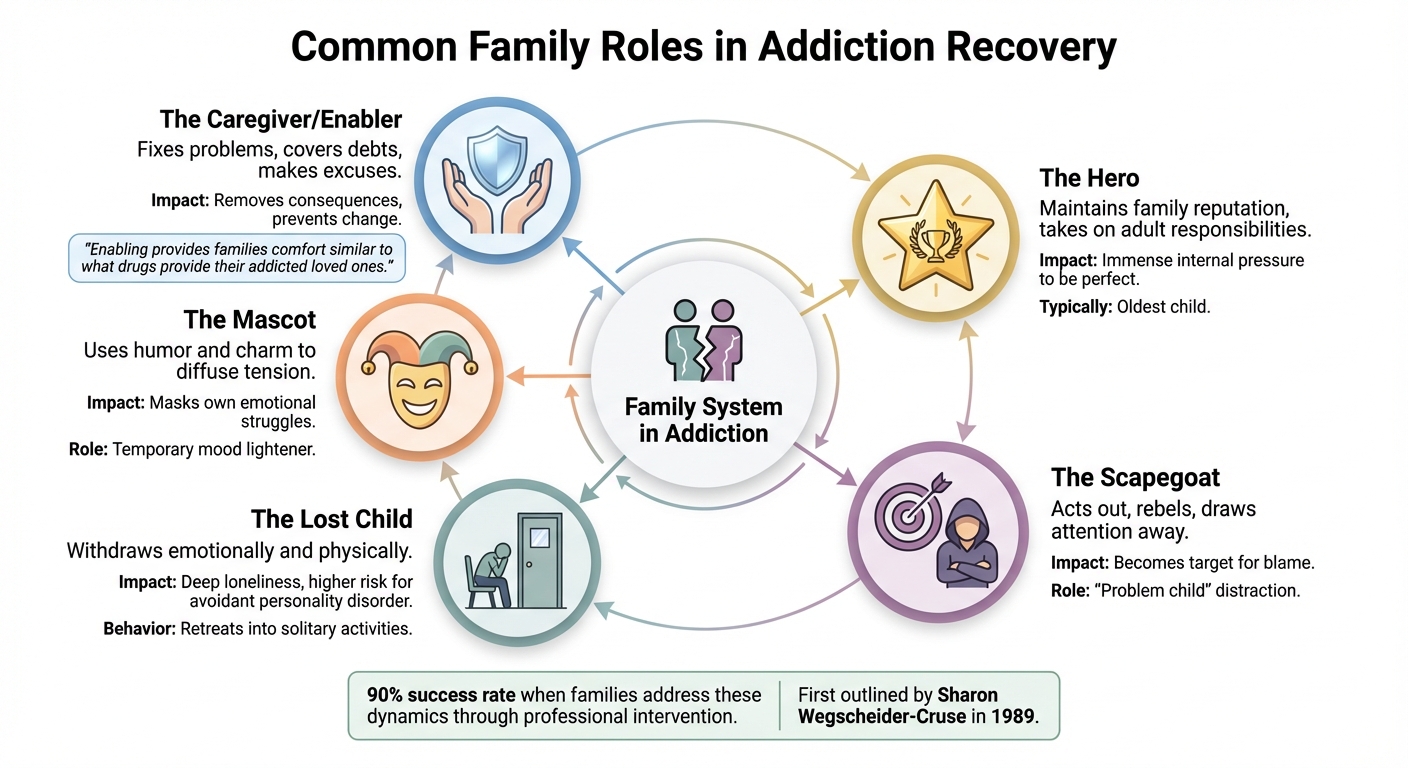
Common Family Roles in Addiction Recovery
When addiction takes hold, family members often unconsciously slip into specific roles as a way to cope with the overwhelming stress. While these roles might feel like a way to regain control, they tend to create more dysfunction and block the path to healing. Let’s dive into some common roles and how they contribute to unhealthy family dynamics.
The Caregiver and the Enabler
Boundaries are crucial for recovery, but in many families affected by addiction, they’re often blurred or completely absent. The Caregiver, for instance, takes on the responsibility of “fixing” the addicted person’s life. This might mean covering their debts, making excuses for their behavior, or picking up the slack on neglected household responsibilities.
As the Intervention Helpline puts it:
"Enabling provides families a level of comfort similar to what drugs or alcohol provide their addicted loved ones." [8]
By protecting the addicted individual from facing the natural consequences of their actions, the Caregiver unintentionally removes a key motivator for change.
The Hero, Scapegoat, and Lost Child
In addition to the Caregiver, other family members often adopt roles that further entrench dysfunction:
- The Hero: Typically the oldest child, the Hero works tirelessly to maintain the family’s reputation and create a sense of stability. They often take on adult responsibilities, but this comes at a cost – an immense internal pressure to be perfect.
- The Scapegoat: This family member acts out or rebels, drawing attention away from the addiction. By becoming the “problem child,” they inadvertently become a target for blame, even though the true issue lies elsewhere.
- The Lost Child: To avoid conflict, the Lost Child withdraws emotionally and physically. They may retreat into solitary activities like reading or video games, but this isolation can lead to deep loneliness. Studies even suggest that Lost Children may be at higher risk for developing avoidant personality disorder.
Another common role is The Mascot, who uses humor and charm to diffuse tension. While their antics might lighten the mood temporarily, this coping mechanism often masks their own emotional struggles.
How These Roles Affect Family Functioning
On the surface, these roles might seem like they help the family function, but in reality, they create a toxic environment where everyone operates in survival mode. The Hero’s quest for perfection, the Scapegoat’s rebellion, the Lost Child’s withdrawal, and the Mascot’s humor all serve as distractions from the real issue: the addiction. These patterns not only keep the family stuck but also shield the addicted person from facing the consequences that could drive them toward recovery.
Sharon Wegscheider-Cruse, a family therapist who first outlined these roles in 1989, emphasized that true healing requires the entire family to grow and change together [4]. Professional intervention services that address these dynamics have shown promising outcomes, with a 90% success rate in helping individuals enter treatment [7].
Recognizing these roles is a vital first step in breaking the cycle. By understanding how these dynamics play out, families can begin to set healthier boundaries and pursue therapeutic interventions that pave the way for genuine recovery.
How to Redefine Family Roles and Boundaries
Changing unhealthy family dynamics takes effort and clear strategies. Without intentional action, dysfunctional roles tend to stick around, creating ongoing challenges.
Setting Clear and Consistent Boundaries
Boundaries are personal choices that safeguard your well-being – they aren’t about controlling others’ actions [10]. Healthy boundaries shift family dynamics from enabling harmful behaviors (like shielding someone from consequences) to encouraging accountability and promoting better decisions [3]. These boundaries generally fall into four categories:
- Physical: Protecting your personal space and safety.
- Emotional: Guarding your feelings and emotional health.
- Financial: Preventing financial manipulation or misuse.
- Communication: Ensuring respectful and constructive interactions.
Start by evaluating your family dynamics honestly. Where are boundaries missing or unclear? Identifying these areas is the first step toward change [3, 13].
When you communicate boundaries, use "I" statements to express your needs without assigning blame. For instance, you might say, "I feel stressed when you don’t let me know if you’ll be late." A helpful formula is: "When you [specific behavior], I feel [specific emotion]. I need [specific action]. If you continue [behavior], I will [specific consequence]" [9]. This approach sets clear expectations and consequences, reinforcing your boundaries.
Consistency is critical. If boundaries are violated, follow through with the stated consequences every time. Inconsistent enforcement can send mixed signals and reinforce old patterns. If someone tests your limits, try the "broken record" technique: calmly repeat your boundary without engaging in arguments. As MARR reminds us, "If nothing changes, nothing changes" [9]. These steps help create a foundation for more honest and productive family interactions.
Encouraging Open and Honest Communication
Open communication is essential for rebuilding trust within a family. The best time for these conversations is during calm, sober moments – not in the heat of a crisis. This creates a safe environment for everyone, including those in recovery, to share their thoughts and feelings. Collaborative planning during these discussions ensures that expectations are realistic and agreed upon by all family members. Over time, these open dialogues can pave the way for professional intervention if needed.
Working with a Family Therapist
Professional guidance can make a world of difference. Family therapists provide a neutral, supportive space where members can explore the roles they’ve unconsciously adopted during addiction and address unresolved issues that might otherwise fuel conflict [3, 10]. Therapy helps families repair damaged relationships while redefining roles and boundaries [5].
John Kane, founder of Growth and Change Counseling, emphasizes, "What you believe about yourself defines and shapes all of your relationships!" [5]. Growth and Change Counseling offers family therapy across California, focusing on parent coaching, addiction recovery, and trauma therapy. They provide actionable "relational homework", helping families practice new communication methods and boundary-setting in everyday situations [5]. Since families naturally strive for balance, a change in one member often requires the whole system to adjust. A skilled therapist can guide this process, helping the family find a healthier equilibrium [6].
Research shows that family counseling improves treatment engagement and retention rates, making professional support a key part of long-term recovery [6]. Growth and Change Counseling offers services in Campbell, San Jose, Los Angeles, and Roseville, as well as telehealth options across California, ensuring access to expert help no matter where you’re located. With the right guidance, families can redefine their roles and create lasting, positive change.
sbb-itb-596b85d
Supporting Family Members’ Emotional Health
In the journey of addiction recovery, emotional health within the family plays a crucial role. Recovery doesn’t just affect the individual – it ripples through the entire family system. Often, family members become so focused on supporting their loved one that they overlook their own well-being. This can lead to burnout, resentment, and even a "martyr complex", where sacrificing personal health feels like the only way to demonstrate love [3]. The truth is, prioritizing your own care isn’t selfish – it’s necessary for offering sustainable, meaningful support.
Prioritizing Self-Care for Family Members
Taking care of yourself begins with recognizing your limits and setting boundaries that protect your emotional and physical health. Boundaries can take many forms: emotional boundaries shield your feelings from manipulation, time boundaries ensure you carve out space for rest and personal activities, and internal boundaries help you replace negative self-talk with self-compassion [11]. Even small actions, like limiting stressful online interactions, can make a big difference [11].
One essential mindset shift is separating your emotional well-being from your loved one’s actions. Your happiness and stability shouldn’t hinge on whether your loved one remains sober or relapses [3]. Incorporating regular "me-time" into your schedule – whether through exercise, hobbies, or quiet reflection – can help you recharge and maintain perspective [3][11]. Additionally, learning about addiction as a family disease can be transformative. It reframes addiction as a systemic challenge rather than a personal failure, reducing feelings of blame and equipping you to respond more effectively [7][6].
These self-care practices lay the groundwork for seeking external resources when needed.
Using Peer Support and Counseling Resources
Peer support groups like Al-Anon, Nar-Anon, and Families Anonymous offer a lifeline for those navigating the challenges of addiction within their families. These groups provide a safe space to share experiences, gain practical advice, and realize you’re not alone in your struggles [3]. For younger family members, Alateen offers tailored support to help teens process the trauma and stress of living with a loved one’s addiction [12][2]. The power of these groups lies in their ability to break through the isolation that often accompanies addiction, offering hope and practical tools when things feel overwhelming.
Individual counseling can also be a game-changer. Therapy provides a space to work through personal trauma, anxiety, or depression that may stem from the family dynamic [5]. Growth and Change Counseling, for example, offers individual and family therapy across several locations in California, including Campbell, San Jose, Los Angeles, and Roseville, as well as telehealth options. Their approach focuses on "relational intelligence", helping families understand the root causes of conflict and develop healthier ways to connect [5]. Professional support can help you step away from unhealthy roles you may have unconsciously adopted, allowing for more genuine emotional expression [1][2].
With external support in place, families can move toward long-term healing and growth.
Building Long-Term Family Growth
Recovery is an ongoing process, and families must grow alongside it. As recovery progresses, boundaries need to adapt to foster both independence and mutual respect [3]. This requires consistent effort and open communication. As Charles Stanley wisely said:
It is not the trials in your life that develop or destroy you, but rather your response to those hardships [5].
Families that focus on their strengths, rather than solely on their problems, tend to see better outcomes in treatment engagement and overall resilience [6]. Long-term growth involves practicing new communication skills, adjusting boundaries as circumstances change, and maintaining self-care routines even after the immediate crisis has passed. By committing to these practices, families can build a healthier, more supportive dynamic for the future.
Conclusion: Building Healthier Family Dynamics in Recovery
Addiction doesn’t just disrupt the life of the individual struggling with it – it reshapes the entire family dynamic. Recovery requires families to reassess their roles, establish healthy boundaries, and make self-care a priority. As mentioned earlier, redefining family roles is a crucial step in the healing process. Breaking away from unhealthy patterns, such as the Enabler, Hero, or Scapegoat roles, helps family members reconnect in more genuine ways, fostering relationships built on mutual respect [3][2].
Boundaries, too, are key. They need to evolve over time – from providing structured support during the early stages of recovery to encouraging healthy independence as progress is made [3][11]. According to research from the National Institute on Drug Abuse, setting clear expectations and enforcing consistent consequences can be a powerful motivator. This approach not only supports ongoing recovery but also helps reduce enabling behaviors [3]. Tools like “I” statements or the “broken record” method can make it easier to maintain these boundaries effectively [3][10].
Professional support plays a vital role in this journey. Family therapy, peer support groups like Al-Anon, and educational programs can help families shift out of survival mode and begin to thrive together [3][7]. Growth and Change Counseling offers family therapy services across California – in Campbell, San Jose, Los Angeles, and Roseville, as well as through telehealth. Their approach focuses on relational intelligence and practical solutions, tailored to meet the unique needs of each family.
Recovery is not just the responsibility of one person – it requires the dedication and effort of every family member. As L.R. Knost so eloquently put it:
Do not be dismayed by the brokenness of the world. All things break. And all things can be mended. Not with time, as they say, but with intention [5].
FAQs
How can families recognize and adjust unhealthy roles during addiction recovery?
Families can spot unhealthy roles by paying attention to recurring patterns in how they interact and behave. Some common roles include the enabler, who often excuses or rescues a loved one dealing with addiction, the protector, who steps in to cover up problems or handle crises, and the lost child, who tends to withdraw to avoid conflict. These roles can lead to feelings of resentment, neglecting personal needs, or even enabling harmful behaviors.
Shifting out of these roles involves setting clear boundaries and fostering personal accountability. This might mean having honest conversations, learning to say "no" to enabling actions, and making self-care a priority. For families seeking extra guidance, professional therapy – like the services offered by Growth and Change Counseling – can provide personalized strategies to help redefine roles, strengthen communication, and build healthier dynamics.
How can I set healthy boundaries with a family member struggling with addiction?
Setting boundaries with a loved one struggling with addiction is crucial – not just for their growth, but for protecting your emotional well-being. Begin by recognizing any enabling behaviors you might have, like giving them money, making excuses for their actions, or trying to solve their problems. Once you’ve identified these patterns, commit to changing them. When discussing boundaries, be straightforward and firm. For example, you might say: “I’m not going to give you money. If you ask again, I’ll have to end the conversation.” The hard part? Sticking to those boundaries, even when it’s tough.
Don’t forget to take care of yourself in the process. Self-care could mean seeking therapy, joining a support group, or carving out time to recharge. Working with a professional – through family therapy or coaching – can also provide the tools you need to establish and uphold boundaries that fit your unique situation. Services like Growth and Change Counseling offer family-centered therapy and support throughout California, both in-person and online, to guide you through these challenges while helping to build healthier relationships.
How can family therapy help improve relationships during addiction recovery?
Family therapy plays an important role in addiction recovery by addressing how addiction affects the entire family unit. It helps family members identify unhelpful patterns, like enabling behaviors or codependency, and replace them with healthier ways of communicating and supporting one another. Therapists also assist families in setting clear boundaries and encouraging mutual respect – both essential for creating a stable environment that supports recovery.
During therapy, families collaborate to reduce stress, develop coping skills, and enhance problem-solving abilities. This often involves recognizing shifting family roles – such as the "protector" or "rescuer" – and working toward more balanced, interdependent relationships. When families embrace these changes, recovery outcomes tend to improve, resulting in reduced stress, stronger bonds, and a home environment that reinforces sobriety.
Growth and Change Counseling provides family therapy sessions rooted in evidence-based practices, helping families across California navigate these challenges. These tailored sessions aim to create healthier dynamics and support long-term recovery for their loved ones.
Related Blog Posts
- Boundaries for Addiction Recovery and Healthy Love
- Family Systems Model for Addiction Recovery
- Scapegoat Role in Addiction Recovery
- Hero Role in Family Systems: Healing Strategies
