Mindfulness can transform how couples communicate by helping them pause, reflect, and respond calmly instead of reacting impulsively. It enhances emotional regulation, empathy, and listening skills, making it easier to navigate conflicts and reduce stress. Studies show that mindfulness improves relationship satisfaction, speeds up stress recovery, and helps couples connect better, especially in neurodiverse relationships where communication challenges are more complex.
Key takeaways:
- Pause before reacting: Mindfulness creates a moment to choose thoughtful responses instead of impulsive reactions.
- Emotional awareness: Observing emotions without judgment helps manage anger, frustration, and stress during conflicts.
- Improved listening: Mindful listening ensures both partners feel heard and understood.
- Neurodiverse support: Tailored mindfulness practices help couples with ADHD or autism navigate sensory sensitivities and communication differences.
Simple practices like deep breathing, gratitude sharing, and reflective listening can improve connection over time. Combining mindfulness with counseling offers additional support for couples facing ongoing challenges.
Two Mindfulness Exercises to Increase Compassion in Your Relationship
How Mindfulness Changes Communication in Marriage
Mindfulness can transform how couples communicate by disrupting the cycle of automatic reactions. Instead of responding impulsively during tense situations, partners learn to pause and choose their words thoughtfully [5][3]. This shift from reacting to responding helps avoid misunderstandings and unnecessary hurt. That brief pause creates space for greater empathy and better emotional regulation.
This change happens on both a physical and mental level. Regular mindfulness practice alters the body’s stress response, making it easier to remain calm and engaged during tough conversations instead of defaulting to fight-or-flight mode [2].
Mindfulness also teaches you to separate your identity from your emotions. Rather than thinking, "I am angry", you begin to observe, "There is anger" [1][3]. This subtle shift allows you to acknowledge emotions without letting them dictate your actions or words, giving you the ability to respond with intention.
Building Empathy Between Partners
Mindfulness nurtures curiosity and openness, encouraging you to genuinely seek your partner’s perspective instead of just waiting for your turn to talk [2]. This mindset helps you view your spouse’s concerns, fears, and desires as worth exploring, rather than as challenges to defend against.
Research even highlights how mindfulness impacts perception during conflicts. In a study of 121 couples, men with lower mindfulness often overestimated their partner’s negative emotions, perceiving more anger or hurt than was actually present. Those with higher mindfulness avoided this misjudgment [7]. By reducing this kind of emotional hypervigilance, mindfulness prevents unnecessary conflict escalation.
Another valuable aspect is approaching your partner with a "beginner’s mind", which means seeing them as they are now rather than through the lens of past disagreements [3]. This perspective allows you to respond to what your partner is communicating in the moment, rather than reacting based on unresolved issues from the past. Once empathy is established, the next step is managing emotional reactions effectively.
Managing Emotional Reactions
The strength of mindfulness lies in its ability to help you observe emotions without being consumed by them. It allows you to notice physical cues – like a tight chest or clenched jaw – before they spiral into reactive behavior [2]. These signals act as early warnings, giving you a chance to pause and regain control before saying something you might regret.
"Mindfulness helps partners to regulate their own responses and more fully accept one another, resulting in less negative fallout from conflict when it arises." – Researchers from the University of Wyoming and the University of Oregon [2]
During heated moments, simply labeling your emotions – mentally noting "anger", "fear", or "frustration" – can create enough distance to engage your brain’s thinking centers rather than staying stuck in emotional reaction [1][2]. This shift moves the focus of communication from "winning" an argument to fostering understanding and connection [5][1].
Even small practices, like five minutes of belly breathing daily, can lower your baseline stress levels. Over time, this builds resilience, helping you stay calmer during future difficult conversations [1].
Improving Active Listening Skills
Mindfulness turns listening into an active and intentional practice. Instead of planning your response while your partner speaks, mindfulness encourages you to be fully present, tuning in to their words without distractions.
By staying grounded in the moment, you can deepen your listening. Using your breath as an "anchor" helps maintain focus [3]. If your mind starts to wander – thinking about yesterday or worrying about tomorrow – you can gently redirect your attention back to your breathing and your partner’s words. This prevents the common habit of "half-listening" while mentally multitasking [7].
Research on Mindfulness-Based Relationship Enhancement found that practicing mindfulness leads to greater relationship satisfaction and improved stress management for days afterward. These benefits were still apparent even three months later [4]. Over time, mindful listening builds trust, as your partner feels genuinely heard and valued, rather than merely tolerated.
Mindfulness Techniques for Neurodiverse Couples
Neurodiverse couples often navigate unique communication challenges that require tailored mindfulness practices. For instance, about 80% of autistic individuals experience sensory sensitivities, which can heavily influence how they communicate and connect with their partners [8]. Traditional mindfulness methods may not always work as intended because neurodivergent partners process information, handle sensory input, and express emotions differently.
The heart of effective communication in these relationships lies in recognizing that it often feels like "deciphering secret codes" [8]. Strategies that work for neurotypical couples might overwhelm neurodivergent individuals due to differences in understanding language and social cues. Mindfulness can help bridge these gaps by introducing structured communication techniques that reduce ambiguity and sensory stress. These adjustments pave the way for practical exercises that foster better connection.
Mindful Listening Exercises
For neurodiverse couples, mindful listening is more than just paying attention – it involves actively confirming that the message has been understood. One effective tool is the "echoing" technique. After your partner speaks, repeat or rephrase what you heard before responding [8]. This ensures that both the literal meaning and emotional intent are clear, minimizing misunderstandings caused by missed social cues.
"When one or both partners lack skill in detecting the subtle messages in communication, misunderstanding can result." – Lynda Geller, PhD, Spectrum Services [9]
Research highlights that the brains of autistic individuals often show heightened activity when processing facial expressions during eye contact [10]. Because of this, traditional face-to-face listening practices may feel overwhelming. Instead, consider alternative approaches like side-by-side conversations during a walk or using written communication, such as letters or emails, for sensitive discussions [10]. These methods maintain a mindful connection while reducing the stress of direct social interactions.
Using ‘I’ Statements
Once listening practices are in place, clear expression becomes the next step. In neurodiverse relationships, ‘I’ statements need to be precise. Instead of saying something vague like "I feel unappreciated", try a specific statement such as, "I feel overwhelmed when the kitchen is cluttered, and I need help cleaning it by 7:00 PM" [10][11]. This approach removes ambiguity and provides actionable information for your partner.
Focus on expressing needs and desires rather than assigning blame. For example, saying "I need 15 minutes of quiet time when I get home from work to decompress" is far more effective than, "You always bombard me with questions the second I walk in." The first statement communicates a clear need without triggering defensiveness, while the latter can feel accusatory.
"In a relationship, we’re always writing and rewriting the ‘instruction manual of me’ and giving insight into what we need, like, don’t like, and how we feel loved." – Michele Michaelson, LMFT [10]
Avoid indirect language, hints, or sarcasm. Statements like "We’re low on supplies" require interpretation, whereas "Please pick up cat food today" provides clear, actionable guidance [10]. This directness respects your partner’s communication style and eliminates unnecessary guesswork.
Pause and Reflect Techniques
Structured pauses during conversations are another tool to help manage sensory and emotional overload. For neurodiverse couples, these pauses work best when they’re planned in advance. Agree on specific "time-out" strategies, including a set duration – like 20 minutes – and a plan for reconnecting afterward [10]. This structure prevents pauses from feeling like abandonment, which can cause anxiety for neurodivergent partners.
During these breaks, use attentional mindfulness to focus on physical sensations instead of getting caught up in emotions. For instance, notice signs of stress in your body, like a tight chest or clenched jaw [2][3]. Asking yourself, "What am I noticing now?" can help redirect your attention to the present moment [2]. This practice can prevent stress from escalating further.
The "anchor" technique is particularly helpful during these moments. By focusing on a physical sensation – like the feeling of your feet on the floor or the rhythm of your breathing – you can ground yourself when emotions start to spiral [3]. This method is especially useful for neurodivergent partners with ADHD or autism, who may struggle with emotional regulation in stressful situations [9].
Another helpful approach is objective labeling: instead of saying, "I am furious", try noting, "Anger is present" [1]. This slight shift creates emotional distance, allowing you to see feelings as temporary rather than overwhelming. Research backs this up: a study of 88 couples found that individuals with higher mindfulness scores experienced faster recovery of cortisol levels (a stress hormone) after conflicts [2]. This quicker recovery helps both partners re-engage in the conversation with less lingering tension.
Neurodivergent individuals often need extra time – 30 to 60 seconds – to process and respond during discussions [8][9]. Instead of interpreting silence as disinterest, use this pause to focus on your breath and stay open to your partner’s response. This patience shows respect for their processing style.
| Technique | Purpose for Neurodiverse Couples | Actionable Step |
|---|---|---|
| Echoing | Ensures both clarity and emotional understanding | Rephrase your partner’s words before responding [8]. |
| Processing Pauses | Supports slower cognitive processing | Allow 30–60 seconds for responses [8][9]. |
| Body Scanning | Identifies stress triggers before escalation | Notice physical tension like a tight chest or clenched jaw [2][3]. |
| Specific ‘I’ Statements | Reduces ambiguity and blame | Use clear, actionable language with timeframes (e.g., "I need help by 7:00 PM") [10]. |
| Structured Time-Outs | Prevents overwhelm and miscommunication | Set a specific duration and check-in plan during breaks [10]. |
Step-by-Step Mindfulness Exercises for Couples
Incorporating daily mindfulness exercises into your routine can strengthen communication between partners and deepen your connection. These practices help you apply mindfulness techniques in real-life situations, fostering better understanding and harmony.
Guided Breathing for Conversations
Belly breathing is a simple yet powerful way to stay calm during challenging conversations. It helps reduce stress and keeps you grounded when emotions are running high[1]. To practice, find a comfortable position – either sitting or lying down – and spend one to two minutes taking slow, natural breaths to settle your mind. Place one hand on your belly and the other on your chest. Focus on breathing deeply so that your belly rises while your chest remains still. Notice the gentle rise and fall of your belly as you continue this exercise for about five minutes each day. This practice can help regulate your stress response over time[1].
"If you are experiencing a strong emotion, you can turn towards it by taking a few deep breaths, softening the mind, and paying attention to the sensations and stories that are moving through us."
– Gillian Florence Sanger, Yoga and Meditation Teacher[1]
During conversations, this breathing technique can be especially helpful if you notice signs of stress, like a clenched jaw or tightness in your chest[2]. If you feel overwhelmed, consider pausing the discussion and taking a 20-minute break to breathe and regain your balance before continuing[13].
Meditating Together
Meditating as a couple creates a sense of calm that can positively influence your daily interactions. A helpful exercise is the one-way listening practice: set a timer for five minutes, and let one partner speak for three minutes while the other listens silently. Then, switch roles[13]. This practice encourages you to hold space for each other without jumping in to interrupt or plan your response.
Some couples find it helpful to use a shared mantra, such as "nam-myoho-renge-kyo", to manage collective anxiety during tense moments[12]. Once you’ve established a sense of calm together, you can move on to reflective practices that ensure both partners feel heard and understood.
Reflective Listening with Paraphrasing
Reflective listening is a powerful way to ensure both partners feel seen and heard. Start by eliminating distractions and fully turning toward your partner to show your presence[13]. When your partner finishes speaking, summarize their message by saying, "What I hear you saying is…"[13]. Follow this with clarifying questions like, "Am I understanding you correctly?" or "Is there more you’d like to share?" to confirm you’ve captured their thoughts accurately[12][13].
Body language also plays a role – relax your shoulders, uncross your arms, and lean forward to show openness[12].
"The truth is, there’s no such thing as perfect communication. There’s only repair, return, and recommitment."
– Barbara (Blaze) Lazarony, LMFT[13]
Focusing entirely on your partner’s words, rather than preparing your response, can be especially helpful in neurodiverse relationships, where clear and direct communication is often a strength[13].
Daily Gratitude Sharing
Practicing gratitude daily can strengthen your bond and encourage positive communication. Gratitude serves as a powerful counter to negativity and helps build a stronger foundation for your relationship[14]. Studies show that expressing gratitude in intimate relationships can boost connection and satisfaction, even the next day[1].
Be specific with your appreciation. For example, instead of a general "thanks", say, "Thank you for making coffee this morning." This small shift can make a big difference[1][13].
You could also try a gratitude practice during dinner. Take a moment of silent reflection before your meal to think about the positive moments of your day, especially those involving your partner. Alternatively, writing a "Letter of Appreciation" to highlight the qualities and actions you value in your partner can create a meaningful keepsake[1].
"Mindfulness helps you turn towards your partner with gratitude and a genuine interest in their inner world. This culture of appreciation… is the best insurance for your relationship and the antidote to contempt."
– Nicole Schiener, Registered Psychotherapist[14]
sbb-itb-596b85d
Benefits of Mindfulness for Marriage Communication
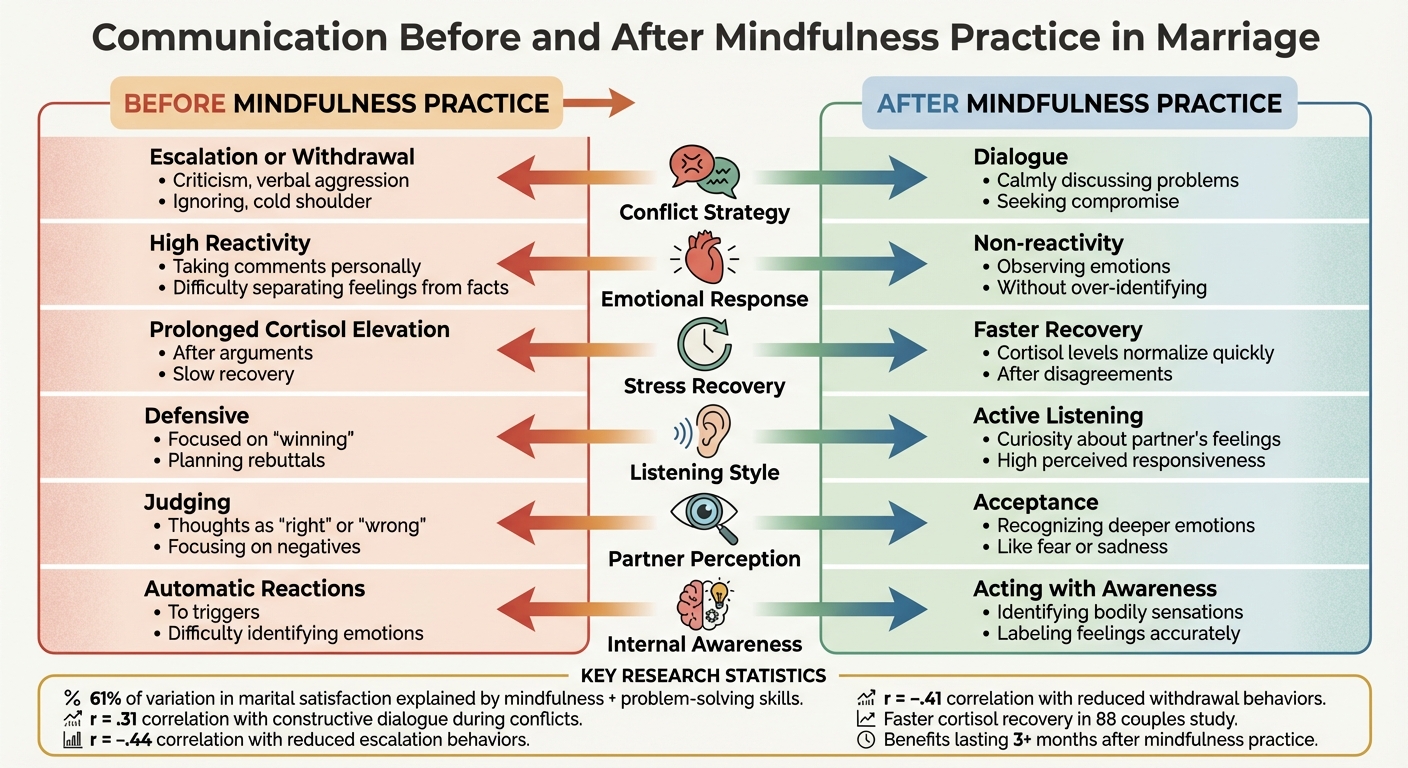
How Mindfulness Transforms Communication Patterns in Marriage
Mindfulness can significantly enhance how couples connect, handle conflicts, and find satisfaction in their relationship. Research shows that practicing mindfulness rewires how partners respond to stress and disagreements, creating lasting positive changes in their interactions.
One key advantage is the clarity mindfulness brings to relationships. It strengthens what experts call "Perceived Partner Responsiveness" – essentially, the feeling that your spouse genuinely understands and cares about your needs [15]. This perception is strongly tied to better overall relationship quality.
"Mindfulness helps partners to regulate their own responses and more fully accept one another, resulting in less negative fallout from conflict when it arises."
– Researchers from the University of Wyoming and University of Oregon [2]
Mindfulness also transforms how couples communicate. Studies reveal that it encourages constructive dialogue during conflicts (r = .31) while discouraging harmful behaviors like escalation (r = –.44) and withdrawal (r = –.41) [18] [19]. In one study involving 153 participants, mindfulness combined with problem-solving skills explained 61% of the variation in marital satisfaction [17]. Another study published in Hormones and Behavior observed 88 couples during conflict discussions. Those with higher mindfulness levels experienced quicker cortisol recovery after arguments compared to less mindful partners [2].
Research Findings on Mindfulness in Marriage
Numerous studies confirm that mindfulness leads to measurable improvements in relationship quality. For instance, a meta-analysis of 10 studies found a statistically significant effect size of .27 linking mindfulness to relationship satisfaction [20]. General mindfulness also correlates positively with relationship quality (r = .28), satisfaction (r = .27), and cohesion (r = .26) [18]. Another study found a correlation of r = .37 between mindfulness and romantic relationship satisfaction [17].
The key to these benefits lies in emotional skills. Research from Clark University highlights that the ability to identify and express emotions while managing anger fully explains how mindfulness improves marital quality [6].
"Mindful attunement to one’s partner may promote the activation and growth of neural circuitry associated with safety, security, and positive affect within the romantic relationship."
– Kendra C. Jones, Researcher [16]
Interestingly, the effects of mindfulness differ slightly between men and women. For men, mindfulness is closely tied to feeling more loved and supported, while for women, it often reduces relationship-related anxiety and sadness [18]. These benefits also endure over time. Mindfulness-based relationship programs have shown lasting improvements, with participants reporting better relationship happiness and stress coping even three months after completing the program [4].
Communication Before and After Mindfulness Practice
When couples incorporate mindfulness into their daily lives, their communication patterns undergo noticeable changes. Here’s how mindfulness reshapes interactions:
| Communication Pattern | Before Mindfulness Practice | After Mindfulness Practice |
|---|---|---|
| Conflict Strategy | Escalation (criticism, verbal aggression) or Withdrawal (ignoring, cold shoulder) [18] | Dialogue (calmly discussing problems, seeking compromise) [18] |
| Emotional Response | High reactivity; taking comments personally; difficulty separating feelings from facts [2] | Non-reactivity; observing emotions without over-identifying with them [2] [18] |
| Stress Recovery | Prolonged cortisol elevation after arguments; slow recovery [2] | Faster recovery; cortisol levels normalize quickly after disagreements [2] |
| Listening Style | Defensive; focused on "winning" the argument; planning rebuttals [2] | Active listening; curiosity about partner’s feelings; high perceived responsiveness [2] [15] |
| Partner Perception | Judging partner’s thoughts or actions as "right" or "wrong"; focusing on negatives [18] | Acceptance; recognizing deeper emotions like fear or sadness [2] [15] |
| Internal Awareness | Automatic reactions to triggers; difficulty identifying emotions [2] | Acting with awareness; identifying bodily sensations and labeling feelings accurately [2] [18] |
This transformation – from reactive behaviors to intentional responses – highlights the core value of mindfulness in marriage. Instead of falling into destructive patterns, mindful partners can pause, assess their emotions, and respond thoughtfully. This leads to fewer misunderstandings, quicker conflict resolution, and a deeper connection, even during tough conversations.
Combining Mindfulness with Professional Counseling
Building on earlier mindfulness techniques, professional counseling takes these skills to the next level. When paired with counseling, mindfulness becomes a tool that not only helps individuals but also fosters healthier relationships. Skilled therapists guide couples in using mindfulness to tackle challenges like conflict, trauma, and neurodiversity, creating a stronger foundation for personal and relational growth.
Structured Support for Couples
Growth and Change Counseling integrates mindfulness into its therapy approach. Their Marriage Rescue Institute offers a 12-week intensive program aimed at couples facing crisis situations. This program is designed for partners who feel stuck in cycles of repetitive arguments or emotional disconnection, helping them identify and change ingrained responses.
The program emphasizes using mindfulness in the heat of the moment, not just during periods of calm. Therapists teach couples how to implement techniques like the STOP method (Stop, Take a breath, Observe, Proceed) to manage emotional triggers during conflicts. This method encourages clear communication and reduces the tendency to react out of anger or defensiveness [22] [21].
Research highlights the effectiveness of this approach, showing that combining mindfulness with problem-solving skills accounts for 61% of the variation in marital satisfaction [17]. Growth and Change Counseling provides these evidence-based strategies through telehealth services across California, making them accessible to a wide range of couples.
Specialized Help for Neurodiverse Relationships
For neurodiverse couples – where one or both partners may have conditions like ADHD or autism – mindfulness strategies need to be customized. Professional guidance is crucial in these cases, as counselors adapt mindfulness exercises to address unique challenges, such as executive functioning difficulties, sensory sensitivities, or differences in emotional interpretation [9].
"The importance of finding a therapist who has an understanding of both couplehood and Asperger Syndrome can be invaluable."
– Lynda Geller, PhD, Spectrum Services [9]
Growth and Change Counseling offers tailored support for neurodiverse relationships, helping couples view executive function differences as brain variations that require specific strategies [9]. Therapists teach techniques like echoing (rephrasing a partner’s words to ensure understanding) and creating "sensory sweet spots" – adjusting environments with softer lighting or reduced noise to ease overwhelm during important discussions [8]. The Marriage Rescue Institute also addresses co-occurring challenges like addiction and trauma, which can complicate communication in relationships already navigating neurodiversity.
Conclusion
Mindfulness offers a powerful way to pause between a triggering moment and your chosen response. It helps you notice physical cues – like a clenched jaw or a tight chest – and respond with words that foster understanding and connection. In fact, research involving 88 romantic couples revealed that those with higher mindfulness levels experienced faster cortisol recovery after conflicts, highlighting its impact on the body’s stress response [2].
This practice doesn’t just reduce stress – it reshapes how couples interact. By adopting a "beginner’s mind", mindfulness encourages you to see your partner anew, free from the weight of past frustrations. Criticism gives way to curiosity, and contempt is replaced by acceptance. A 2004 study from the University of North Carolina found that couples practicing mindfulness reported noticeable improvements in their relationship satisfaction and stress levels, with these benefits still evident three months later [23].
For neurodiverse couples, mindfulness can be especially helpful, offering tools to navigate distinct communication styles and sensory differences.
Simple daily practices like belly breathing, gratitude exercises, and reflective listening can spark meaningful change. However, combining these with professional support often leads to faster progress. Growth and Change Counseling, for example, incorporates mindfulness into evidence-based therapy. Programs like The Marriage Rescue Institute’s intensive 12-week offering help couples apply these skills during conflicts, fostering reconnection even in challenging times.
Ultimately, better communication grows from both personal practice and expert guidance. With mindfulness and targeted support, couples can replace automatic reactions with thoughtful choices, cultivate emotional closeness, and build bonds that stand the test of time.
Final Steps to a Healthier Marriage with Growth and Change Counseling
How does mindfulness help couples communicate better during conflicts?
Mindfulness plays a key role in helping couples navigate conflicts by promoting a calm and non-judgmental awareness of their emotions and physical sensations. When tensions rise – like feeling a racing heartbeat or a knot in the stomach – mindfulness encourages partners to pause, reflect, and avoid reacting impulsively. This moment of reflection creates room for more thoughtful and measured responses, leading to clearer communication and fewer misunderstandings.
By staying present and resisting the urge to jump to conclusions, couples can better manage their emotions and genuinely focus on understanding each other’s viewpoints. Studies reveal that couples who practice mindfulness are more likely to adopt constructive conflict-resolution techniques, such as actively listening and sharing emotions without placing blame. This mindful approach can stop small disagreements from spiraling into bigger problems.
For couples looking for guidance, Growth and Change Counseling offers coaching through The Marriage Rescue Institute. This program incorporates mindfulness strategies to help partners rebuild trust and strengthen communication within a supportive and structured setting.
What are some simple mindfulness practices that can help couples communicate better?
Mindfulness can work wonders in improving communication within relationships. Couples can try incorporating a few straightforward practices into their daily interactions:
- Shared breathing: Take 2 minutes to sit or stand together with your eyes closed. Focus on slow, deep breaths – inhale through your nose for a count of 4 and exhale through your mouth for a count of 6. This simple exercise promotes calmness and a sense of connection.
- Pausing before reacting: When disagreements arise, take a brief pause to breathe and acknowledge your emotions (e.g., "I feel frustrated right now"). This moment of reflection can help you respond thoughtfully instead of reacting impulsively, breaking unhelpful communication patterns.
- Mindful listening: Dedicate 1 minute each to speaking and listening. While one partner talks, the other listens fully – no interruptions, no judgments. This practice encourages mutual understanding and respect.
These small, intentional habits can gradually deepen emotional bonds and reduce the likelihood of misunderstandings.
How can mindfulness improve communication in neurodiverse marriages?
Mindfulness – the practice of staying present and non-judgmental – can play a big role in improving communication within neurodiverse marriages. It helps couples navigate the differences in how they process information, especially when one partner is neurodivergent, such as being autistic or having ADHD. Misunderstandings in these situations often stem from assumptions or misinterpretations, but mindfulness encourages both partners to pause, reflect on their emotions, and respond thoughtfully instead of reacting on impulse.
One key benefit of mindfulness is its ability to boost self-awareness. By recognizing emotional triggers, partners can prevent conflicts from escalating. It also encourages active listening, where each person focuses on truly understanding the other’s perspective instead of making assumptions. Even simple techniques like intentional breathing can ease stress, creating a calmer environment for more productive conversations.
At Growth and Change Counseling, mindfulness strategies are woven into couples coaching programs. These tools are designed to help neurodiverse couples improve communication, minimize misunderstandings, and strengthen their connections.
Related Blog Posts
- How Active Listening Resolves Couple Conflicts
- Mindfulness for Couples in Addiction Recovery
- Ultimate Guide to Emotional Growth for Neurodiverse Couples
- Ultimate Guide to Emotional Communication in Marriage
