When ADHD or autism is part of a marriage, communication and daily interactions can become challenging due to differences in how each partner processes information. Sensory sensitivities, emotional regulation, and executive functioning issues often lead to misunderstandings. Standard relationship advice may not work for neurodiverse couples, making tailored strategies essential.
Here’s what works:
- Assess Needs: Understand each partner’s traits, sensory triggers, and communication styles.
- Educate: Learn how ADHD and autism influence behavior to reduce conflict and build empathy.
- Develop Tools: Use structured communication strategies, external reminders, and emotional regulation techniques.
- Create Routines: Plan shared responsibilities and schedule time for connection.
- Coaching: Structured programs, like a 12-week plan, can guide couples in applying these strategies effectively.
Specialized support, such as the Marriage Rescue Institute‘s coaching program, offers practical steps for couples to improve communication, reduce stress, and strengthen their relationship.
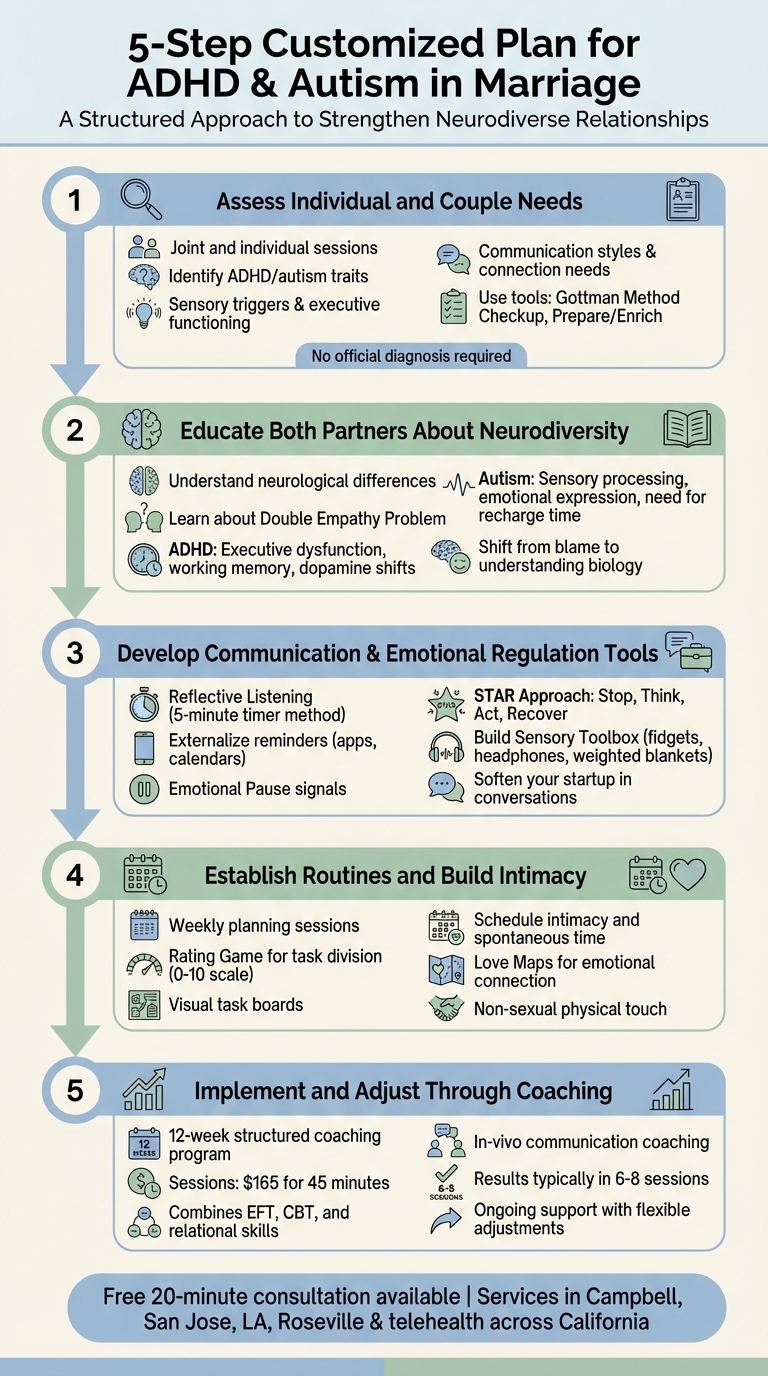
5-Step Process for ADHD and Autism Marriage Coaching
Online Couples-Coaching for People in a Neurodiverse Marriage #autismmarriage
Step 1: Assess Individual and Couple Needs
The first step involves a detailed evaluation of both partners and their relationship as a whole. This isn’t about pinpointing problems – it’s about understanding each person’s neurological makeup. Typically, specialized providers begin with a short consultation to get a sense of the couple’s needs [1]. After this, the assessment usually follows a structured process: a joint session to discuss the relationship dynamics, individual sessions to explore personal traits, and a final joint session to outline a tailored action plan [9]. Below, we break down the key components of these evaluations, which serve as the foundation for creating a customized coaching strategy.
Identify ADHD and Autism Traits
During individual sessions, the focus is on understanding sensory triggers, executive functioning, and emotional regulation – key areas where ADHD or autism can shape daily life [1][4][7]. Sensory profiles are used to identify triggers like noise, touch, or bright lights that might cause sensory overload, shutdowns, or meltdowns. Executive functioning assessments look at how each partner handles daily tasks, including any struggles with starting or completing them. Emotional regulation is another critical aspect, with particular attention paid to Rejection Sensitivity Dysphoria (RSD) and behaviors like masking, where one partner suppresses their traits to fit societal norms [1][4].
The evaluation also examines communication styles, noting differences in how each partner expresses their thoughts and feelings [4]. Connection needs are explored, such as whether one partner thrives on quality time while the other needs solitude to recharge. Importantly, the process emphasizes strengths, highlighting each partner’s unique talents and perspectives to foster growth in the relationship rather than focusing solely on challenges [7][8].
Use Assessment Tools for Relationship Analysis
Once individual traits are assessed, the relationship is examined as a system using structured tools. For long-term couples, the Gottman Method Checkup is often used to identify areas of distress and recurring conflict patterns. For newer or premarital couples, tools like Prepare/Enrich help uncover potential challenges in areas like financial management, parenting, or household responsibilities [6]. Some providers may also utilize the Gottman Love Lab’s video analysis to offer a scientific "x-ray" of how the partners interact [6]. These tools provide actionable insights, helping to craft a plan that improves understanding and communication. For instance, the analysis might reveal relational patterns like "Cassandra Syndrome", where a non-neurodivergent partner feels perpetually unheard, or parent-child dynamics that arise when differences in executive functioning create an imbalance [1][4][7].
This comprehensive assessment approach is central to programs like Growth and Change Counseling‘s 12-week Marriage Rescue Institute, where sessions are priced at $165 for 45 minutes [3]. It’s worth noting that an official ADHD or autism diagnosis isn’t required at this stage. The goal is to understand how each partner’s brain works and how those differences influence the relationship. This insight becomes the foundation for a coaching plan tailored to the couple’s specific neurological needs, steering away from generic advice and focusing on what truly matters for their unique dynamic.
Step 2: Educate Both Partners About Neurodiversity
Once the assessment is complete, it’s time to help both partners understand their neurological differences. This step isn’t about labeling or diagnosing problems – it’s about recognizing that certain behaviors, often misinterpreted as personal slights, are actually rooted in neurological differences. Emily Nagoski, PhD, explains it well: "If you have a relationship with two brains in it, you have a neurodiverse relationship" [10]. This perspective shifts the focus from assigning blame to understanding biology, allowing partners to see traits like forgetfulness or missed social cues as reflections of how their brains operate rather than conscious choices [12]. This understanding lays the groundwork for the practical communication tools discussed later.
Another crucial concept to address is the "Double Empathy Problem," introduced by Dr. Damian Milton in 2012 [15]. This idea challenges the stereotype that neurodivergent individuals lack empathy. Instead, it highlights that communication breakdowns occur because both partners often struggle to grasp each other’s distinct ways of processing information – whether it’s direct versus indirect language or literal versus figurative interpretation [2]. A 2024 study by Jones et al. found that interactions between mixed-neurotype pairs were rated lower in "smoothness and enjoyment" compared to those between partners of the same neurotype. This was largely because these interactions were judged against neurotypical standards [13]. By understanding this dynamic, couples can move away from assuming negative intent and instead focus on asking clarifying questions.
Explain How ADHD and Autism Affect Daily Interactions
To reduce conflict, it’s essential to understand how ADHD and autism uniquely influence daily routines. For partners with ADHD, executive dysfunction can disrupt time management, working memory, and the ability to start or finish tasks. Sharon Saline, Psy.D., explains: "I am absolutely sure that the adult with ADHD would rather remember actions or commitments if they could. But due to biological challenges with working memory and processing speed, they struggle with recalling things…" [11]. Additionally, ADHD-related dopamine shifts can cause attentiveness to wane over time, which may confuse the non-ADHD partner [11].
Autism, on the other hand, affects interactions in distinct ways. Research shows that autistic brains exhibit heightened activity in areas related to processing facial expressions during eye contact, which can make written communication a less stressful option [10]. Autistic partners may also need quiet time to recharge, use less emotional language, or experience sensory overload from stimuli like noise or touch, which can lead to shutdowns or meltdowns [2][4]. As one individual, Dave, shares: "I can tell when someone is sad or angry or happy; it’s just that the details are fuzzy" [10]. This doesn’t indicate a lack of care but rather a different way of processing emotional cues. Recognizing these differences is key to fostering empathy and reducing misunderstandings.
Build Awareness for Compassionate Responses
Educating both partners encourages compassion by shifting the focus from misunderstandings to the traits behind them. For example, instead of assuming an ADHD partner "doesn’t care" when they forget an important date, the neurotypical partner can recognize this as a working memory challenge and suggest tools like phone alerts or shared calendars [11]. Similarly, if an autistic partner steps away during a heated conversation, the other partner can understand it’s due to sensory overload, not avoidance, and allow the needed space [1][4].
Practical strategies can further support this compassionate approach. One useful tool is the "Support or Strategy" question: when a partner shares a challenge, ask, "Do you need support (emotional validation) or strategy (practical solutions)?" [16]. This prevents the common clash where one partner focuses on logic while the other seeks emotional connection [16]. Couples might also use shared signals or "emotion cards" to express feelings when verbal communication feels difficult [14]. Liz Zhou, a neurodivergent therapist, emphasizes that this approach "does not pathologize individuals or blame relationship issues on neurodivergence. Instead, it affirms the gifts of each neurotype and helps partners understand why their brains work the way they do" [2]. By building this foundation of understanding, couples can replace frustration with empathy and prepare for the communication strategies discussed in the next steps.
Step 3: Develop Communication and Emotional Regulation Tools
With a better grasp of neurodiversity, the next step is all about creating practical tools that fit each partner’s unique way of processing. These tools turn understanding into action, making day-to-day interactions smoother. Ruben Velazquez, LMFT, highlights the importance of "softening your startup" when tackling tough conversations: "This skill helps reduce the chances of both people feeling attacked or defensive when moving through a hard conversation" [9]. For example, instead of saying, "You never listen to me", a gentler approach could be, "I feel disconnected when we don’t finish our conversations. Can we find a time to talk?" This small shift helps avoid triggering rejection-sensitive dysphoria (RSD), which can make ADHD partners more likely to misinterpret criticism [9].
Create Neuroaffirming Communication Strategies
In neurodiverse marriages, communication thrives on structure and predictability. One helpful method is Reflective Listening, where partners set a timer for five minutes. During this time, one partner speaks while the other listens and repeats back exactly what was said – word for word – before switching roles [11]. This approach reduces misunderstandings often linked to the Double Empathy Problem and ensures both partners feel truly heard.
Another tip is to externalize reminders to avoid slipping into a "parent-child" dynamic, which can harm intimacy. Sharon Saline, Psy.D., offers a simple example: "It builds more autonomy to say: ‘Check your phone for the list,’ rather than: ‘Have you done this yet?’" [11]. Using external tools like apps or calendars helps maintain equality in the relationship.
For couples with differing processing speeds, "Emotional Pause" signals – like a specific code word or hand gesture – can help de-escalate situations when one partner feels overwhelmed [17]. Regular check-ins, such as brief weekly meetings, also provide a structured opportunity to address frustrations or adjustments calmly, rather than letting issues boil over in the moment [11]. These strategies naturally lead into emotional regulation techniques that help both partners stay grounded during conflicts.
Teach Emotional Regulation Techniques
Emotional regulation looks different for everyone, depending on their neurotype, and learning what works takes time and experimentation. The STAR Approach offers a clear framework for managing conflicts: Stop (take a break), Think (reflect on your role in the situation), Act (work together to find solutions), and Recover (look back on the process) [11]. This method helps prevent conflicts from spiraling and gives both partners the time they need to self-regulate. As Stephanie Moulton Sarkis, Ph.D., puts it, "You can’t have a fight when one of you is not present" [11].
Building a Sensory Toolbox can also be a game-changer, especially for autistic partners who might struggle with sensory overload caused by noise, touch, or visual distractions [17][18]. Items like fidget tools, noise-canceling headphones, weighted blankets, or having a quiet, designated retreat space can make a big difference. Importantly, taking time in these spaces should never be seen as rejection [17]. For ADHD partners, who may experience rapid emotional escalation, the "Pause and Name" technique – stopping to identify and name the emotion before reacting – can help curb impulsive responses that might damage trust [17].
Liz Zhou, a holistic therapist, reminds couples that "communication difficulties are not due to the deficits of either autistic or allistic people, but due to the differences in neurotype" [18]. By viewing emotional regulation as a shared responsibility rather than placing blame on one partner, couples can build compassion and understanding – laying the groundwork for the routines and intimacy-focused strategies covered in the next step.
sbb-itb-596b85d
Step 4: Establish Routines and Build Intimacy
Creating predictable routines that cater to both partners’ needs can help reduce chaos and lay the groundwork for stronger emotional and physical connections.
Design Shared Routines and Responsibilities
Managing household responsibilities works best when approached as a team effort rather than a one-sided task list. Melissa Orlov, a Marriage Consultant and Author, highlights the importance of collaboration:
"Because they are more organized, non-ADHD partners often fall into a pattern of ordering the ADHD partner to complete things. Instead, sit down and coordinate your efforts on a weekly basis" [19].
Weekly planning sessions can help couples align priorities, assign tasks, and agree on clear timelines. A useful strategy for dividing chores is the "Rating Game", where each partner rates tasks on a scale of 0–10 based on how much energy or importance they attach to them [21]. During these sessions, it’s helpful to immediately input tasks into reminder systems, like phone alarms, to ensure nothing gets overlooked [19].
Visual tools can also make a big difference. Posting the week’s planned tasks in a spot where both partners see them daily encourages accountability without nagging [19]. Orlov also suggests embracing spontaneity within structured routines:
"To ‘capture’ the benefit of an ADHD partner’s spontaneity, schedule time to be spontaneous" [19].
For instance, setting aside Saturday afternoons for unplanned activities can strike a balance between structure and a shared sense of adventure.
Strengthen Emotional and Physical Intimacy
In neurodiverse relationships, building intimacy often requires deliberate effort. Executive function challenges or sensory sensitivities can make it easy for connection to take a back seat. Orlov offers this practical advice:
"Use the logistical tenacity of the non-ADHD partner to ensure that the two of you have at least some specific ‘dates’ set aside to be intimate. That way sex isn’t an activity that just happens after all other distractions are worked through" [19].
Scheduling intimacy ensures that physical connection remains a priority, even amidst busy lives.
Emotional closeness can grow through small, meaningful rituals. For example, using "Love Maps" from the Gottman Method helps partners explore each other’s emotional worlds, interests, and stressors to foster deeper understanding [9]. It can also be helpful to map out each partner’s sensory preferences. By identifying sensory triggers related to touch, food, or environment, couples can create affectionate moments that feel comfortable and nurturing [4].
Non-sexual physical touch, such as stroking, caressing, or massage, can be another way to rebuild trust and closeness without the immediate pressure of sexual intimacy [20]. These gestures not only strengthen the bond but also create a safe space for connection to flourish.
Step 5: Implement and Adjust Plans Through Coaching
After creating personalized assessments and communication strategies, the next step is putting these insights into action. At Growth and Change Counseling, this is done through a structured 12-week coaching program designed to help couples shift from crisis to connection. This phase is all about accountability and adapting strategies to meet the unique needs of neurodiverse relationships.
The 12-Week Coaching Process
The Marriage Rescue Institute, founded by John Kane, LMFT, takes a hands-on, action-oriented approach that stands apart from traditional therapy. Instead of waiting for gradual progress over months, this program provides clear guidance and actionable steps right away. As John Kane puts it:
"We revolutionize the way therapy works by integrating proven ancient and modern methods. Our focus stays on creating positive changes that last." [3]
The program combines techniques from EFT (Emotionally Focused Therapy), CBT (Cognitive Behavioral Therapy), and practical relational skills, all tailored specifically for neurodiverse couples. One of the most impactful elements is "in-vivo" communication coaching, where the coach steps in during sessions to guide healthier interactions in real time. This immediate feedback is especially helpful for autistic partners, who often benefit from clear, direct explanations rather than subtle suggestions. [5]
The foundational skills are typically established over 6 to 8 sessions, with the full 12-week framework providing a solid base for long-term improvements. Homework assignments play a key role, allowing couples to practice these skills in their daily lives. This structured approach ensures that the program remains focused and effective, addressing challenges as they arise.
Ongoing Support and Flexible Adjustments
Once the initial 12-week coaching phase is complete, ongoing support helps refine and reinforce the progress made. Each session starts with a review of the previous week’s assignments and how the skills were applied in real-life situations. This allows the coach to highlight successes and identify areas that need further attention. The entire process is goal-driven, focusing on measurable outcomes like better communication, fewer conflicts, and stronger intimacy. As John Kane explains:
"Endless therapy isn’t our style. We work quickly toward your goals and celebrate your progress." [3]
A key focus of the program is building "relational intelligence", helping couples move away from defensive or manipulative behaviors and toward strategies that meet each partner’s needs effectively. Because challenges like executive functioning difficulties and sensory sensitivities can vary, the program is designed to be flexible. Couples might start with weekly sessions and transition to bi-weekly meetings as they stabilize, ensuring the coaching adapts to their changing needs. This flexibility keeps the process responsive and supportive throughout the journey.
Conclusion
Building a strong and fulfilling marriage when ADHD or autism is part of the picture requires a thoughtful, step-by-step approach that acknowledges each partner’s unique way of processing the world. This journey starts with understanding – through targeted assessments of neurodivergence and relationship challenges – then moves into education about neurodiversity, developing better communication tools, creating routines, and following a coaching plan tailored to your specific needs. Each step is designed to create meaningful and lasting progress.
Research supports this approach, showing that couples who engage in marriage counseling often experience noticeable improvements in their relationships. For neurodiverse couples, premarital counseling has been shown to lead to better long-term outcomes, helping to address the unique challenges they face [3][6].
To put these strategies into action, Growth and Change Counseling’s Marriage Rescue Institute offers a structured 12-week coaching program. This program combines proven techniques with modern methods like EFT (Emotionally Focused Therapy) and CBT (Cognitive Behavioral Therapy) to deliver results. Many couples report seeing significant improvements within just 6 to 8 sessions, thanks to a practical and focused approach [3].
If you’re dealing with communication breakdowns, sensory struggles, or unmet needs, specialized support can make a world of difference. Growth and Change Counseling provides services in Campbell, San Jose, Los Angeles, Roseville, and across California through telehealth. They even offer a free 20-minute consultation to help you decide if their program is the right fit for you [3].
You don’t need endless therapy to build a stronger marriage. What you need are the right tools, expert guidance, and a commitment to better understanding each other’s neurological differences. With the right support, you can transform your relationship.
FAQs
How can understanding ADHD and autism strengthen my marriage?
ADHD and autism bring unique perspectives to a relationship, reshaping how partners connect, communicate, and handle emotions. These neurodiverse traits aren’t flaws; they’re simply different ways of experiencing the world. Acknowledging these differences can lead to greater empathy, fewer misunderstandings, and a stronger sense of being valued by one another.
When you take the time to understand your partner’s specific needs, you open the door to practical changes that can strengthen your bond. For instance, knowing how ADHD affects focus and emotional regulation can help you de-escalate potential conflicts. Similarly, being aware of sensory sensitivities often associated with autism allows you to create a more soothing and supportive environment. Simple tools like shared calendars, clear communication guidelines, and structured routines can make daily life smoother and reduce stress for both partners.
For couples navigating neurodiverse dynamics, Growth and Change Counseling offers a 12-week intensive coaching program designed specifically for these relationships. This program provides tailored strategies, communication exercises, and ongoing support to help couples turn their differences into opportunities for growth, creating a stronger and more rewarding partnership.
What are some effective ways to improve communication in relationships where one or both partners have ADHD or autism?
Improving communication in neurodiverse relationships often means finding ways to create clarity and reduce misunderstandings. Here are a few strategies that can help:
- Give time to process: During conversations, allow your partner some pauses to think before responding. This extra time can prevent confusion and help avoid miscommunication that might happen in fast-paced exchanges.
- Share topics in advance: If you’re planning to discuss something important, consider giving your partner a quick outline of the topics beforehand. This allows them to prepare their thoughts and eases the pressure of responding on the spot.
- Provide a summary: After a discussion, send a brief written summary of the main points and any agreed-upon next steps. This helps ensure both of you are on the same page and offers a handy reference for later.
Using these approaches can make conversations feel more thoughtful and supportive, encouraging better understanding and a stronger connection in neurodiverse relationships.
How does the 12-week coaching program support couples with ADHD or autism?
The 12-week coaching program from Growth and Change Counseling is tailored to support neurodiverse couples in strengthening their relationships by addressing their specific challenges. This structured approach helps couples stay focused, minimizing the risk of communication breakdowns along the way.
Through the program, couples gain practical tools to rebuild trust, navigate conflicts more effectively, and create a sense of emotional safety. It provides a supportive environment where both partners can share their perspectives and feel genuinely heard – an essential aspect for those managing the complexities of neurodiverse relationships. By introducing strategies that align with each partner’s unique communication style and needs, the program helps couples foster a deeper, more meaningful connection.
Related Blog Posts
- Autism vs. Depression: Understanding Co-occurring Conditions
- ADHD and Marriage: Emotional Regulation Strategies
- ADHD and Autism: Conflict Resolution Strategies
- Ultimate Guide to Emotional Support in Autism-Neurotypical Marriages
