When trust is broken in a relationship, rebuilding it requires consistent effort, patience, and open communication. The process involves:
- Honest conversations: Address the root causes, apologize sincerely, and validate each other’s feelings.
- Creating emotional safety: Avoid criticism, blame, or defensiveness to ensure both partners feel secure.
- Practical communication strategies: Use "I" statements, listen actively, and set ground rules for discussions.
- Repairing trust through actions: Follow through on promises, show accountability, and use small, daily gestures to demonstrate reliability.
- Professional support: Therapists can help couples navigate deeper issues and provide structured tools for healing.
Programs like the Marriage Rescue Institute offer focused approaches to help couples repair and strengthen their relationships. Rebuilding trust is a gradual process, but with dedication and consistent effort, couples can restore their connection and create a stronger bond.
How To Rebuild Trust In A Relationship
Creating a Safe Space for Open Communication
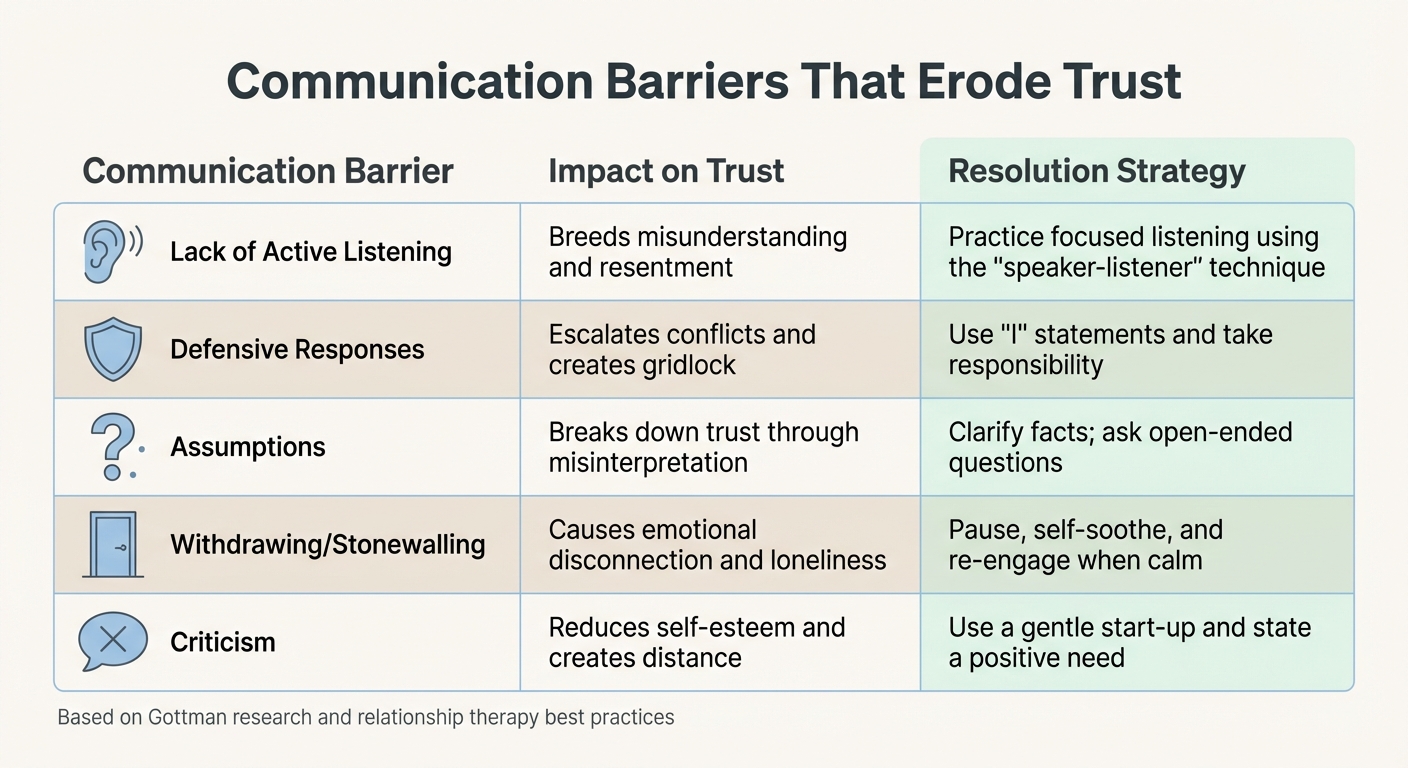
5 Communication Barriers That Erode Trust and How to Overcome Them
Once honest dialogue is established, the next essential step is creating an emotionally safe environment. This safety allows trust to rebuild by ensuring both partners feel secure from criticism, blame, rejection, invalidation, or dismissal [7]. Without this foundation, open and honest communication simply cannot thrive.
Emotional safety thrives when vulnerability is welcomed. Research highlights that non-verbal cues play a dominant role in communication [7], so your tone and body language carry just as much weight as your words.
The ATTUNE model offers a practical framework for fostering emotional safety. It includes six key elements: Awareness of your partner’s needs, Turning toward their bids for connection, Tolerance for differences, Understanding their perspective, Non-defensive responding, and Empathy for their feelings [1]. As Zach Brittle, a Certified Gottman Therapist, explains:
"Trust is built slowly over time. The basis of trust is the idea of attunement" [1].
Setting Ground Rules for Conversations
To avoid destructive patterns, clear ground rules are essential for effective communication. These rules should prioritize understanding over advice and encourage gentle approaches to difficult topics [11][2].
Key ground rules include:
- No interruptions while your partner is speaking.
- Avoid blame or shame-filled language.
- Maintain a respectful tone, even during tough discussions.
Timing matters too. Schedule serious conversations when both partners are emotionally ready, rather than during moments of stress [15][2]. Active listening is equally crucial – give your full attention, maintain eye contact, and reflect back what your partner has shared before responding [8]. The Safe Conversation Process, which includes Mirroring (repeating what you heard), Validation (acknowledging your partner’s perspective), and Empathy (understanding their feelings), provides structure to these exchanges [9]. Harville Hendrix and Helen LaKelly Hunt emphasize:
"The Safe Conversation Process (Imago Dialogue) is the most important skill set a couple can possess. It is the language of conscious partnerships" [9].
One couple even found success by meeting weekly in a quiet public space and typing messages to each other, ensuring careful listening and preventing escalation [10].
After establishing these ground rules, the next step is identifying and addressing communication barriers.
Identifying and Overcoming Communication Barriers
Even with clear rules, some patterns can still erode trust. The "Four Horsemen" – criticism, defensiveness, contempt, and stonewalling – are major predictors of relationship distress and divorce, according to Gottman research [2].
Defensiveness, in particular, can be destructive because it shifts blame back to your partner, essentially saying, "The problem isn’t me, it’s you" [14]. A better approach is to acknowledge your part, even if it’s small [2][14]. When you feel defensive, pause and reflect on your tone or timing.
Another challenge is emotional flooding – when overwhelming emotions make it difficult to process or listen effectively. In such cases, taking a 20-minute break to self-soothe can help reset the dialogue [8][2].
| Communication Barrier | Impact on Trust | Resolution Strategy |
|---|---|---|
| Lack of Active Listening | Breeds misunderstanding and resentment | Practice focused listening using the "speaker-listener" technique [8] |
| Defensive Responses | Escalates conflicts and creates gridlock | Use "I" statements and take responsibility [8] |
| Assumptions | Breaks down trust through misinterpretation | Clarify facts; ask open-ended questions [8] |
| Withdrawing/Stonewalling | Causes emotional disconnection and loneliness | Pause, self-soothe, and re-engage when calm [8] |
| Criticism | Reduces self-esteem and creates distance | Use a gentle start-up and state a positive need [8] |
Another helpful strategy is practicing the "Most Generous Interpretation" when your partner’s actions seem ambiguous [4]. For instance, if they’re late, assume a non-hostile reason rather than jumping to negative conclusions. Lead with vulnerability by expressing feelings like sadness or disappointment instead of anger, which can cause your partner to withdraw [12]. Show appreciation for their willingness to share and trust you with their emotions [7][8].
Techniques for Honest and Empathetic Dialogue
Once you’ve created a safe space and removed barriers, the next step is to use effective techniques that can transform conflict into meaningful connection. These methods build on the foundation of safety, turning honest dialogue into a regular part of your relationships.
Using ‘I-Statements’ to Express Emotions
A powerful way to communicate feelings without triggering defensiveness is by using "I" statements. This three-part structure helps you take ownership of your emotions: "I feel [emotion] when [specific event] happens because [impact], and I need [positive request]" [22–24]. By focusing on your experience rather than assigning blame, you reduce the likelihood of your partner feeling attacked [20, 22].
For example, Ryan and Alyssa, a couple married for 11 years, used this approach to address the strain caused by Ryan’s long work hours. Instead of accusing him, Alyssa said: "I need you to be home at least two nights a week… I feel overwhelmed with the problems our boys are having at school." This opened the door for Ryan to ask thoughtful questions about their financial goals. Together, they reached a compromise – he reduced his hours, and she made an effort to acknowledge his contributions [17].
When describing situations, keep your tone neutral. For instance, instead of saying, "You didn’t empty the dishwasher", try: "I feel frustrated when I come home and see things undone, especially when it seems there was time to do them." This approach invites understanding rather than defensiveness. In one instance, this phrasing allowed a partner to explain that they’d had a tough day and needed time to decompress [16]. Be clear about your needs, such as saying, "I need us to talk for 15 minutes when you get home to help me feel connected" [23, 24].
Once you’re comfortable expressing emotions clearly, incorporating regular check-ins can strengthen trust and communication.
Holding Weekly Emotional Check-Ins
Weekly check-ins are an excellent way to address concerns before they escalate into bigger issues. They’re simple to set up: dedicate 10–15 minutes each week, remove distractions, and focus on three key areas – your emotional state, practical needs like household logistics or parenting, and your intimacy [18].
Paula Kirsch, LMSW, LCSW, from Authentic Living Psychotherapy, highlights the value of this practice:
"I often help clients use this in session when conversations spiral. It’s remarkable how quickly empathy can emerge when words are structured with intention" [18].
During these check-ins, use "I" statements to express your feelings and ask open-ended questions like "What can I do to support you this week?" or "What’s a dream or fear you haven’t shared recently?" These questions encourage deeper understanding [20, 23, 25]. If emotions run high, take a moment to calm down before continuing [2, 12]. End each session on a positive note by acknowledging something your partner did well that week [23, 25]. These check-ins are a small but meaningful way to maintain and strengthen your bond [18].
sbb-itb-596b85d
Repairing Trust After Harmful Events
Rebuilding trust after it’s been broken takes intentional and consistent effort. The person responsible for the breach must take full ownership of their actions – no excuses allowed [19] [5] [20]. This means clearly identifying what they did to damage the relationship and validating the emotions of the hurt partner [19] [5] [13]. As Steve Cuffari, LMFT from In Touch Individual & Family Counseling, aptly puts it:
"Trust is earned in drops and lost in buckets." [13]
A helpful approach to recovery involves three phases: Atone, Attune, and Attach. During the Atone phase, the responsible partner makes amends by being fully transparent and taking accountability, laying the groundwork for open communication [20]. The Attune phase focuses on developing a deeper understanding of each other’s emotions, while the Attach phase works to rebuild intimacy through honest and meaningful conversations. Healing is rarely linear and requires patience from both partners [5]. These phases provide a framework for navigating repair conversations effectively.
How to Conduct Repair Conversations
Repair conversations are rooted in accountability and active listening. To set the right tone, pick a time when you can both talk without distractions. Show you’re listening by reflecting back your partner’s words before responding [19] [6] [13]. The person responsible for the harm should clearly acknowledge their actions. For instance, instead of saying, "I’m sorry for what happened", try: "I broke your trust by hiding certain purchases, and I understand why you feel betrayed."
Dr. Harriet Lerner emphasizes the importance of a sincere apology:
"An effective apology doesn’t include excuses or justifications but focuses on acknowledging the hurt caused." [5]
After acknowledging the harm, it’s critical to show a commitment to repairing the relationship. This might include being more transparent about daily activities, finances, or digital boundaries – without waiting to be asked [13] [20]. Trust is rebuilt not just through words but by consistently following through on these promises. Beyond these structured conversations, small, everyday actions play an equally important role in the healing process.
Using Daily Gestures to Rebuild Trust
Once accountability has been established, trust can be strengthened through everyday gestures. While grand gestures might feel impactful, it’s the small, consistent acts of reliability that truly rebuild trust over time [13] [22]. Simple actions – like being home when you say you will or calling if you’re running late – can add up, drop by drop, to restore trust.
Creating shared routines can also help foster connection. Whether it’s enjoying a morning coffee together or taking evening walks, these rituals build a sense of stability. Small, thoughtful acts – leaving a kind note, giving your full attention during conversations, or planning uninterrupted time together – can nurture a cycle of appreciation [2]. While each gesture may seem minor, their cumulative effect is powerful. It’s also important to remember that forgiveness often comes before complete trust is restored, so patience and consistency remain key throughout the process [22].
Getting Professional Support to Improve Communication
Seeking professional help provides couples with a neutral and supportive environment to address their emotions and challenges. A trained therapist creates a space where feelings like hurt, betrayal, and guilt can be expressed openly, without the fear of immediate backlash or judgment [5][21]. This safe setting encourages vulnerability, something couples often find difficult to achieve on their own.
Therapists also serve as mediators, helping couples stay focused on the root of their issues instead of being overwhelmed by strong emotions. As Reshawna Chapple, PhD, LCSW from Talkspace explains:
"A counselor can help by interpreting and mediating the interactions so that the couple can stay focused on the issues and not allow emotions to take over." [3]
Professional guidance delves into deeper issues, such as emotional neglect or long-standing communication barriers [5][4]. Problems like infidelity, financial dishonesty, or broken promises often stem from unresolved conflicts or attachment wounds [5][4]. Therapists use structured methods, including guided reflections and role-playing, to help couples work through these challenges. These techniques also help partners craft meaningful apologies and develop "relational intelligence" – the skills needed to build and maintain a healthy connection [21][5][6]. Research suggests that trust issues in therapy often improve significantly after about six months, though the timeline depends on the severity of the situation and the commitment of both partners [4]. Through expert intervention, couples can remain accountable and focused on their journey toward healing.
The Marriage Rescue Institute: A 12‑Week Program
Growth and Change Counseling offers the Marriage Rescue Institute, a 12‑week intensive program designed to help even the most strained marriages. Founder John Mark Kane describes the program’s mission:
"The Marriage Rescue Institute, our 12 week marriage program is in the habit of putting marriages in dire circumstances back together!" [21]
Unlike traditional therapy sessions that may continue indefinitely, this program takes a direct, results-driven approach. It has successfully helped couples, even those who had separated, to reconcile and rebuild their relationships [24]. All practitioners are trained in a unified approach that blends Emotionally Focused Therapy (EFT) with solution-oriented techniques [24][21]. Arione Capolupo, LMFT from Growth and Change Counseling, highlights the practice’s philosophy:
"We don’t believe in endless therapy. Our goal is to get you in and out as quickly as reasonably can be done and do it in a way that hopefully you will never need to come back!" [21]
In addition to the Marriage Rescue Institute, the practice offers a range of services tailored to meet the unique needs of couples and individuals.
Services for Couples and Individuals
Growth and Change Counseling provides a variety of options to support both couples and individuals. Their couples therapy focuses on high-conflict situations [24], and they also specialize in neurodiverse couples counseling for relationships where one or both partners have Asperger’s or High Functioning ASD [24][21].
For individuals, therapy is available to address concerns such as anxiety, depression, and addiction. They offer specialized programs for media and sex addiction, including internet and video game use [24][21]. Family therapy and parent coaching are also available to help restore parental authority and strengthen parent-child relationships [24].
The practice operates from physical locations in Campbell, San Jose, Roseville, and Los Angeles, CA, and offers telehealth services for residents across California [21][23]. Individual therapy sessions with a Licensed Marriage and Family Therapist (LMFT) cost $200 for 45 minutes, while sessions with an Associate Marriage and Family Therapist (AMFT) are $150. Sliding scale options start at $100+ for those with financial constraints [24]. To help couples decide if their approach is suitable, the practice also offers free initial consultations [21][23].
Conclusion
Rebuilding trust in a relationship takes more than just time – it requires creating a space where vulnerability feels safe, engaging in open and honest conversations, and proving reliability through consistent, everyday actions. As Dr. John Gottman puts it, trust is often built in those small, seemingly insignificant "sliding door" moments where care and attention shine through [5].
Sometimes, internal efforts alone might not be enough. That’s where professional support can make a difference. Therapists can help couples uncover deeper issues, offer practical tools for handling conflicts, and provide the structure needed for healing. Studies suggest that trust issues in therapy often show marked improvement around the six-month point, as partners work through apologies and begin laying a new foundation [4].
It’s important to remember that rebuilding trust is a process, not a quick fix. Setbacks are natural, and the betrayed partner needs time to heal. What truly matters is the responsible partner’s unwavering commitment to being transparent, accountable, and dependable in their actions every single day.
With dedication and the right support system, couples can move past broken trust and create a relationship that’s not only repaired but strengthened. Programs like the Marriage Rescue Institute’s 12-week Growth and Change Counseling are designed to guide couples through this journey, offering intensive support to help rebuild their connection. By embracing vulnerability, fostering honest communication, and committing to daily effort, couples can lay the groundwork for a relationship rooted in deeper understanding and emotional security.
FAQs
How can I create a safe space for honest communication in my relationship?
Creating an environment where open communication can flourish is a key step in rebuilding trust within a relationship. Begin by setting clear ground rules for your conversations. These might include speaking without interruptions, steering clear of blame, and using "I" statements to express your feelings. These guidelines encourage mutual respect and help keep defensiveness at bay.
Another important aspect is practicing active listening. This means giving your full attention to your partner’s words, reflecting back what you hear to ensure understanding, and asking thoughtful, non-confrontational questions. Empathy plays a big role here too – acknowledge your partner’s emotions before jumping to solutions. This approach helps them feel truly heard and valued. At the same time, make it a habit to share your own thoughts and feelings openly and regularly, which helps establish reliability and rebuild trust over time.
If things feel overwhelming or progress stalls, seeking professional help can make a big difference. Counseling services, like those at Growth and Change Counseling, offer tailored strategies and exercises to help couples improve communication and rebuild trust. With dedication and consistent effort, you can create a safe, supportive space where honest conversations can thrive.
What are effective ways to improve communication and rebuild trust in a relationship?
Improving communication and rebuilding trust begins with creating an environment where both partners feel safe to share openly. One way to do this is through active listening – giving your full attention to your partner without distractions, reflecting on what they’ve said, and resisting the urge to plan your response while they’re speaking. Combine this with empathetic curiosity by asking open-ended questions like, "What’s been on your mind lately?" This approach encourages meaningful conversations and shows that you genuinely value their thoughts.
Using clear and assertive language is another important step in avoiding misunderstandings. Be direct about your feelings by saying things like, "I feel [emotion] when [situation] happens", and clearly communicate your boundaries. This ensures both partners understand each other’s needs. Small gestures, such as starting conversations in a calm tone or using humor to defuse tension, can also make a big difference in reducing conflict and fostering connection.
If communication feels blocked, seeking help from a professional, like Growth and Change Counseling, can provide couples with tailored tools, guidance, and support to reestablish open communication and rebuild trust in their relationship.
How does professional counseling help couples rebuild trust?
Professional counseling offers couples a supportive and impartial environment to tackle the pain and challenges that arise from broken trust. A therapist acts as a guide, helping partners engage in honest conversations and truly hear one another, which promotes understanding and mutual respect. They also assist in navigating accountability, encouraging heartfelt apologies, and developing habits that reinforce trust.
In addition, counseling provides strategies to handle tough emotions like anxiety and resentment, making it easier to have meaningful and productive discussions. Therapists often use structured exercises and create action plans to help couples transform good intentions into tangible progress. For instance, programs like Growth and Change Counseling’s 12-week Marriage Rescue Institute focus on providing practical, solutions-driven support to help couples rebuild trust and strengthen their relationship.
Related Blog Posts
- Addiction Recovery and Emotional Connection in Marriage
- Marriage Coaching for Trust After Addiction
- Trust-Building Exercises for Couples in Recovery
- Top Strategies for Rebuilding Trust in Marriage
