Managing emotions in neurodiverse relationships requires understanding, patience, and tailored strategies. Partners in these relationships often face challenges like sensory overload, communication gaps, and differences in emotional processing speeds. This article outlines 10 actionable strategies to address these challenges effectively:
- Identify sensory triggers: Recognize and manage sensory overload with recovery plans and tools like weighted blankets or calming music.
- Communicate clearly: Use direct, literal language and "I statements" to avoid misunderstandings.
- Allow processing time: Give your partner space to regulate emotions before continuing discussions.
- Schedule emotional check-ins: Regular, planned conversations help maintain connection and reduce emotional reactivity.
- Develop shared emotional language: Agree on words or code phrases to describe feelings and triggers.
- Use visual aids or notes: Tools like feelings thermometers or written communication can ease emotional exchanges.
- Set boundaries: Establish limits on sensory and emotional demands to avoid overwhelm.
- Create pause signals: Agree on non-verbal cues to pause intense conversations and allow emotional resets.
- Design calm spaces: Set up low-stimulus areas for recovery and self-care.
- Track emotional patterns: Use apps or journals to identify triggers and trends, fostering better understanding.
These strategies aim to build emotional balance and connection in neurodiverse relationships. If challenges persist, seeking professional support can provide further guidance.
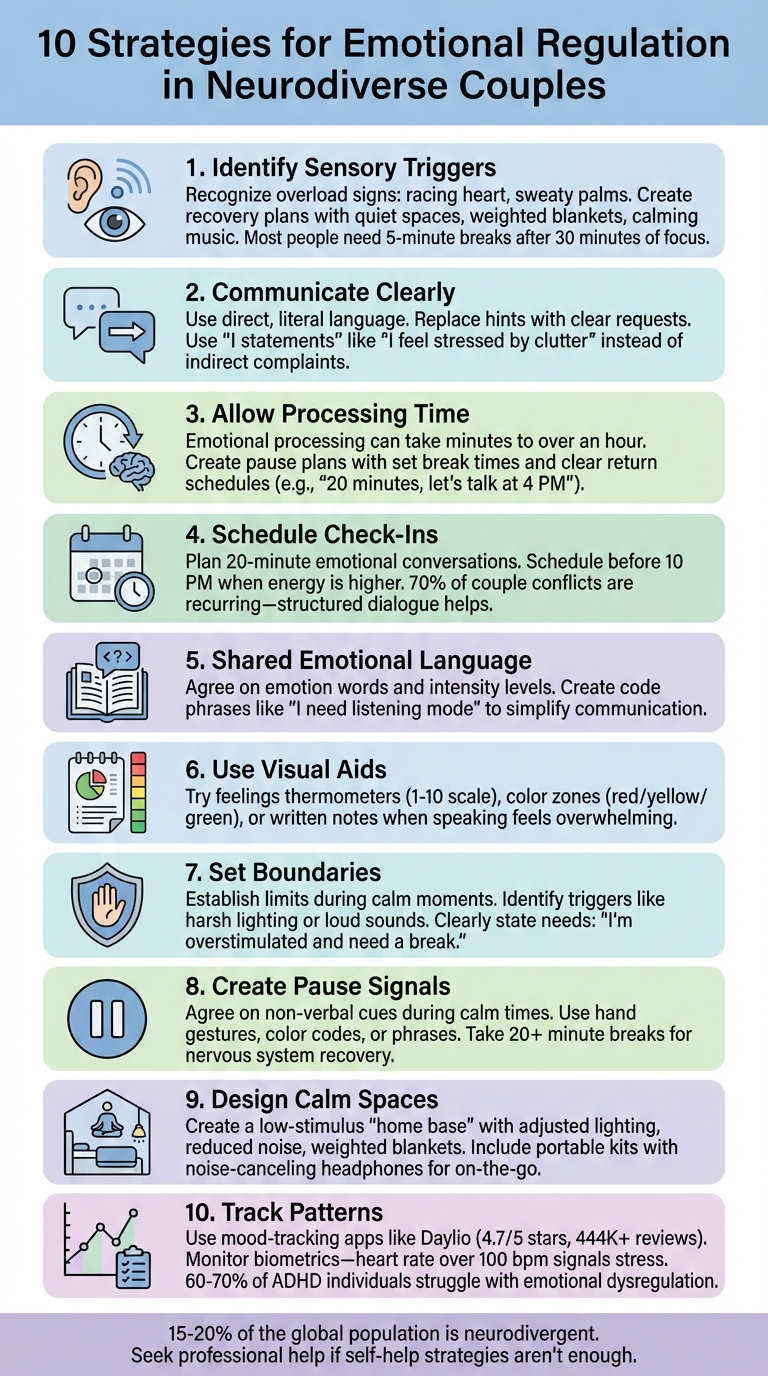
10 Emotional Regulation Strategies for Neurodiverse Couples
Tools for Neurodiverse/Mixed-Neurotype Couples: Zones of Regulation (emotion communication)
1. Identify Sensory Overload Triggers and Allow Recovery Time
Understanding sensory triggers plays a key role in managing emotions within neurodiverse relationships. Sensory overload often activates the fight, flight, or freeze response, making it tough to communicate calmly when it happens [11]. Recognizing these triggers helps create strategies to manage them effectively.
Some common triggers include loud sounds, bright or flickering lights, strong smells, uncomfortable clothing textures, temperature changes, and visual clutter [8][9]. Research suggests that most people can focus well for about 30 minutes before needing a short break, such as five minutes to reset [9].
Pay attention to early signs of sensory overwhelm, like a racing heartbeat, sweaty palms, or jaw clenching [3]. Clinical psychologist Dr. Megan Anna Neff highlights the importance of adopting a sensory-based perspective to understand how different inputs influence emotions [10]. Once you identify your triggers and warning signs, having a recovery plan in place becomes crucial.
Create a recovery plan tailored to your needs. This might include setting up quiet spaces or assembling a self-regulation kit with items such as weighted blankets, calming music, or soothing scents [8]. Holistic therapist Liz Zhou explains:
"When sensory input exceeds an individual’s tolerance, it can lead to a state of overload. This can manifest as anxiety, frustration, or withdrawal, effectively shutting down the relaxation response needed for intimacy" [8].
Communicate your needs clearly during sensory overwhelm. For example, you might say, "I need the lights off" or "I need 20 minutes of quiet." Pre-agreed signals can also be helpful for pausing conversations [9][12]. Importantly, if a partner withdraws, recognize it as a natural neurological response rather than a personal slight [1].
2. Communicate Emotional Needs Directly and Clearly
When it comes to neurodiverse relationships, subtle hints or sarcasm can often go unnoticed. Instead, it’s vital to use straightforward language. For instance, rather than hinting at frustration, say something like, "I feel stressed by the clutter; could you please help me clear the counters?" This approach removes ambiguity, making it easier to avoid misunderstandings.
Adela Stone, an expert in neurodiverse relationships, emphasizes this point:
"Neurodivergent partners may not easily pick up on sarcasm, tone, or subtle emotional cues. Clear, direct, and literal language is often the most helpful."
To build on this idea of clarity, a few strategies can make communication even more effective. Start with "I statements" to share your feelings without sounding accusatory. For example, instead of saying, "You never listen to me", try, "I feel hurt that you didn’t respond when I asked for help." This keeps the focus on your emotions and avoids placing blame.
Be explicit about your intentions. Whether you’re looking for advice, solutions, or just empathy, stating it upfront can reduce confusion and prevent overwhelming your partner. Just like addressing sensory triggers, clear communication minimizes the risk of misinterpretation or emotional overload.
Another helpful tool is developing a shared emotional vocabulary. For example, using a "feelings thermometer" can quickly convey emotional states or capacity, making it easier to navigate sensitive moments together.
Finally, don’t hesitate to ask clarifying questions. Simple inquiries like, "What do you mean by support?" or "Do you need advice or just someone to listen?" can go a long way in fostering understanding. As Dr. Kenneth Roberson explains:
"Ambiguity can often lead to confusion or misinterpretation."
3. Allow Extra Time for Emotional Processing
In neurodiverse relationships, expecting immediate answers isn’t always realistic. When stress takes over, the prefrontal cortex – often called the "thinking brain" – can temporarily shut down. Experts refer to this as losing regulatory control. When this happens, logical thinking and perspective-taking are out of reach until the nervous system has a chance to settle. Allowing extra time during these moments can prevent sensory overload or communication breakdowns [7].
Dr. Brittany Carswell, a psychologist at Wellness Psychological Services, offers insight into this process:
"The emotional brain reacts faster than the thinking brain can regulate."
This delay in emotional processing can range from a few minutes to over an hour [7]. For many neurodiverse individuals, including autistic partners, processing complex emotions takes more time [1]. This highlights why patience and intentional pauses are so important.
To navigate these situations, creating a "pause plan" can be a game-changer for both partners. A pause plan provides structure during emotional highs. As psychologist Crystal I. Lee explains, a delayed response often reflects a different cognitive style, not a lack of care. Silence during stress is a sign of nervous system regulation, not rejection.
Here’s how a pause plan can work: agree on a set break and a clear return time (for example, "I need 20 minutes; let’s talk at 4:00 PM"). This ensures neither partner feels abandoned. You can also use calming phrases like "Take your time" or "We’re okay" to ease tension while still giving the needed space [7].
4. Schedule Regular Emotional Check-Ins
For neurodiverse couples, unscheduled emotional conversations can feel overwhelming and chaotic. Predictability is key, and scheduling regular emotional check-ins offers a structured way to navigate feelings and relationship dynamics. Psychologist Crystal I. Lee highlights the importance of this approach:
"regular, scheduled conversations about feelings and relationship dynamics provide a safe framework for emotional connection without the unpredictability of spontaneous discussions" [1]
This method is particularly helpful for autistic partners, who often find comfort in routines, and for partners with ADHD, who may struggle with "time-blindness" [1]. By setting aside specific times for these conversations, couples can build on clear communication and sensory regulation strategies discussed earlier.
The Gottman Institute suggests dedicating 20 minutes to these check-ins as a way to maintain emotional intimacy [14]. Predictable conversations reduce emotional reactivity, creating more stability in the relationship. Research also shows that around 70% of conflicts between couples are recurring, which makes having a structured dialogue an effective way to address ongoing challenges [15].
Timing matters. Plan these check-ins earlier in the day or before 10:00 PM, when both partners are likely to have enough energy. Avoid scheduling them during times of hunger, exhaustion, or after consuming alcohol or other substances [14]. For partners with ADHD, setting reminders can act as helpful nudges to stay on track [1]. To ease into the conversation, try starting with "I" statements and include a brief transition activity, like taking a short walk or listening to calming music, to shift gears from daily tasks to relationship time [14].
To avoid misunderstandings, clarify expectations right from the start by asking, "Do you want my input, or would you prefer I just listen?" This ensures both partners are aligned. If verbal communication becomes too overwhelming due to sensory overload, consider using alternative methods like visual tools or written notes. Tools such as a "feelings thermometer" or a red/yellow/green zone system can quickly convey emotional states without requiring lengthy explanations.
5. Agree on Words to Describe Emotions
Once you’ve established open communication and regular check-ins, it’s time to take things a step further by fine-tuning how you and your partner talk about emotions.
Miscommunication often happens when we assume our partner defines emotions the same way we do. Developing a shared emotional vocabulary can help cut down on misunderstandings. Psychologist Crystal I. Lee highlights the importance of this:
"Developing a shared language for emotions, including intensity levels and specific triggers, creates a more precise communication system that works for both partners." [1]
To start, focus on identifying words that truly capture what you’re feeling. If you’re struggling to name an emotion, take a moment to reflect and find the right word. Pay attention to how your body reacts – sometimes, a sense of ease can confirm you’ve landed on the right emotion. For example, you might use words like amused, appreciated, satisfied, proud, alienated, tense, misunderstood, or powerless to describe how you feel.
Ellie Lisitsa from The Gottman Institute explains why this practice matters:
"If you cannot identify your own emotions, how are you supposed to understand them or process them or communicate about them with others?" [16]
You can also create code words to simplify emotional communication. For instance, saying something like "I need listening mode" can quickly convey your need for support without requiring a lengthy explanation.
Another helpful approach is neurotype translation, which involves explaining your internal experiences in clear terms that both of you understand. For example, what one person describes as frustration might feel more like sensory overload to the other. By using straightforward, literal language, you can bridge these differences and avoid the confusion that comes from assuming everyone processes emotions the same way.
6. Use Charts or Written Notes to Express Feelings
Sometimes, face-to-face conversations can feel overwhelming, especially during moments of high stress or sensory overload. That’s where visual tools and written communication come in – they offer a way to share your emotions without the pressure of speaking in the moment. These methods tie in with earlier suggestions for clear communication, giving you nonverbal options when emotions are running high.
Psychologist Crystal I. Lee highlights why this can be so effective:
"Using charts, scales, or written notes provides alternative communication methods that can be especially helpful during times of high emotion or sensory overload." [1]
One option is to use a feelings thermometer – a simple chart that uses colors or numbers to show how intense your emotions are. For example, you might use a scale from 1 to 10 or color-code your feelings: green for calm, yellow for stressed, and red for overwhelmed. This can quickly let your partner know if you’re ready to talk or if you need some space. Similarly, a red/yellow/green zone system can signal your emotional state at a glance, helping you both decide whether to dive into a tough conversation or hold off until later.
If charts aren’t your thing, written notes or letters might work better. As Yolanda Renteria suggests, tools like letters, texts, or even time-limited calls can reduce the stress of face-to-face exchanges [6]. Writing gives you the chance to organize your thoughts and removes the pressure of responding right away. For instance, you could send a quick text like, "I’m feeling anxious about tonight’s discussion", or leave a note explaining your feelings when talking feels too difficult.
Another helpful idea is creating a shared trigger list during calmer times. This list can outline specific triggers and strategies for managing strong emotions. When tensions rise, referring back to this list can help both of you navigate the situation more effectively. Therapist Adela Stone explains:
"These tools can defuse anger before it escalates and create a shared language for emotional experiences." [2]
sbb-itb-596b85d
7. Set Clear Limits on Sensory and Emotional Demands
The brain can only handle so much sensory and emotional input before it hits a breaking point. When that threshold is crossed, feelings like anxiety, frustration, or even withdrawal can take over [8].
To prevent this, it’s crucial to establish boundaries during calm moments. Psychologist Crystal I. Lee advises:
"Establish clear boundaries around sensory needs and emotional capacity. It’s best to do this when everyone is feeling calm and well regulated, versus in a moment of intense emotion or dysregulation" [1]
Work with your partner to identify specific triggers – things like harsh fluorescent lighting, loud chewing, or feeling overwhelmed by too much information. Once these are pinpointed, agree on strategies to manage them, such as setting "quiet hours" or asking for consent before initiating physical touch. These boundaries create a framework for open and direct communication about sensory needs.
Instead of relying on subtle hints, clearly express when you’re nearing your sensory limit. For example, you might say, "I’m feeling overstimulated and need a short break." This kind of direct communication helps clarify that taking space is about managing your well-being, not rejecting the other person.
It can also help to create a shared list of sensitivities – like certain fabrics that feel uncomfortable – to minimize accidental overstimulation [6].
By setting and respecting these limits, you can stay more present and connected in your relationship. Trauma therapist Yolanda Renteria highlights the importance of this practice:
"Honoring and meeting these basic needs for nervous system regulation can play a huge role in developing intimacy and bringing the relationship closer" [6]
When both partners respect each other’s boundaries, it fosters deeper connection without the risk of overwhelm.
8. Create Signals to Pause Difficult Conversations
Building on earlier strategies for managing sensory and emotional overload, creating pause signals offers couples a way to regain control during intense conversations. When emotions run high, communicating verbally can become difficult – especially for neurodivergent partners who may feel overwhelmed. Having pre-agreed signals to pause a discussion helps prevent an exchange from spiraling into a full-blown argument.
The key is to establish these signals during calm, neutral moments – not in the middle of a heated discussion. Psychologist Crystal I. Lee highlights the importance of this preparation:
"Having agreed-upon ways to request a break during difficult conversations prevents escalation and allows for emotional regulation before continuing" [1].
It’s important to understand that requesting a pause isn’t about dodging the issue. Instead, it’s about giving both partners the chance to reset emotionally and physically.
Often, non-verbal cues work best when words feel too overwhelming. These can include simple hand gestures, brief phrases like "I need 20 minutes", or even a color-coded system. For example, red might mean "I need to stop now", yellow could signal "I’m starting to feel overwhelmed", and green might indicate "I’m okay to keep going." Some couples also use "tap out" signals or unique code words as a way to immediately pause the conversation. These methods show how flexible and effective non-verbal communication can be in moments of distress.
There’s science behind why these pauses are so effective. Dr. John Gottman explains that the body needs at least 20 minutes to naturally calm down after emotional flooding [4]. This means any break should last at least that long to allow the nervous system to recover.
When calling for a pause, it’s helpful to specify when you’ll return to the conversation. For example, professionals at Rise Healing Center suggest saying something like, "Can we pause and revisit this at 4:00 PM?" [13]. This approach ensures clarity and reassures both partners that the discussion isn’t being abandoned – just postponed until both are ready to engage constructively.
9. Set Up Calm Spaces and Recovery Routines
After establishing pause signals, creating a calm space for recovery can make a world of difference. Often called a "home base", this is a designated low-stimulus area where neurodivergent partners can reset and recharge. Dr. K, a licensed psychologist, highlights the value of such spaces:
"A ‘home base’ is essential – a calm and low-stimulus environment where the neurodivergent person can find solace" [3].
This space works hand-in-hand with pause signals, offering a physical retreat for emotional recovery.
Designing these calm spaces should be a collaborative effort that considers both partners’ sensory preferences. For instance, you might adjust the lighting to avoid harsh fluorescents, reduce noise levels, or include soothing elements like weighted blankets. Psychologist Crystal I. Lee explains:
"Designating quiet, comfortable areas where either partner can retreat for self-care supports individual needs while maintaining the relationship dynamic" [1].
The key is to make this space a haven, not a place of isolation.
Once in the calm space, having a recovery routine can help restore balance. Simple, predictable steps – like staying hydrated or managing blood sugar levels – can make a big difference. Therapist Adela Stone suggests:
"Routines, visual schedules, or even a ‘cool-down plan’ can help create emotional safety" [2].
For situations where you’re not at home, a portable "meltdown kit" can be a lifesaver. Items like noise-canceling headphones, fidget tools, or calming apps can help manage overwhelm on the go.
After both partners have had time to recover, a quick post-recovery check-in can be helpful. Use this time to identify what caused the distress and what strategies worked well. This isn’t about blaming anyone but about learning and growing together. During these moments, respect verbal boundaries – sometimes a calming touch or simply being present is more supportive than asking for immediate explanations. Calm spaces and recovery routines are powerful tools for fostering emotional regulation, which is essential for strong neurodiverse relationships.
10. Use Apps or Journals to Monitor Emotional Patterns
Keeping track of emotional patterns can reveal trends that might otherwise go unnoticed, especially during stressful moments. Apps like Daylio (rated 4.7/5 stars with over 444,000 reviews) make it simple to log your mood and track changes over time [18]. Tools like this can help you and your partner pinpoint emotional triggers and recognize recurring cycles.
In addition to mood-tracking apps, wearable devices and other biometric tools can provide deeper insights into emotional states. For example, a heart rate exceeding 100 bpm might signal rising stress [4]. Having this kind of objective data allows you to pause and address emotions before they spiral out of control.
Sharing this information with your partner can turn emotional regulation into a collaborative effort. Consider creating a shared digital document where you both list common triggers and calming strategies. This way, you’ll have a quick reference guide during tense moments. As La Concierge Psychologist puts it:
"Implementing mood tracking apps, journals, or visual charts helps both partners understand emotional cycles and anticipate support needs more effectively" [1].
This teamwork-oriented approach removes the guesswork, making it easier for both partners to support each other.
The real power of tracking comes from identifying patterns over time. Research shows that 60–70% of individuals with ADHD struggle with emotional dysregulation [5]. By tracking moods, you can uncover whether specific times of day, activities, or physical states – like hunger or fatigue – tend to trigger emotional reactions. For those with ADHD who deal with time-blindness, setting phone reminders for regular emotional check-ins can make a big difference. These alerts help ensure emotional well-being becomes a consistent habit, rather than something forgotten during periods of hyperfocus [1].
When to Seek Professional Help
Sometimes, personalized strategies just aren’t enough to maintain emotional balance in neurodiverse relationships. That’s when seeking professional help becomes a crucial step in protecting your emotional well-being.
If you find yourself walking on eggshells around your partner’s moods or avoiding important conversations out of fear of their reaction, it might be time to seek support. Licensed psychologist Dr. K puts it this way:
"If you find yourself tiptoeing around moods, postponing important conversations, or dreading your partner’s reactions, you’re likely absorbing more stress than you should" [15].
Another common challenge is when sensory withdrawal is mistaken for personal rejection. This is where professional intervention can help resolve what therapists often call the "double empathy problem" [8]. Therapy becomes especially important when couples feel like they’re speaking completely different languages, leading to resentment and a sense of being stuck [6][8].
When self-help methods fall short, professional guidance can make a world of difference. Growth and Change Counseling, for example, focuses on neurodiverse relationships, particularly when one partner has Asperger’s or high-functioning ASD [20]. Founded by John Mark Kane, LMFT, the practice uses a blend of Cognitive Behavioral Therapy, mindfulness, and relationship-focused techniques tailored for neurodiverse couples. Importantly, their approach avoids labeling the neurodivergent partner in a way that could cause shame or rejection – an issue that sometimes arises in traditional therapy [17][8].
Another option is the Marriage Rescue Institute, which offers a 12-week intensive program aimed at stabilizing high-stress relationships. This program builds on earlier strategies to foster lasting improvements in emotionally complex dynamics. They provide a free initial consultation, and therapy sessions are priced at $150 for a 45-minute session with an Associate Marriage and Family Therapist or $200 with a Licensed Marriage and Family Therapist. Services are available in Campbell, San Jose, Los Angeles, Roseville, and via telehealth for clients throughout California [20][19].
Conclusion
Navigating emotions in neurodiverse relationships isn’t about quick solutions – it’s about creating lasting habits. Consistency is essential for these strategies to work effectively. As psychologist Crystal I. Lee puts it:
"Success in mixed neurotype relationships requires moving beyond mere accommodation to genuine understanding and appreciation of different emotional landscapes" [1].
At the heart of this approach is mutual respect for each partner’s unique way of processing the world. For instance, if one partner needs extra time to process emotions or prefers written communication over verbal discussions, these aren’t barriers – they’re simply different methods of coping. When seen through this lens, such behaviors foster trust and deepen connection [1].
To make these habits stick, start practicing them during calm, low-stress moments. For example, using a smartwatch to monitor your heart rate can help you recognize when it’s time to pause – if your heart rate hits 100 beats per minute or more, that’s your body telling you to take a break [4].
With an estimated 15% to 20% of the global population identifying as neurodivergent [6], you’re far from alone in facing these challenges. Many couples discover that tools like structured routines, visual aids, and clear communication protocols can transform misunderstandings into stronger partnerships. These strategies emphasize the value of clarity and structure in building emotional resilience.
If self-help approaches don’t seem to be enough, professional guidance can make a significant difference. Growth and Change Counseling offers specialized support for neurodiverse relationships, including a free initial consultation for those in California. Whether you opt for individual sessions or the Marriage Rescue Institute’s 12-week intensive program, working with professionals can help you build the emotional connection you’re striving for.
FAQs
How can neurodiverse couples recognize and manage sensory overload triggers?
Neurodiverse couples can start by pinpointing sensory triggers that may cause overload. These might include things like bright lights, loud sounds, strong odors, or crowded spaces. A helpful first step is keeping a simple sensory log for a week. By tracking environments, activities, and emotional reactions, couples can uncover patterns and start meaningful conversations – without assigning blame.
After identifying these triggers, couples can collaborate to design a sensory-friendly space. Small adjustments can go a long way: noise-canceling headphones, softer lighting, designated quiet areas, or planned sensory breaks can all help. Tools like a “feelings thermometer” or other visual aids can also make it easier for partners to express how they’re feeling.
If managing these challenges feels daunting, reaching out for professional guidance can make a difference. Growth and Change Counseling offers support tailored to neurodiverse relationships, helping couples build personalized strategies for sensory and emotional well-being.
How can neurodiverse couples develop a shared emotional language?
Developing a shared emotional language can help neurodiverse couples better navigate each other’s feelings, triggers, and needs. Since neurodivergent individuals often process emotions and social cues differently, having a clear and intentional way to communicate can cut down on misunderstandings and create stronger connections.
The first step is boosting self-awareness. Each partner should take time to reflect on their emotions, triggers, and preferred ways of coping, then share these insights openly. Together, couples can create tools like a visual "feelings chart" – for example, green for calm, yellow for stressed, and red for overwhelmed – to make emotions easier to recognize and talk about. Using specific and concrete phrases, like "I feel anxious because of the loud noise", instead of vague expressions, can also make communication much clearer.
To make this shared language part of daily life, couples can adopt simple practices. These might include scheduling regular emotional check-ins, keeping written logs to track triggers and coping strategies, or agreeing on a signal – like a word or gesture – to indicate when someone needs a break. If creating these tools feels daunting, working with a professional can make a big difference. Growth and Change Counseling offers personalized support to help neurodiverse couples build effective communication systems and strengthen their relationships.
When should neurodiverse couples seek professional support for emotional regulation challenges?
Neurodiverse couples might find professional support helpful when emotional regulation challenges go beyond occasional disagreements and start to put strain on the relationship. Some key indicators to look out for include frequent or increasingly intense arguments, repeated shutdowns or meltdowns, difficulty recovering after conflicts, or feeling unheard or unsafe within the partnership. If these issues begin to interfere with daily life – like work, sleep, or mental health – or if self-help efforts no longer seem to work, seeking therapy could be a valuable step.
For couples finding it hard to navigate communication differences tied to their neurotypes, a therapist experienced in neurodiverse relationships can provide customized strategies and guidance. Growth and Change Counseling offers neurodiversity-affirming services, including the 12-week Marriage Rescue Institute program. This program is designed to help couples achieve emotional balance, strengthen communication, and rebuild trust in their relationship.
Related Blog Posts
- Emotional Intelligence for Neurodiverse Couples
- Understanding Emotional Cues in Neurodiverse Couples
- Ultimate Guide to Emotional Growth for Neurodiverse Couples
- Ultimate Guide to Emotional Communication in Marriage
