Marriage intensives are short-term, focused counseling programs designed to address deep relationship challenges in just 2 to 5 days. Unlike weekly therapy sessions, which often take months to show progress, intensives provide concentrated support, equivalent to 6 months to a year of counseling, in a retreat-like setting. Here’s what you need to know:
- Time Commitment: 16–24 hours of therapy spread over 2–5 days.
- Effectiveness: Studies show 70–80% of couples see improvement with follow-up care, compared to just 7% for weekly sessions in severe cases.
- Approach: Evidence-based methods like the Gottman Method and Solution Oriented Counseling focus on actionable solutions rather than dwelling on past conflicts.
- Cost: Prices range from $1,300 to over $7,000, depending on program length and format.
- Formats: Available in-person or virtually, with options for private sessions or group workshops.
Marriage intensives are ideal for couples facing major conflicts, recovering from infidelity, or those who find weekly therapy ineffective. Whether in-person or online, these programs offer a structured path to rebuild trust, improve communication, and strengthen your relationship.
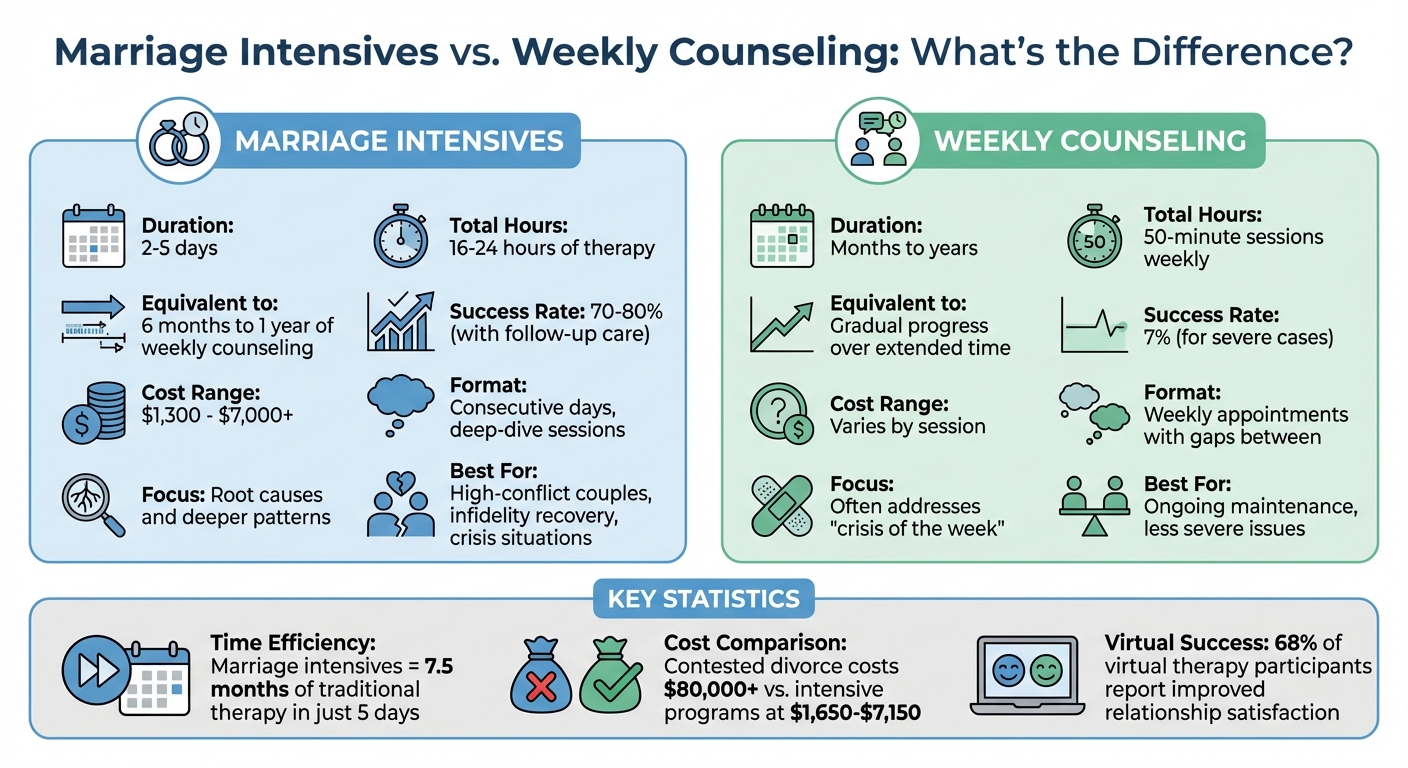
Marriage Intensives vs Weekly Counseling: Key Differences and Success Rates
How Marriage Intensives Differ from Weekly Counseling
What Makes the Intensive Model Different
The biggest difference between marriage intensives and traditional counseling lies in the condensed format. Instead of the usual 50-minute weekly sessions that stretch over months, marriage intensives pack over 20 hours of therapy into just a few consecutive days. This eliminates the time spent catching up or transitioning between appointments, allowing couples to dive straight into the work [3][1].
Weekly counseling often gets sidetracked by the "crisis of the week", focusing on the latest argument or surface-level tension. Marriage intensives, on the other hand, go straight to the root of the problem, addressing deeper patterns and issues that fuel recurring conflicts [3][2].
Another key advantage is the setting. By stepping away from daily distractions like work, household chores, and childcare, couples can fully dedicate themselves to repairing their relationship. This uninterrupted focus makes it easier to engage deeply and work through challenges effectively [1][4].
Main Benefits of Marriage Intensives
The structure of marriage intensives offers unique benefits that weekly counseling often can’t match. For couples on the verge of separation, this format provides a concentrated "reset" that can quickly resolve conflicts and rebuild trust. Rather than waiting weeks or months for progress, couples can move from crisis to renewed commitment in just a few days [9][6][7].
The extended, continuous nature of intensives also allows therapists to tackle complicated emotional wounds and destructive patterns that are hard to address in shorter, fragmented sessions. Studies show that 70–80% of couples see measurable improvements when follow-up care is included [9]. This approach is especially effective for couples dealing with high-conflict situations, recovering from infidelity, or those who feel traditional weekly counseling hasn’t worked for them.
What Happens During Marriage Intensives
Initial Assessment and Goal Setting
The journey through a marriage intensive typically begins with a thorough assessment and goal-setting process. Before your first session, many programs kick things off with pre-intensive work, which might include detailed questionnaires and a 50-minute video session. These steps help identify the key challenges in your relationship and set clear objectives. By doing this groundwork upfront, therapists can dive straight into addressing your concerns during the sessions, avoiding the need to spend time on intake paperwork [5].
Some programs also incorporate tools like the Gottman Relationship Checkup to evaluate your relationship dynamics [5]. On the first day, you’ll review your relationship history, and the therapist will conduct individual interviews with each partner to understand your perspectives. By the end of this initial day, you’ll have a customized treatment plan tailored to your relationship’s unique needs [4][6].
Therapy Techniques and Tools Used
Marriage intensives focus on evidence-based methods that have demonstrated success. Popular approaches include the Gottman Method and Solution Oriented Counseling (SOC). These techniques emphasize actionable solutions over dwelling on past conflicts, allowing couples to make meaningful changes right away [4][5][10].
Therapists use solution-driven strategies to tackle deeply rooted issues. For example:
"Solution Oriented Counseling (SOC) has the highest success rate of all counseling methods… we do not hang out in the past – blaming, fault finding… we put our time and energy into creating do-able solutions."
- Marriage Rescue Institute [5]
Beyond discussion, intensives incorporate hands-on exercises like communication drills, conflict resolution practice, and specific "behavior requests" designed to prompt immediate change. Many programs also provide resources such as customized workbooks, digital tools, and the Gottman Builder to support ongoing progress. Supplemental homework assignments reinforce what you’ve learned, ensuring that the lessons stick [5].
How Sessions Build on Each Other
Once goals are set and tools are introduced, the sessions are designed to build progressively. Each day typically involves 4 to 6 hours of therapy, divided into morning and afternoon blocks with breaks in between [4][5]. This structure keeps the momentum going, avoiding the weekly reset that often interrupts progress in traditional therapy.
As the sessions continue, the focus shifts to deeper work. Therapists help couples process painful experiences, resolve stubborn conflicts, and tackle the underlying issues driving recurring arguments [5][6]. Toward the end of the intensive, the emphasis moves to integration – practicing new skills, creating a clear plan for the future, and fostering shared meaning in the relationship [4][5].
The sequential nature of these sessions is key to their success. With no week-long gaps, couples remain immersed in a focused environment, free from everyday distractions like work or household responsibilities. This concentrated approach allows progress to compound quickly, making the most of the time spent in therapy [5].
Program Formats and Delivery Options
Short-Term Programs: 2-5 Day Intensives
Short-term intensives pack months of therapy into just a few focused days. For couples with a strong foundation of trust, a three-day program can be highly effective. However, when trust has been broken – such as in cases of infidelity – a four-day intensive allows more time to rebuild safety and connection. For more complex challenges, like blended family dynamics or parenting conflicts, a five-day program provides the space needed to work through these issues. To put it into perspective, a five-day intensive can achieve results comparable to about seven-and-a-half months of traditional therapy [5].
Pricing for these programs varies. The Marriage Rescue Institute offers set rates: $2,795 for a three-day program, $3,695 for four days, and $4,595 for five days [5]. Other providers might charge as low as $1,300 for a single day, while premium multi-day packages can exceed $7,000 [2, 4, 12]. For couples seeking a longer-term option, extended 12-week programs are another viable route.
Extended Programs: 12-Week Structured Models
The 12-week model, like the one offered by The Marriage Rescue Institute, provides a different approach. Instead of compressing therapy into a few days, this format spreads out intensive coaching and support over three months. This structure allows couples to gradually practice new skills, implement lasting changes in their daily routines, and develop healthier habits with ongoing guidance and accountability.
In-Person vs. Virtual Delivery
Regardless of the program format, couples can choose between in-person or virtual delivery, both of which offer effective results. Research shows no significant difference in outcomes – whether it’s improved communication, mental health, or relationship satisfaction – between the two formats [13, 14, 15]. In fact, 68% of participants in virtual couples therapy report improved relationship satisfaction, a success rate on par with traditional in-person sessions [12].
In-person intensives provide a fresh environment, free from everyday distractions like work emails, chores, or parenting demands. This neutral setting helps couples focus entirely on their relationship [5, 8]. Virtual intensives, on the other hand, offer unmatched convenience. They eliminate the need for travel, childcare, or taking time off work [16, 17]. For those unable to attend in person, The Marriage Rescue Institute offers private virtual sessions via Zoom, sending materials ahead of time and encouraging a quiet, distraction-free setting at home [5]. This option is particularly helpful for busy professionals, parents, and those in rural areas with limited access to local services [16, 18].
To make virtual sessions as effective as in-person ones, it’s essential to approach them with the same level of commitment. This means being punctual, avoiding multitasking, and ensuring a stable internet connection. When these conditions are met, the bond between couples and their counselor can be just as strong as in face-to-face sessions [14, 15].
Expected Outcomes and Follow-Up Support
Immediate Results
Marriage intensives deliver noticeable changes in just a matter of days [10]. By the second day, many couples report emotional stabilization, transitioning from the edge of divorce to a renewed commitment to their relationship [4][10]. The focused nature of these sessions – usually spanning 12 to 24 hours over 2–5 days – creates an environment where destructive communication patterns can be interrupted, trust rebuilt, and intimacy restored [4].
"Had a better insight by day two than listening to other therapists for years."
- Relationship Therapy Center client [10]
Couples leave these sessions equipped with practical tools for resolving conflicts, rekindling friendship, and rediscovering shared goals. These foundational skills can be immediately applied at home, setting the stage for long-term transformation [4].
Long-Term Changes
While the immediate breakthroughs bring relief, the key to lasting change lies in consistently applying new behaviors. Studies reveal that 70–80% of couples see measurable improvements when follow-up care is integrated into the process [9]. The difference between couples who sustain their progress and those who don’t often hinges on their openness to trying new strategies. As The Marriage Rescue Institute aptly puts it: if old methods had worked, there wouldn’t have been a need for change [5].
Sustained success requires couples to implement "behavior requests" developed during the final sessions. These might include daily communication habits or new approaches to managing conflict [5]. A physical manual or workbook provided during the intensive serves as a helpful guide, ensuring couples stay on track when challenges arise at home [3]. To fully embed these changes, structured follow-up support is critical.
Aftercare and Continued Growth
Aftercare is what transforms temporary relief into lasting recovery. Effective programs combine the intensive experience with structured follow-up, such as coaching sessions, digital tools, and ongoing support [5][9]. For instance, The Marriage Rescue Institute offers six months of phone support at no extra cost, while Hope Restored provides two free check-in sessions with a coach [5]. Programs that include this combination of intensive therapy and aftercare report significantly higher success rates compared to those offering only the initial retreat [9].
Follow-up care often includes at least one 50-minute session to evaluate progress and fine-tune the couple’s action plan [2]. Some programs, like The Marriage Restoration Project, extend their support with a series of private coaching sessions to reinforce the breakthroughs achieved during the intensive [9]. Many couples also gain access to digital resources, such as expert-led videos and customized workbooks, to continue practicing their new skills [3]. This ongoing support helps couples navigate the challenges of applying what they’ve learned to their daily lives, ensuring the progress made during the intensive becomes a lasting part of their relationship.
sbb-itb-596b85d
Choosing the Right Intensive for Your Needs
Evaluating Your Marital Challenges
The first step in selecting a marriage intensive is understanding the specific challenges in your relationship. Couples facing serious issues like divorce, infidelity, or an inability to communicate effectively often require clinical intensives led by licensed therapists rather than motivational retreats [9][15]. If you’re dealing with sensitive matters such as betrayal or addiction, a private one-on-one intensive can provide the confidentiality and safe space needed for meaningful healing [9][16].
Different programs cater to various challenges. Some focus on recovering from infidelity, while others address issues like "roommate syndrome", trauma, or the complexities of blended families [13][9][16]. It’s also important to consider the therapeutic approach used. Methods like the Gottman Method or Emotionally Focused Therapy (EFT) are evidence-based and widely respected [13][9][15]. Understanding these factors can help you narrow down your options before weighing practical considerations.
Practical Factors to Consider
Once you’ve assessed your relationship needs, think about the logistics of choosing a program. Time and cost are often major considerations. A 2-day intensive can deliver the same benefits as six months of weekly counseling sessions [4][6], making it a great option for busy professionals who can’t commit to long-term therapy [3][5]. Prices range from about $1,300 for single-day sessions to $7,150 for multi-day programs [2][4][5][11]. Keep in mind that most intensives aren’t covered by insurance, though you may be able to request a receipt for potential out-of-network reimbursement [3][5].
Another key decision is whether to choose a faith-based or a strictly scientific approach. Some couples value Biblical integration, while others prefer methods grounded in science [14][9][1]. The format of the intensive is also worth considering. Private intensives typically offer 16–20 hours of focused counseling over 3–5 days, while group workshops provide shared learning experiences but less individualized attention [5].
Virtual Options with The Marriage Rescue Institute
For couples unable to attend in-person sessions, The Marriage Rescue Institute offers a 12-week virtual intensive through Growth and Change Counseling. This program provides a structured, extended approach, allowing couples to work on their relationship over time while maintaining their daily routines. Virtual sessions eliminate travel costs and stress while offering the same clinical depth as in-person programs [8][5].
To make the most of a virtual intensive, it’s essential to create a distraction-free environment and ensure you have a reliable internet connection [5][11]. The Marriage Rescue Institute’s telehealth services are available to couples across California, making it a convenient option for those with tight schedules, childcare obligations, or geographic challenges. This accessibility ensures that even couples with demanding circumstances can access high-quality marriage support.
Intensive & Marathon Couples Therapy – Explained by Gottman Couples Therapists
Conclusion: Taking the First Step Toward Healing
If your marriage is struggling, waiting often makes things worse. Traditional weekly counseling has a success rate of just 7% for high-conflict couples [5], while marriage intensives show success rates between 70% and 80% when follow-up care is included [9]. The key difference is the intensive format – it dives deep into the root causes of conflict, breaking harmful cycles instead of just addressing surface-level disagreements.
Taking that first step is a commitment to change. As Rabbi Shlomo Slatkin, M.S., LCPC, explains:
"A marriage intensive is like a ‘relationship reset button’ – giving you a fresh start in days, not months" [9].
This reset provides practical tools to rebuild trust and strengthen your connection.
The cost of these programs ranges from $1,650 to $7,150 [2][4][5], but consider this: a contested divorce can cost over $80,000 [9], not to mention the emotional strain on you, your spouse, and your family. When viewed as an investment in your relationship, the value becomes undeniable.
For couples in California who can’t travel or need a more flexible option, The Marriage Rescue Institute offers a 12-week virtual intensive through Growth and Change Counseling. This program delivers the same clinical depth as in-person sessions, while allowing you to stay on top of your daily responsibilities.
Break the cycle of conflict, seek expert guidance, and give your marriage the focused attention it needs. Choosing an intensive program means committing to meaningful, focused progress. Your relationship can change – it all starts with that first step.
FAQs
What makes a marriage intensive more effective than traditional weekly counseling?
A marriage intensive is like a fast-track solution for couples looking to repair and strengthen their relationship. Instead of stretching therapy sessions over months, this approach condenses the work into just a few focused days. This uninterrupted format keeps the momentum going and allows couples to dive deeper into the core issues, free from the usual distractions of daily life.
These intensives are also designed with flexibility and privacy in mind. You can choose a schedule that works for you, typically ranging from 1 to 3 days. And if traveling isn’t an option, Growth and Change Counseling’s The Marriage Rescue Institute offers a Virtual Intensive program. This means couples across California can access the same in-depth experience through secure telehealth sessions, making it easier to prioritize their relationship without disrupting their busy routines or worrying about location barriers.
How can marriage intensives help couples dealing with infidelity or constant conflict?
Marriage intensives offer couples a dedicated and immersive setting to tackle serious relationship challenges, such as infidelity or persistent high-conflict dynamics. Typically lasting 2–5 days, these programs involve over 20 hours of concentrated therapy with a licensed therapist. The goal? To create a safe and private space where couples can engage in honest conversations and begin the healing process without the distractions of everyday life.
Therapists employ proven approaches like Emotionally Focused Therapy (EFT), Imago Relationship Therapy, and trauma-focused methods such as EMDR. These techniques help couples rebuild trust, reduce conflicts, and establish healthier communication habits. By the end of the intensive, couples leave with a clear action plan, practical tools, and accountability steps to continue strengthening their relationship.
For those who prefer to work from home, Growth & Change Counseling offers The Marriage Rescue Institute’s Virtual Intensive. This 12-week remote program provides the same depth as in-person sessions, featuring structured therapy, betrayal recovery support, and personalized guidance – all without requiring travel.
How do couples decide between in-person and virtual marriage intensives?
When choosing between in-person and virtual marriage intensives, couples should weigh factors like cost, travel, and scheduling flexibility to determine what works best for them. In-person intensives often take place in peaceful, retreat-like settings, offering couples a chance to step away from daily distractions and concentrate solely on their relationship. While this immersive experience can be incredibly beneficial, it often comes with added travel time and expenses, which might not be practical for everyone.
On the other hand, virtual intensives – such as those provided through Growth and Change Counseling’s Marriage Rescue Institute – deliver the same structured and private counseling experience without requiring travel. These sessions are more adaptable to busy schedules, making it easier for couples to balance work and family commitments. Plus, they can be done from home, as long as there’s a stable internet connection and a quiet, private space available.
The decision ultimately comes down to what feels right for each couple. Whether it’s the focused atmosphere of a retreat or the convenience and flexibility of telehealth, the choice should align with their preferences, comfort with technology, and budget.
Related Blog Posts
- Anger Management Therapy for Trust Repair
- Marriage Rescue: Intensive Therapy for Couples in Crisis
- How to Create a Crisis Recovery Plan for Your Marriage
- Marriage Counseling for Generational Trauma Recovery
