Recovery can strain finances, especially for couples. Costs like treatment, legal fees, and missed bills often pile up, creating stress. Money issues also impact trust, with hidden spending and financial missteps causing conflict. Here’s how couples can regain control:
- Review Finances Together: List income, expenses, debts, and assets. Reflect on past money habits and address any hidden financial issues.
- Set Joint Goals: Focus on priorities like emergency funds, debt repayment, or retirement. Use SMART goals to stay clear and actionable.
- Build a Budget: Include essentials, recovery costs, and savings. Choose a money management method that works for both partners.
- Stay Accountable: Use tools like budgeting apps or shared accounts. Schedule regular check-ins to track progress.
- Rebuild Trust: Be open about financial decisions and use spending limits to avoid surprises. Seek professional help if conflicts persist.
Managing money during recovery isn’t just about numbers – it’s about working as a team to rebuild trust and stability.
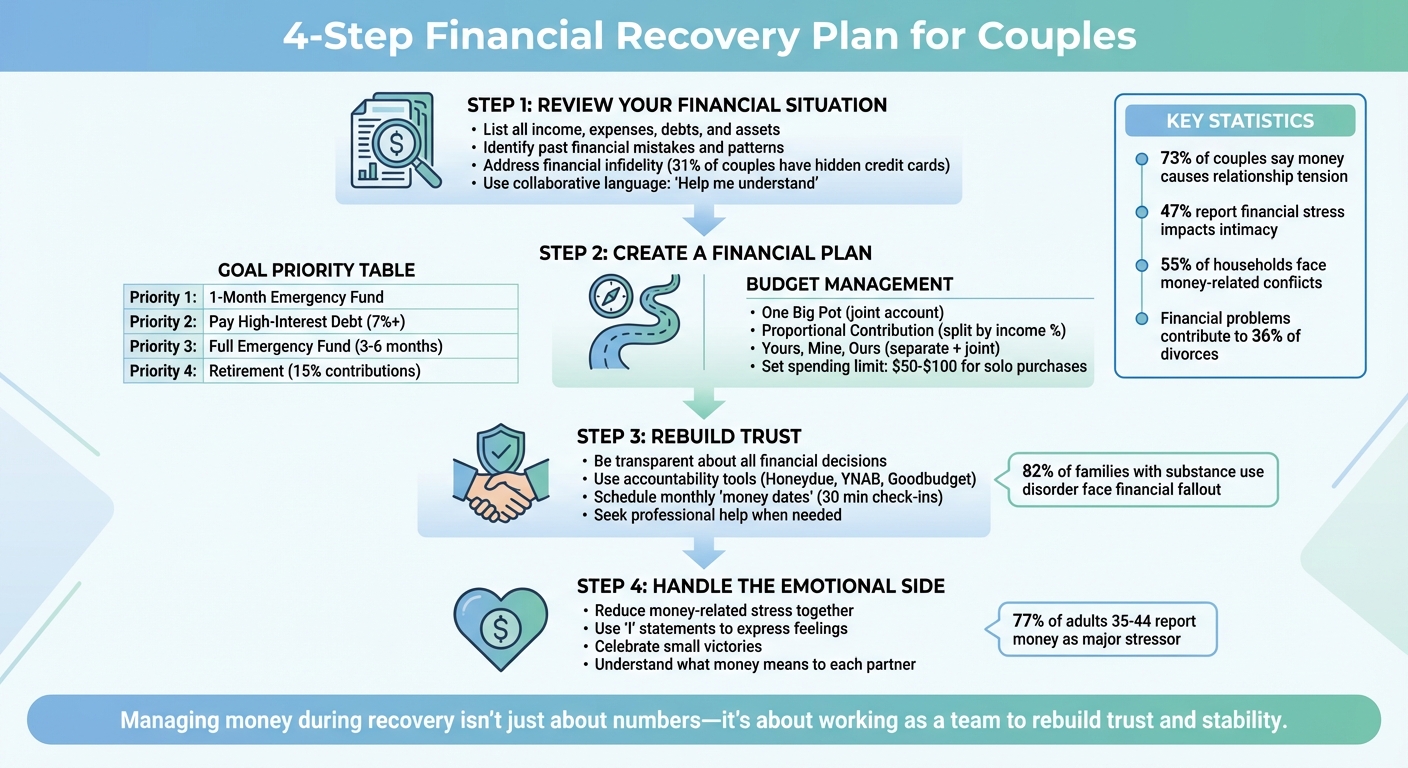
4-Step Financial Recovery Plan for Couples
Finances and Budgeting in Recovery
Step 1: Review Your Financial Situation Together
The first step in managing money during recovery is sitting down as a team to take an honest look at where you stand financially. This isn’t about pointing fingers or assigning blame – it’s about getting a clear picture so you can move forward together. Let’s break it down into actionable steps.
List All Assets, Debts, and Expenses
Set aside a couple of hours in a quiet, private space where you won’t be interrupted. Use this time to gather all your important financial documents: pay stubs, bank statements, debt records, credit reports, and bills. If most of your records are digital, review them together on a laptop or tablet.
Here’s what to include in your financial inventory:
- Income Sources: List everything – primary paychecks, bonuses, side gigs, rental income, dividends, or Social Security benefits.
- Expenses: Separate fixed costs (like rent, insurance, and utilities) from variable costs (like groceries, entertainment, and personal care).
- Debts: Document all outstanding balances – credit cards, student loans, car payments, medical bills, and mortgages. Make sure to note the interest rates, especially for high-interest debts (7% or higher), as they can significantly impact your financial progress.
- Assets: Record your checking and savings account balances, retirement funds, investments, and the current value of any property you own.
Identify Past Financial Mistakes
Once you’ve laid everything out, take a moment to reflect on past financial habits and behaviors. Think about how your early experiences shaped your views on money. Financial therapists often refer to these early beliefs as "money scripts." For example, one of you might have grown up with a mindset of scarcity, while the other experienced abundance. Or perhaps money was tied to feelings of security, freedom, or stress. These beliefs can influence how you approach finances today.
"Money isn’t just math – it’s meaning (safety, fairness, freedom, identity). That’s why money talks can feel so charged."
- Shlomo Slatkin, Licensed Couples Therapist
Next, review your spending habits together. Look for patterns of impulsive or thoughtless spending and identify areas where financial tension has arisen in the past. Maybe one of you values saving for the future while the other prioritizes spending on experiences. Or perhaps hobbies and personal interests have caused disagreements before. Recognizing these patterns can help you avoid repeating the same mistakes.
Another critical area to address is financial infidelity. This includes hidden accounts, undisclosed debt, secret spending, or even stashing paychecks. In fact, 31% of couples admit to having a credit card their partner doesn’t know about, and one in three married individuals admits to hiding a purchase [4].
"Intentionally keeping financial information from your spouse (or lying about it) is known as financial infidelity, because it is that serious."
- Gal Szekely, The Couples Center
It’s important to distinguish between an innocent oversight and deliberate secrecy. Forgetting to mention a small purchase is very different from hiding a major expense or debt. The goal here isn’t to blame but to uncover the fears or dynamics behind these actions so you can rebuild trust.
Use language that invites collaboration, like “Help me understand,” and take breaks if emotions run high. Remember, you’re tackling this together. By understanding these patterns and behaviors, you can start building a stronger, more transparent financial partnership.
Step 2: Create a Financial Plan Together
Once you’ve got a solid overview of your finances, the next step is crafting a plan that works for both the short and long term. This means setting a clear direction for your financial future while also creating a weekly budget to keep things on track. During recovery, being aligned on financial goals is just as important as working through emotional challenges. Think of the financial plan as your roadmap (where you’re headed) and the budget as the daily steps that get you there [9].
Set Financial Goals as a Couple
Using your financial review as a starting point, set specific goals that reflect your shared priorities. Are you aiming for security, like building savings or paying off debt? Or are you focused on family needs, such as a new home or childcare expenses? These goals should represent your shared values, not just numbers on a spreadsheet [9].
"Creating a financial plan as a couple enables you and your partner to align on what you want to accomplish, and empowers you to make progress as a team."
- Natalie Taylor, CFP®, BFA™, Monarch Money [9]
Here’s a common approach to prioritizing goals:
| Goal Priority | Action Step | Purpose |
|---|---|---|
| Priority 1 | 1-Month Emergency Fund | Provides immediate security for unexpected expenses [9]. |
| Priority 2 | High-Interest Debt (7%+) | Cuts interest costs and improves cash flow [9]. |
| Priority 3 | Full Emergency Fund (3-6 months) | Ensures long-term financial stability [9]. |
| Priority 4 | Retirement Contributions (15%) | Builds financial independence for the future [9][7]. |
To make these goals actionable, use the SMART framework: Specific, Measurable, Achievable, Relevant, and Time-bound [10]. For instance, instead of saying, “save more money,” say, “save $1,500 for a one-month emergency fund by June 30, 2026.” This gives you a clear target and timeline.
It’s also essential to address any “financial baggage” upfront – things like hidden debt, past spending mistakes, or poor credit scores [8][3]. Tackling these issues early prevents misunderstandings later. Keep in mind, 73% of married or cohabitating Americans say money decisions cause tension in their relationship, and 47% report that financial stress has impacted their intimacy [9]. Aligning on goals can help turn this around.
Build a Budget That Works
A successful budget should cover three main areas: essential expenses (housing, utilities, groceries), recovery-related costs (therapy, medical bills, or support groups), and debt repayment (credit cards, student loans, back taxes) [8][10]. Including recovery costs ensures your budget is realistic and comprehensive.
Start by dividing your monthly expenses into fixed (e.g., rent, utilities) and variable categories (e.g., groceries, entertainment). Then, choose a money management approach that suits your relationship:
- One Big Pot: Combine all income into a joint account for shared expenses. This works best when trust is high and spending habits are similar [8].
- Proportional Contribution: Split expenses based on income percentages. For example, if one partner earns 60% of the household income, they cover 60% of the shared costs [5][6].
- Yours, Mine, and Ours: Maintain separate accounts for personal spending while contributing to a joint account for shared bills and goals. This is often recommended when there’s a history of substance abuse or spending issues [8][5][6].
To avoid disputes, set a “no-questions-asked” spending limit – say $50 or $100. Purchases above that amount should be discussed first [10][6]. This approach balances individual freedom with accountability.
Make budgeting a team effort by scheduling monthly “budget dates.” Spend 30 minutes reviewing your progress – what’s working, what’s not, and what adjustments are needed. Celebrate small wins, like saving on groceries or paying extra toward debt. Tools like Mint, Goodbudget, YNAB, or Honeydue can simplify tracking and keep you both accountable in real-time [8].
"Spend extravagantly on the things [you] love, and cut cost mercilessly on the things [you] don’t."
- Ramit Sethi, Author [7]
This mindset ensures your budget doesn’t feel like a punishment. Love dining out? Cut back on less meaningful expenses, like unused subscriptions, so you can enjoy guilt-free restaurant meals.
Divide Financial Responsibilities
Even with a solid budget, someone needs to handle the day-to-day tasks like paying bills, monitoring accounts, and updating the budget. Divide these responsibilities based on each person’s strengths while keeping both partners informed.
Start by listing all financial tasks – paying the mortgage, managing credit card payments, filing taxes, and so on. Then, decide who’s better suited for each task. Maybe one of you is great with spreadsheets, while the other prefers big-picture planning. Play to your strengths, but ensure both partners have equal decision-making power [3].
Maintaining transparency is key. Use shared spreadsheets or apps to track expenses and avoid financial secrecy, which can erode trust. Regular check-ins help ensure everyone stays on the same page.
"Conflict about money is rarely just about dollars and cents, it’s about the emotions, values, and dreams underneath."
Automate savings, retirement contributions, and debt payments to stay consistent without the emotional stress of manual transfers [7]. For instance, if you’re saving $200 a month for an emergency fund, set up an automatic transfer right after payday.
Lastly, don’t overlook the importance of a backup plan. Build a safety net with tools like life insurance, long-term disability coverage, and a will or power of attorney [9][6]. About one in four 20-year-olds will face a disability that prevents them from working for at least a year [9]. Preparing for such scenarios ensures your family’s financial security, no matter what life throws your way.
sbb-itb-596b85d
Step 3: Rebuild Trust Around Money
Once your financial plan is in place, the next step is to tackle the deeper issues – like fears, shame, or past trauma – that often linger around money [2]. Without trust, even the most carefully crafted budget won’t hold up. Rebuilding trust requires honesty, reliable tools for accountability, and professional guidance when needed.
Be Open About All Financial Decisions
Rebuilding trust starts with complete transparency. Set aside two hours to review key financial documents together – pay stubs, debt statements, account balances, and credit scores. Approach this without judgment to ensure you’re both aligned [6].
One of the biggest trust-breakers in relationships is financial infidelity. This kind of secrecy often stems from fear or shame, and it can be especially damaging during recovery. Hidden spending, for instance, can act as a relapse trigger. In fact, research shows that 82% of people who have a loved one with a substance use disorder report financial fallout, such as unpaid bills or drained savings [1].
"Financial infidelity is when one or both partners in a relationship lie about or hide financial information from each other. It can stem from fear, shame, or past financial trauma, and it often feels like a form of betrayal because it breaks trust."
To rebuild that trust, shift your perspective from “yours and mine” to “ours” [5]. While it’s fine to keep some personal spending money, both partners should stay informed about major financial decisions. For instance, you might agree that any purchase over a certain amount – say $50 or $100 – requires a joint discussion [6].
Once open communication is established, technology can help keep things on track.
Use Tools to Stay Accountable
Transparency is just the first step. To sustain your progress, practical tools can help both partners stay accountable. Shared bank accounts or budgeting apps allow you to see transactions in real time, minimizing the risk of impulsive spending [11]. Interestingly, a study of 38,000 couples found that those who pooled their finances often reported feeling more connected [11].
For couples navigating recovery, specialized tools can add an extra layer of security. For example, the True Link Visa Prepaid Card lets a support person set spending rules, block risky merchants (like liquor stores), and receive real-time alerts on transactions [1]. This isn’t about control – it’s about creating a safe financial environment during a vulnerable period.
Here are a few tools that work particularly well for couples:
| Tool/App | Key Feature | Cost |
|---|---|---|
| Honeydue | Lets couples view balances and bills together | Free |
| Goodbudget | Uses a digital "envelope system" to organize spending | Free / $8/month |
| YNAB | Assigns every dollar a purpose; great for tackling debt | $14.99/month |
| True Link Visa | Offers spending rules and real-time monitoring for recovery | Varies |
Consider scheduling a monthly “money date” – a relaxed 30-minute check-in to review spending, celebrate wins, and tweak your plans as needed [6]. Automation can also make life easier. Set up automatic transfers for savings, debt payments, and retirement contributions to eliminate manual decisions each month [7].
Get Professional Help When Needed
If money disagreements become frequent, financial infidelity surfaces, or stress about finances starts to affect your relationship, it’s time to seek professional help [2].
A financial advisor can guide you through technical aspects like debt repayment, retirement planning, or setting joint financial goals [2]. But if your money issues are tied to deeper emotional struggles – such as control, fear, or resentment – working with a couples therapist might be more effective.
"A couples counselor assists partners in expressing their emotions, addressing relationship challenges, and resolving disputes regarding money/finances. Couples therapy fosters greater understanding, respect, affection, and intimacy."
- Reshawna Chapple, PhD, LCSW, Talkspace [2]
For couples in addiction recovery, targeted support is even more critical. Money can often be a trigger for relapse. In fact, 80% of adults with a loved one battling a substance use disorder say that regaining financial control is one of the toughest challenges in recovery [1]. Growth and Change Counseling offers specialized services, including a 12-week Marriage Rescue Institute program. This program is designed to help couples rebuild trust, including financial trust, and is available in Campbell, San Jose, Los Angeles, Roseville, and via telehealth across California.
Don’t wait for small money arguments to spiral into major conflicts. Seeking help early can address the emotional challenges tied to finances and set a solid foundation for the future.
Step 4: Handle the Emotional Side of Money Problems
After reviewing and organizing your finances together, it’s important to address the emotional toll money issues can take. Financial struggles in recovery aren’t just about numbers – they often reflect deeper needs for security, freedom, or control. In fact, 77% of adults aged 35–44 report money as a major stressor, and financial problems contribute to 36% of divorces [2]. The emotional strain tied to these challenges can sometimes be just as overwhelming as the financial burden itself, especially for couples navigating recovery.
Reduce Money-Related Stress Together
Creating a budget is a great start, but it doesn’t automatically erase financial anxiety. The real work lies in tackling the emotional triggers behind that stress. Begin by exploring what money means to each of you. For one partner, money might represent security, while for the other, it could symbolize independence or freedom [13][14]. These beliefs often stem from childhood experiences with money [12].
When discussing finances, use "I" statements like, "I feel uneasy when our savings drop below a certain amount." This approach shifts the focus to feelings rather than assigning blame [2]. If tensions rise, take a break – 20 to 30 minutes can help you regroup and return to the conversation with a clearer mindset [2][14]. Creating a nonjudgmental space for open sharing is key.
"Money conflict isn’t about math – it’s about meaning. One partner may fear scarcity and crave control, while the other values freedom and feels criticized."
- Dr. Mary Perleoni, Ph.D., It Begins Within [13]
Celebrate small victories, like paying off a credit card or sticking to your budget for a month. These moments of progress can ease anxiety and remind you that you’re making strides together [12]. However, if arguments about money become constant or signs of financial infidelity appear, it may be time to seek professional help. Growth and Change Counseling offers specialized programs, including the 12-week Marriage Rescue Institute, available in Campbell, San Jose, Los Angeles, Roseville, and via telehealth throughout California.
By addressing financial stress through open communication, you create an opportunity to strengthen your relationship.
Grow Closer Through Financial Planning
Once money-related stress begins to subside, you can shift your focus to building a stronger connection through financial planning. Tackling financial challenges as a team often deepens emotional bonds. Studies show that couples who share finances tend to feel more connected and unified [11]. Moving from "yours and mine" to "ours" isn’t just about merging bank accounts – it’s about creating a shared vision for your future [5][3].
Financial planning opens up discussions about what truly matters: your priorities, dreams, and values. Whether you’re deciding between saving for a home or paying down debt faster, these conversations are ultimately about the life you want to create together [7][13]. Regular financial check-ins can help maintain both emotional and financial harmony, ensuring that both partners stay informed and engaged [7][6].
"In our sessions, we’re not just balancing budgets… We’re helping couples balance emotional safety with financial responsibility."
- Julia Loewi, LCSW, Clinical Director & Financial Therapist [13]
Conclusion: Building Financial Stability as a Couple
Managing money during recovery isn’t just about numbers – it’s about trust, teamwork, and building a shared future. This process blends practical budgeting with the emotional work of reconnecting, laying the groundwork for lasting stability. With 55% of American households facing money-related conflicts [3], it’s clear that approaching finances as a team can lead to happier, longer-lasting relationships [11].
Honesty is the cornerstone of this journey. Being open about income, debts, and spending habits helps rebuild trust and avoids the secrecy that can harm your relationship [3][5]. Setting aside time for regular financial check-ins – whether through monthly "money dates" or quarterly reviews – ensures both partners stay on the same page and can address concerns before they grow into larger issues [6].
"Combining finances isn’t really about money. It’s about trust, communication, and creating a shared vision for your life together."
- The Gottman Institute [6]
If financial stress becomes overwhelming, don’t hesitate to seek professional help. Therapy can address emotional challenges, while financial advisors can guide you through technical decisions. For couples in crisis, Growth and Change Counseling offers specialized support through The Marriage Rescue Institute. This 12-week intensive program is tailored to help couples rebuild their relationships, with services available in Campbell, San Jose, Los Angeles, Roseville, and through telehealth across California. With expert guidance, you can turn financial struggles into opportunities for growth.
Think of financial recovery not just as a way to strengthen your finances, but also as a chance to deepen your connection. Every dollar saved and every debt paid down reinforces not only your financial future but also your emotional bond. While the path may have its challenges, tackling it together builds a foundation that supports both your relationship and your financial goals.
Financial Recovery FAQs at Growth and Change Counseling
How can couples rebuild trust after financial infidelity?
Rebuilding trust after financial infidelity takes effort, honesty, and a willingness to work together. The first step is laying everything on the table – this means fully disclosing all financial details, including debts, accounts, and spending habits. Transparency is key to moving forward. From there, commit to having regular conversations about your finances. Use these meetings to review budgets, track progress, and discuss goals. Keep the tone respectful and solution-focused to avoid unnecessary conflict.
The partner who withheld financial information needs to take full responsibility. A heartfelt apology and consistent actions to rebuild trust are essential. Together, create a joint budget that covers shared expenses, savings goals, and personal spending allowances. Make sure both partners have access to this plan to maintain accountability. Celebrate even the small wins along the way to keep motivation high. If the process feels overwhelming, consider seeking help from a professional. Growth and Change Counseling, for instance, offers couples coaching and therapy to guide you through these challenges and help rebuild the trust in your relationship.
What are some effective strategies for couples to rebuild trust and work toward shared financial goals during recovery?
Rebuilding trust and working toward shared financial goals as a couple takes effort, but it starts with honest communication and a clear plan. Set aside time for regular conversations about your finances. Use these discussions to express concerns, agree on priorities, and outline both short-term and long-term goals – whether it’s saving for a getaway or planning to buy a home. Transparency is essential, so go over all income and expenses together to get a full picture of where you stand financially.
From there, create a budget that feels realistic for both of you. This should balance each person’s contributions, cover joint expenses, and include savings for emergencies and specific goals. Automating savings and debt payments can make sticking to your plan much easier. Check in on your progress regularly – monthly or quarterly – to celebrate wins, make adjustments, and address any lingering concerns. If trust issues or financial disagreements persist, seeking help from a couples counselor might provide the tools you need to strengthen your financial teamwork and rebuild trust.
Why is it important for couples to regularly review their finances together?
Regularly discussing finances as a couple helps you stay aligned on your goals, minimize misunderstandings, and strengthen trust. By sitting down together to review your financial situation, you can tackle potential problems early, sidestep unexpected surprises, and create a shared sense of responsibility.
It also encourages open communication, which not only deepens your connection but also eases the tension often tied to money – one of the biggest sources of conflict in relationships. When you consistently approach finances as a team, you’re more likely to stay on the same page and be ready to navigate any financial hurdles together.
Related Blog Posts
- How Addiction Impacts Marital Stability
- Addiction Recovery and Emotional Connection in Marriage
- How Couples Build Accountability After Addiction
- Addiction Recovery and Marriage: What Works
