Struggling in your marriage? Prayer and forgiveness can transform even the most strained relationships. Prayer shifts your focus from pain to hope, inviting God’s guidance and peace into your marriage. Forgiveness, meanwhile, helps release resentment, paving the way for trust to rebuild. Together, these practices can restore emotional closeness and spiritual connection.
Key takeaways:
- Prayer strengthens commitment: Couples who pray daily report higher satisfaction and unity.
- Forgiveness heals wounds: Letting go of past hurts creates space for reconciliation.
- Bible-based guidance: Verses like Ephesians 4:32 and Matthew 6:14-15 emphasize grace and restoration.
- Practical steps: Start with individual reflection, then pray together as a couple in a distraction-free space.
If you’re feeling stuck, consider seeking help through Christian counseling for guidance rooted in faith. These steps can help rebuild trust, deepen intimacy, and renew your marriage.
The Problem: How Unforgiveness Blocks Marriage Healing
Common Marriage Struggles: Resentment, Betrayal, and Distance
Unresolved pain in a marriage creates an emotional debt that traps both partners in a cycle of blame, making it nearly impossible to foster the vulnerability needed for closeness and healing [6][8]. Whether the source of the pain stems from infidelity, addiction, hurtful words, or repeated letdowns, resentment becomes a wall that blocks intimacy.
This emotional shutdown often shows up as the silent treatment, physical withdrawal, or even treating each other like adversaries. These behaviors not only stall attempts to repair the relationship but also escalate minor disagreements into bigger issues [1][4][8]. Dr. John Gottman of The Gottman Institute sheds light on this dynamic:
"The number one thing that prevents couples from building trust and emotional attunement is the inability to bounce back from conflict in a healthy way" [8].
If left unaddressed, resentment can grow into criticism and contempt, which are among the strongest predictors of marital breakdown [8].
Studies highlight that the ability to both seek and offer forgiveness plays a major role in marital satisfaction and the long-term health of a relationship [8]. However, many couples find themselves stuck in what researchers call a "mistrustful mindset." In this state, they automatically assume the worst about their partner’s intentions, even when genuine efforts are made to change [8].
These emotional barriers don’t just harm the bond between spouses – they also seep into your spiritual life, creating even deeper challenges.
How Unforgiveness Affects Your Spiritual Life
Unforgiveness doesn’t just disrupt marital intimacy; it also creates a spiritual divide, distancing you from the grace and peace God offers. Holding onto bitterness can make it harder to see your spouse as a partner and even blocks your connection to God. In Matthew 6:15, the Bible warns that withholding forgiveness from others can hinder your ability to receive God’s forgiveness [6].
From a Christian perspective, unforgiveness acts as a trap – one that deepens division and prevents the kind of emotional connection God desires for marriage [1][6]. Therapist Terry Gaspard explains:
"Forgiveness is about choosing to live a life wherein others don’t have power over you and you’re not dominated by unresolved bitterness and resentment" [8].
Without actively addressing these emotional wounds through prayer and the deliberate choice to forgive, couples lose the spiritual unity that is central to a thriving, God-centered marriage. This disconnection robs both partners of the deep sense of unity and purpose that marriage is meant to provide.
What the Bible Says About Prayer and Forgiveness
Bible Verses on Forgiveness and Reconciliation
The Bible lays out valuable guidance for forgiveness in marriage. Take Ephesians 4:32, for example: "Be kind and compassionate to one another, forgiving each other, just as in Christ God forgave you" [9][5]. This verse reminds us that forgiveness isn’t about whether your spouse deserves it – it’s about reflecting the grace you’ve already received from God.
In Matthew 6:14-15, Jesus takes this teaching even further: "For if you forgive men their trespasses, your heavenly Father will also forgive you. But if you do not forgive men their trespasses, neither will your Father forgive yours" [9]. This verse underscores the spiritual stakes of forgiveness. Holding onto resentment doesn’t just harm your relationship; it disrupts your connection with God.
Another key verse, Colossians 3:13, speaks directly to the everyday challenges of marriage: "Bear with each other and forgive any complaints you have against one another. Forgive as the Lord forgave you" [9][5]. The phrase "bear with each other" acknowledges that both partners are flawed and will need grace repeatedly. This idea is echoed in Matthew 18:21-22, where Jesus tells Peter to forgive "seventy-seven times", emphasizing forgiveness as an ongoing, limitless practice [9].
These verses collectively show how forgiveness is not just a one-time act but a continuous process that lays the foundation for prayer to transform and strengthen a marriage.
How Prayer Brings Healing and Unity
Once forgiveness is in motion, prayer becomes the tool that turns these principles into real change. Philippians 4:6-7 offers a practical promise: by replacing anxiety with prayer and petition, God’s peace – beyond human understanding – "will guard your hearts and your minds" [5]. For couples facing broken trust or strained communication, this peace can be a lifeline.
Restoration, however, often comes after a period of struggle. 1 Peter 5:10 reassures us: "And the God of all grace, who called you to his eternal glory in Christ, after you have suffered a little while, will himself restore you and make you strong, firm, and steadfast" [5]. Prayer invites God to lead this process, softening hearts and revealing the barriers that need to be addressed for healing to occur.
Mutual prayer between spouses is particularly powerful. James 5:16 states: "Confess your sins to each other and pray for each other so that you may be healed. The earnest prayer of a righteous person has great power and produces wonderful results" [5]. This verse ties confession, prayer, and healing together, showing how these acts can strengthen a marriage. When couples pray together, they’re not just seeking solutions – they’re inviting God to be an active part of their relationship. As Ecclesiastes 4:12 describes, this makes God the "third strand" in their bond, creating a connection that is far stronger than either partner alone [4].
How to Use Prayer and Forgiveness in Your Marriage
Individual Prayer for Self-Reflection and Change
Before you can effectively pray with your spouse, it’s crucial to begin with your own heart. Individual prayer serves as a moment of self-reflection, where you ask God to reveal your own shortcomings. This mirrors the teaching in Matthew 7:5 about addressing the "log" in your own eye before focusing on the "speck" in someone else’s.
Use Psalm 139:23-24 as a guide in your quiet prayer time. Ask God to search your heart and bring hidden faults to light. Be specific in your confessions. Instead of saying, "I’m sorry for being difficult", identify particular actions – like using hurtful words, harboring unkind thoughts, or dismissing your spouse’s feelings. Consider keeping a journal to document insights from prayer and Scripture, as well as any challenges in your marriage, such as communication struggles, intimacy issues, or financial disagreements.
One effective practice is to dedicate a 3-day period of prayer and fasting to repentance and seeking God’s guidance for your marriage. During this time, pray for God to soften your heart and remove any bitterness or "hardness" that hinders love. It’s also important to remember that forgiveness is a deliberate act of obedience. You may need to ask God repeatedly for the strength to release the debts you feel your spouse owes you, especially when emotions make it difficult. The "24-hour rule" can be helpful: commit to confessing any newly identified sins or hurtful actions to your spouse within 24 hours, so resentment doesn’t have time to take root.
Once you’ve addressed personal barriers, you’ll be ready to come together in prayer as a couple.
Praying Together as a Couple to Rebuild Trust
After personal renewal, praying together as a couple can strengthen trust and connection. The Bible encourages mutual confession in James 5:16, which lays the groundwork for healing. It’s important to understand the difference between forgiveness and reconciliation: forgiveness is an immediate choice, but rebuilding trust takes time and consistent effort.
Create a safe and distraction-free space for prayer and confession. Turn off your phones, step away from the TV, and focus entirely on each other. When confessing, follow three key principles: be humble by acknowledging how your actions have affected your spouse, be specific without being vague or overly detailed, and be honest by sharing the full truth instead of partial truths that can lead to further misunderstandings.
Incorporate daily spiritual habits into your relationship. Read Scripture together, focusing on passages like 1 Corinthians 13 (on love) or Ephesians 4:2-3 (on patience and unity). Include gratitude in your prayers, thanking God for specific qualities in your spouse – even during tough times. Follow Jesus’ example by seeking a quiet place for prayer. This might mean hiring a babysitter or saying no to other commitments to prioritize your marriage. Shift the focus from only your own needs to asking God to heal your spouse’s pain and restore trust, using verses like Psalm 147:3 as inspiration.
Getting Help Through Christian Counseling
If personal and shared prayer aren’t enough to resolve ongoing challenges, Christian counseling can provide much-needed support. Christian counselors offer an objective, biblically grounded perspective, helping couples navigate issues that feel too overwhelming to handle alone. They can guide open, honest communication when spouses struggle to truly listen to each other and help establish healthy boundaries alongside forgiveness.
Real-life examples show how Christian counseling can restore even the most strained marriages. For instance, Scott, a participant in a marriage retreat, described arriving feeling "hopeless" and "broken-hearted." Reflecting on the experience, he said:
"The presence of God in the room was truly felt. It was amazing to feel the love of God come back into our lives" [1].
Scott returned home transformed, with a renewed love for his wife and a deeper commitment to their relationship.
Programs like Growth and Change Counseling’s Marriage Rescue Institute offer structured support for couples facing serious challenges. Their 12-week coaching program combines biblical principles with therapeutic techniques to help couples rebuild their relationships. Available in locations like Campbell, San Jose, Los Angeles, and Roseville, CA, as well as through telehealth across California, the program provides accountability, tools, and spiritual guidance for couples feeling stuck or overwhelmed. If you’ve been praying for direction and feel like your efforts aren’t enough, Christian counseling might be the next step God is calling you to take.
sbb-itb-596b85d
DAY 12 | FORGIVENESS PRAYER | MARRIAGES
What Changes When You Practice Prayer and Forgiveness
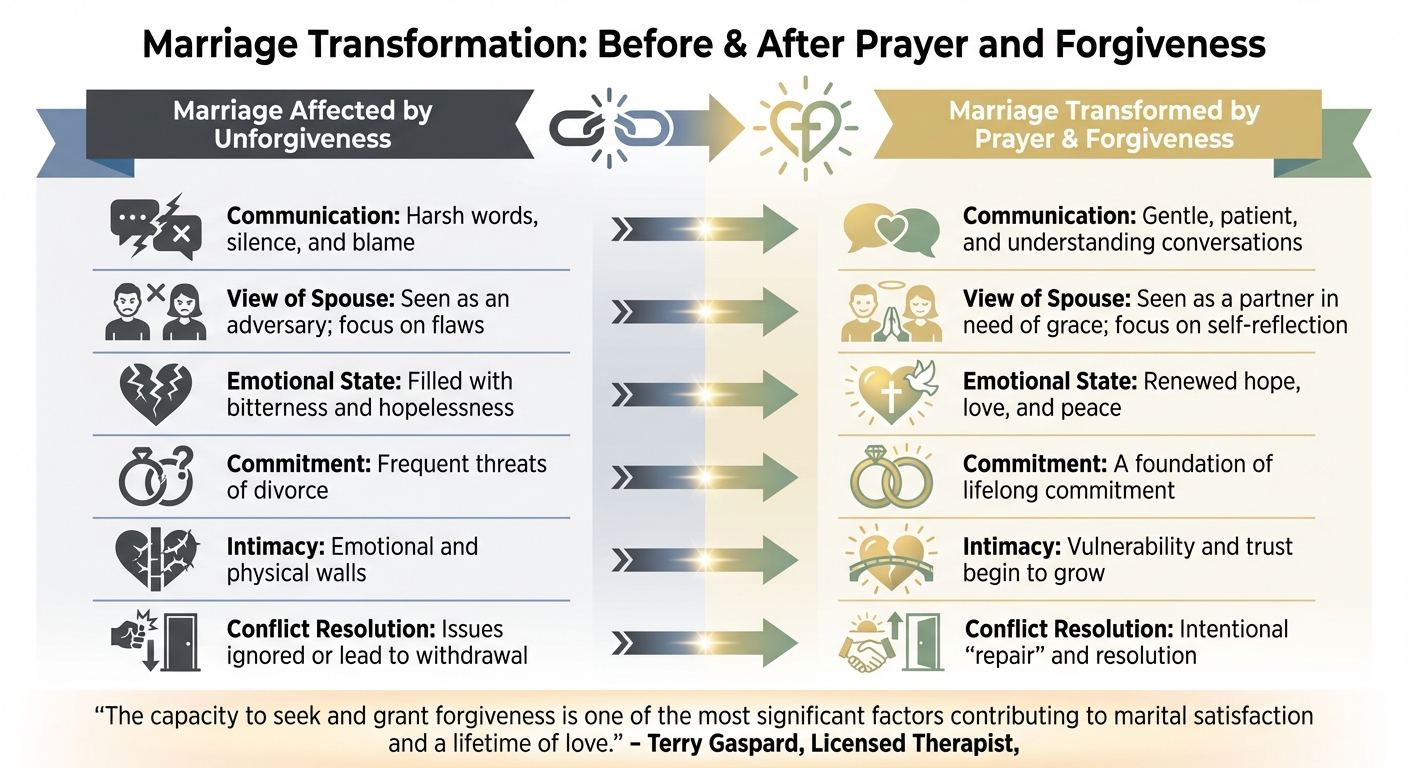
Before and After Prayer and Forgiveness in Marriage
Signs Your Marriage Is Healing
When prayer and forgiveness become part of your marriage, the changes can be profound. One of the first shifts you’ll notice is in how you communicate. Instead of heated arguments that feel like "World War Three", conversations take on a tone of gentleness and patience. The focus moves from winning arguments to genuinely understanding each other’s perspectives [1][2].
As forgiveness takes hold, emotional safety and trust start to rebuild. Over time, the barriers you may have created for self-protection begin to fall away. You feel more comfortable sharing your fears and dreams without fear of judgment. This openness is met with a similar willingness from your spouse, who becomes less defensive and more accountable for their role in conflicts. Research by Drs. Julie and John Gottman highlights how responding with grace rather than anger can significantly shift your partner’s emotional state [8].
Another major milestone is the ability to recover from disagreements. Instead of letting conflicts simmer for days, you’ll develop "repair attempts" – small but intentional efforts to reconnect after an argument [8]. These make a big difference, preventing minor issues from growing into long-term resentment. You’ll begin to see your spouse not as an adversary but as someone who, like you, needs grace and understanding [1][2].
Couples who pray together often experience a deeper commitment to their relationship. Daily prayer serves as a safeguard against infidelity, reducing the likelihood of romantic involvement outside the marriage, even if satisfaction levels were previously low [7].
Before and After: The Impact of Prayer and Forgiveness
The contrast between a marriage burdened by unforgiveness and one renewed through prayer and forgiveness is striking. Here’s a closer look at how these practices can transform key aspects of a relationship:
| Aspect | Marriage Affected by Unforgiveness | Marriage Transformed by Prayer & Forgiveness |
|---|---|---|
| Communication | Harsh words, silence, and blame [1][4] | Gentle, patient, and understanding conversations [1][2] |
| View of Spouse | Seen as an adversary; focus on flaws [1][6] | Seen as a partner in need of grace; focus on self-reflection [1][3] |
| Emotional State | Filled with bitterness and hopelessness [1][6] | Renewed hope, love, and peace [1][4] |
| Commitment | Frequent threats of divorce [1][4] | A foundation of lifelong commitment [1][2] |
| Intimacy | Emotional and physical walls [1][5] | Vulnerability and trust begin to grow [1][2] |
| Conflict Resolution | Issues ignored or lead to withdrawal [8] | Intentional "repair" and resolution [8] |
Licensed therapist Terry Gaspard underscores this transformation:
"The capacity to seek and grant forgiveness is one of the most significant factors contributing to marital satisfaction and a lifetime of love" [8].
Real-life stories echo this sentiment. Take Kiera and Daniel, participants in a marriage restoration program, who shared:
"Our home felt like World War Three. We came broken, nervous, skeptical… Our marriage has transformed in the past four days. The closeness we feel with each other now, we have never felt before" [1].
Through consistent prayer and forgiveness, couples can rebuild intimacy, trust, and emotional strength, creating a solid foundation for a thriving marriage.
Finding Hope and Healing with Growth and Change Counseling
Prayer and forgiveness can breathe new life into struggling marriages by shifting the focus away from self-centered desires and aligning it with God’s intentions. This shift creates an opportunity for healing and restoration to take root [5]. Forgiveness, in particular, helps release the bitterness and anger that often block intimacy, while prayer provides emotional grounding, allowing couples to communicate with grace rather than defensiveness [5][2].
Research highlights that couples who pray together daily tend to show stronger commitment and are less likely to seek intimacy outside their marriage [7]. Julie Holmquist from Focus on the Family beautifully reminds us:
"God is a God who restores. The Bible is filled with stories of restoration. It’s also the story of restoration, of God bringing His children back into relationship with himself." [2]
Your marriage can be one of those stories of restoration.
These principles encourage immediate personal and relational action. Begin with your own prayer, asking for a softened heart and a clearer view of your own shortcomings. Then, take a step further – hold your spouse’s hand and pray together. Shared prayer has the power to break down walls of resentment that may have built up over time [7][4]. Use Scripture as a guide, such as James 1:19 to practice speaking slowly and thoughtfully during conflicts, and 1 Corinthians 13 to keep love at the center of your relationship [2][5].
If your communication feels broken or your marriage seems beyond repair, seeking professional help can provide the tools and safe environment needed to rebuild [2][3]. Growth and Change Counseling’s Marriage Rescue Institute offers intensive coaching designed to support couples in urgent need of restoration.
FAQs
How does prayer help couples communicate better in marriage?
Prayer offers couples a chance to pause, set aside life’s distractions, and focus on each other with purpose. By welcoming God into their relationship, they are reminded of their shared journey as a team. This practice encourages humility, patience, and a willingness to truly listen. It creates an environment where pride softens, defenses lower, and open, compassionate communication becomes possible.
Couples who pray together often experience a stronger bond and greater satisfaction in their relationship. Prayer can also provide clarity and gentleness in how they express themselves, making it easier to communicate thoughts with respect and understanding. For those looking for additional support, Growth and Change Counseling offers a 12-week intensive couples coaching program. This program combines the power of prayer with practical communication tools to help partners rebuild trust and strengthen their connection.
How can I start practicing forgiveness to restore my marriage?
Forgiveness plays a crucial role in repairing trust and fostering unity within a marriage. It starts with making a conscious effort every day to release resentment and shift your focus toward building a better future, rather than dwelling on past wounds. To move forward, honest communication is essential. Dedicate time to openly discuss how you’ve hurt one another, creating an environment where vulnerability is met with understanding, not judgment.
Another powerful step is praying together. Share your struggles with each other and seek guidance and healing through prayer. Keeping a journal to document these prayers and moments of progress can be a meaningful way to reflect on how far you’ve come as a couple. Remember, forgiveness isn’t a one-time event – it’s an ongoing journey. Approach each challenge with a mindset of restoration and grace, allowing the process to deepen your connection over time.
How can Christian counseling help restore a struggling marriage?
Christian counseling offers a meaningful approach to helping struggling marriages by blending professional support with biblical teachings and the practice of prayer. This method encourages couples to reconnect with their faith, embrace forgiveness, and restore trust within a caring and supportive setting.
At the heart of this approach is prayer, which serves as a powerful tool for strengthening the bond between partners and fostering hope during difficult times. Research suggests that couples who pray together often report a stronger sense of commitment and greater satisfaction in their relationship. Christian counseling also highlights the importance of forgiveness, drawing on biblical teachings and God’s promise to mend broken relationships. This provides a solid foundation for couples seeking long-term healing and renewal.
Growth and Change Counseling offers this faith-centered guidance through its 12-week Marriage Rescue Institute program. This program combines structured coaching with Scripture-based principles, helping couples rebuild their relationships while fostering a deeper spiritual and emotional connection.
Related Blog Posts
- 5 Ways Faith Supports Emotional Healing in Marriage
- 5 Steps to Forgiveness in Christian Marriage
- Why Long-Suffering Matters in Christian Marriage
- What the Bible Says About Reconciliation in Marriage
