When ADHD and anxiety overlap in relationships, they can lead to cycles of conflict, criticism, and withdrawal. But effective therapy can help break these patterns. Here are eight therapy approaches that address the unique challenges of ADHD and anxiety in couples:
- Cognitive Behavioral Therapy (CBT): Focuses on improving communication, emotional regulation, and executive functioning skills. Sessions are structured with homework to practice real-life strategies.
- Emotionally Focused Therapy (EFT): Strengthens emotional bonds by addressing unmet emotional needs and fostering connection.
- Gottman Method Couples Therapy: Uses research-backed tools like "softened startups" and "repair attempts" to manage ongoing relationship challenges.
- ADHD-Focused Couples Coaching: Provides practical tools for managing ADHD-specific issues like time management, organization, and impulsivity.
- Acceptance and Commitment Therapy (ACT): Encourages mindfulness and value-driven actions to manage emotional turbulence.
- Neurodiverse Relationship Therapy: Helps couples understand and navigate differences in neurotypes, focusing on ADHD and anxiety dynamics.
- Combined Therapy and Medication: Combines medication to stabilize symptoms with therapy to build long-term coping skills.
- Marriage Rescue Institute Program: A 12-week intensive program for couples in crisis, offering targeted strategies to rebuild trust and communication.
Each approach is designed to address specific challenges, from emotional disconnection to ADHD-related impulsivity. Research shows therapy can significantly improve relationship satisfaction, with some methods achieving success rates of 70% or more. Choose a method that fits your needs and commit to working together toward a healthier, more supportive relationship.
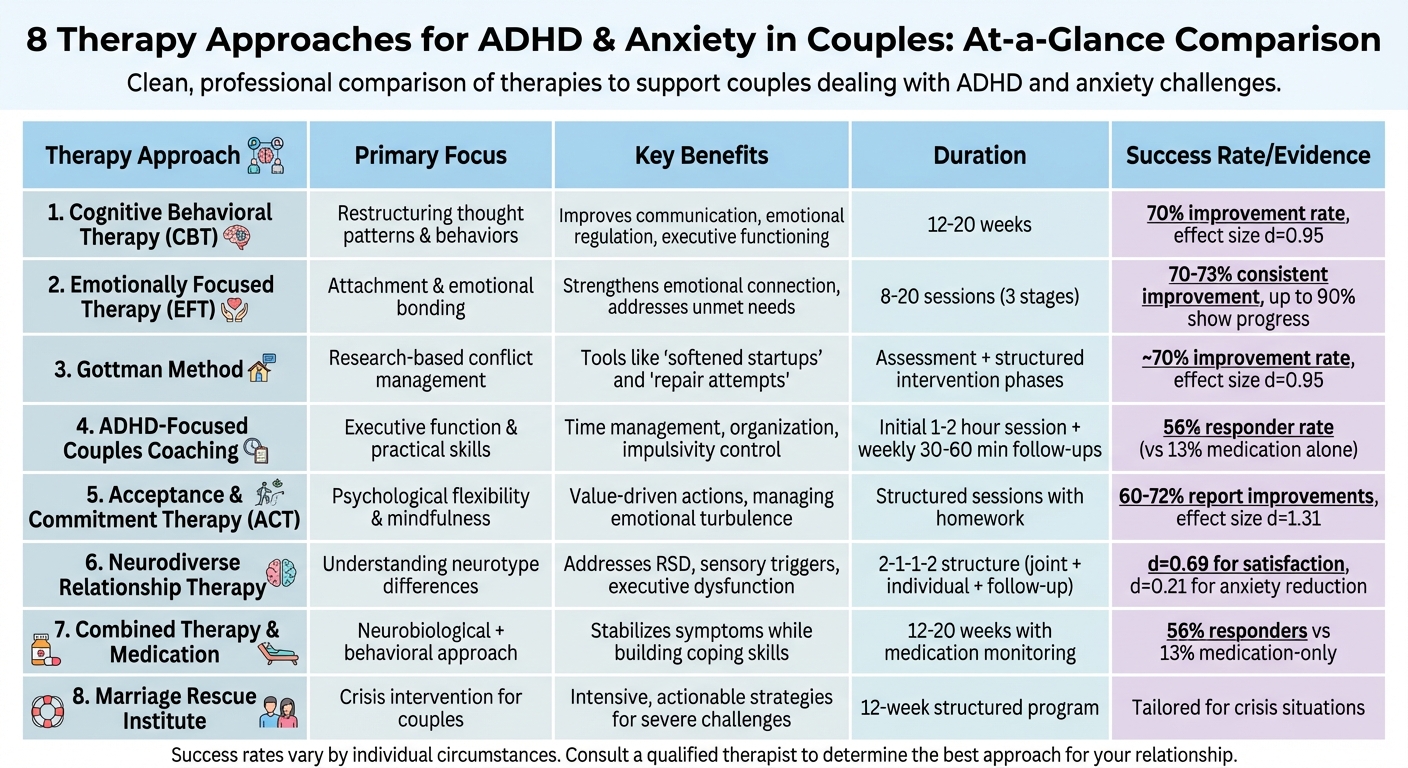
Comparison of 8 Therapy Approaches for ADHD and Anxiety in Couples
1. Cognitive Behavioral Therapy (CBT)
Primary Focus
Cognitive Behavioral Therapy (CBT) for couples hones in on the thought and behavior patterns that trap partners in negative cycles. The therapy works to reshape how partners interact, correct distorted beliefs (like "You don’t care about me" or "I’m a failure"), and improve emotional regulation [5][6]. It also emphasizes executive functioning skills, such as planning, organization, and time management, which can reduce everyday conflicts that often escalate into larger relationship issues [7].
Rooted in social learning theory, CBT highlights the interconnected nature of partners’ behaviors – each person’s actions influence and are shaped by the other. The therapy’s main aim is to create a healthier balance of positive and negative interactions, steering couples away from destructive patterns like criticism and withdrawal [1]. This approach lays the groundwork for noticeable improvements in how neurodiverse couples relate to each other.
Key Benefits for ADHD-Anxiety Couples
CBT provides couples with actionable tools to improve their relationship dynamics. Research indicates that couple-based CBT is as effective as individual CBT for addressing various psychological disorders – and often even more effective when both partners are actively involved [4]. Melanie S. Fischer from the University of North Carolina at Chapel Hill explains:
"Adapted for individual problems, cognitive-behavioral couple-based interventions appear to be at least as effective as individual cognitive behavioral therapy (CBT) across a variety of psychological disorders, and often more effective, especially when partners are substantially involved in treatment." [4]
Couples learn practical communication techniques, such as the "speaker-listener" method, which encourages expressing needs without eliciting defensiveness [2]. Tools like "Stop-Think-Act" and the "5-minute rule" offer individuals with ADHD a structured way to pause and think before acting impulsively [7]. The ADDA Editorial Team puts it this way:
"If medication helps your brain chemistry, CBT gives you the life skills to make the most of that boost." [7]
Duration and Typical Structure
CBT typically spans 12 to 20 weeks, with sessions lasting 45 minutes to an hour, scheduled weekly or bi-weekly [7]. Even shorter programs – like a six-session model tested in a 2024 clinical trial – have shown measurable improvements [7]. Sessions focus on reviewing progress, addressing specific issues, reframing unhelpful thoughts, and assigning practical homework.
Homework plays a critical role, as couples practice strategies like task chunking and time-blocking in their daily lives. This real-world application helps solidify the skills learned in therapy. Additionally, relapse prevention is built into the structure, ensuring couples can sustain their progress long after the sessions conclude [6]. When seeking professional help, it is vital to choose a neurodiverse couples therapist who understands these specific dynamics.
Evidence Base
Cognitive-Behavioral Couple Therapy has demonstrated long-term success. Studies show that 50% of couples maintain stable positive outcomes over five years, with an effect size of d = 0.92 observed at the five-year mark [2]. A 2023 review further highlighted that both individual and group CBT not only reduced core ADHD symptoms but also improved self-esteem and overall quality of life [7]. Meta-analyses from trials conducted across the United States, Europe, and Australia confirm the global effectiveness of behavioral and cognitive-behavioral couple therapies [4]. These findings underscore CBT’s ability to help couples navigate challenges like technology-related distractions and impulsivity, which often strain relationships.
sbb-itb-596b85d
2. Emotionally Focused Therapy (EFT)
Primary Focus
Emotionally Focused Therapy (EFT) takes a unique approach by prioritizing emotional connection over focusing solely on skills and behaviors. Rooted in attachment theory, this therapy emphasizes the importance of a secure bond between partners as the foundation for meaningful change. The core idea is to examine and address the emotional dynamics that shape how partners interact with each other [2].
For couples grappling with ADHD and anxiety, EFT reframes problematic behaviors as signals of unmet emotional needs. For instance, one partner might withdraw due to ADHD-related overwhelm, while the other reacts with anxiety-driven criticism. EFT helps couples recognize these behaviors as expressions of deeper emotions, such as fear of abandonment, shame, or loneliness [9]. By shifting the focus from surface-level symptoms like irritability and worry to the underlying emotions, EFT opens the door to stronger emotional connections and a more secure partnership.
Key Benefits for ADHD-Anxiety Couples
One of EFT’s strengths is its ability to create a sense of emotional safety within the relationship. When one partner becomes a reliable source of comfort and reassurance, it can significantly reduce distress and improve the overall dynamic. For couples where one partner has ADHD and the other struggles with anxiety, this emotional security can act as a stabilizing force.
Research highlights EFT’s success: 70–73% of couples report consistent improvements, with up to 90% experiencing meaningful progress overall [2][8]. In one study, 61% of couples completely resolved their distress, and another 11% showed significant progress [2]. EFT has also been shown to benefit couples dealing with both relational struggles and depression, improving both areas simultaneously [9].
Duration and Typical Structure
EFT typically involves 8 to 20 weekly sessions, divided into three key stages. The first stage focuses on de-escalation, where couples identify negative interaction patterns and the unspoken fears driving them. The second stage works on restructuring these interactions, helping partners form a secure emotional bond by sharing vulnerabilities. Finally, the third stage consolidates these changes, enabling couples to tackle deeper, long-standing issues [2]. By fostering a new emotional dynamic, EFT gradually transforms how partners respond to each other.
Evidence Base
EFT’s effectiveness is well-supported by research. Meta-analyses show a mean effect size of d = 1.31, indicating strong results compared to other couple therapies [2]. Another analysis reported an even larger effect size of g = 2.09, and follow-up studies reveal that 70% of couples maintain their progress three months after therapy [2]. According to the International Centre for Excellence in Emotionally Focused Therapy:
"EFT is grounded in attachment theory, offering a solid, research-based framework for understanding human emotions and relationships." [8]
3. Gottman Method Couples Therapy
Primary Focus
The Gottman Method is built around the Sound Relationship House Theory, which stems from decades of research emphasizing the importance of friendship, constructive conflict resolution, and shared meaning in relationships [10][11]. According to this approach, 69% of marital conflicts are what Dr. John Gottman refers to as "perpetual problems" – issues that don’t fully go away but can be managed over time [11]. As Dr. Gottman explains:
"Although you may feel your situation is unique, we have found that all marital conflicts fall into two categories: Either they can be resolved, or they are perpetual, which means they will be part of your lives forever, in some form or another." [11]
For couples navigating ADHD and anxiety, this perspective is particularly helpful. Instead of attempting to "fix" every issue, the focus shifts toward managing ongoing challenges through better communication and emotional connection. This mindset creates a foundation for tools that address the specific needs of ADHD and anxiety, as outlined below.
Key Benefits for ADHD-Anxiety Couples
The Gottman Method offers practical strategies tailored to the needs of partners dealing with ADHD and anxiety. Tools like softened startups – a way to begin conversations gently – and repair attempts – techniques to defuse tension – are especially effective in calming discussions and reducing conflict [10]. Dr. Nick Bach, a licensed clinical psychologist and marriage counselor in Roseville, CA, highlights these benefits:
"For the ADHD spouse, [the Gottman Method] offers structured tools to improve attentiveness and emotional regulation, such as ‘softened startups’ to initiate discussions calmly or ‘repair attempts’ to de-escalate conflicts" [10].
Additionally, the method encourages small, consistent gestures like daily expressions of appreciation, which help ADHD partners stay emotionally connected despite their tendency to become distracted. By focusing on managing ongoing issues rather than achieving perfection, the Gottman Method complements earlier approaches and addresses the impulsivity and anxiety often seen in neurodiverse relationships.
Duration and Typical Structure
Therapy typically starts with an assessment phase, which includes a mix of joint and individual sessions. Couples may also complete questionnaires like the Gottman Relationship Checkup [11]. After the assessment, the structured intervention phase begins, focusing on strengthening friendship, navigating conflict, building shared meaning, and preventing setbacks [11]. These steps follow a well-researched framework designed to guide couples toward healthier dynamics.
Evidence Base
Research shows that about 70% of couples experience improvement with evidence-based interventions, with couple therapy achieving a mean effect size of d = 0.95 [2][11]. The Gottman Method, supported by five decades of scientific research [11], has identified key patterns that contribute to relationship distress, including the "Four Horsemen" – criticism, defensiveness, contempt, and stonewalling [2]. This extensive research underscores the method’s effectiveness, particularly for couples dealing with challenges like anxiety.
4. ADHD-Focused Couples Coaching
Primary Focus
ADHD-focused couples coaching is all about providing practical tools to tackle the everyday challenges that ADHD brings into relationships, similar to the support offered by a marriage therapist in Roseville, CA. This approach zeroes in on specific ADHD-related difficulties like planning, time management, organization, and problem-solving – issues that often disrupt cooperation at home [14]. A key part of this method is psychoeducation, which helps both partners understand how ADHD’s neurobiology can fuel conflict. As Gina Pera and Arthur Robin put it:
"The ADHD partner often listens poorly, fails to finish tasks or fulfill commitments, manifests inappropriate emotional outbursts, and generally acts in the relationship more like a child than an adult" [13].
By recognizing these behaviors as symptoms of ADHD rather than personal shortcomings, couples can shift away from blame and focus on finding workable solutions. This coaching style goes beyond emotion-centered therapies by offering clear, actionable steps that address the day-to-day realities of living with ADHD, making it a practical and solution-driven option.
Key Benefits for ADHD-Anxiety Couples
For many adults, ADHD is often overlooked, with symptoms mistaken for anxiety or depression. In fact, only about one in ten adults with ADHD in the U.S. receives a diagnosis [13]. Coaching helps distinguish between anxiety disorders and the anxiety that stems from the ongoing stress of untreated ADHD. It also offers tailored strategies to navigate high-conflict areas like managing finances, co-parenting, intimacy, and even digital addictions [12][13]. By addressing these challenges head-on, coaching provides a structured path to better manage the unique dynamics of ADHD in relationships.
Duration and Typical Structure
The coaching process kicks off with a detailed initial session lasting one to two hours, where couples evaluate their current satisfaction and set clear relationship goals [14]. After that, weekly follow-up sessions – usually 30 to 60 minutes long – help track progress, tackle obstacles, and plan actionable steps for the week ahead [14]. Between sessions, couples can access additional support via phone, text, or email to stay on track and maintain accountability. At the end of the agreed-upon coaching period, an evaluation session is conducted to measure progress and decide on next steps, whether that means continuing, adjusting, or concluding the coaching relationship [14].
Evidence Base
ADHD doesn’t just disappear with age; it persists into adulthood for 65–70% of individuals [13]. This highlights the importance of adult-focused interventions. Research has shown that group ADHD coaching can lead to improvements in areas like anxiety, interpersonal skills, assertiveness, and executive functioning [14]. The coaching framework is built on the work of experts like Gina Pera, Arthur Robin, and Russell Barkley, and its effectiveness is backed by over 20 detailed case studies [12]. Unlike traditional therapy, which often delves into the "why" of psychological barriers, ADHD-focused coaching emphasizes the "what, when, and how" of managing daily life. This practical, wellness-oriented model is particularly effective for couples navigating the intertwined challenges of ADHD and anxiety [14]. It’s a targeted approach designed to bring clarity and actionable solutions to relationships impacted by ADHD.
5. Acceptance and Commitment Therapy (ACT)
Primary Focus
Acceptance and Commitment Therapy (ACT) focuses on fostering psychological flexibility – the ability to face difficult emotions and thoughts while continuing to act in line with your values [16]. Instead of resisting anxiety or the frustrations tied to ADHD, ACT encourages couples to acknowledge these challenges as part of life and move forward regardless. The therapy revolves around six key principles: cognitive defusion, acceptance, being present, self-observation, value identification, and committed action [15]. By following these principles, ACT helps couples navigate emotional turbulence without becoming overwhelmed. As the Bay Area CBT Center puts it:
"ACT’s primary function is to foster the acceptance of negative emotions and experiences, guiding individuals and couples towards a rich and meaningful life using commitment therapy techniques" [15].
A core aspect of ACT is mindfulness, which helps manage mental clutter – a crucial skill for couples dealing with ADHD, where chaotic thoughts and anxiety can easily spiral [15].
Key Benefits for ADHD-Anxiety Couples
For couples facing the dual challenges of ADHD and anxiety, ACT offers practical tools for relief. A 2025 systematic review of 17 randomized controlled trials revealed that ACT outperformed passive control groups in reducing anxiety, improving communication, increasing marital intimacy, and enhancing overall psychological well-being [17]. One of ACT’s strengths is teaching partners how to step back from unhelpful thought patterns, such as "I’m always failing" or "They never listen." A simple yet effective technique involves repeating a distressing thought in a silly voice, which diminishes its emotional weight [15].
ACT also helps couples identify and focus on shared values, providing a roadmap for tackling relationship challenges with intention rather than reacting impulsively. This complements other therapeutic methods by turning reactive behaviors into actions guided by values. Research highlights that 60–72% of couples report noticeable improvements in relationship satisfaction when using ACT or similar behavioral therapies [2]. By addressing ADHD-related distractions and anxiety-driven responses, ACT equips couples with tools to navigate daily challenges more effectively.
Duration and Typical Structure
ACT sessions are structured around practical steps that align with shared values, emphasizing actionable progress over merely discussing problems [15]. Between sessions, couples practice techniques that enhance emotional awareness and reduce reactivity, helping them apply what they’ve learned in real-life situations [15].
Evidence Base
The evidence backing ACT is robust. Meta-analyses have shown significant results, with one study reporting a Cohen’s d of 1.31 for reducing couple distress [2]. Another analysis found an effect size of g = 0.73 at post-test [2]. In one outcome study, 61% of participants fully recovered, 11% showed improvement, while 25% saw no change [2]. ACT has also proven effective for addressing alexithymia – a difficulty in understanding emotional cues – which can be a significant hurdle in neurodiverse relationships [17]. Although some research suggests Cognitive Behavioral Couple Therapy might have a slight edge in improving marital satisfaction, ACT remains a valuable approach for couples managing the intertwined challenges of ADHD and anxiety [17].
6. Neurodiverse Relationship Therapy
Primary Focus
Neurodiverse Relationship Therapy builds on earlier therapeutic models to provide a tailored framework for couples navigating the challenges of ADHD and anxiety. Instead of focusing on changing a partner, this approach emphasizes understanding and translating the differences between neurotypes. The aim is to uncover the reasons behind behaviors – like ADHD-driven impulsivity or anxiety-induced withdrawal – so they aren’t misinterpreted as personal failings. Therapist and author Jenni Hartwell describes it best:
"A therapist’s job here isn’t to ‘fix’ either partner. It’s to become a translator." [20]
This therapy tackles specific ADHD dynamics such as Rejection Sensitivity Dysphoria (RSD), difficulties with executive functioning (like time management and organization), and hyper-fixation. It also addresses sensory triggers that can lead to anxiety or shutdowns, which might be misread as rejection. Similar to how digital distractions can impact ADHD brains, these triggers require careful navigation. To guide this process, therapists use the DEEP framework, which focuses on Differences in neurotypes, Emotional sensitivities, External stressors, and Patterns of interaction. This structured approach helps validate each partner’s needs while avoiding feelings of shame.
Key Benefits for ADHD-Anxiety Couples
This therapy helps couples see conflicts through the lens of neurological differences rather than as signs of a lack of love or care. By framing challenges as brain-based, partners can depersonalize conflicts and focus on solutions. Couples are taught dyadic coping strategies, which adapt emotional support to each partner’s unique neurodivergent traits and anxiety triggers [2].
Another essential aspect is addressing "partner accommodation", where one partner may unintentionally reinforce the other’s symptoms – something often seen in anxiety and OCD. This therapy helps couples establish healthier boundaries and communication patterns. For neurodiverse relationships, this framework stands out by validating neurological differences while fostering practical communication tools. It complements the structured techniques covered earlier in the article.
Duration and Typical Structure
The therapy typically follows a 2-1-1-2 structure: one joint session, two individual assessments, and a follow-up couple session to create a long-term plan [19]. Sessions are highly organized, focusing on skill-building with tools like visual aids and straightforward language. Techniques such as sensory audits and visual schedules are used to identify and manage anxiety triggers [20].
Evidence Base
A nationwide clinical trial of an online program rooted in Integrative Behavioral Couple Therapy (IBCT) showed promising results. Participants reported notable improvements in relationship satisfaction (effect size d = 0.69) and reduced anxiety symptoms (effect size d = 0.21) [18]. The integrative approach also delivered longer-lasting relationship benefits compared to traditional behavioral therapy [18]. Additionally, 86% of couples completed the program, and 97% said they would recommend it to others [18].
7. Combined Therapy and Medication Management
Primary Focus
This approach tackles both ADHD and anxiety by pairing medication with therapy. Medication helps adjust brain chemistry, improving attention and reducing impulsivity, while therapy focuses on building practical skills to manage lingering symptoms. As Russell Barkley points out, understanding a problem isn’t enough – there needs to be a way to turn knowledge into action. Medication provides the mental clarity needed, and therapy equips individuals with strategies to navigate everyday challenges, particularly in relationships. Knowing what to expect in couples therapy can help partners prepare for this collaborative work. Together, they address both biological and behavioral aspects of these conditions.
Key Benefits for ADHD-Anxiety Couples
Even when medication reduces symptoms by 30% or more, many adults still face challenges in their daily lives. Combining therapy with medication helps bridge this gap. For instance, a randomized controlled trial showed that 56% of patients using both CBT and medication were classified as treatment responders, compared to just 13% of those relying on medication alone [21]. This combined approach not only reduces core symptoms like distractibility and emotional dysregulation but also enhances the ADHD partner’s ability to participate in relationship-focused work. By addressing these symptoms, the ADHD partner becomes more emotionally present, which can strengthen the overall relationship dynamic [3][2].
Therapy also plays a crucial role in tackling issues like persistent negative self-talk and the "inner critic", which can linger even after medication improves focus and attention [7].
Duration and Typical Structure
Structured treatment models bring this approach to life. Typically, combined therapy and medication management spans 12–20 weeks, with therapy sessions running alongside regular medication monitoring and dosage adjustments [21]. One study published in Psychiatric Clinics of North America followed 43 adults with ADHD who underwent 16 individual CBT sessions over six months while taking titrated doses of Adderall (up to 20 mg twice daily). Results showed a drop in clinician-rated ADHD severity from 5.28 to 3.40, alongside significant reductions in anxiety and depression [21]. These improvements translated into better communication and emotional connection within relationships. Therapy modules often focus on practical areas like organization, reducing distractions, and reframing negative thought patterns [21].
Evidence Base
Research consistently supports the effectiveness of combining therapy with medication over relying on medication alone. Randomized controlled trials highlight how this dual approach not only reduces ADHD symptoms but also alleviates relationship stress [21]. A 2023 review further revealed that CBT enhances self-esteem and overall quality of life while addressing core ADHD challenges [7]. While symptoms may return if medication is discontinued, the skills learned through therapy often have a lasting impact, continuing to benefit individuals long after treatment ends [7].
8. Marriage Rescue Institute by Growth and Change Counseling
Primary Focus
The Marriage Rescue Institute offers a 12-week couples coaching program designed specifically for marriages in crisis. This structured approach tackles the unique challenges that arise when ADHD and anxiety intersect in a relationship. Instead of relying on traditional talk therapy, the program focuses on practical strategies to address destructive behaviors such as constant arguing and stonewalling – issues often intensified by ADHD and anxiety. By emphasizing actionable solutions, couples can start making immediate changes to rebuild trust and strengthen their relationship. The goal is to improve communication and foster empathy through targeted, results-driven methods.
Key Benefits for Couples Managing ADHD and Anxiety
This program helps couples move beyond surface-level conflicts by fostering a deeper understanding of their neurological differences. The intensive structure encourages partners to develop empathy and bridge communication gaps [22]. Couples are guided to establish routines that respect both partners’ needs, reducing tension and misunderstandings. By reframing behaviors as neurological traits rather than deliberate actions, the program helps reduce blame and conflict. These foundational strategies prepare couples to embrace the more structured interventions that follow.
Duration and Structure
The 12-week format offers focused, intensive support within a set timeframe, creating a sense of urgency and momentum that longer-term therapy may lack. Sessions are available at several California locations as well as through telehealth, with pricing determined during an initial strategy session. The program’s directive approach ensures therapists actively guide couples through exercises and interventions – an essential feature for those who may struggle with ADHD-related challenges like executive functioning, making it easier to implement meaningful changes.
The Gottman Method for Couples: ADHD and Relationships with Dr. Michelle Frank
Comparison Table
Below is a detailed comparison of the therapeutic methods discussed, highlighting their main focus, benefits, typical structure, and supporting evidence.
| Therapy Approach | Primary Focus | Key Benefits for ADHD-Anxiety Couples | Duration/Typical Structure | Evidence Base |
|---|---|---|---|---|
| Cognitive Behavioral Therapy (CBT/CBCT) | Social learning and restructuring thought patterns [2] | Improves communication, problem-solving, and reduces dysfunctional attributions [2] | Typically spans 12–20 sessions; highly structured and manualized [2] | Strong evidence; 70% improvement rate with an effect size of d = 0.95 [2] |
| Emotionally Focused Therapy (EFT) | Attachment theory; fostering emotional security [2] | Encourages primary emotional expression, repairing attachment bonds [2] | Structured in 3 stages: De-escalation, Restructuring, and Consolidation [2] | Strong evidence; 70% recovery at follow-up with an effect size of d = 1.31 [2] |
| ADHD-Focused Couples Coaching | Addressing executive function deficits with performance-oriented strategies [21] | Provides practical tools for organization, planning, and managing chronic challenges [21] | Delivered in 12–15 sessions with a focus on skill-building [21] | Emerging evidence; 56% responder rate compared to 13% for medication alone [21] |
| Combined Therapy and Medication | Combines neurobiological and psychosocial approaches [21] | Stabilizes brain chemistry while fostering behavioral and emotional regulation [21] | Involves ongoing medication with 16+ CBT sessions [21] | Strong support; effectively addresses residual symptoms [21] |
| Marriage Rescue Institute | Crisis intervention with actionable solutions | A focused 12-week program aimed at restoring strained relationship dynamics | 12 weeks; available in-person or via telehealth | Tailored for couples facing severe challenges |
This table serves as a guide to help align your relationship’s challenges with the most appropriate therapeutic approach. For example, ADHD-focused coaching may be particularly helpful if executive dysfunction is a primary issue, offering a 56% responder rate [21]. On the other hand, EFT might be better suited for couples dealing with attachment issues, as it emphasizes emotional intelligence and connection and has shown strong recovery outcomes [2].
The duration of therapy is another factor to consider. Intensive programs, like the 12-week Marriage Rescue Institute, may be ideal for couples in crisis. Meanwhile, longer-term interventions, such as CBCT, can provide lasting benefits – 50% of couples report stable positive effects for at least five years after completing CBCT [2].
Conclusion
Navigating ADHD and anxiety as a couple calls for therapy approaches tailored to the unique challenges both partners face. Whether it’s Cognitive Behavioral Therapy (CBT), Emotionally Focused Therapy (EFT), ADHD-specific coaching, or other strategies mentioned earlier, the goal is clear: moving from cycles of negativity to healthier, more supportive interactions. As Donald H. Baucom, Ph.D. explains, "Relationship distress was defined largely by an excess of negative and deficit of positive behavioral exchanges between partners" [1]. This insight underscores the importance of learning communication skills that foster mutual understanding and emotional safety.
Research highlights that couple-based CBT not only improves individual symptoms but also strengthens the relationship as a whole [3][4]. Including both partners in therapy has been shown to significantly enhance outcomes for managing anxiety and ADHD symptoms [4].
These therapeutic approaches work by addressing the underlying patterns that contribute to distress. Couples are guided to identify and reshape unhelpful thought processes, manage overwhelming emotions, and step away from blame cycles. For instance, one common dynamic involves one partner taking on a caregiving role while the other feels criticized – a pattern that therapy helps to dismantle [23][24]. The skills learned during therapy become essential tools for tackling everyday challenges together.
For couples in urgent need of focused support, intensive therapy for couples in crisis can provide immediate relief. The Marriage Rescue Institute by Growth and Change Counseling offers a structured 12-week program designed for couples in crisis. This program is available in Campbell, San Jose, Los Angeles, and Roseville, CA, as well as via telehealth for residents across California.
The key to progress lies in selecting a therapeutic approach that aligns with your specific needs, committing to building new skills as a team, and staying consistent with relapse prevention strategies. With the right guidance, couples managing ADHD and anxiety can transform their relationship from one of struggle to one of deeper connection and mutual support.
FAQs
What are the best therapy options for couples dealing with ADHD and anxiety?
The right therapy approach varies based on what each couple needs most. For those navigating the challenges of ADHD in their relationship, therapy often focuses on managing symptoms like impulsivity, disorganization, or struggles with staying present due to technology distractions. Practical strategies such as setting up organizational systems, improving time management, and building stronger communication skills can make a real difference.
When anxiety is part of the equation, Cognitive-Behavioral Therapy (CBT) can be especially helpful. This approach equips couples with tools to handle stress, reframe negative thought patterns, and develop healthier coping mechanisms. On the other hand, if a relationship feels stuck or weighed down by emotional conflict, Emotion-Focused Therapy (EFT) can help partners identify and address unmet emotional needs, paving the way for deeper connections.
For couples experiencing a crisis, structured programs like the 12-week Marriage Rescue Institute coaching process from Growth and Change Counseling offer intensive support to help rebuild trust and repair the relationship.
It’s also important to think about practical details, like whether in-person sessions at a California office or telehealth options work better, and whether the therapist has expertise in both ADHD and couples counseling. A quick consultation can clarify what feels like the best fit, setting the stage for meaningful progress together.
What’s the difference between ADHD-focused coaching and traditional therapy?
ADHD-focused coaching and traditional therapy both aim to support individuals with ADHD, but they take distinct approaches. Coaching is geared toward action and emphasizes practical strategies, such as improving time management, staying organized, and setting achievable goals. It’s forward-looking, concentrating on tools to enhance daily routines and boost productivity, rather than diving into emotional or psychological roots.
Therapy, by contrast, is a clinical approach that delves into emotional struggles, past experiences, and mental health concerns. Techniques like cognitive-behavioral therapy (CBT) are often used to address self-esteem issues, manage frustration, and improve emotional regulation – all areas that can be impacted by ADHD.
To put it simply, coaching focuses on building practical skills and accountability, while therapy centers on emotional growth and addressing mental health challenges.
How can combining therapy and medication help couples dealing with ADHD and anxiety?
Combining therapy with medication often proves to be the most effective strategy for couples navigating ADHD and anxiety. While medications – like stimulants or non-stimulants – can help alleviate symptoms such as inattention, hyperactivity, and excessive worry, they often fall short when it comes to addressing emotional, organizational, or relationship challenges. This is where therapy, particularly cognitive-behavioral therapy (CBT), steps in to fill the gaps. CBT provides practical tools for managing emotions, improving communication, and resolving conflicts.
Couples who pursue therapy together frequently report greater relationship satisfaction and less overall distress. Therapy introduces actionable strategies, such as creating shared schedules, managing impulsive behaviors, and resolving disagreements constructively. When combined with medication, this approach fosters better emotional stability and strengthens the partnership.
For those in California, Growth and Change Counseling offers a comprehensive approach, blending evidence-based couples counseling with medication management. Their 12-week "Marriage Rescue Institute" program integrates CBT techniques with relationship coaching, empowering couples to rebuild and fortify their connection.
Related Blog Posts
- OCD and Emotional Intimacy in Neurodiverse Couples
- Managing Eating Disorders in Neurodiverse Couples
- Trauma Recovery in Neurodiverse Relationships: 7 Steps
- ADHD and Marriage: Emotional Regulation Strategies
