When you discover a partner’s addiction, the emotional pain can feel overwhelming. This isn’t just about broken trust – it’s betrayal trauma. It often triggers symptoms like anxiety, hypervigilance, and even PTSD. Partners may experience emotional numbness, self-doubt, or obsessive behaviors as they try to make sense of the deception. The effects ripple through relationships, disrupting trust, intimacy, and even physical well-being.
Key points to know:
- Emotional Impact: Intense anger, grief, shame, and long-term emotional instability are common.
- Mental Effects: Hypervigilance, intrusive thoughts, and gaslighting can erode self-trust.
- Relationship Strain: Loss of trust and intimacy often leads to withdrawal and isolation.
- Healing Steps: Trauma-informed therapy, setting boundaries, and couples counseling can help rebuild trust and emotional safety.
Recovery requires patience, clear boundaries, and professional support to address the trauma and rebuild both individual and relational health.
Emotional Effects of Betrayal Trauma
Common Emotional Reactions
The discovery of betrayal often hits like a thunderbolt, leaving a partner reeling. Many describe it as a visceral, gut-wrenching blow that changes everything in an instant [3][7]. The initial shock can ignite a whirlwind of conflicting emotions – ranging from intense anger and sorrow to horror and deep grief [8][1][6].
"It puts you on an emotional rack and pulls you in opposite directions until you are begging for mercy or you break and ricochet over to one of the extremes just to find some relief."
– Michelle Mays, Licensed Professional Counselor [3]
Feelings of shame and self-blame are heartbreakingly common [8][4]. Society often compounds this pain by unfairly shifting responsibility onto the betrayed partner, despite the fact that the betrayal stems from the betrayer’s own struggles and decisions.
Some individuals cope by emotionally shutting down, feeling numb or disconnected – a dissociative response [1][6]. Others find themselves trapped in a loop of anxiety and panic. This happens because the brain’s fear center, the amygdala, stays on high alert, flooding the body with stress hormones and creating a constant sense of danger [3][1].
Long-Term Emotional Patterns
The immediate emotional storm often evolves into long-lasting patterns, especially when betrayal trauma isn’t addressed. Many partners experience ongoing mood swings and emotional instability [8][6]. Living in a heightened state of alertness makes it challenging to feel joy, often leading to depression and a loss of emotional fulfillment.
Over time, the brain may even begin to rewrite or "tint" once-happy memories to align them with the betrayal [1]. This mental shift can lead to agonizing questions like, "Was any of it real?" Such doubts not only deepen emotional pain but also erode trust in oneself and others. These enduring patterns make rebuilding trust and stability in relationships an uphill battle.
Cognitive and Behavioral Effects of Betrayal
Hypervigilance and Intrusive Thoughts
Betrayal trauma can deeply impact how the brain processes threats. When someone discovers lies or addictive behaviors in their partner, the amygdala – known as the brain’s fear center – kicks into overdrive, triggering a fight-or-flight response. At the same time, the hippocampus struggles to reconcile the person they trusted with the reality of the deception. This internal conflict often leads to intrusive thoughts and obsessive behaviors, like repeatedly checking phone records, bank statements, or browsing histories, as a way to regain a sense of control.
"The hyper-vigilance may protect us from haplessly wandering into another psychological injury."
– Joshua Coleman, Ph.D. [7]
This heightened sense of alertness floods the body with stress hormones like adrenaline and cortisol. Research shows that such responses can even meet the clinical criteria for Post-Traumatic Stress Disorder (PTSD) [4][8]. Over time, this altered mental state can make individuals more vulnerable to manipulative behaviors, further eroding their sense of self-trust.
Gaslighting and Self-Blame
For some, the effects of betrayal are compounded by manipulation, particularly through gaslighting. This tactic involves distorting reality to conceal harmful behaviors, leaving the betrayed partner questioning their own perceptions. Phrases like, "You’re just being paranoid" or "You have trust issues", are often used to dismiss legitimate concerns and shift blame.
"George kept denying that anything was wrong and kept telling her that she was being ‘paranoid,’ and had to work on herself because she had ‘trust issues.’"
– Anna Aslanian, LMFT [1]
This manipulation intensifies self-doubt, forcing the betrayed partner to reconcile the paradox of someone who is both caring and harmful. It creates a psychological tug-of-war that destabilizes their sense of reality.
Social Withdrawal and Isolation
Shame and embarrassment over a partner’s destructive behaviors – whether related to sex addiction, gambling, or chronic dishonesty – often lead individuals to withdraw from their social circles. The fear of judgment, paired with societal stigmas surrounding addiction and infidelity, makes seeking support feel nearly impossible.
In a case study shared by Licensed Marriage and Family Therapist Anna Aslanian, a woman named Mary discovered her husband had drained their savings on gambling while living a double life tied to sex addiction. The betrayal left Mary in a state of hypervigilance, causing her to retreat further into isolation, making trust and connection even harder to rebuild.
"Mistrust shatters the sense of personal safety needed to engage in an intimate relationship."
– Anna Aslanian, Licensed Marriage and Family Therapist [1]
After such experiences, many survivors find their mental energy consumed by efforts to manage internal chaos and maintain constant alertness. Research involving 140 participants revealed a strong positive correlation (r = 0.398, p < 0.001) between betrayal trauma and the development of anxious attachment styles [9]. Emotional numbing often follows, reinforcing avoidance behaviors [1][10]. These patterns make the process of rebuilding trust within a relationship an even greater challenge.
The Unique Scars of Betrayal Trauma | Understanding S/P Addiction & Infidelity Trauma
sbb-itb-596b85d
How Betrayal Trauma Affects Relationships
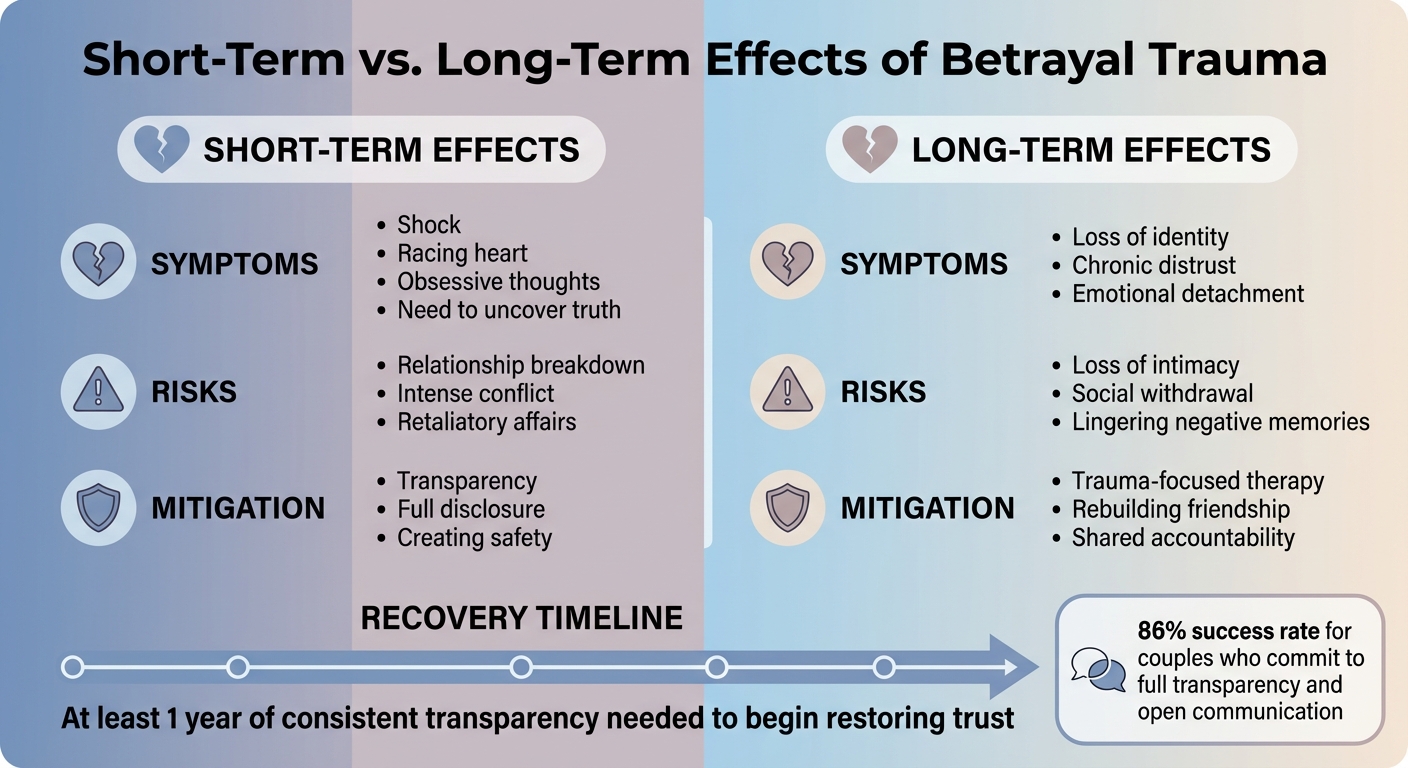
Short-Term vs Long-Term Effects of Betrayal Trauma on Relationships
Loss of Trust and Intimacy
Addiction and betrayal don’t just create cracks in a relationship – they can dismantle its very foundation. In healthy partnerships, couples form what researchers describe as a "physiological unit", meaning they influence each other’s heart rate, blood pressure, and even breathing patterns [3]. When betrayal occurs, this biological connection is disrupted, and a trusted partner can suddenly feel like a threat.
"Betrayal traumas overwhelm coping capacities and define the relationship as a source of danger rather than a safe haven in times of stress."
– Sue Johnson, Founder of Emotionally Focused Therapy [3]
Trust isn’t just an emotional concept; it’s central to how we navigate relationships and even how we see ourselves. When a betrayal happens – especially one tied to addiction – it shakes the betrayed partner’s sense of reality and self-worth.
What was once a safe and intimate connection can become a source of fear. Emotional and physical closeness may now trigger anxiety instead of comfort. Partners often avoid intimacy to shield themselves from further harm, whether that’s emotional pain, boundary violations, or concerns like the risk of disease in cases involving sexual addiction [2][4]. These reactions aren’t calculated – they’re survival mechanisms in response to the trauma of betrayal. This shift can create a ripple effect, with immediate turmoil and long-term struggles taking hold.
Short-Term vs. Long-Term Relationship Effects
The fallout from betrayal trauma doesn’t happen all at once – it unfolds in stages, each with its own set of challenges:
| Feature | Short-Term Effects | Long-Term Effects |
|---|---|---|
| Symptoms | Shock, racing heart, obsessive thoughts, and a need to uncover the truth [1][4] | Loss of identity, chronic distrust of others or institutions, and emotional detachment [3][7] |
| Risks | Relationship breakdown, intense conflict, or even retaliatory affairs [1][2] | Loss of intimacy, social withdrawal, and lingering negative memories of the relationship [1][7] |
| Mitigation Strategies | Transparency, full disclosure, and creating a sense of safety [1][7] | Trauma-focused therapy, rebuilding friendship, and shared accountability for healing [1][7] |
Rebuilding trust after betrayal is no quick fix – it’s a process that demands sustained effort. Research suggests it often takes at least a year of consistent transparency to begin restoring trust [7]. During this time, the betrayed partner might need to verify actions match words, which could include checking phone records, emails, or financial statements. For the partner who caused the betrayal, accepting these boundaries without defensiveness is key to rebuilding safety.
Interestingly, studies show that strong family relationships play a significant role in an addict’s long-term recovery [1]. This creates a challenging dynamic: the relationship is crucial for recovery, yet the behaviors that damaged it must first be addressed. Growth and Change Counseling offers support through programs like The Marriage Rescue Institute, a 12-week intensive designed to blend trauma-aware care with strategies to rebuild trust.
Recovery Steps for Betrayed Partners
Trauma-Informed Therapy
Healing from the pain of betrayal often requires support from professionals who understand your reactions as natural responses to trauma, not personal shortcomings. Licensed Marriage and Family Therapist Anna Aslanian highlights this approach:
"Therapy should always be trauma-informed. Instead of labeling someone ‘codependent,’ it’s important to recognize that these are normal reactions to trauma and not psychopathology." [1]
Trauma-informed therapy incorporates techniques like EMDR, Polyvagal-based regulation, Acceptance and Commitment Therapy (ACT), and Emotionally Focused Therapy (EFT) to help process trauma and rebuild emotional connections [1][3].
Recovery typically unfolds in three stages: creating emotional and physical safety, processing and grieving the betrayal, and then either reconnecting or moving forward [12]. Therapists with specialized certifications, such as those from the Association of Partners of Sex Addicts Trauma Specialists (APSATS) or Certified Sex Addiction Therapists (CSAT), are trained to guide individuals through this process [12]. Growth and Change Counseling offers trauma-informed individual therapy starting at $150 for a 45-minute session, with sliding scale options available for those facing financial challenges. In addition to therapy, setting clear personal boundaries can further support recovery and provide a sense of safety.
Setting Healthy Boundaries
Establishing healthy boundaries is a crucial step in protecting your progress and fostering a sense of security. These boundaries help rebuild trust and reassure your nervous system in a relationship that may now feel uncertain [1][3].
Practical measures might include sharing access to phones, emails, and social media accounts to reduce suspicion [13]. Some partners also opt for GPS location tracking or accountability tools like Covenant Eyes to provide peace of mind [12]. If financial betrayal occurred, revoking access to joint bank accounts can be another step toward rebuilding trust [12][1]. Coach Laura, an APSATS-trained Betrayal Trauma Recovery Coach, emphasizes the importance of communication:
"Uncommunicated boundary changes cause us to question whether our partners are being honest – until it has been communicated, a boundary change is a boundary violation." [12]
Boundaries should adapt as recovery progresses, but any changes must be openly discussed and agreed upon. These measures aren’t about punishment – they’re about creating an environment where healing can take place.
Couples Counseling for Addiction and Trauma
Once individual healing is underway and boundaries are in place, couples counseling can help rebuild trust and strengthen the relationship. Research shows that healthy family relationships are one of the strongest indicators of long-term recovery from addiction [1]. This highlights the importance of addressing both individual and relational healing.
Couples counseling focuses on fostering transparency, making hidden behaviors visible, and beginning to heal emotional wounds [1]. Together, partners work to transform the relationship from a source of pain into a place of safety [3]. Tools like Impact Statements allow each partner to express their feelings openly and without interruption, helping to restore connection [14].
Growth and Change Counseling’s Marriage Rescue Institute offers a 12-week intensive program specifically designed for couples dealing with addiction and betrayal trauma. These services are available in Campbell, San Jose, Los Angeles, and Roseville, CA, as well as through telehealth for clients across California.
Conclusion
Betrayal trauma deeply disrupts trust, shaking the very foundation of both a person and their relationships. As Licensed Marriage and Family Therapist Anna Aslanian puts it, "Betrayal trauma hits the foundation of the person and the relationship – trust" [1]. When left unresolved, this type of trauma doesn’t just affect your emotional well-being; it can also show up in physical symptoms, leaving your mind and body in distress [1][4][11].
But healing is within reach. The first step is understanding that your reactions – whether it’s hypervigilance, intrusive thoughts, or overwhelming emotions – are completely normal responses to an extraordinary breach of trust. These are not personal flaws but natural human responses to betrayal [1][3]. This awareness creates the foundation for rebuilding trust, starting with yourself. Professional guidance can help you move from a place of feeling powerless to one of empowerment, allowing you to reclaim your identity while creating a safe environment for healing [5][15]. Trauma-informed therapy and setting clear boundaries are essential tools for this process, helping you rebuild both trust and intimacy.
Addressing betrayal trauma also strengthens relationships. Your personal recovery plays a critical role in creating a healthier partnership. Research highlights that strong family connections are key to long-term sobriety [1]. Couples who commit to full transparency and open communication see an impressive 86% success rate in staying together [16].
If you’re ready to take the next step, Growth and Change Counseling offers the support you need. Their trauma-informed individual therapy and The Marriage Rescue Institute’s 12-week intensive program are designed to guide you through this challenging journey. Whether in person or via telehealth in California, you don’t have to face this alone. Help is just a call away.
FAQs
What are the signs of betrayal trauma caused by my partner’s addiction?
Betrayal trauma occurs when a partner violates the trust that holds a relationship together. This often stems from actions like lying, secrecy, or behaviors linked to addiction. The emotional fallout from such betrayal can resemble symptoms of post-traumatic stress disorder (PTSD), with effects that may linger long after the initial discovery.
Here are some common signs of betrayal trauma:
- Intense emotional swings: Overwhelming waves of anger, sadness, or anxiety that can feel impossible to manage.
- Hyper-vigilance: Obsessively replaying past events, scrutinizing for dishonesty, or fixating on "what-if" scenarios.
- Physical symptoms: Sleep difficulties, persistent headaches, stomach discomfort, or a constant sense of unease.
- Behavioral changes: Struggling to focus, avoiding anything linked to the betrayal, or compulsively monitoring your partner’s actions.
If these experiences feel familiar, reaching out for professional help can be a vital step in processing your emotions and rebuilding trust. Growth and Change Counseling offers tailored therapy for individuals and couples facing betrayal trauma, including a structured 12-week coaching program designed to support healing and strengthen relationships.
How does trauma-informed therapy help partners recover from betrayal trauma?
Trauma-informed therapy creates a secure and understanding space for partners to work through the emotional pain caused by betrayal trauma. The focus is on rebuilding trust, easing feelings of shame, and addressing the deep wounds left by betrayal. By prioritizing safety, collaboration, and empowerment, this approach helps individuals regain emotional balance and a sense of control over their lives.
Through methods like attachment-focused work and cognitive-behavioral techniques, trauma-informed therapy tackles critical challenges such as broken trust, feelings of helplessness, and strained emotional bonds. The process typically unfolds in structured stages: starting with crisis stabilization, moving into exploring the impact of the betrayal, and finally fostering a stronger sense of self and healthier coping mechanisms.
At Growth and Change Counseling, trauma-informed therapy is specifically designed to support partners of addicts. Their compassionate approach guides individuals through the healing journey, helping them rebuild emotional strength and restore their relationships.
How can I rebuild trust and intimacy with my partner after betrayal?
Rebuilding trust and intimacy after betrayal is a process that requires patience, dedication, and open dialogue from both partners. Begin by having a sincere conversation in a private, comfortable setting where both parties can express their feelings openly. Use "I" statements to share emotions like hurt or anger without assigning blame, and focus on truly listening to one another without interruptions.
For the partner who broke the trust, taking full responsibility for their actions is crucial. This includes being transparent about things like schedules or finances and consistently demonstrating accountability. Small, meaningful actions – like showing empathy and being emotionally present – play a big role in earning back trust over time. Rebuilding intimacy can start with simple gestures, such as holding hands or spending quality time together, progressing at a pace that feels secure for both individuals.
Professional support can also be incredibly helpful in this journey. Growth and Change Counseling offers a specialized 12-week couples coaching program called The Marriage Rescue Institute, which helps couples navigate the healing process after betrayal. With the right tools and guidance, couples can work toward repairing their relationship and building a stronger foundation.
Related Blog Posts
- Relationship Trauma: Root Causes and Solutions
- Restoring Trust in Marriage After Addiction
- Common Challenges in Partner Support During Recovery
- Trauma and Shame: How Couples Rebuild Trust
