Addiction recovery often requires addressing more than just physical or behavioral issues – it involves healing emotional and spiritual wounds. Faith-based telehealth counseling combines clinical therapy with Christian principles, offering a private, flexible, and effective way to recover. This approach focuses on root causes like trauma, shame, and spiritual disconnection, while providing convenience and privacy through secure online sessions. Here’s how it works:
- Accessibility: Telehealth eliminates barriers like travel, scheduling conflicts, and childcare needs, making it easier to attend sessions from home.
- Privacy: Virtual sessions protect confidentiality, especially for those worried about stigma or judgment.
- Faith Integration: Counseling incorporates prayer, scripture, and spiritual guidance alongside evidence-based therapies like CBT.
- Whole-Person Care: It addresses mental, emotional, and spiritual needs, helping individuals rebuild relationships with God, themselves, and others.
With licensed Christian therapists and HIPAA-compliant platforms, telehealth provides a supportive environment for lasting recovery. Whether you’re seeking help for yourself or a loved one, this method offers a path to healing that fits into your life.
Problems with Traditional Addiction Treatment
While traditional addiction treatment programs have helped many, they often come with challenges that make it difficult for people to seek or stick with treatment. These hurdles range from logistical issues to deeply personal concerns about privacy and judgment. Exploring these challenges sheds light on why alternative options, like faith-based telehealth, are becoming more popular.
Access Problems with In-Person Treatment
One of the biggest obstacles to traditional addiction treatment is geographic distance. Many people live in rural or underserved areas where addiction counseling services are scarce or unavailable. This often means traveling long distances – sometimes hours each way – just to attend a single session. For those without reliable transportation or access to public transit, getting to appointments regularly can feel impossible.
Then there’s the issue of time commitment. Most in-person programs require weekly or even multiple weekly appointments, often scheduled during regular business hours. For people with demanding jobs or irregular shifts – like those in healthcare or service industries – this can mean choosing between keeping their job or prioritizing their recovery. Missing work repeatedly, especially without pay, isn’t financially realistic for many, and skipping appointments can derail progress.
John Kane, LMFT, founder of Growth and Change Counseling, explains how these challenges often worsen existing struggles:
"Anxious, addicted, depressed people isolate because they are pulling away from relationships, it hurts too much, it’s easier in the moment. But they get more mentally unwell because the root issues are endured instead of resolved, marriages are isolated instead of repaired."
For parents, childcare obligations add another layer of difficulty. They must arrange for childcare during appointments, which comes with extra costs. The rigid schedules of traditional programs make it especially hard for those juggling work, family, and caregiving responsibilities. As a result, many delay starting treatment or quit altogether.
Financial strain is another significant issue. Costs for transportation, childcare, program fees, and lost wages pile up, especially for lower-income individuals. Ironically, those most vulnerable to addiction often find traditional treatment the hardest to access.
To address these access challenges, Growth and Change Counseling operates exclusively through telehealth video sessions, reaching clients across California from its Campbell, CA location. By eliminating the need for travel and offering flexible scheduling, this approach makes consistent care possible for many who would otherwise miss out.
But logistical barriers aren’t the only problem – emotional hurdles also play a major role.
Stigma and Privacy Issues
The fear of being judged keeps many people from seeking treatment. Attending in-person sessions can raise privacy concerns, especially in smaller communities where anonymity is hard to maintain. Simply being seen at a treatment center could expose someone’s struggles to neighbors or coworkers, which is enough to deter some from getting help.
There’s also the worry about employment discrimination or custody issues. Professionals, public figures, and others in high-profile roles may fear that their reputation could take a hit if their addiction becomes public knowledge. The very act of showing up to a treatment facility can feel like “evidence” of a problem, leading to hesitation or avoidance.
Concerns about confidentiality also weigh heavily. Some worry that their medical records or insurance documentation might not stay private. Even the possibility of a breach can make people reluctant to open up about their addiction, triggers, or risk of relapse. This lack of honesty can ultimately undermine the effectiveness of their treatment.
Research shows that stigma and fear of judgment often lead people to delay or avoid seeking help, allowing their addiction to worsen. Telehealth offers a way around this by letting individuals access care from the privacy of their own home. Video counseling has been clinically proven to be just as effective as in-person therapy for certain conditions [8]. This approach eliminates the need for physical exposure while maintaining professional care standards.
Another issue with traditional programs is the lack of personalized care. Many rely on standardized schedules and one-size-fits-all protocols, which don’t always account for co-occurring mental health conditions, past trauma, or the spiritual beliefs that can be central to recovery. For individuals whose faith is a core part of their identity, a treatment approach that incorporates their values and spiritual practices can make a significant difference. Secular-only methods often leave these needs unmet, making recovery feel incomplete even after finishing a program.
These challenges – whether logistical, financial, or emotional – can trap people in a cycle where they need help but can’t access it. Faith-based telehealth offers a solution by addressing these barriers while also meeting the spiritual needs of clients.
How Faith-Based Counseling Helps with Addiction Recovery
Faith-based counseling takes a unique approach to addiction recovery by addressing the emotional and spiritual voids that often fuel addictive behaviors. Unlike traditional methods that primarily focus on behavioral changes, this approach delves into the deeper roots of addiction, such as unresolved trauma, shame, or a sense of spiritual emptiness. By prioritizing both inner healing and spiritual growth, faith-based counseling offers a pathway to recovery that connects practical strategies with a renewed sense of purpose.
Spiritual Healing for Addiction
Addiction is often described as an attempt to fill an inner void [6]. This perspective highlights the deep sense of disconnection that can drive people toward addictive behaviors. Faith-based counseling directly tackles this spiritual aspect, offering tools and practices that extend beyond the scope of secular programs. For instance, a study published in the American Journal of Psychiatry revealed that individuals who engaged in daily prayer for four weeks reduced their alcohol consumption by about 50% compared to a control group [6]. Additional research has shown that early involvement in prayer correlates with sustained reductions in alcohol use over time. Dr. Gerald May, in his book Addiction and Grace (1988), further supports the idea that nurturing one’s spiritual life significantly improves the chances of achieving and maintaining sobriety [6].
This approach helps to mend the spiritual disconnection that often lies at the heart of addiction. Many who struggle with substance abuse feel distant from God’s love and purpose, turning to drugs or alcohol as a way to cope with that emptiness. Faith-based counseling reassures individuals that no one is beyond redemption, emphasizing that healing and freedom are always possible. By addressing the shame that frequently accompanies addiction, counselors help clients shift from identifying solely as "an addict" to seeing themselves as "a person in recovery, worthy of love and grace." This reframing supports a more holistic recovery process, addressing the needs of the body, mind, and spirit.
At Growth and Change Counseling, therapists seamlessly integrate Christian faith with psychological principles to support long-term recovery. John Mark Kane, LMFT, explains his approach:
"I take a practical and integrated approach to therapy, using skill-building interventions and techniques from science, psychology, and the Christian faith."
This method acknowledges the whole person – spiritual health, thought patterns, relationships, and life purpose – while relying on the guidance of the Holy Spirit and a deeper relationship with Jesus Christ. For many clients, incorporating their faith into therapy provides the strength and resilience needed to confront painful truths, process past trauma, and rebuild their lives.
Combining Faith with Evidence-Based Therapy
Faith-based counseling doesn’t stop at spiritual healing; it also incorporates proven therapeutic methods to create a well-rounded recovery process. By integrating biblical principles with established psychological techniques, Christian counselors provide a balanced approach. These counselors are highly trained through accredited programs and hold independent licenses, ensuring that their work is grounded in both professional expertise and spiritual insight [2].
One example of this integration is the use of cognitive behavioral therapy (CBT), which helps clients identify and change harmful thought patterns. In a faith-based setting, this framework is enriched with biblical truths, offering clients a dual perspective. For instance, when addressing issues like shame or low self-esteem, therapists combine cognitive restructuring with affirmations of an individual’s inherent worth in God’s eyes. This blend of psychological tools and spiritual encouragement provides a more comprehensive path to healing.
Brianna Martin, AMFT at Growth and Change Counseling, shares her perspective on this approach:
"This integrative model allows me to get to the root of issues efficiently and compassionately, combining clinical wisdom with insight to bring lasting, meaningful change."
By adopting a trauma-informed approach, faith-based counseling creates a safe and supportive space for clients to explore and heal deep wounds – whether from loss, rejection, or spiritual disconnection. Additionally, physicians specializing in addiction medicine within these programs address physical, mental, and emotional health alongside spiritual care, recognizing that untreated physical issues can hinder recovery [6].
Stephanie Hayes, AMFT at Growth and Change Counseling, offers a message of hope:
"If your spirit is wounded, or you’re struggling with anxiety, depression, addiction, or relational challenges, I would love to come alongside you and offer support. As an Associate Marriage and Family Therapist in Campbell CA and San Jose CA, I believe that even the most broken relationships can be restored. If you are in a dark place, wondering if there is hope, wondering if redemption is possible – it is."
This holistic approach – addressing the body, mind, and spirit – ensures that clients receive care rooted in professional standards while drawing on the healing power of faith. By combining clinical expertise with spiritual guidance, faith-based counseling lays a strong foundation for lasting recovery and transformation.
Using Telehealth for Faith-Based Addiction Recovery
Traditional addiction treatment often comes with challenges that can discourage individuals from seeking help. Telehealth is changing the game by offering faith-based addiction counseling to anyone with internet access. This approach addresses barriers that previously kept people from getting support, especially those wanting to integrate their Christian faith into their recovery. By bringing professional counseling straight into people’s homes, telehealth opens doors to a level of care that was harder to achieve with in-person treatment alone.
Access and Convenience of Online Counseling
Telehealth has eliminated the roadblocks of distance and location when it comes to accessing faith-based addiction counseling. For people living in rural parts of California, where Christian addiction treatment centers might be hours away, telehealth provides an alternative that doesn’t require long drives. This matters even more for those without reliable transportation or access to local mental health resources.
Growth and Change Counseling’s telehealth services connect clients across the entire state of California, reaching areas like Chula Vista (91911), Los Angeles (90022), and San Jose (95128), all from their office in Campbell, CA. Whether someone is in a remote mountain town or a bustling city, they can access the same specialized faith-based counseling without leaving their community.
Flexibility is another major perk. Working professionals can fit sessions into their busy schedules – during lunch breaks, early mornings, or evenings – without needing to take time off. Parents juggling childcare can attend therapy sessions without stepping away from their kids. This convenience removes a significant hurdle, making it easier for people to prioritize their recovery without sacrificing their daily responsibilities.
Telehealth also saves time and money by cutting out the need for commuting. Logging in from home eliminates travel costs and frees up time, making it much easier to stay engaged with treatment. For individuals with mobility issues, chronic illnesses, or disabilities, telehealth removes the physical challenges of attending in-person sessions. Even those without stable housing can access care through smartphones or public internet connections, ensuring that support is available to everyone, regardless of life circumstances.
Privacy Through Virtual Sessions
Privacy is one of the standout benefits of telehealth for addiction recovery. Many people hesitate to seek help because they fear being recognized at a treatment center or running into someone they know in a waiting room. This concern is especially common in smaller communities, where anonymity can be hard to maintain. Virtual sessions solve this problem by allowing people to attend counseling from the comfort of their own homes.
The ability to seek help discreetly is a game-changer, especially for individuals worried about how their struggles might affect their relationships, careers, or standing in their church communities. For those in public-facing roles or leadership positions, the added layer of privacy can make all the difference. With telehealth, they can address their challenges without fear of judgment or exposure.
Growth and Change Counseling provides a secure, judgment-free space for clients to open up about sensitive issues like shame, trauma, and spiritual struggles. All sessions are conducted through private telehealth platforms that meet HIPAA standards, ensuring confidentiality through features like end-to-end encryption and secure login systems. These safeguards give clients peace of mind, knowing their recovery journey is protected.
For many, the reduced stigma of virtual sessions is a key factor in deciding to seek help. With nearly 74% of addiction recovery programs now incorporating faith-based elements, and 74% of participants in such programs reporting better mental health outcomes, telehealth makes these resources available to people who might otherwise avoid traditional treatment settings [4].
Features of Faith-Based Telehealth Platforms
Faith-based telehealth platforms go beyond basic counseling by weaving spiritual support into the recovery process. Virtual support groups foster a sense of community, allowing participants to share experiences, challenges, and victories in a faith-centered environment. This peer connection helps reduce the isolation that often comes with addiction recovery, while shared spiritual encouragement strengthens commitment to sobriety. Research shows that 81% of clients feel their faith enhances their therapy experience, and 70% report significant progress in faith-integrated counseling [4].
These platforms also offer scripture-based resources to guide clients between sessions. Tools like prayer-based recovery exercises, biblical counseling materials, and guided spiritual practices are accessible through treatment portals. Some platforms even send automated reminders for prayer times, daily scripture readings, and reflection prompts, helping clients stay connected to their faith and recovery goals throughout the week.
Telehealth sessions themselves can include prayer, scripture reflection, and theological exercises like confession and forgiveness, all tailored to fit individual schedules. Counselors work with clients to develop daily spiritual practices, whether it’s morning devotionals or evening reflections, making these habits a natural part of their lives rather than an added burden.
Virtual Christian-based Intensive Outpatient Programs (IOPs) offer a structured blend of individual therapy, group sessions, and spiritual guidance. These programs allow clients to maintain work and family commitments while receiving comprehensive support. By addressing addiction on emotional, behavioral, and spiritual levels, this approach creates a well-rounded path to recovery.
Studies show that faith-based care reduces the risk of relapse compared to secular treatment alone [5]. When clients receive both professional counseling and spiritual restoration through Christ-centered recovery, they develop stronger coping skills, deeper self-awareness, and a renewed sense of purpose. This combination leads to lasting transformation, helping individuals move beyond their struggles and embrace a healthier, more fulfilling life.
sbb-itb-596b85d
Steps for Building a Recovery Plan with Faith-Based Telehealth
Creating a recovery plan through faith-based telehealth counseling involves addressing both practical needs and spiritual growth. This personalized approach aligns with your unique challenges and faith journey, combining professional expertise, spiritual practices, and consistent engagement to support lasting change.
Growth and Change Counseling takes a Christian Psychology approach, blending biblical principles with proven therapeutic methods. Their telehealth services, available across California, provide specialized addiction recovery support no matter where you are. The focus goes beyond symptom management, addressing root causes while helping you build relational skills and a strong spiritual foundation for long-term success.
Building Accountability and Support
Accountability is key to overcoming addiction. Without it, even the most determined individuals can falter when faced with cravings, emotional struggles, or triggers. Faith-based telehealth offers layered accountability to keep you on track.
Your counselor acts as your primary accountability partner, guiding you through weekly sessions where you can share progress, confront challenges, and receive professional support. Telehealth makes this process more accessible, eliminating barriers like travel or scheduling conflicts. Beyond counseling, involving trusted members of your faith community adds another layer of support. Work with your counselor to identify individuals in your church, such as small group leaders, mentors, or close friends, who can check in with you regularly and provide encouragement and prayer.
Dr. Gerald May, an addiction psychiatrist, found that individuals who actively maintained a spiritual life achieved better recovery outcomes than those who didn’t [6]. This highlights the importance of staying connected to your faith community. Participating in church activities can offer fellowship, prayer support, and accountability relationships that reinforce the lessons learned in counseling.
While external accountability provides structure, personal spiritual practices strengthen internal resilience.
Adding Daily Spiritual Practices
Incorporating daily spiritual practices can significantly enhance your recovery journey. Studies show that individuals who prayed daily for four weeks consumed nearly 50% less alcohol compared to those who didn’t pray [6]. Even more striking, earlier prayer habits have been linked to a long-term reduction in alcohol use [6].
Faith-based telehealth programs often integrate structured spiritual exercises into treatment plans. Your counselor may assign activities like journaling, affirmations, forgiveness exercises, scripture readings, meditation, and prayer. These aren’t just tasks to check off – they’re tools to reshape your mindset and connect with God’s healing power.
Start by setting specific times for prayer and scripture reading. Many find that morning devotionals help set a positive tone for the day, while evening reflections provide a chance to process emotions and experiences. Even dedicating five to ten minutes daily can make a meaningful difference. Journaling, for instance, allows you to track your struggles, victories, and spiritual growth, while scripture-based meditation can provide clarity and encouragement. Reflecting on passages about healing and identity in Christ can illuminate your recovery path. Many people in recovery have shared that their struggles stemmed from trying to fill a "God-shaped hole", and healing began when they turned to God for fulfillment [6].
Growth and Change Counseling also incorporates skill-building exercises and practical assignments to help you develop healthier habits. The flexibility of telehealth allows you to engage in these practices from home while balancing responsibilities like work, family, and church.
Regular Engagement with Counseling Services
Consistency is vital for maintaining progress in recovery. Regular telehealth sessions provide a reliable foundation, blending professional care with spiritual guidance.
Weekly appointments with licensed Christian therapists deliver evidence-based techniques alongside faith-based support. These sessions help you navigate challenges as they arise, offering immediate guidance for handling triggers or emotional difficulties. By maintaining a structured routine, you keep recovery at the forefront of your priorities, rather than addressing it only during crises.
Research supports the effectiveness of telehealth addiction treatment. Studies show it’s just as successful as in-person care for improving retention, building therapeutic relationships, and achieving substance use goals [11]. In fact, Cognitive Behavioral Therapy (CBT) delivered through telehealth has been found to match or even exceed in-person sessions in reducing depressive symptoms, with high client satisfaction once rapport is established [10].
Telehealth’s convenience eliminates common barriers to attending therapy, like travel time or childcare needs. You can schedule sessions during lunch breaks, early mornings, or evenings, making it easier to stay consistent. Parents, for example, can participate without worrying about arranging babysitting. By removing logistical hurdles, telehealth ensures that recovery remains a priority.
Faith-based support groups also play a critical role, offering a sense of community where you can share experiences with others who understand your struggles and share your values. These groups, led by licensed clinicians, provide encouragement and reduce feelings of isolation [1].
Growth and Change Counseling’s HIPAA-compliant telehealth platform ensures confidentiality and flexibility, allowing you to attend therapy from the comfort of your home [1]. All sessions are conducted via secure video calls, combining convenience with privacy. This setup supports consistent engagement without the logistical challenges of traditional treatment centers.
This approach not only addresses addiction but also tackles deeper issues like trauma, shame, and spiritual disconnection. By developing relational skills and fostering healthy relationships with God, family, and friends, you create a solid foundation for lasting recovery.
Commit fully to the process: attend every session, apply what you learn, complete assignments, and engage honestly in group discussions. This level of dedication transforms recovery into a journey of personal growth, aligning with the faith-integrated care discussed earlier.
Growth and Change Counseling‘s Faith-Based Addiction Recovery Services
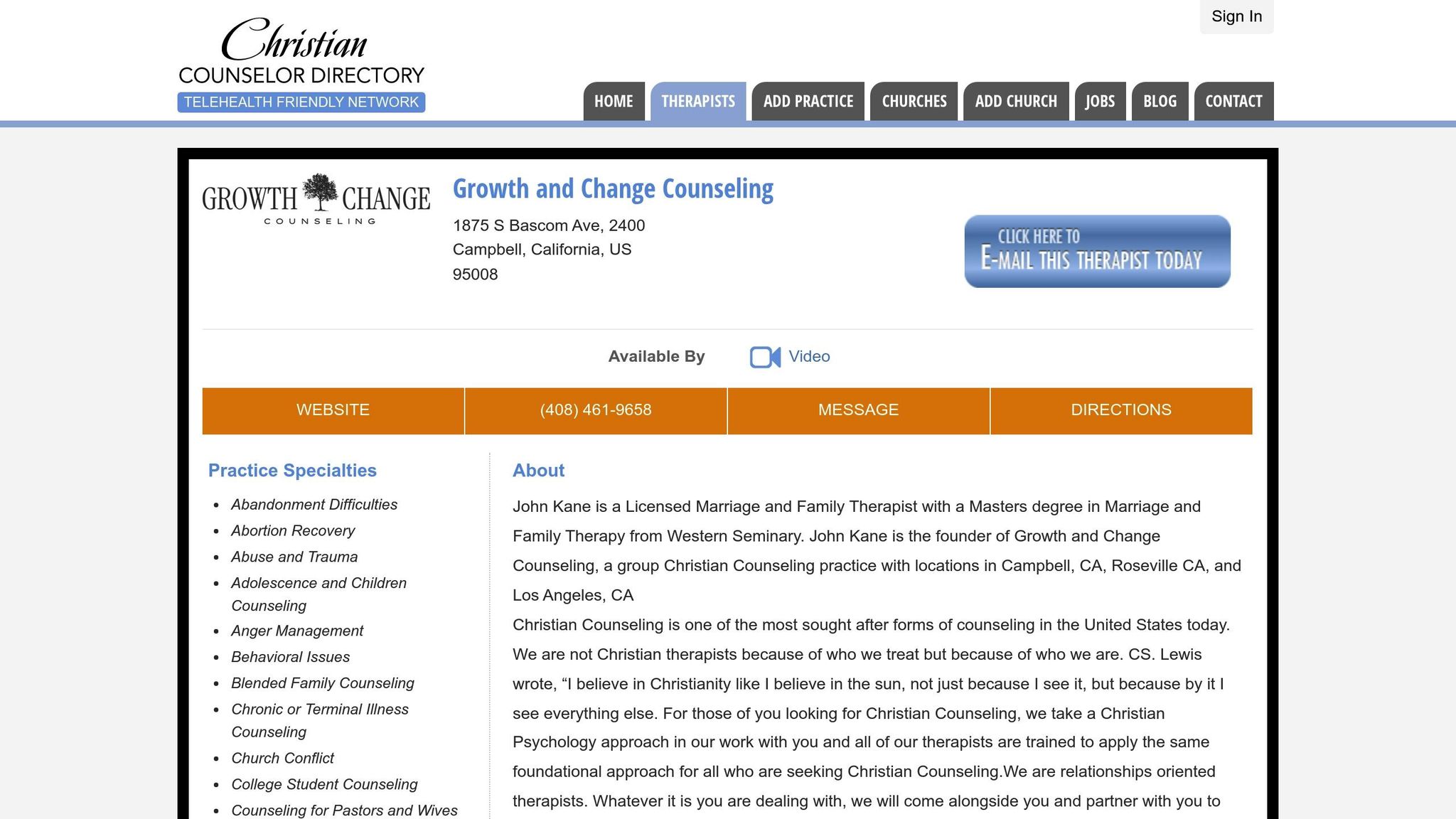
Growth and Change Counseling provides a unique approach to addiction recovery by combining clinical treatment with spiritual healing rooted in Christian principles. Founded by John Mark Kane, LMFT, this practice serves clients throughout California, offering support that goes beyond addressing surface-level symptoms. By focusing on the deeper wounds that often drive addiction – such as trauma, shame, and spiritual disconnection – Growth and Change Counseling aims to provide comprehensive care that integrates both evidence-based methods and faith-based guidance.
At the heart of their approach is Christian Psychology, which blends biblical teachings with proven therapeutic techniques. Instead of relying on a one-size-fits-all model, the counselors create personalized treatment plans tailored to each individual. They work to uncover the underlying causes of addiction, whether it stems from unresolved trauma, strained relationships, or a sense of spiritual emptiness. This holistic approach addresses recovery on physical, emotional, and spiritual levels, acknowledging that true healing requires attention to all aspects of a person’s well-being.
The practice treats a variety of addictions, including substance abuse, media-related dependencies (such as internet, video games, and pornography), and sex addiction. By fostering a nonjudgmental and supportive environment, clients feel safe discussing their struggles openly. Counselors guide individuals in identifying the root causes of their behaviors and help them regain control over their lives.
In addition to traditional therapy, Growth and Change Counseling incorporates specialized treatments that focus on the neurobiological aspects of addiction. These include Alpha-Stim therapy for managing depression and anxiety, and Freespira Biofeedback for addressing panic disorders [9]. When necessary, psychiatric medication management is also available, allowing the practice to address both the chemical and spiritual dimensions of recovery.
The practice’s commitment extends beyond symptom management, emphasizing emotional and relational growth. Counselors assist clients in developing healthier coping strategies, repairing damaged relationships, and finding a renewed sense of purpose. This approach aligns with the Christian counseling concept of becoming the "true self in Christ", where individuals achieve emotional health, spiritual growth, and restored dignity [7].
Faith-based addiction recovery programs have shown measurable success. Studies reveal that these programs often lower relapse rates compared to secular approaches [5]. Additionally, 81% of clients report that their faith enhances their therapy experience, while 70% note significant progress in faith-integrated counseling [4].
Telehealth Services Across California
To ensure accessibility for all Californians, Growth and Change Counseling offers telehealth services alongside in-person care at locations in Campbell, San Jose, Los Angeles, and Roseville. This combination of virtual and physical options allows clients to receive faith-based addiction recovery services no matter where they reside in the state.
Telehealth sessions are conducted through secure, HIPAA-compliant video platforms, making it possible for individuals in rural areas or those with mobility challenges to participate from the comfort of their homes. Research indicates that telehealth addiction treatment is just as effective as in-person care, particularly in fostering strong therapeutic relationships, improving retention, and achieving recovery goals [11].
The practice accepts a range of major insurance providers, including Anthem Blue Cross, Aetna, United Health Care, and Medicare Part B, among others. For those using out-of-network coverage, superbills are provided. Session costs vary based on the therapist’s licensure level: $200 per 45-minute session with a Licensed Marriage and Family Therapist (LMFT) and $150 with an Associate Marriage and Family Therapist (AMFT). Sliding scale options are also available, starting at $100 per session for clients experiencing financial hardship.
By offering telehealth services, Growth and Change Counseling helps bridge the gap for individuals unable to find Christian counseling in their local area. Given that nearly 74% of addiction recovery programs incorporate faith-based components [4], this statewide reach ensures that no one is excluded from receiving the care they need.
Addiction Recovery Programs
Growth and Change Counseling designs customized recovery plans that integrate spiritual insight with clinical expertise. These personalized programs focus on uncovering the deeper issues behind addiction, such as unresolved trauma or spiritual disconnection, and address each client’s unique relationship with God and life circumstances [3].
Individual therapy is central to the recovery process. Licensed Christian therapists guide clients through one-on-one sessions that delve into thought patterns and behaviors misaligned with spiritual health and recovery goals [12]. These sessions help clients process trauma, develop healthier coping mechanisms, and align their recovery journey with both psychological principles and Christian faith.
Family therapy is another key component, recognizing that addiction impacts entire family systems. These sessions help loved ones understand addiction through a faith-based perspective, work through their own pain, and rebuild trust and connection. For families navigating addiction with children or adolescents, the practice also offers parent coaching, equipping parents with tools for effective communication, boundary-setting, and spiritual guidance.
The practice’s solutions-oriented approach ensures that even complex cases receive thorough support. Therapists blend various therapeutic perspectives to create tailored strategies for each client, addressing not just the addiction but the underlying spiritual and psychological factors driving it [7].
Accountability is built into the recovery process through consistent therapeutic relationships, regular progress monitoring, and collaborative goal-setting [3]. Counselors work with clients to integrate spiritual practices into their daily lives and adjust strategies as needed. This combination of professional guidance and personal spiritual discipline creates a strong foundation for sustained recovery.
Treatment duration varies based on factors like addiction severity, co-occurring mental health conditions, family dynamics, and the client’s readiness for change. While some clients may require more intensive support initially, others transition to maintenance therapy as their recovery stabilizes. The practice prioritizes long-term healing over quick fixes, ensuring clients receive the support they need for lasting change.
Success is measured through outcomes such as sustained abstinence, improved mental health, restored family relationships, and increased spiritual engagement. Progress is tracked through treatment retention rates, goal achievement, and clients’ self-reported spiritual restoration. Notably, 74% of individuals in faith-based support groups report improved mental health outcomes [4], underscoring the effectiveness of this integrated approach.
In November 2025, Growth and Change Counseling published an article titled "Restoring Trust in Marriage After Addiction" on their website. This resource highlights the importance of patience, honesty, and effort from both partners in rebuilding trust, reflecting the practice’s dedication to addressing the relational aspects of addiction recovery.
Start Your Path to Healing with Growth and Change Counseling
Recovery requires addressing not just the physical aspects of addiction but also the emotional and spiritual challenges that come with it. Faith-based telehealth counseling offers a unique blend of clinical expertise and spiritual support, helping individuals work toward a deeper, lasting freedom from addiction.
This approach doesn’t just focus on surface-level symptoms. Instead, it tackles the root causes – trauma, broken relationships, shame, and spiritual disconnection. Licensed counselors, who are well-versed in both addiction complexities and faith-based principles, provide care that lays a strong foundation for a meaningful recovery.
Telehealth has revolutionized access to specialized addiction treatment, removing traditional barriers like location or mobility issues. With secure, convenient sessions available from the comfort of home, individuals – whether they’re busy parents, rural residents, or those with limited mobility – can now access professional, faith-integrated care.
The privacy of telehealth also helps reduce the stigma that often prevents people from seeking help. Being able to attend counseling sessions from home, whether during a lunch break or after the kids are asleep, makes it easier to take that first step toward healing.
Faith-based counseling has shown measurable success, with studies indicating lower relapse rates and improved outcomes when spiritual elements are included in treatment. By addressing both clinical and spiritual needs, this approach creates a powerful path to transformation.
Incorporating daily spiritual practices alongside professional counseling fosters recovery on multiple levels. Faith-based telehealth platforms encourage clients to integrate prayer, scripture study, and connection with faith communities into their healing journey. These practices provide the resilience and sense of purpose needed to navigate challenges.
Addiction doesn’t just affect the individual – it impacts entire families. Faith-based counseling recognizes this, offering support not only to the person in recovery but also to family members who may be carrying their own emotional scars. By addressing these dynamics, this approach promotes relational healing and strengthens accountability and support systems within the family.
If you or someone you care about is struggling with addiction, taking the first step toward recovery is an act of bravery. Growth and Change Counseling provides faith-based addiction recovery services across California, combining professional expertise with Christian principles to offer personalized care. Their telehealth services ensure access to treatment no matter where you are, tailoring support to fit your unique needs.
Freedom from addiction is possible. Healing is within your reach, no matter your past struggles. Contact Growth and Change Counseling today to schedule a consultation and explore how faith-based telehealth counseling can help you build a recovery plan that nurtures both your mental health and spiritual well-being. Your path to wholeness begins with one step – and you don’t have to take it alone.
FAQs
How can faith-based telehealth counseling support addiction recovery on both emotional and spiritual levels?
Faith-based telehealth counseling blends spiritual insight with effective therapeutic methods to tackle the underlying causes of addiction. This approach merges emotional support with spiritual development, creating a well-rounded path toward recovery.
At Growth and Change Counseling, the services are tailored to fit the specific needs of individuals and families, providing caring support that encourages personal growth and meaningful, lasting progress.
What are the advantages of using telehealth for addiction recovery compared to in-person treatment?
Telehealth brings a range of advantages to addiction recovery, particularly for those seeking faith-based counseling. One of its standout benefits is convenience – no need to travel, which makes it easier to fit therapy sessions into a packed schedule. This is especially valuable for people living in remote areas or those without easy access to in-person services.
Another key advantage is the ability to receive care from the comfort of home. This setting can foster a sense of privacy and security, which is often crucial during such a vulnerable period. For those pursuing faith-based counseling, telehealth opens the door to connecting with specialized Christian therapists who might not be available locally. This ensures spiritual guidance is woven into the recovery journey.
In short, telehealth offers a flexible and supportive way to tackle addiction while staying grounded in faith and the path to healing.
How can spiritual practices be incorporated into a telehealth recovery plan to support long-term addiction recovery?
Integrating spiritual practices into a telehealth recovery plan can offer emotional support and a renewed sense of purpose for those navigating addiction recovery. Activities like prayer, meditation, or reading scripture can help individuals feel more centered and stay focused on their recovery goals. These practices not only deepen one’s connection to faith but also encourage mindfulness and emotional strength.
Working with a faith-based telehealth counselor can make this process even more effective. These professionals help clients design a recovery plan that weaves spiritual practices with proven, evidence-based methods. This combination creates a solid framework for long-term progress, even when challenges arise. Regular counseling sessions provide consistent support and accountability, ensuring individuals remain aligned with their recovery path.
Related Blog Posts
- Overcoming Addiction and Anxiety in Christian Marriages
- Faith-Based Tools for Couples in Recovery
- Parent Coaching with Faith in Addiction Recovery
- How Faith Helps Rebuild Trust After Addiction
