Is screen time hurting family time? Here’s the reality: 75% of families own personal devices, and 61% admit to using phones during important moments. Excessive screen use can lead to emotional disconnection, reduced communication, and even health risks like poor sleep and anxiety. But it’s not all bad – when used intentionally, technology can enhance learning, creativity, and even social connections.
The key is balance. Families can create screen-free zones, plan shared activities, and model healthy habits. If conflicts persist, professional guidance like family therapy or parent coaching can help rebuild emotional bonds and set boundaries.
Quick Takeaways:
- Problem: Overuse of screens disrupts family connections and impacts health.
- Solution: Set screen-free times, engage in shared activities, and model good habits.
- When to Get Help: If screen use causes ongoing conflicts or behavioral issues.
The goal isn’t to eliminate screens but to use them in ways that strengthen – not weaken – family relationships.
Not All Screen Time Is Bad: How to Teach Kids Digital Awareness and Balance
sbb-itb-596b85d
Benefits of Screen Time
Technology itself isn’t the problem – it’s how we use it. When approached with care and intention, screens can encourage learning, spark creativity, and help us stay connected. The real challenge lies in understanding what we’re doing on our devices and how we’re engaging with the digital world.
As Julianna Miner, author of Raising a Screen-Smart Kid, explains: "If you think about screen time the way you think about nutrition, there’s like digital broccoli and digital ice cream" [5].
Just like food, some digital content is enriching, while other content is less helpful. Knowing the difference makes it easier for families to make informed decisions about technology use. This balance is especially important for education and social connections.
Educational and Learning Benefits
When managed thoughtfully, screen time can enhance family life rather than disrupt it. High-quality educational apps like Khan Academy Kids and Duolingo are excellent examples of tools that help children build language skills, phonics, and word recognition [14, 16]. For preschoolers, these interactive platforms often outperform traditional methods in preparing them for school.
Certain games also encourage critical thinking and problem-solving. Strategy-based games, resource management challenges, and creative platforms like Minecraft or chess apps teach resilience by allowing kids to learn through trial and error [13, 14]. Additionally, research highlights how video games can improve hand-eye coordination, with notable benefits for children with developmental disabilities, especially in gross motor skill development [13, 14].
Screens can also be a gateway to creativity. Platforms like Canva let kids explore graphic design, while CAD software introduces them to 3D modeling and design. These tools help children develop skills that can lead to academic and even professional opportunities [5].
Social Connection and Recreation
Screens aren’t just for learning – they’re also a way to stay connected. Technology bridges physical distance, allowing families and friends to maintain relationships through platforms like Zoom and FaceTime [14, 15]. For children who struggle to find friends locally or have niche interests, online communities can provide meaningful social support.
Katie Davis, co-director of the UW Digital Youth Lab and author of Technology’s Child, advises: "Parents should ask themselves: Is my child’s technology use self-directed and fostering growth? These qualities matter far more than the number of minutes logged on a device" [4].
When screens are used for genuine social interaction – like multiplayer games that require teamwork or video calls with relatives – they can create lasting bonds. Even within families, shared screen activities can strengthen relationships, turning technology into a tool for connection rather than isolation [1].
The key takeaway? It’s not about the amount of screen time but how it’s used. Intentional, shared experiences with screens can bring people together and enrich lives.
Benefits of Family Time
While screens can offer opportunities for learning and connection, nothing replaces the emotional bonds built during unplugged family moments. Face-to-face interactions foster emotional well-being and personal growth in ways that digital communication simply can’t. These moments are crucial for healthy development.
As psychologist Urie Bronfenbrenner said: "In order to develop normally, a child requires progressively more complex joint activity with one or more adults who have an irrational emotional relationship with the child. Somebody’s got to be crazy about that kid" [6].
This kind of deep connection happens when families choose one another over devices. These moments create the foundation for the practical benefits outlined below.
Building Stronger Family Relationships
Spending regular time together strengthens trust, often in ways that only become clear over time. Simple rituals – like a weekly family meeting where everyone, even the kids, gets a say in setting boundaries – help children feel valued and heard [1]. This sense of inclusion builds a stronger family dynamic.
Everyday routines, like folding laundry together, reading side-by-side, or working on a project, foster teamwork and trust without the need for forced conversations [3]. These shared tasks replace the constant battle over screen time with genuine collaboration.
Even disagreements can become opportunities for growth. Acknowledging a child’s frustration when screen time ends – by saying something like, “I can see you’re upset about the limit” – shows them their feelings are valid [1]. These moments teach empathy and respect, strengthening emotional bonds.
Beyond the emotional benefits, family time also plays a key role in helping children develop essential life skills.
How Family Time Supports Child Development
Unplugged activities are powerful tools for developing children’s executive functions, such as planning, impulse control, and delaying gratification. These skills have been linked to better college graduation rates and higher income levels in adulthood [7].
Developmental pediatrician Mark Bertin, M.D., highlights: "Children need unstructured, ‘unplugged’ play – away from screens and computers – to grow in ways that will help them thrive throughout life" [7].
Reading together is particularly impactful. Discussing books as a family helps children develop "theory of mind" – the ability to understand others’ thoughts and feelings [3]. This skill is the foundation for empathy and positive relationships.
The data is clear: when parents are actively involved in unplugged activities, children experience better academic, social, and physical outcomes [7]. On the flip side, nearly 70% of children feel their parents spend too much time on their phones [7]. This shows that how parents model behavior is just as important as the rules they set. Prioritizing face-to-face interaction encourages children to do the same naturally.
The Costs of Too Much Screen Time
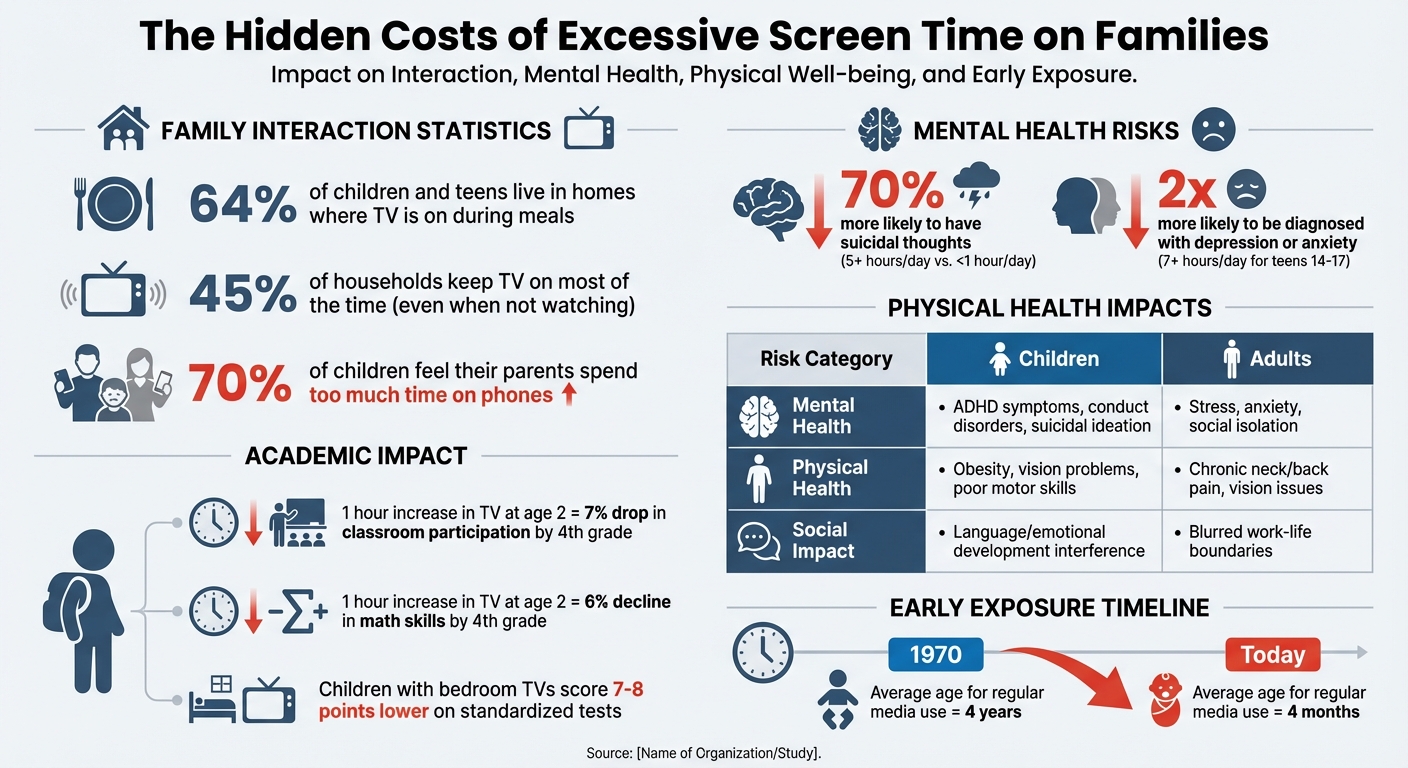
Screen Time Impact on Families: Key Statistics and Health Effects
Spending excessive time in front of screens can weaken family connections and hinder children’s growth in critical areas.
Reduced Family Interaction
When screens dominate the household, they often take the place of meaningful face-to-face conversations that strengthen relationships. For example, studies show that 64% of children and teens live in homes where the TV is on during meals, and 45% of households keep the TV on most of the time, even when no one is actively watching it [14]. This constant background noise disrupts family communication and bonding.
"Screen time diminishes the quantity and quality of interactions between children and their parents, resulting in fewer chances for the child to practice and develop their language abilities", says Sudheer Kumar Muppalla, a pediatrics expert [10].
The effects extend beyond communication. Every additional hour of screen exposure takes away from activities like reading or playing outdoors. Research highlights the impact: a one-hour increase in TV exposure at age two leads to a 7% drop in classroom participation and a 6% decline in math skills by fourth grade [9]. Additionally, children with televisions in their bedrooms score 7 to 8 points lower on standardized math and reading tests [14].
But the consequences don’t stop at reduced interaction – excessive screen time also affects physical and mental health.
Physical and Mental Health Effects
Prolonged screen use can have serious effects on physical health. For children and teens, it increases the risks of obesity and vision issues [10][11]. Adults aren’t immune either, often experiencing neck and back pain or computer vision syndrome from extended screen time [8].
The mental health risks are equally alarming. Adolescents who spend more than five hours a day on digital devices are 70% more likely to have suicidal thoughts or behaviors compared to those who limit their screen time to under an hour [8]. Among teens aged 14 to 17, heavy users (7+ hours daily) are over twice as likely to be diagnosed with depression or anxiety compared to light users [12].
| Risk Category | Impact on Children | Impact on Adults |
|---|---|---|
| Mental Health | Increased ADHD symptoms, conduct disorders, and suicidal ideation [10][13] | Higher stress, anxiety, and social isolation [8] |
| Physical Health | Greater likelihood of obesity, vision problems, and poor motor skills [11][10] | Chronic neck/back pain and vision issues [8] |
| Social Impact | Interference with language and emotional development [10] | Blurred work-life boundaries, less face-to-face interaction [10] |
Sleep disruption is another major concern. Using screens at night delays falling asleep, reduces sleep duration, and lowers overall sleep quality [8][10]. The blue light from devices and the mental stimulation from content create a perfect storm for poor rest, which can worsen both mental health and academic performance.
"Excessive screen time can reduce attention span, decrease creativity, and limit problem-solving abilities", says Khumukcham A Devi from AIIMS [8].
Adding to the problem, children are starting screen use at much younger ages than before. In 1970, the average age for regular media use was four years. Today, it’s just four months [9]. This early exposure replaces interactive, real-world experiences that are essential for developing social and cognitive skills. As a result, children show higher levels of emotional reactivity, aggression, and other behavioral challenges.
Strategies for Balancing Screen Time and Family Time
Striking the right balance between screen use and family time doesn’t mean cutting out devices entirely – it’s about setting thoughtful boundaries that nurture your family’s connections. By combining clear rules, engaging activities, and mindful habits, families can create an environment where technology enhances rather than disrupts relationships.
Create Screen-Free Zones and Times
One effective way to reduce screen distractions is by designating specific areas and times as screen-free. For example, make the dining room and bedrooms device-free zones to encourage face-to-face interaction and improve sleep quality. A central charging station in a shared space can help keep devices out of bedrooms overnight. You might also try the "one-hour rule", which involves turning off screens at least 60 minutes before bedtime to promote better sleep habits [15].
Research backs this up. A 2019 study by The Gottman Institute and ABC News found that families who implemented screen-free routines – like shared meals and weekly family meetings – experienced more meaningful interactions instead of merely coexisting with their devices [1].
Once these boundaries are in place, the next step is to focus on activities that naturally replace screen time with quality family moments.
Plan Regular Family Activities
Rather than just limiting screen time, families can focus on adding activities that bring everyone together. Whether it’s outdoor adventures, game nights, or reading sessions, setting shared goals for family time can make a big difference. Getting kids involved in the planning process ensures they feel excited and invested in these moments.
"Rather than focusing on reducing screen time, families can consider how to crowd back in important activities, like building a healthy bedtime routine or spending time outside."
– American Academy of Pediatrics [2]
Take a closer look at your weekly schedule. Are there opportunities to prioritize outdoor play or a family board game night? When children have a say in choosing these activities, they’re more likely to engage and enjoy the time spent together.
But creating balance isn’t just about rules and routines – it’s also about how parents model their own screen habits.
Parents Should Model Healthy Screen Habits
Kids often mimic what they see. If parents are glued to their phones during downtime, children will likely follow suit. In fact, nearly 70% of kids report feeling that their parents spend too much time on devices [7].
"If you want your child to be a reader, they must see you reading a book, not a screen, since if you’re on a device, they have no idea if you’re playing a first-person shooter or reading a novel."
– Mark Bertin, M.D., Developmental Pediatrician [7]
Set an example by choosing physical books over screens when your children are nearby. Avoid checking your phone during family time, and instead, demonstrate how to use features like "do-not-disturb" and notification limits. These small actions show kids how to take control of their tech use. Additionally, holding weekly family meetings to discuss and agree on screen time rules can make a big impact – when children help create the rules, they’re more likely to follow them [1].
When to Seek Professional Help
If setting boundaries around screen habits feels like an uphill battle and conflicts keep arising, it might be time to consider professional support. When technology becomes a constant source of tension in your home, seeking expert help can provide the tools needed to address the deeper issues at play.
This kind of intervention often requires solutions that focus on the family as a whole.
How Family Therapy Can Help
Family therapy dives into the underlying causes behind screen overuse. Often, excessive screen time serves as an escape from unresolved problems like anger, anxiety, or family tension. Therapy works to address these issues, helping families reconnect emotionally and break away from isolated, device-centered routines.
For families where members are physically present but emotionally distant – each lost in their own digital worlds – therapy can rebuild those critical bonds. It’s not just about limiting screen time; it’s about creating a foundation for healthier interactions.
Therapeutic interventions have shown success in guiding families toward more meaningful, screen-free activities. Growth and Change Counseling, for example, uses a solutions-focused approach to address these challenges. John Kane, a Relationship Therapist with the organization, highlights the connection between emotional well-being and screen habits:
"The more relationally healthy people are, the less anxious, addicted, and depressed they are."
Warning signs that professional help may be needed include screen use interfering with important activities like sleep, exercise, or schoolwork. Other red flags include slipping grades, ongoing mood swings, or intense outbursts when screen limits are enforced.
In addition to family therapy, coaching parents directly can reinforce these changes.
Parent Coaching for Screen Time Management
Parent coaching offers a hands-on approach to help caregivers regain confidence and authority when managing screen time. A coach works with parents to develop tailored strategies that fit their unique family dynamics.
One effective tool is the "Four Pillars" assessment, which evaluates whether a child is physically healthy, socially engaged, doing well in school, and participating in non-digital hobbies. This method provides a clear picture of when professional intervention might be necessary.
Growth and Change Counseling also provides parent coaching, available both in-person (in Campbell, San Jose, Los Angeles, and Roseville, CA) and through telehealth across California. Their coaching services aim to help parents establish consistent rules and discipline, which are crucial when boundaries have eroded and conflicts over screen time dominate daily life. Sessions start at $150 for 45 minutes with an Associate Marriage and Family Therapist, and sliding scale options are available for families with financial challenges.
Conclusion
Balancing screen time with family time isn’t about cutting out technology entirely – it’s about using it thoughtfully and with purpose. As Katie Davis, author of Technology’s Child, explains:
"Parents should ask themselves: Is my child’s technology use self-directed and fostering growth? These qualities matter far more than the number of minutes logged on a device." [4]
Setting a good example is crucial. Simple actions, like putting your phone away during meals or choosing a board game over scrolling, can teach kids the importance of healthy boundaries. Instead of focusing solely on limiting screen time, try incorporating positive alternatives. Activities like outdoor play, establishing screen-free zones, or even co-viewing content with your kids can naturally strengthen family bonds without vilifying technology [3]. However, if these strategies don’t seem to help, additional support might be needed.
When screen use leads to ongoing conflicts or warning signs like falling grades, mood changes, or withdrawal from family activities, seeking professional guidance can make a difference. Growth and Change Counseling provides family therapy and parent coaching, available in-person in Campbell, San Jose, Los Angeles, and Roseville, CA, or via telehealth across California. This approach helps families make meaningful, lasting improvements.
The goal isn’t perfection – it’s progress. Small, steady changes, whether in screen habits or quality time together, can reinforce the strength and well-being of your family.
FAQs
What are some effective ways to balance screen time and family time?
Balancing screen time with family time starts by setting clear boundaries and prioritizing meaningful moments together. One effective approach is to establish screen-free times or spaces – like during meals or family activities – where everyone can focus on conversation and shared experiences. When screens are used, aim to make it purposeful by prioritizing educational or enriching content over purely recreational use.
Getting kids and teens involved in setting these boundaries can make a big difference. It helps them feel more responsible and invested in the process. Beyond that, encourage outdoor adventures, unstructured play, and in-person interactions to support their emotional and social growth. As your family evolves, take time to revisit and adjust these habits to ensure they continue to work well. If you need extra guidance, services like Growth and Change Counseling can offer strategies to build routines that nurture stronger connections and emotional health.
How can I create screen-free zones at home to encourage more family time?
Setting up screen-free zones at home can help bring families closer together and cut down on distractions. For example, you might decide that areas like the dining room or bedrooms are off-limits for phones, tablets, and other devices. This opens the door for more face-to-face interactions and meaningful conversations.
Another idea is to establish tech-free times, such as during meals or the hour before bedtime. These moments encourage everyone to unplug and focus on being present with one another. To make these rules stick, involve your family in creating them. When everyone has a say, it’s easier to understand and follow through. These small shifts can go a long way in building stronger connections and creating a better balance with technology.
When should families seek professional help for screen time challenges?
Families might want to seek professional help when screen time starts disrupting emotional health, family bonds, or daily routines. For example, if screens are cutting into quality family time, sparking frequent arguments, or taking the place of vital activities like playing or in-person conversations, it could be a sign to consult a counselor.
Getting expert advice is also a good idea if children or teens seem distressed, have trouble managing their screen use, or if attempts to set healthy boundaries aren’t working. Addressing the issue early can help families regain balance and strengthen their relationships, ensuring screen habits support overall well-being.
Related Blog Posts
- Signs Screen Time Hurts Your Marriage
- How Couples Heal After Technology-Driven Conflicts
- Screen Time vs. Family Time: Finding Balance
- Ultimate Guide to Digital Detox for Couples
