Parenting with ADHD can feel overwhelming, especially when sensory overload strikes. Everyday sounds, touch, and visual clutter can overstimulate your brain, making it hard to stay calm and focused. Research shows up to 60% of people with ADHD also experience sensory processing challenges, leading to irritability, fatigue, and emotional outbursts.
Here’s how to manage sensory overload:
- Identify triggers: Keep a sensory diary to track overwhelming situations and early warning signs like a racing heart or muscle tension.
- Create a calming environment: Reduce clutter, use dimmable lighting, and opt for fragrance-free products to minimize sensory irritants.
- Use tools: Noise-canceling headphones, weighted blankets, and fidget toys can help regulate your nervous system.
- Practice quick resets: Techniques like deep breathing or stepping into a quiet space can help regain control.
- Seek support: Therapy or counseling can provide tailored strategies if sensory overload disrupts your daily life.
Small adjustments and self-awareness can make parenting with ADHD more manageable, helping you create a calmer home for yourself and your family.
How ADHD Affects Sensory Processing in Parents
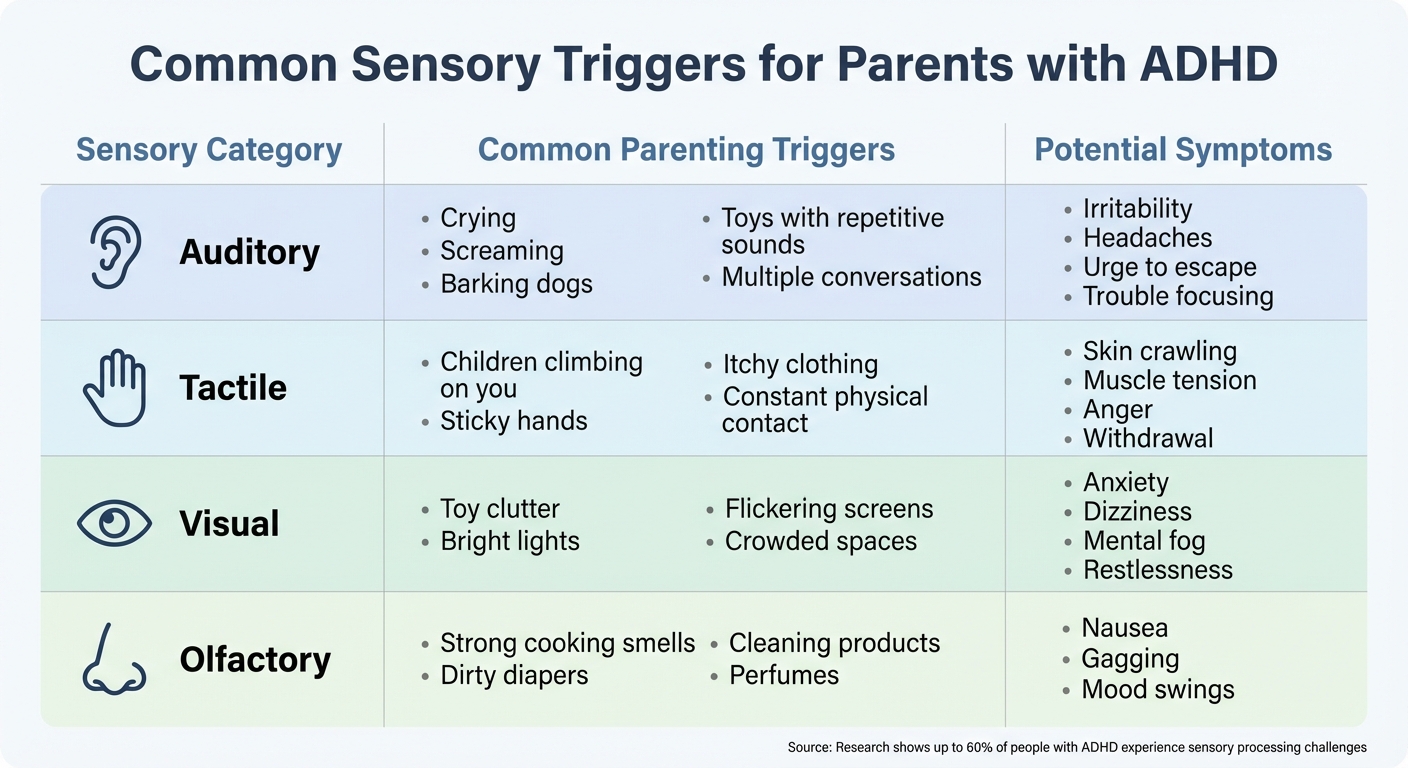
Common Sensory Triggers for Parents with ADHD
What Sensory Overload Means
For parents with ADHD, sensory overload adds an extra layer of difficulty to the already demanding job of parenting. Sensory overload happens when your brain is bombarded with more information than it can handle, leading to a physical reaction. Grace Tworek, PsyD, a health psychologist at Cleveland Clinic, explains it like this:
"Sensory overload happens when input from any of your senses – sight, sound, taste, smell – feel overwhelming and trigger a physiological response. It’s your sympathetic nervous system letting you know that something requires your attention." [8]
When this occurs, your body shifts into fight-or-flight mode. You might feel your heart racing, start sweating, get dizzy, or experience an intense urge to escape the situation. Unlike neurotypical individuals who can filter out background noise – like the hum of a refrigerator or the ticking of a clock – those with ADHD tend to process everything simultaneously. It’s like having too many browser tabs open at once [9][10].
Another complicating factor is the struggle with "set shifting", which is the ability to move your focus from one thing to another. A small annoyance, like a repetitive noise or a spill on your shirt, can dominate your attention, making it hard to move on. ADHD can also impact your awareness of your surroundings, so these sensory inputs often catch you off guard [4][5][1].
These reactions are tied to specific sensory triggers, which we’ll break down below.
Common Sensory Triggers for Parents
Parenting naturally brings a whirlwind of sensory experiences, and for parents with ADHD, this can quickly become overwhelming. Sounds, for instance, are a major source of overload. Crying or screaming children, toys with repetitive sounds, barking dogs, or multiple conversations happening at once can make it nearly impossible to think clearly [4][7][10].
Touch can be another challenging area. Constant physical contact – like children climbing on you, sticky hands grabbing your face, or endless hugs – can lead to what’s often called sensory fatigue. Even clothing can become unbearable, with itchy tags or tight fabrics suddenly feeling intolerable during moments of high stress [7][5][3].
Here’s a breakdown of common sensory triggers and how they might affect you:
| Sensory Category | Common Parenting Triggers | Potential Symptoms |
|---|---|---|
| Auditory | Crying, screaming, barking dogs, toys with repetitive sounds, multiple conversations | Irritability, headaches, urge to escape, trouble focusing |
| Tactile | Children climbing on you, sticky hands, itchy clothing, constant physical contact | Skin crawling, muscle tension, anger, withdrawal |
| Visual | Toy clutter, bright lights, flickering screens, crowded spaces | Anxiety, dizziness, mental fog, restlessness |
| Olfactory | Strong cooking smells, dirty diapers, cleaning products, perfumes | Nausea, gagging, mood swings |
Visual clutter is another sensory minefield. Scattered toys, flickering lights, and the chaos of kids running around can overwhelm your brain, creating what experts call "cognitive noise" [4][7][10]. On top of that, strong smells – whether from frying food, dirty diapers, or cleaning chemicals – can trigger nausea or sudden changes in mood. Combine all of this with the constant juggling act of parenting – answering questions, cooking dinner, and managing a million tasks at once – and it’s easy to see how quickly your sensory system can hit its limit [4][5][10].
Finding and Managing Your Sensory Triggers
How to Recognize Your Triggers
Dealing with sensory overload starts with figuring out what sets it off for you. Sometimes, these triggers aren’t immediately obvious – they can sneak up on you before you even realize what’s happening. A good way to start is by keeping a sensory diary. Jot down details about the situation, like where you were, what was happening around you, and the specific sensory elements you noticed – sounds, smells, lights, or physical sensations. Don’t forget to include internal factors, such as whether you’ve eaten recently, how well you slept, or if you’ve taken your ADHD medication, as these can make you more sensitive to your surroundings [4].
Pay attention to your body’s early warning signs. Your nervous system often sends subtle signals before you hit full sensory overload. These might include a racing heart, shallow breathing, sweating, a clenched jaw, or muscle tension. You might even notice an intense urge to leave the situation or find yourself snapping at your kids over something minor. Dr. Megan Anna Neff, a clinical psychologist, emphasizes:
"When you understand your sensory triggers, we can proactively manage and avoid them. This is why identifying sensory triggers is a vital step in creating a sensory safety plan" [11].
If you’re having trouble identifying these triggers on your own, try using a sensory checklist. These lists often cover areas like lighting, sounds, textures, smells, and movement. Sometimes seeing these factors laid out can help you recognize irritants you’ve been quietly enduring for years [11]. Once you’ve pinpointed your triggers, you can start building a personalized plan to manage them.
Building Your Sensory Management Plan
Once you’ve identified your triggers, it’s time to create a plan to manage them. Start by adjusting your home environment. Reduce visual clutter by tidying up regularly, switch out harsh light bulbs for dimmable LEDs, and opt for unscented cleaning products to cut down on sensory irritants [4][7].
Sensory tools can also be incredibly helpful. Noise-canceling headphones or simple foam earplugs can block out disruptive sounds, especially during chaotic moments. Weighted blankets, fidget tools, or seamless clothing without scratchy tags can help keep your nervous system steady throughout the day [4]. Another idea is to set up a sensory-friendly zone in your home – a quiet, low-stimulation space to retreat to when you feel overwhelmed [2][7].
Don’t overlook the importance of setting boundaries. Therapist Shaye Meissen suggests that stepping away briefly can teach kids the value of respecting personal space [7]. You can also create predictable routines, like a family quiet time after school or before dinner, so everyone knows when it’s time to tone things down.
Finally, when you feel sensory overload creeping in, try the 3-3-3 breathing technique: breathe in for three counts, hold for three, and breathe out for three. This simple exercise can help calm your nervous system and bring back a sense of control [7][8].
Practical Solutions for Managing Sensory Overload
Adjusting Your Home Environment
Your home should be a sanctuary, not a source of stress. Start by tweaking your lighting – swap out flickering fluorescent bulbs for dimmable LEDs to control brightness based on your needs. If bright sunlight feels overwhelming, blackout curtains can help you manage natural light levels.
Soundproofing your space is equally important. Turn off TVs or podcasts when they’re not in use, and add soft furnishings like rugs and curtains to absorb echoes and reduce noise. Visual clutter can also be a trigger, so consider rotating your kids’ toys to keep things tidy and set up a quiet, clutter-free corner just for yourself.
Scents matter too. Opt for fragrance-free laundry detergents, soaps, and cleaning products to cut down on overwhelming chemical smells. Small changes like these can make a big difference in creating a calming environment.
Now, let’s talk about tools that can make managing sensory overload even easier.
Tools and Products That Help
Sometimes, the right tools can feel like a lifeline. Noise-canceling headphones or earplugs can block out distracting sounds, while white noise machines or even a simple fan can provide soothing background noise.
For physical comfort, weighted blankets or lap pads can help calm your nervous system, and having fidget toys on hand offers quick relief during stressful moments. Clothing also plays a role – choose soft, non-irritating fabrics and remove scratchy tags to avoid tactile discomfort. Some people even find that wearing sunglasses indoors helps reduce overwhelming visual input, and essential oil rollers with calming scents like lavender or peppermint can provide a grounding effect.
If you’re in the middle of sensory overload, these quick techniques can offer immediate relief.
Quick Coping Techniques
When sensory overload strikes, grounding yourself can help you regain control. A simple exercise like the 5-4-3-2-1 technique – where you identify 5 things you see, 4 things you can touch, 3 you hear, 2 you smell, and 1 you taste – can bring your focus back to the present moment.
Breathing exercises are another effective option. Try "4/6 breathing" by inhaling for four counts and exhaling for six. This slows your heart rate and helps calm your body. Physical resets work too – splash cold water on your face, sip cool water, or press your feet firmly into the ground to feel more anchored.
Sometimes, the best solution is to step away. Take a short 30–60 second break in a quiet space. Let your family know, “I’m feeling overwhelmed and need five minutes of quiet to reset.” This not only gives you the space you need but also shows your children how to manage emotions in a healthy way.
sbb-itb-596b85d
Getting Professional Support
When to Consider Therapy or Counseling
While practical strategies can help manage sensory overload, sometimes they aren’t enough on their own. If you find yourself frequently snapping at your kids, feeling the need to escape or shut down, or experiencing physical symptoms like a racing heart, tightness in your chest, or nausea, it might be time to consider professional support. Research shows that many people with ADHD also experience Sensory Processing Disorder [4][13].
Seeking therapy becomes especially important when sensory meltdowns start to disrupt your daily life or strain your relationships. For instance, if your family misinterprets your need for quiet as rejection or if you’re avoiding social situations to prevent feeling overwhelmed, a therapist can help repair and maintain those connections. Occupational therapists can create a personalized sensory plan to help you process stimuli more effectively, while counselors can address the emotional challenges of parenting with ADHD.
"When overstimulation disrupts relationships or leaves you feeling out of control, therapy becomes essential." – Emily Aleksy, Therapist, ERA Wellness [6]
Professional support can provide you with tools and strategies to better navigate sensory overload, offering a path to regain balance and control in your life.
How Growth and Change Counseling Can Help
Growth and Change Counseling specializes in helping parents manage ADHD and sensory overload. Their team includes therapists with expertise in ADHD, Autism Spectrum Disorder (ASD), and neurodiverse family dynamics. They offer parent coaching to help rebuild confidence and strengthen parent-child relationships, as well as individualized and family therapy tailored to your specific needs.
Their approach focuses on finding practical solutions quickly. As Jamula Taylor, LMFT, explains:
"We understand that our mental health conditions are related to the breakdown in our relationships and that we can’t simply make depression, anxiety, or other problems go away by simply treating the symptoms. We have to get down to the roots" [12].
Growth and Change Counseling aims to provide meaningful support without dragging you into endless therapy sessions. They offer services in Campbell, San Jose, Los Angeles, Roseville, and through telehealth across California, making it convenient for busy parents to access the help they need when they need it most.
Conclusion
Parenting with ADHD while dealing with sensory overload is undeniably challenging, but recognizing how your brain works is a crucial first step toward finding relief. Research shows that up to 60% of people with ADHD also experience symptoms of Sensory Processing Disorder, emphasizing the biological roots of these struggles [4].
Start by identifying your sensory triggers – whether it’s overlapping conversations, constant physical contact, or other stimuli. Once you know what overwhelms you, you can make simple adjustments to your environment. Tools like noise-canceling headphones, softer lighting, or creating quiet zones at home can make a big difference. Quick techniques, such as 4/6 breathing, can also help you regain control in high-stress moments. These steps lay the groundwork for maintaining emotional balance.
Equally important is practicing self-compassion. As Emily Aleksy reminds us, "Overstimulation doesn’t mean you’re a bad parent – it means you’re human" [6]. When you take the time to apologize to your kids after a tough moment or explain why you needed a break, you’re not just repairing the situation – you’re teaching them about emotional regulation and healthy boundaries.
If personal strategies don’t feel like enough, seeking professional support can be a game-changer. Managing sensory triggers is essential for a calmer household, and professionals can offer tailored solutions. Occupational therapy can help with sensory integration, while counseling can address the emotional challenges. Growth and Change Counseling, for example, offers parent coaching and therapy designed for families navigating ADHD and sensory overload.
Moving Forward with Growth and Change Counseling
How can I recognize and manage sensory triggers as a parent with ADHD?
Recognizing sensory triggers as a parent with ADHD begins with paying close attention to how different situations make you feel. Do you notice a spike in irritability, anxiety, or a sense of being overwhelmed? Triggers often include things like loud noises, bright lights, or crowded spaces – but they can vary from person to person. Identifying these patterns helps you understand which environments or stimuli might be pushing your limits.
Physical signs can also clue you in. A racing heart, sweaty palms, or tight muscles might indicate sensory overload. Consider jotting down these moments in a journal or simply keeping mental notes to track recurring patterns. Once you’ve identified your triggers, you can explore strategies to manage them. Whether it’s stepping away for a quick break, creating quieter areas at home, or practicing calming techniques, these small adjustments can make a big difference in navigating sensory challenges.
How can I quickly manage sensory overload as a parent with ADHD?
Managing sensory overload in the moment can feel overwhelming, but there are a few practical steps that can help you regain your balance. One of the simplest and most effective methods is deep breathing. By taking slow, deliberate breaths, you can help calm your nervous system and ease that sense of being overwhelmed.
If you’re able, try stepping into a quieter space or heading outdoors for a brief moment. Removing yourself from the source of loud noises or bright lights can provide immediate relief. Another quick trick is to temporarily cover your ears or close your eyes to reduce the intensity of sensory input. This can be a lifesaver when sounds or lights become too much to handle.
These straightforward techniques can help you stay grounded, even during those high-stress parenting moments when sensory overload feels like it’s taking over.
When should I seek help for sensory overload as a parent with ADHD?
If dealing with sensory overload is making it tough to navigate daily life, maintain relationships, or take care of your emotional health, it might be time to reach out for professional support. Some signs to keep an eye on include ongoing anxiety, frequent emotional meltdowns, trouble managing outbursts, or physical reactions like sweating or a racing heartbeat.
It’s also worth seeking help if sensory overload is stopping you from participating in social activities, keeping up with relationships, or handling everyday responsibilities. A mental health professional can guide you in developing practical coping techniques, addressing deeper issues, and enhancing your overall well-being. Knowing when to ask for help is an essential step toward regaining balance and managing sensory overload effectively.
Related Blog Posts
- ADHD and Autism: Conflict Resolution Strategies
- Parenting Stress: Solutions for Neurodiverse Families
- Q&A: Sensory Challenges in Recovery Contexts
- ADHD Parenting Tips for Neurodiverse Families
