When an ADHD meltdown starts, I don’t try to teach first – I try to calm the moment. That’s the core idea here: my calm helps my child settle, and that comes before problem-solving.
Here’s the short version:
- I regulate myself first by pausing, breathing, and lowering my voice.
- I make home easier to move through with routines, visual cues, and fewer loud distractions.
- I use short, calm support during meltdowns instead of lectures, questions, or “calm down.”
- I practice regulation skills during calm parts of the day so they’re easier to use under stress.
- I watch for patterns like time of day, triggers, and what helps.
A few facts from the article stand out:
- Kids with ADHD may be 2 to 3 years behind peers in self-regulation.
- Movement breaks every 60–90 minutes can help lower overload.
- If intense episodes last more than 20 minutes or happen many times a day, extra support may help.
What this means for me is simple: I stay steady, lower demands, stay close, and wait for my child’s body to settle before I talk things through. That is co-regulation in daily life.
The rest of the article explains how I can do that at home, in the moment, and during calm routines.
Co-regulation: The ADHD Parenting Skill Every Parent Needs to Learn
Step 1: Prepare Yourself to Be the Calm Anchor
Co-regulation starts with you. Kids with ADHD often need more outside help to settle their nervous system, so they look to you for calm signals. If you’re steady, you can guide. If you’re flooded, that gets much harder.
Notice Your Early Stress Signals
A lot of parents don’t catch themselves escalating until they’re already deep in it. The earlier you spot your own stress response, the easier it is to stop the spiral. Usually, your body tells you first: a tight jaw, clenched teeth, tense shoulders, or hands that feel tight [1][3][4].
Your behavior can shift too. Maybe your voice gets louder. Maybe you start talking faster. Maybe you feel that pull to lecture, plead, bribe, or threaten consequences [6][8][4]. That moment matters.
It also helps to notice built-up stress. Sometimes the issue isn’t just this moment. It’s that your own "stress cup" is already close to full, so one small trigger hits much harder than it should [4].
Use Short Grounding Routines Before Responding
Pause first. Then respond.
You don’t need a long reset. You need a short one that works. Even a brief pause can lower your arousal and help you avoid mirroring your child’s intensity [4]. Try three slow belly breaths. Or inhale for a count of 3 and exhale for a count of 5 [5][4].
As you breathe, let your shoulders drop. Soften your jaw. Unclench your hands [5][3].
If that still feels like too much, go even simpler. Hold something cold or take a sip of water [1]. Small sensory cues can help you get back under yourself.
Then crouch or sit at your child’s level, and keep your hands at your sides to signal safety [7][6]. Lower your voice and soften your tone. Calm body language and a calmer voice often send the message faster than more words do [3][6].
If you need something to say while you reset, keep it short:
"I’m here, I’m just taking a breath." [1]
Once you’re steadier, the next step is to make the environment easier for your child to regulate in.
Step 2: Set Up an ADHD-Friendly Home That Supports Regulation
Once you’re steadier, shape the home so it helps with regulation too. The big idea is simple: let the environment carry some of the load. When your child has fewer decisions to make and fewer things to remember, blowups often ease up before they even begin.
Once your own tone is calm, make the home do part of the calming work.
Predictability cuts down the number of decisions and transitions your child has to juggle.
Use Routines, Visual Cues, and Transition Warnings
Children with ADHD often have a hard time keeping a mental to-do list in mind. So don’t leave reminders in their head. Put them in the room.
A picture checklist on the bathroom mirror, a whiteboard with after-school steps, or a "pack-your-bag" photo card by the door can take a lot off their plate. Instead of trying to remember everything on their own, they can just look up and see the next step.
Transitions matter too. A visual timer and a 5-minute warning can make a shift feel gradual instead of sudden. A "First… Then…" visual strip – showing "First: finish homework, Then: screen time" – helps the child focus on one step at a time without having to hold the whole plan in mind. These supports can cut down the small moments that so often turn into conflict.
Reduce Stimulation and Build in Movement
The hardest parts of the day are often mornings, homework time, mealtimes, and bedtime. That’s when regulation is already under strain. Add background TV, clutter on the homework desk, and loud verbal reminders, and the load can spill over fast.
A quieter setup can change the feel of those moments. Clear the workspace. Lower your voice. Cut back on extra noise. Small shifts like these can change the tone of the whole room.
Movement breaks also help fast. Planned breaks every 60–90 minutes – wall push-ups or a brisk walk – can help the brain reset, making it easier to return to tasks with more focus and less frustration.
High-Stimulation Home vs. Co-Regulation-Supportive Home: A Side-by-Side Comparison
The goal is fewer triggers, fewer transitions, and less overload. Here’s what that looks like in practice.
| Feature | High-Stimulation Home | Co-Regulation-Supportive Home |
|---|---|---|
| Noise Level | Constant background TV, loud verbal reminders, or shouting across rooms | Noise-reducing headphones, soft voices, and quiet zones for homework and focused tasks |
| Transition Style | Sudden commands to stop; "We’re late!" urgency | Visual timers, 5-minute warnings, and gradual shifts |
| Visual Structure | Cluttered surfaces; reliance on mental to-do lists | Labeled bins, "Done Bins", and picture checklists |
| Movement | Expected to sit still for long periods; movement seen as "fidgeting" | Planned movement breaks every 60–90 minutes |
| Likely Effects | High impulsivity, frequent meltdowns, "survival mode" reactions | Lower frustration, increased follow-through, easier emotional recovery |
If your child still escalates, the next move is to lower input in the moment.
sbb-itb-596b85d
Step 3: Calm ADHD Meltdowns with Co-Regulation - Growth and Change
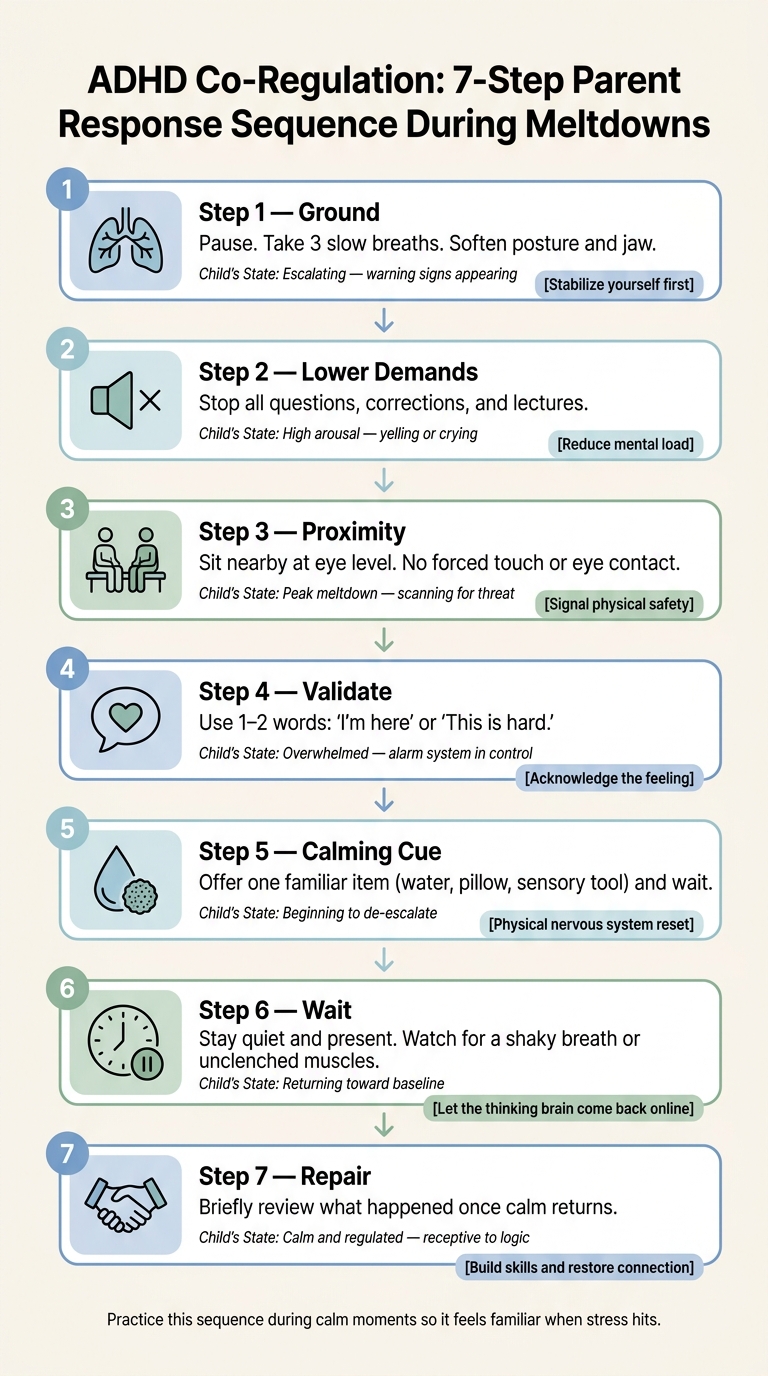
ADHD Co-Regulation: 7-Step Parent Response Sequence During Meltdowns
If the room is already overloaded, stop trying to teach and start trying to lower the intensity of the moment.
When a meltdown starts, the thinking part of the brain goes offline while the alarm system takes over. In plain English, your child has a lot less access to logic, so explanations and lectures usually don’t get through.
Lower Input; Use Few Calm Words
As soon as you spot the warning signs, pause and get quiet. Skip the questions, explanations, and long talks. Each extra word adds more load to a brain that’s already overwhelmed.
Use short, grounding phrases instead: "I’m here." "You’re safe." "This is hard." Stay low, close by, and at your child’s level.
Don’t force eye contact. Don’t demand an apology. And don’t say "calm down."
Offer One Familiar Calming Action, Then Wait
After you’ve lowered the noise and stayed close, offer one simple sensory reset. That could be a sip of water, a pillow to squeeze, a weighted lap pad, or a slow "flower and bubbles" breathing pattern you’ve practiced during calm times. Then wait quietly. The nervous system needs time to settle.
Look for small signs that your child is coming down from the peak: crying slows, shoulders or hands unclench, or a deep shaky breath shows up. That’s the moment to talk, not before.
Once your child settles, move to repair.
What the Parent Does at Each Stage: A Step-by-Step Table
| Stage | Parent Action | Child’s Likely State | Parent’s Goal |
|---|---|---|---|
| 1. Ground | Pause, take 3 slow breaths, soften posture and jaw. | Escalating; warning signs appearing. | Stabilize your own nervous system first. |
| 2. Lower Demands | Stop all questions, corrections, and lectures. | High arousal; yelling or crying. | Reduce the mental load on the child’s alarm state. |
| 3. Proximity | Sit nearby at eye level; do not force touch or eye contact. | Peak meltdown; scanning for threat. | Signal physical safety and calm presence. |
| 4. Validate | Use 1–2 words: "I’m here" or "This is hard." | Overwhelmed; alarm system in control. | Acknowledge the feeling so the child feels seen, not judged. |
| 5. Calming Cue | Offer one familiar item (water, pillow, sensory tool) and wait. | Beginning to de-escalate; breathing may slow. | Provide a physical reset for the nervous system. |
| 6. Wait | Stay quiet and present; watch for a shaky breath or unclenched muscles. | Returning toward baseline. | Allow the thinking brain to come back online. |
| 7. Repair | Briefly review what happened once calm returns. | Calm and regulated; receptive to logic. | Build skills and restore the connection. |
Practice this same sequence during calm moments too. That way, when the next upset hits, it feels more familiar and easier to use.
The next step is practicing these same calming tools during quiet times.
Step 4: Build Daily Routines That Strengthen Impulse Control and Emotional Recovery
After the crisis tools in Step 3, the next move is to turn them into everyday habits during calm parts of the day.
Practice Regulation Skills During Calm Times
As Dr. Russell Barkley puts it, "ADHD is fundamentally a disorder of self-regulation." [2] So the skills your child needs most have to be practiced on purpose, again and again. Not only when things fall apart, but even more when things are going smoothly.
A simple morning check-in can help. Before school, ask your child how they feel: Sunny, Cloudy, or Stormy? It’s fast, easy, and it helps them notice their own state before stress kicks in.
After school, try a 2-minute Body Detective check-in. Ask your child to name one physical sensation they notice right now, such as “my stomach feels tight” or “my hands feel buzzy.” That small pause can spot after-school overload before it turns into a blowup.
Before homework, give the body a chance to settle first. Five minutes of pushing, carrying, or wall pushes can help your child calm their system before sitting down. At bedtime, a slow body scan from feet to head can help a tired-but-wired brain ease toward sleep.
And one more thing: practice Stop-Think-Do during calm play, not only during conflict. That way, the skill is already there when your child needs it.
Track Triggers, Patterns, and What Actually Helps
Keep a simple log with four things:
- Time
- Trigger
- Behavior
- What helped
You don’t need anything fancy. A few notes each day can show you what keeps setting things off. Once patterns start to show up, it gets easier to head off the next blowup instead of just reacting to it.
Co-Regulation Tools and When to Use Them: A Side-by-Side Comparison
| Tool | Best Use Case | Main Benefit | When to Use |
|---|---|---|---|
| Calm Voice & Posture | Active meltdowns | Signals safety | During escalation |
| Sensory Breaks | After-school overload or high energy | Lowers overload and resets the body | Before or during escalation |
| Emotion Naming | Early frustration or calm moments | Builds body awareness | Before escalation |
| Stop-Think-Do Coaching | Transitions, homework, sibling play | Builds the pause skill | Before a known trigger |
| Praise for Effort | After a child tries any regulation skill | Builds confidence and reduces shame | After the moment |
| Pushing, Carrying, or Wall Pushes | High energy or anger | Helps the body settle | Before or during escalation |
Short, specific praise helps the skill stick. Instead of “good job,” try: “I noticed you were really upset, and you kept trying to use your breathing” [3]. Focus on the effort, not the outcome, so your child starts to build the habit without tying it to perfection.
Conclusion: Keep the Process Simple, Calm, and Consistent
Taken together, these steps make co-regulation simple enough to use again and again. It tends to work best when you stay calm, lower overload, respond in a steady way each time, and practice skills during calm moments.
Progress is often slow at first. In many cases, the first signs show up as shorter recovery periods and fewer intense blowups. The clearest signs of growth are faster recovery, less explosive reactions, and a child who can handle more stress before hitting a breaking point.
If progress stalls even with steady practice, extra support may help. If your child’s intense episodes last more than 20 minutes or happen multiple times a day, parent coaching or family therapy can make a difference. Growth and Change Counseling offers both in Campbell, San Jose, Los Angeles, Roseville, and via telehealth across California.
FAQs
How is co-regulation different from discipline?
Co-regulation and discipline do different jobs.
Discipline often centers on compliance and stopping a behavior in the moment. Co-regulation is different. It focuses on helping your child feel calm, safe, and supported when they’re upset.
So instead of pushing for obedience right away, you offer a steady, calm presence. That helps your child move through big feelings and, over time, build stronger self-regulation skills. Growth and Change Counseling offers parent coaching to help families use these approaches.
What should I do if my child rejects calming tools?
If your child pushes back on the usual calming tools, don’t force it. That often makes things worse. A better move is to make the experience personal with items they already like and find soothing.
It also helps to notice what sets them off. Then practice these strategies during calm moments, not in the middle of a meltdown. That way, the tools feel familiar when they’re needed.
Most of all, stay calm yourself. Your steady presence can be the best grounding tool in the room. When you model patience again and again, your child may slowly become more open to using these tools over time.
How do I know when my child needs extra support?
Children with ADHD often show they need extra support when their nervous system gets overloaded. You might notice frequent emotional blowups, trouble getting started on tasks, a hard time sticking with routines, and shifts between feeling under-stimulated and overstimulated.
If your child’s behavior seems more connected to impulse control and executive function than plain defiance, they likely need more co-regulation support.
Related Blog Posts
- ADHD Parenting Tips for Neurodiverse Families
- Parenting with ADHD: Sensory Overload Solutions
- ADHD Parenting: Emotional Regulation Strategies
- Meltdowns vs. Tantrums: Key Differences Explained
