Yes – money stress is linked to a higher divorce risk, but the biggest problem is not income alone. What seems to matter most is repeated money conflict, hidden debt, job loss, and unclear money roles.
Here’s the short version:
- 84% of Americans report financial stress.
- 56% of couples say they argue about money more than anything else.
- Research found that frequent money arguments predicted divorce 5 to 7 years later better than income level by itself.
- 42% of divorced Americans in 2025 said credit card debt played a part.
- Divorce can also be delayed during recessions because many couples can’t afford the cost of splitting up, which averages about $11,300 in the U.S.
What I take from the research is simple: financial stress becomes dangerous when it turns into the same unresolved fight. Debt, secrecy, layoffs, and confusion over who handles bills can wear down trust fast.
The clearest ways to lower the risk are also simple:
- have short, regular money talks
- set clear bill-paying and spending roles
- agree on when purchases need joint approval
- get outside help if the same fight keeps coming back
This means money problems are often less about math and more about stress, trust, and communication.
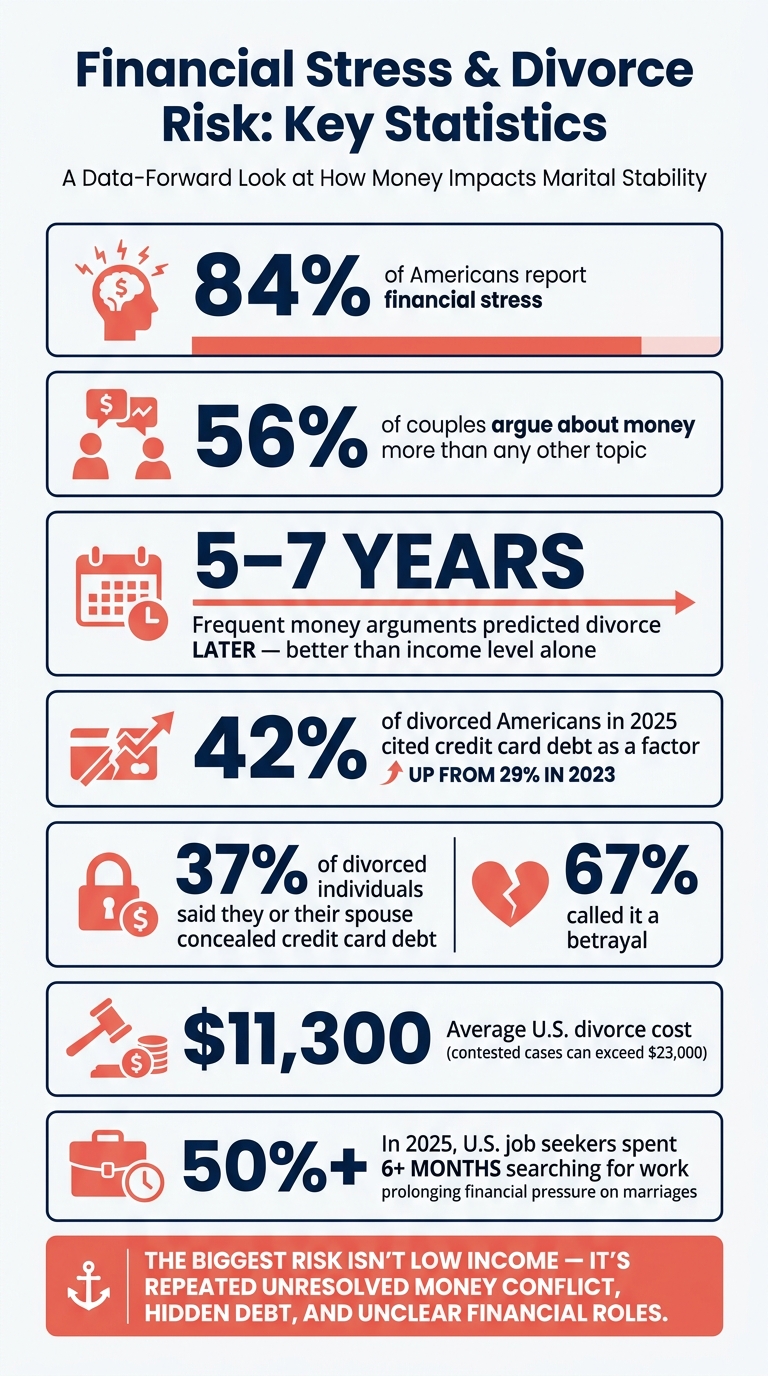
Financial Stress & Divorce Risk: Key Statistics
Xennials: Why Money Stress Is Killing Your Marriage
sbb-itb-596b85d
What Research Shows About Financial Stress and Marital Instability
Studies that track couples over time link financial strain, repeated money conflict, and a higher risk of separation and divorce [1]. The risk goes up when money problems turn into the same fight over and over, mixed with secrecy and mistrust. In plain English: income by itself isn’t the main issue. The bigger warning signs are repeated arguments, hidden debt, and spending decisions that never get settled.
Money Disagreements Often Predict Divorce Better Than Income Alone
One of the steadiest findings in family research is simple: how often couples fight about money matters more than how much money they earn [1]. A high household income doesn’t protect a marriage if the couple keeps clashing over how that money is used or handled.
In Britt & Huston’s study in the Journal of Social and Personal Relationships:
"Only frequency of disagreements about finances and sex were significant predictors of divorce 5–7 years later."
Put another way, only the frequency of financial and sex-related disagreements predicted divorce 5 to 7 years later, even after financial well-being was controlled for [1]. Money fights also tend to hit harder than arguments about chores, in-laws, or time spent together [1]. Why? Because they often come back again and again instead of getting settled once and staying settled.
That cycle gets worse when debt, secrecy, or unpaid bills show up.
Debt and Ongoing Money Pressure Drive More Conflict
Credit card debt was cited as a factor by 42% of divorced Americans in 2025, up from 29% in 2023 [4]. About a third of divorced Americans said money was the main factor in ending their marriage, and hidden debt made things worse: 37% said they or their spouse concealed credit card debt, and 67% called it a betrayal [4].
Recurring pressure from rent, mortgage payments, medical bills, or late bills can turn everyday stress into repeated conflict [4]. Over time, that kind of strain doesn’t just hurt a budget. It wears down trust and changes how partners react to each other, often requiring intentional steps for overcoming trust issues.
How Financial Stress Leads to Relationship Problems
Money problems don’t just squeeze a budget – they can change the way partners act with each other. Research points to the family stress model, which shows that financial pressure chips away at the patience and steadiness couples need to communicate well [2]. When that happens, tempers get shorter, support gets thinner, and conflict starts faster. So the harm isn’t only about dollars and bills. It also changes how partners talk, make decisions, and try to repair conflict.
Stress and Emotional Overload Reduce Support Between Partners
Financial strain can bring on anxiety, irritability, and a heavy sense of overwhelm. Those feelings don’t stay neatly boxed up. They spill into everyday conversations and make harsh communication more likely. As Tasha Seiter, MS, PhD, LMFT, puts it:
"Financial stress impacts relationships by affecting communication… When we are more stressed, we are more vulnerable to negative communication, which negatively impacts our relationships." [2]
And that’s where the cycle can get ugly. Financial stress creates emotional overload. That overload leads to harsher communication. Then the relationship gets worse, which makes the stress feel even heavier [2].
Unclear Money Roles and Repeated Conflict Can Weaken Trust Over Time
When roles and expectations aren’t clear, stress can turn into blame. One big source of marital tension is unclear money roles – like not agreeing on who pays the bills, who handles spending decisions, or how major purchases get approved [5]. Couples with unclear financial management roles often start out with more disagreement, and those disagreements can stick around over time [5].
Money fights also tend to carry more emotion than arguments about chores or free time [6]. And too often, those talks get postponed instead of settled [6]. Things like unclear bill-paying roles, uneven cost-sharing, clashing spending values, and hidden debt can turn money pressure into repeated conflict and mistrust.
Job Loss, Economic Shocks, and the U.S. Context Couples Face
Job loss is one of the fastest ways money stress spills into a marriage.
Individual Job Loss Can Increase Separation Risk
Studies show that divorce risk goes up in the 24 months after a layoff. The hit isn’t just about losing a paycheck. It can also mean loss of identity, more stress, and emotional withdrawal [7][8][9]. And once someone starts pulling back, the same communication problems and trust damage from the previous section often get worse.
When income drops out, couples usually argue about the bills that can’t wait: housing, debt payments, and childcare [7]. These aren’t abstract money debates. They’re fights about keeping life afloat. As the Econofact Research Team put it:
"Sudden income loss from losing employment can increase stress, impair health, and increase marital strain." [8]
A weak hiring market can drag this out. In 2025, more than 50% of U.S. job seekers spent six months or more looking for work, which stretched the period of financial pressure on many marriages [8].
Why Divorce Rates Can Look Different During Recessions
At the big-picture level, recession data can seem calmer even while many marriages are under more pressure.
Divorce filings often drop during recessions because couples simply can’t pay for legal fees, separate housing, or the loss of insurance, even when the relationship is already under heavy strain [9][10]. In the U.S., the average divorce costs $11,300, and contested cases can top $23,000 [11].
Psychologist Mark Travers says it plainly:
"When the economy plunges, so does the financial feasibility of divorce… strained couples – who may well desire separation – stay together because they have no other choice." [9]
That creates a delay effect. Filings often pick up once one spouse gets steady work again or the economy improves [9]. As Mark Travers summarizes:
"Divorces tend to be delayed during recessions, then accelerate during expansions." [9]
That’s the key difference: a recession can push down population-level divorce rates while pushing up stress inside individual marriages. For many couples, the choice to leave happens emotionally long before it becomes possible in financial terms [9][10].
What Couples Can Do to Lower the Risk
Once you can see the pattern, the next move is to interrupt it. Regular check-ins, clear roles, and open disclosure can lower conflict. Most money fights aren’t just about dollars. They’re often about stress, trust, and roles that were never fully worked out.
Schedule Regular Money Talks, Set Clear Roles, and Plan Together
The first fix is structure. Set up short, regular money talks when you’re both calm, not in the middle of an argument. Use that time to review spending and talk through upcoming decisions [6].
Clear roles can also cut down on friction. One person can handle bills, while the other focuses on long-term planning. That way, if something gets missed, it’s easier to fix without turning it into a blame game. For couples with unequal incomes, it can also help to split shared expenses based on income instead of forcing a strict 50/50 setup. That can ease resentment and take pressure off the lower earner [12].
Open conversations matter for another reason too: they help stop financial secrecy before it starts. Secrecy, not debt, is the real threat to trust [3]. A simple way to handle this is to agree on a dollar limit for purchases that need to be discussed first [12].
Get Structured Help When Financial Strain Is Damaging the Marriage
If the same fight keeps coming back, outside support can help stop the loop. Money arguments often last longer than other kinds of disputes [13]. And when financial strain has already hurt trust, a more structured approach may help couples shift the pattern.
When financial strain has already damaged trust, structured couples support can help; Growth and Change Counseling offers The Marriage Rescue Institute, a 12-week couples coaching process for marriages in crisis, focused on building trust after a relapse and communication.
FAQs
Can money stress ruin a strong marriage?
Yes. Financial stress can shake even a strong marriage, and money is one of the top predictors of divorce. Fights about money also tend to last longer and feel harder to sort out than other kinds of conflict.
That’s often because these arguments aren’t just about the numbers in a budget. They can point to deeper issues like security, control, and identity. Growth and Change Counseling supports couples through this kind of strain with its 12-week Marriage Rescue Institute program.
What are the biggest financial red flags in a marriage?
The biggest financial red flags include financial infidelity: hiding debt, secret spending, or keeping accounts off the books. Other signs show up when one partner controls access to money, leaves the other out of key choices, or when fights about spending and debt never seem to stop.
When money talks keep ending in divorce threats, silence, fear, or resentment, it may be time to get outside help. Growth and Change Counseling offers couples coaching and therapy to help rebuild trust.
When should couples get help for money fights?
Couples should get help when money fights stop being occasional stress and start turning into ongoing resentment.
That’s often the point where the issue isn’t just about dollars and budgets anymore. It may point to deeper problems around control, fairness, or trust.
If you feel stuck in the same damaging pattern again and again, or the conflict includes financial infidelity and emotional distance, outside support can help shift those fights into joint problem-solving. Growth and Change Counseling offers couples support for exactly these kinds of struggles.
Financial Stress FAQs at Growth and Change Counseling
- How Addiction Impacts Marital Stability
- Ultimate Guide to Resilient Marriages
- How Couples Manage Money During Recovery
- Healing Marriages Affected by Work Stress
