I’d start with one shared change – not a demand for everyone to calm down. Pick a recurring stress point, agree on a break signal, and try one voluntary support, such as less noise or downtime after school, for 2–4 weeks.
In a mixed-neurotype family, the same sound, request, or routine can affect each person differently. My focus here is on helping you:
- Spot early distress and check needs like hunger, pain, and sleep.
- Offer calm support, fewer demands, and time to respond.
- Choose sensory tools safely, without forced use.
- Make a family plan that covers boundaries, recovery, and when to seek professional help. For couples, this might include marriage counseling to navigate these dynamics.
<u>The goal is safer communication and recovery</u> – not hiding feelings or looking calm.
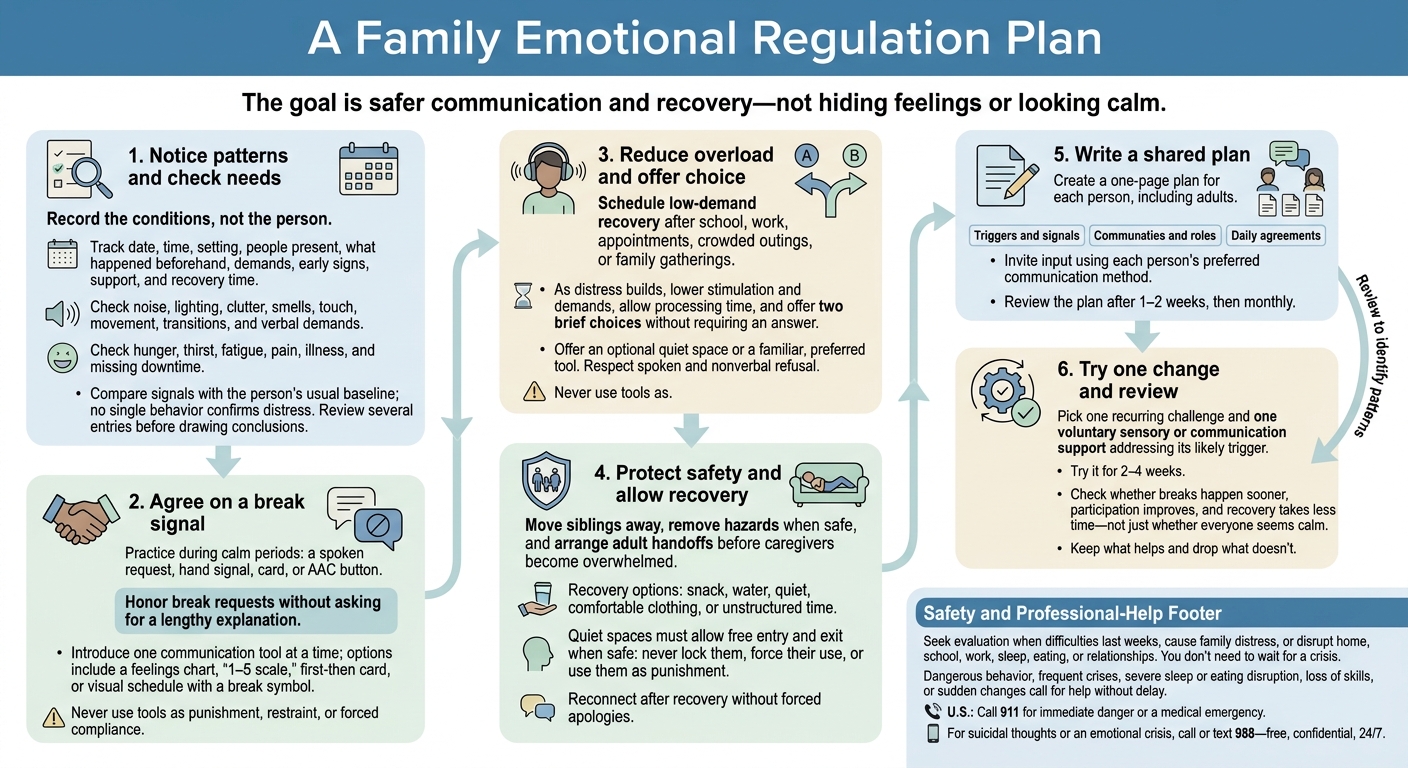
A Family Emotional Regulation Plan
Identify Triggers and Early Signs of Overwhelm
Track Sensory Triggers and Physical Needs
Use the early signs from the last section to look for patterns behind overload. A diary can help you spot sensory patterns over time.[3] Record the conditions, not the person: date, time, setting, people present, what happened beforehand, demands, early signs, support, and recovery time. Review several entries before drawing conclusions.
Track noise, lighting, clutter, smells, touch, movement, transitions, and verbal demands. Note physical needs, too: hunger, thirst, fatigue, pain, illness, and missing downtime.
Pay attention to after-school exhaustion: a child may manage at school but arrive home with little capacity left for chores or conversation. The final request may trigger the collapse, not cause it alone.
The options below are examples, not prescriptions. Test them together, and stop anything that increases distress.
Trigger Early signal Changes to surroundings Sensory support Loud sibling play during homework Covers ears; loses place Move homework to a quieter room; lower competing sound Optional headphones or ear defenders Bright kitchen lighting at dinner Squints; looks away Dim some lights; reduce visual clutter Hat or tinted glasses, if preferred Clothing seams or tags Pulls at clothing Remove tags; offer clothing choices Soft, familiar clothing Quick shift from school to chores Rapid speech; refusal Add decompression time and a visual transition cue Quiet activity, movement break, or fidget
Once you see a pattern, practice asking for a break before distress peaks.
Notice Early Signals and Practice Asking for Breaks
Compare behavior with the person’s usual baseline. Covering ears, pacing, withdrawal, rapid speech, irritability, refusal, or more repetitive movement may signal rising distress – but none confirms it. Look for changes in frequency, intensity, or timing. Safe repetitive movement can help with self-regulation; it isn’t something to suppress. Ask later what the person experienced.
Practice communication during calm periods.
Introduce one tool at a time: a feelings chart, 1–5 scale, first-then card, or visual schedule with a break symbol.
Rehearse a spoken request, hand signal, card, or AAC button. Honor break requests without asking for a lengthy explanation. Visual tools should make breaks and transitions easier – not hold up relief until tasks are finished.
sbb-itb-596b85d
Our 8 Sensory Systems: Understanding and Supporting Neurodivergent Children – with Cheryl Warren
Add Sensory Supports to Daily Life
Reduce overload before it starts. Once distress begins, lower stimulation and demands. Sensory tools may help, but results vary and the evidence is mixed. AOTA recommends documenting specific sensory-processing problems before using sensory supports.[5] With daily supports in place, choose tools that fit each person safely.
| Preventive support | Purpose | Support during distress | Purpose |
|---|---|---|---|
| Predictable routines | Reduce uncertainty and transition stress | Reduced demands | Lower cognitive and emotional load |
| Scheduled breaks | Allow recovery before overload | Optional quiet space | Reduce noise, light, and social input |
| Visual schedules or timers | Make expectations and transitions concrete | Familiar, preferred tool | Offer familiar comfort or input that supports regulation |
Plan Recovery Time and Optional Quiet Spaces
Schedule low-demand recovery time after school, work, appointments, crowded outings, or family gatherings.
Recovery might include a snack, water, quiet, comfortable clothing, or unstructured time.
Set up an optional quiet area with adjustable lighting, less noise, comfortable seating, and tools within reach. Let the person enter and leave freely when safe. Never lock the space, force someone to use it, or use it as punishment.
In a mixed-neurotype household, separate activity zones, protected quiet periods, and adult handoffs can help balance competing needs. Before outings, test portable supports at home. Find out where breaks are available and plan an exit route before entering a busy setting.
If these supports aren’t enough, the family needs a clearer response plan.
Choose Sensory Tools for Each Person
Match supports to the person – not a standard kit. Try one change at a time. After several uses, review comfort, recovery time, communication, and participation. Stillness alone isn’t a measure of success. Respect spoken and nonverbal refusal, and make sure tools don’t block needed communication or safety cues.
As you lower daily stress, choose tools that reduce overload without adding risks.
| Tool and sensory system | Intended purpose | Portability | Supervision needs | Why it may not fit |
|---|---|---|---|---|
| Noise-reducing headphones – auditory | Reduce overwhelming background noise | High | Check that speech and safety cues remain detectable | May feel uncomfortable or block important instructions |
| Putty – tactile | Provide hand-based input | High | Inspect for breakage; supervise young children | Texture, smell, or chewing risk may make it unsuitable |
| Pushing or carrying an appropriate item – proprioceptive | Offer purposeful resistance | Moderate | Supervise technique and surroundings | Can cause strain, falls, or unsafe lifting if poorly matched |
| Walking, rocking, or other preferred movement – vestibular/movement | Support regulation, alertness, or recovery | Variable | Supervise around stairs, traffic, and equipment | May increase arousal, dizziness, or fall risk |
| Lighting changes – visual | Reduce glare or visual intensity | Low to moderate | Check visibility and safe navigation | Dimness may create fall or communication risks |
| Oral chewy tool – oral | Provide safe chewing or oral input | High | Use age- and ability-appropriate products; inspect regularly | May be unsafe with chewing or swallowing problems or unsupervised use |
Use Weighted, Movement, and Oral Tools Safely
The goal is regulation, not control. Never use tools as punishment, restraint, or forced compliance. Get guidance tailored to the person from an occupational therapist or medical professional before using weighted items or movement equipment. This is especially important for young children or anyone with medical, motor, swallowing, or breathing concerns.
Don’t use a universal weight formula. Evidence for weighted blankets and similar products remains limited, particularly for improving sleep.[4][5] The person should be able to refuse or remove the item when able. Keep the head and neck uncovered, and stop immediately for breathing difficulty, overheating, pain, or other distress.[7] Inspect items for damage.
Avoid forced touch or movement. Stop for dizziness, nausea, pain, shortness of breath, or increasing distress.
For oral tools, choose products designed for chewing that suit the person’s age and abilities. Don’t use necklaces, household objects, small toys, or food. Follow age guidance, inspect before every use, and discard cracked or torn items. Keep small or detachable parts away from young children and supervise use.[6][8]
Seek pediatric, occupational therapy, or speech-language guidance for swallowing problems, frequent coughing, weak chewing, or breathing concerns. Stop use immediately for gagging, choking, pain, or breathing difficulty.
If supports ease distress only briefly, or distress continues to escalate, shift from tools to a shared family response plan.
Plan Family Responses and Professional Support
When sensory tools aren’t enough, families need a shared plan for how to respond.
Reduce Demands as Distress Builds
Respond to what the person can handle, not just their behavior. Pause instructions that can wait, ease social pressure, and allow time to process. Offer two brief choices without requiring an answer. Avoid arguments, forced explanations, demands for eye contact, or unwanted touch.
Keep safety limits clear. Move siblings away, remove hazards when it’s safe, and ask another adult to take over before the caregiver becomes overwhelmed. After the person has recovered, talk about what happened and choose one change that may help prevent a repeat.
Use these responses to build a plan everyone can follow.
Write a Shared Family Regulation Plan
Create a one-page plan for each person, including adults. Ask for input in whatever form of communication works best for them. Review the plan after 1–2 weeks, then monthly.
| Field | What to record |
|---|---|
| Triggers and signals | Sensory demands, physical needs, rushed transitions, and early signs of strain |
| Communication | Signals for a break or no touch, preferred tools, and ways to communicate during distress |
| Boundaries and roles | Safety limits, supervision, exit routes, sibling support, and adult relief |
| Daily agreements | Access to quiet and movement, transition warnings, and meal or bedtime adjustments |
| Recovery | Space, food, water, or rest; checking for harm and reconnecting without forced apologies |
If distress keeps returning, bring in outside support.
Know When to Seek Professional Help
Professional help belongs in the family’s regulation plan when home supports aren’t enough. Seek an evaluation when difficulties last weeks, cause family distress, or disrupt home, school, work, sleep, eating, or relationships.[11][13]
You don’t need to wait for a crisis. Dangerous behavior, frequent crises, severe sleep or eating disruption, loss of skills, or sudden changes call for help without delay. Suspected developmental or mental health differences also warrant an evaluation.
Different professionals can help with different needs. A medical clinician can assess pain, sleep, nutrition, medication effects, and sudden changes. An occupational therapist can assess sensory-motor needs. Mental health professionals can address anxiety, mood, trauma, coping, and family communication, while a speech-language pathologist can support communication access.[14][15]
Growth and Change Counseling offers family therapy, parent coaching, and neurodiverse relationship support in Campbell, San Jose, Los Angeles, Roseville, and statewide by telehealth.
Call 911 for immediate danger or a medical emergency, including serious injury or when someone cannot be kept safe.[11][12] For suicidal thoughts or an emotional crisis, call or text 988. The 988 Lifeline is free, confidential, and available 24/7.[9][10]
Conclusion: Start With One Shared Change
Start with the shared family regulation plan or seek counseling for growth and change. The goal isn’t fewer feelings or greater sameness. It’s safer communication, participation, and recovery.
Pick one recurring challenge and one voluntary sensory or communication support that addresses its likely trigger. Try it for 2–4 weeks. Then check whether breaks happen sooner, participation improves, and recovery takes less time – not just whether everyone seems calm. Keep what helps and drop what doesn’t.
A support can help even when strong emotions still happen.
FAQs
How can we balance conflicting sensory needs?
Plan and talk things through during calm moments, not during dysregulation. Set up a quiet corner with soft lighting, noise-canceling headphones, and cozy textures where family members can reset. Use red, yellow, and green capacity cards to show energy levels and sensory limits without words.
Routines and visual schedules make it easier to know what comes next, which can help reduce anxiety. Share a list of specific sensitivities so everyone knows which triggers to avoid.
How can I set boundaries without increasing overwhelm?
Set boundaries when things are calm – not in the middle of a crisis. Be clear about your sensory or emotional needs, whether that means quiet hours or asking for consent before physical touch.
When you reach your limit, say:
“I’m feeling overstimulated and need a short break.”
Explain that the boundary helps you take care of yourself; it doesn’t mean you’re rejecting anyone. You can also agree on hand gestures or code words ahead of time to pause interactions when you feel overwhelmed.
What if my child refuses every sensory support?
Rejection usually points to overwhelm, not defiance. During distress, don’t push tools. Stop anything that adds discomfort, ease demands, and focus on safety and recovery. Check for pain, hunger, fatigue, or sensory overload. Reduce sensory input and acknowledge what they’re experiencing.
Offer supports they find soothing, and practice using them when they’re calm. Let them choose a quiet space and use it freely. Consider parent coaching or family therapy to create a plan that fits their needs. [1][2]
Related Blog Posts
- Parenting Stress: Solutions for Neurodiverse Families
- Research: Communication in Mixed-Neurotype Families
- Parenting Tips for Neurodiverse Families: Building Support
- Stress Management for Neurodiverse Families
