Virtual couples counseling is making relationship support more accessible, with 70% of therapists offering online sessions and 80% of clients reporting satisfaction. To make these sessions work, you need the right strategies. Here’s a quick summary of the five key tips:
- Set Clear Rules and Tech Protocols: Establish expectations for punctuality, communication, and tech backups to avoid disruptions.
- Use Verbal Check-Ins: Focus on direct communication to compensate for the lack of body language.
- Create a Private Space: Ensure sessions happen in quiet, distraction-free areas to maintain focus.
- Adjust Proven Techniques: Modify methods like Emotionally Focused Therapy (EFT) for virtual settings.
- Follow Up Regularly: Consistent check-ins help track progress and reinforce positive changes.
These tips ensure virtual counseling remains effective, even without in-person interactions. Whether you’re a therapist or a couple, a mix of preparation, clear communication, and structured follow-ups can strengthen relationships online.
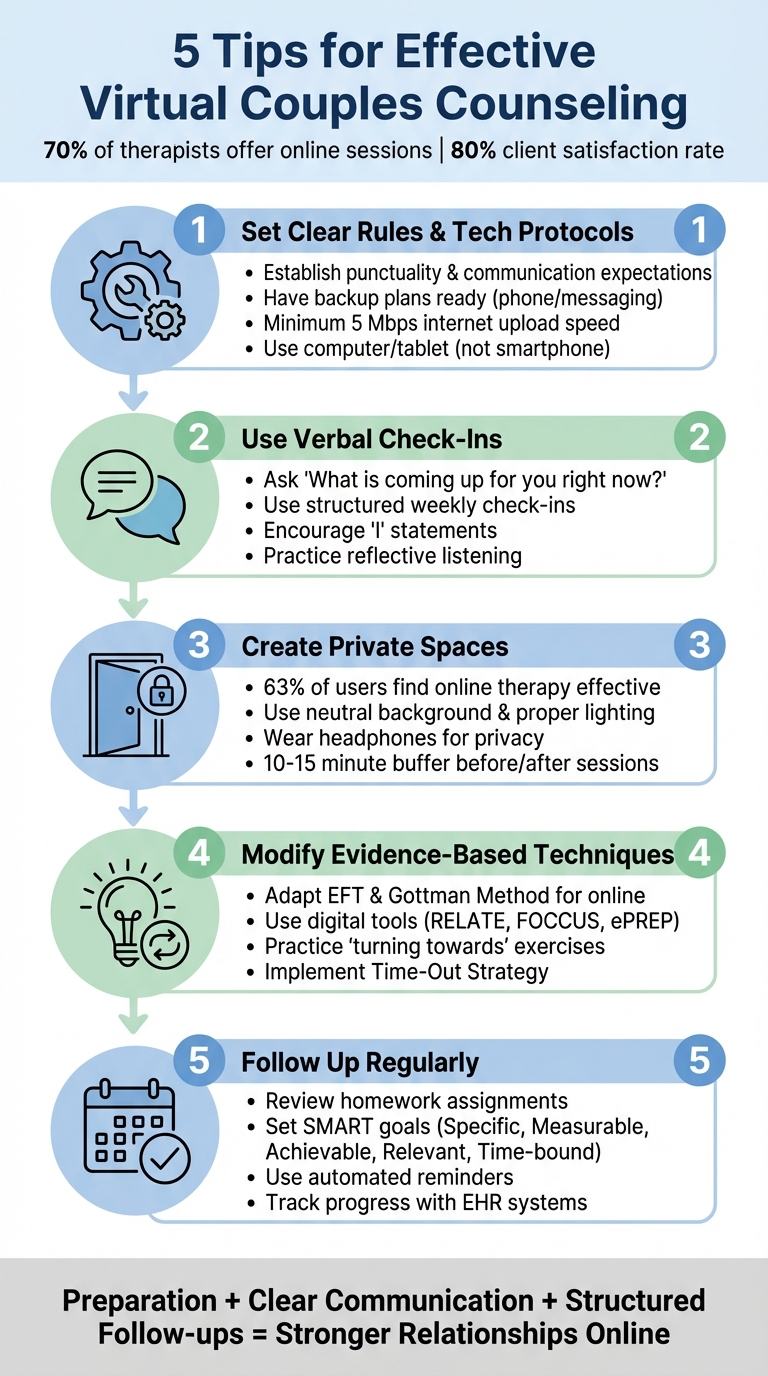
5 Essential Tips for Effective Virtual Couples Counseling
How To Do Online Couples Counseling.
1. Set Clear Ground Rules and Technology Protocols
Laying out clear expectations from the very beginning is crucial for successful virtual therapy. During the initial consultation or informed consent process, therapists should outline rules for punctuality, cancellations, and communication. This helps establish professional boundaries and creates a secure digital environment for both parties to work effectively [3].
Since tech issues are bound to happen, it’s smart to have a backup plan ready. For example, if the video call drops, you could switch to a phone call or secure messaging. Jill E. Daino, LCSW-R, from Talkspace, emphasizes:
"Planning ahead of time how to handle disruptions in technology and any clinical emergencies is key to a successful telehealth practice" [3].
A strong technical setup is equally important. For a smooth session, ensure your internet upload speed is at least 5 Mbps. Couples should use a computer or tablet rather than a smartphone, keep their software updated, and wear headphones to improve audio quality and maintain confidentiality. A well-prepared device setup can minimize distractions and interruptions [4].
Therapists should also assess whether virtual sessions are suitable for the couple by screening for safety concerns or high-conflict situations during pre-treatment. This step is especially critical for neurodiverse couples, as technical lags can worsen sensory or communication difficulties [2]. Lastly, always confirm the client’s physical location at the start of each session – this ensures you’re prepared to respond appropriately in case of a clinical emergency [3].
2. Use Verbal Check-Ins to Understand Emotions
Virtual therapy sessions can feel a bit different from in-person ones, mainly because they lack the body language and subtle cues we often rely on. To bridge this gap, therapists must lean into direct verbal communication and intentional emotional check-ins. For instance, asking something as simple as, "What is coming up for you right now?" encourages partners to open up about their feelings and experiences [5].
A great way to start sessions is with a structured check-in. Here, each partner can briefly share significant positive and negative events from their week, along with the emotions tied to them. This approach, inspired by the Weekly Questionnaire from Integrated Behavioral Couple Therapy (IBCT), creates a natural flow while assessing both personal and relationship dynamics [5].
Addressing each partner by name during these discussions (e.g., "Sarah, what’s your perspective?") helps keep the conversation clear and engaging [5]. Encouraging the use of "I" statements – like "I feel hurt when…" – can also make a big difference. It allows individuals to express emotions clearly while reducing the likelihood of defensiveness [2].
Reflective listening is another tool that works incredibly well in virtual settings. After one partner shares, asking the other to repeat back what they heard ensures that both feel understood. As Maggie O’Reilly Treter from the University of Denver explains:
"It can be even more powerful for individuals to give their partner space to feel what they are feeling and demonstrate that they hear and support them" [5].
This practice not only fosters emotional validation but also strengthens the couple’s connection, even outside therapy.
Interestingly, research shows no major difference in how effective in-person and online sessions are for tackling relationship challenges like communication issues [6]. Clear, deliberate verbal exchanges can successfully bridge the physical distance. The next step? Creating a distraction-free environment to make these techniques even more effective.
3. Create Private, Distraction-Free Session Spaces
The physical setup plays a crucial role in the success of virtual therapy sessions, complementing clear technology protocols. Virtual therapy thrives in quiet, private spaces where sensitive conversations can occur without interruptions. In fact, a 2023 study revealed that 63% of online therapy users found it effective [9].
For therapists, creating a professional environment is key. This involves using a neutral background, ensuring proper lighting (a ring light works well), and wearing headphones for better sound quality [3][7]. Jill Daino, LCSW-R, from Talkspace, emphasizes:
"Creating a productive environment will ensure you and your clients are as comfortable as possible. More importantly, it’ll help your clients feel safe and more likely to open up during sessions." [3]
Couples engaging in virtual therapy should also maintain professionalism. This includes dressing appropriately, avoiding distractions like eating or lounging casually, and positioning the camera several feet away to capture body language effectively [7][8].
Maintaining privacy is just as important. Simple steps like using a white noise app and keeping pets out of the room can make a big difference. If a private room isn’t available, alternative spaces such as a garage or even a parked car can work. A stable internet connection, with a speed of at least 10 Mbps, is also recommended to ensure smooth communication [7][8].
Additionally, scheduling a 10–15 minute buffer before and after sessions gives couples time to mentally prepare and decompress, setting the tone for a more focused and meaningful experience [4][8].
sbb-itb-596b85d
4. Modify Evidence-Based Techniques for Online Sessions
Time-tested approaches like Emotionally Focused Therapy (EFT) and the Gottman Method can be just as effective in online settings when physical exercises are adjusted without losing their essence.
For EFT, having couples join sessions from the same physical space is ideal. This setup allows therapists to observe genuine communication patterns and non-verbal cues – like body language and physical proximity – that are central to understanding attachment dynamics. For example, the "turning towards" exercise can be adapted by asking partners to face each other during conversations, encouraging healthier communication even in a virtual format.
Stress-reducing conversations are another effective tool. One partner can share external stressors, such as work frustrations or daily annoyances, while the other listens attentively. This simple exercise promotes a "we’re in this together" mentality. Techniques like softened startups, where partners use "I" statements, help reduce defensiveness during conflicts. Additionally, a Time-Out Strategy can give couples a structured way to pause and cool down before re-engaging in discussions. Digital tools can complement these techniques by offering measurable insights and structured follow-ups.
Assessment tools like RELATE and FOCCUS provide detailed initial evaluations, while digital programs like ePREP have been shown to significantly enhance communication skills. These tools combine at-home assignments with therapy sessions, bridging the gap between traditional methods and modern technology to improve relationship dynamics.
In virtual settings, clear verbal feedback becomes even more critical. Since subtle gestures and expressions can be harder to notice online, therapists must explicitly voice their observations. For instance, a therapist might say, "I notice you looking away when this topic comes up", to address non-verbal cues that might otherwise go unnoticed. This approach ensures couples stay engaged and connected throughout the process.
5. Maintain Progress Through Regular Follow-Up
Once ground rules are in place, regular follow-ups are key to avoiding the same conflicts resurfacing repeatedly. These check-ins help couples stay focused on the treatment plan instead of veering into personal grievances. As Dr. October Boyles, DNP, MSN, BSN, RN from ICANotes puts it:
"Clear direction will help your patients feel more productive than going around in circles over the same unresolved conflicts" [10].
Follow-up sessions also provide a chance to review any "homework" or communication techniques practiced outside of therapy. This process reinforces healthier patterns and integrates them into daily interactions. Dr. Boyles emphasizes:
"Highlighting their progress each session can be a great way to help a couple shift to a positive mindset" [10].
Even small improvements should be recognized during these sessions to encourage continued effort.
Digital tools in telehealth make it easier to maintain consistency. Features like automated appointment reminders reduce the risk of missed sessions, while progress-tracking apps and electronic health record (EHR) systems allow therapists to document goals and track behavioral changes over time. For couples navigating co-parenting, specialized apps can facilitate neutral communication and keep records of agreements, helping reduce conflicts between sessions [2].
To further enhance progress, setting SMART goals – Specific, Measurable, Achievable, Relevant, and Time-bound – can transform vague aspirations into actionable steps. For example, instead of aiming to "communicate better", a SMART goal might be "use softened startups in three out of five disagreements this week." This kind of clarity makes follow-up sessions more effective by providing concrete metrics to assess what’s working and where adjustments are needed.
At Growth and Change Counseling, we integrate regular follow-ups with digital tracking tools to celebrate milestones and build lasting improvements in couples counseling.
Conclusion
Virtual couples counseling has proven to be an effective way to support relationships, especially when physical distance is a challenge. By focusing on five key strategies – setting clear protocols, using regular verbal check-ins, creating distraction-free environments, applying proven therapeutic techniques, and maintaining consistent follow-ups – therapists can establish a strong foundation for successful sessions, even online.
What makes virtual counseling particularly impactful is its ability to provide context-sensitive care. Telehealth allows therapists to observe and address couples’ unique circumstances in real-time, tailoring interventions to fit their specific needs.
At Growth and Change Counseling, therapists leverage these tools to serve couples across California, including areas like Campbell, San Jose, Los Angeles, and Roseville. Using secure virtual platforms, the team offers integrative, solutions-focused care. As Arione Capolupo, LMFT, explains:
"Regardless of which therapist you work with at Growth and Change Counseling, you are getting the same foundation that has given us our reputation for producing real change quickly and effectively!" [1]
This approach highlights the practice’s dedication to providing consistent and impactful care for every client.
Programs like The Marriage Rescue Institute‘s 12-week intervention further demonstrate how combining virtual sessions with targeted relational homework can help couples rebuild trust and connection [1]. For therapists, adopting telehealth not only broadens their reach but also equips them to better support clients in overcoming their challenges.
With thoughtful preparation, clear communication, and tailored techniques, virtual counseling creates meaningful therapeutic connections. These strategies empower therapists to help couples strengthen their relationships, no matter the physical distance.
Moving Forward With Growth and Change Counseling
What steps can we take to ensure privacy during virtual couples counseling sessions?
Ensuring privacy in virtual couples counseling is essential to building trust and maintaining confidentiality. Therapists and clients alike should prioritize using HIPAA-compliant telehealth platforms and secure, private internet connections. A quiet, private space where conversations can’t be overheard is equally important.
For clients, additional steps can bolster privacy, such as setting strong, unique passwords, enabling multi-factor authentication, and encrypting their devices. It’s also wise to avoid shared devices during sessions and ensure no one else has unauthorized access to the session. These measures help create a secure and comfortable environment for meaningful virtual counseling sessions.
How can therapists effectively adapt traditional techniques for virtual couples counseling?
Therapists can modify traditional techniques for virtual couples counseling by making a few thoughtful adjustments:
- Encourage shared participation: Suggest that both partners join sessions from the same location. This allows the therapist to observe their natural interactions and communication patterns, creating more authentic discussions.
- Create a distraction-free zone: Recommend a quiet, private space where both individuals feel at ease sharing their thoughts and feelings openly.
- Fine-tune the tech setup: Use a dependable device with a good camera angle to capture facial expressions and body language. Minimizing the self-view option can also help reduce distractions during sessions.
- Adjust therapeutic methods: Techniques like reflective listening, the Gottman Method, or emotion-focused therapy can be tailored to strengthen emotional bonds in a virtual format.
- Stay fully engaged: Maintain eye contact through the camera and foster a warm, supportive environment to ensure both partners feel heard and valued.
By focusing on these strategies, therapists can deliver meaningful and effective virtual sessions that closely mirror the benefits of in-person counseling.
How often should we schedule follow-up sessions to stay on track with our progress?
To keep the momentum going in virtual couples counseling, it’s usually a good idea to plan follow-up sessions either weekly or every other week. The right frequency will depend on your specific needs, goals, and the plan you and your therapist create together.
Sticking to regular sessions helps maintain open communication, build on new skills, and tackle issues as they come up. Your therapist can work with you to decide on a schedule that best supports your relationship’s progress and healing.
Related Blog Posts
- Ultimate Guide to Virtual Therapy for Addicted Couples
- Best Practices for Multicultural Telehealth Counseling
- Ultimate Guide to Telehealth for Neurodiverse Couples
- Best Practices for Video Counseling with Couples
