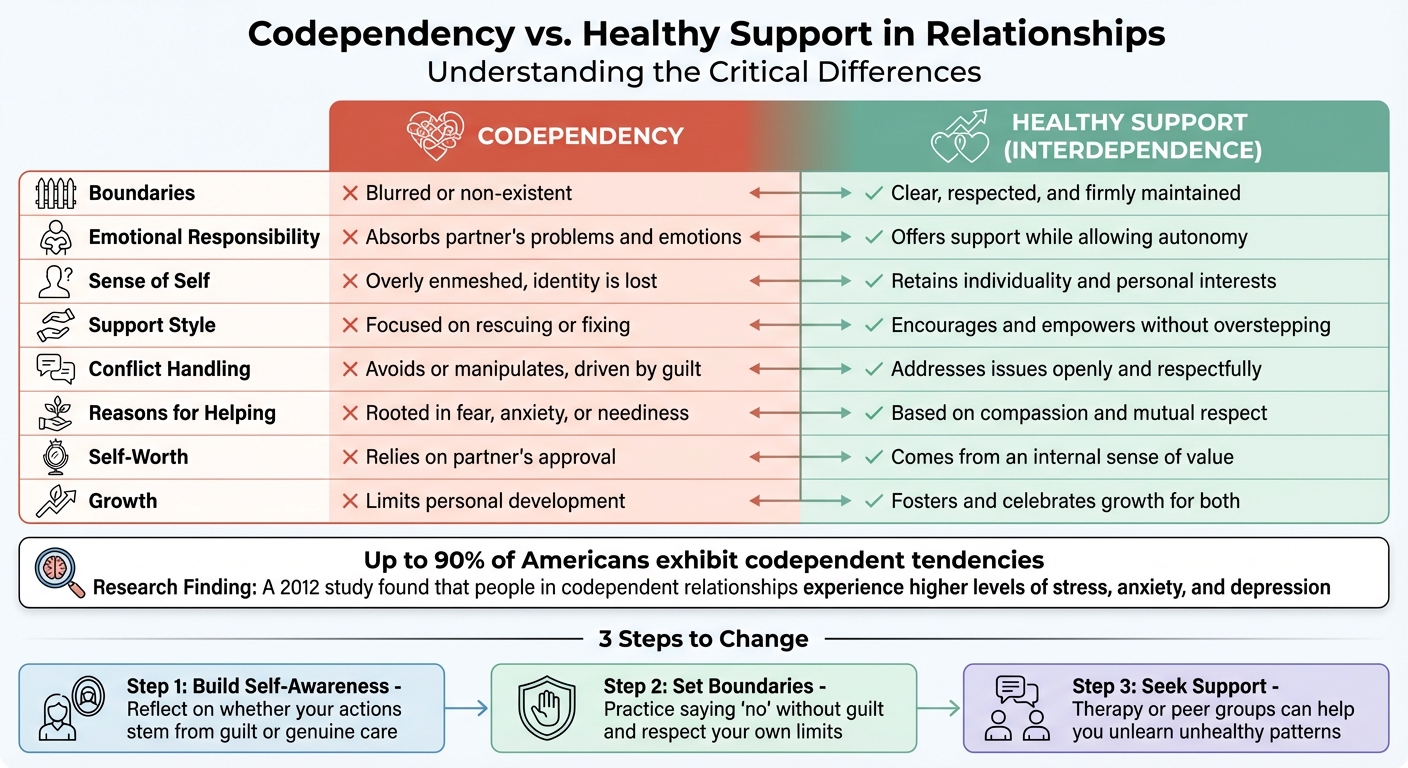
Codependency and healthy support may seem similar, but they are fundamentally different. Codependency happens when one person sacrifices their identity to meet their partner’s needs, leading to emotional exhaustion and blurred boundaries. Healthy support, on the other hand, allows both partners to maintain independence while offering care and encouragement.
Here’s a quick breakdown:
- Codependency: Blurred boundaries, over-responsibility for your partner’s emotions, and loss of personal identity.
- Healthy Support: Clear boundaries, emotional independence, and mutual respect for personal growth.
A 2012 study found that people in codependent relationships experience higher levels of stress, anxiety, and depression. Recognizing these patterns and setting boundaries can help shift from codependency to a balanced, supportive relationship.
Quick Comparison:
| Aspect | Codependency | Healthy Support |
|---|---|---|
| Boundaries | Blurred or ignored | Clear and respected |
| Emotional Responsibility | Absorbs partner’s emotions | Supports without overstepping |
| Sense of Self | Lost in the relationship | Maintained alongside the relationship |
| Support Style | Focused on rescuing or fixing | Encourages independence |
Key Steps to Change:
- Build self-awareness: Reflect on whether your actions stem from guilt or genuine care.
- Set boundaries: Practice saying “no” without guilt and respect your own limits.
- Seek support: Therapy or peer groups can help you unlearn unhealthy patterns.
Healthy relationships thrive when both partners can grow individually while supporting each other. Start by prioritizing your well-being and fostering mutual respect.
Codependency vs Healthy Support in Relationships: Key Differences
Supportive or Codependent? Here’s How to Tell the Difference
Warning Signs of Codependency
Recognizing codependency often means spotting behaviors that disrupt emotional balance. These patterns tend to creep in over time, creating issues that affect both personal well-being and the health of your relationships.
Unclear Personal Boundaries
Codependency frequently begins with blurred boundaries. You might find yourself prioritizing your partner’s needs over your own, even at the expense of your health, finances, or goals. Saying "no" becomes nearly impossible, as avoiding conflict takes precedence over asserting your needs.
Marriage and Family Therapist Vicki Botnick explains this dynamic:
"Codependency refers to any enmeshed relationship in which one person loses their sense of independence and believes they need to tend to someone else" [6].
This might also look like making excuses for your partner’s behavior to others or taking on responsibilities they are fully capable of managing themselves.
Taking Too Much Responsibility for Your Partner’s Feelings
In a codependent relationship, your emotional state may become tied to your partner’s mood. If they’re upset, you might feel anxious or guilty, leading you to monitor their emotions and attempt to prevent any negativity. While caring for a partner is normal, codependency crosses into trying to control or manage their feelings.
Therapist Katherine Fabrizio highlights this distinction:
"A healthy, supportive relationship involves listening, striving to understand, and keeping in mind the concerns of another person. Codependency is when that caring behavior crosses the line into trying to direct or control them" [6].
This control often stems from a trauma response, an attempt to create emotional safety. However, shielding your partner from the consequences of their actions can prevent them from taking accountability. A 2012 study of 49 Codependents Anonymous members revealed that individuals with higher codependency scores experienced elevated levels of stress, anxiety, and depression compared to the general population [2].
This overwhelming sense of responsibility can ultimately strip away your individuality.
Losing Your Sense of Self
As codependency deepens, you may begin to neglect your personal interests, hobbies, and friendships, focusing entirely on your partner. Over time, your self-worth may hinge on keeping your partner happy or solving their problems. This dynamic can create a void, leaving you feeling empty or unsure of who you are outside the relationship. Without room for personal growth, it becomes increasingly difficult to reconnect with the things that once brought you joy or fulfillment.
What Healthy Support Looks Like
Healthy support strikes a balance between maintaining individuality and fostering mutual connection. It allows people to grow both together and independently. Licensed clinical social worker Sharon Martin puts it this way:
"Interdependency also allows you to be your own separate person, so there’s a balance of dependence and independence. In other words, healthy dependency doesn’t hold you back; it supports you in being your best self" [3].
This balance plays out in three key areas: respecting boundaries, encouraging personal growth, and honest communication. Let’s explore what sets healthy support apart from codependency.
Respecting Each Other’s Boundaries
Boundaries are essential for maintaining individuality within a relationship. When partners respect each other’s limits, they affirm that both individuals have their own thoughts, feelings, and responsibilities. This means being able to say "no" without guilt and having that response accepted without resentment.
Research from 2016 highlights that couples in interdependent relationships thrive when they can pursue personal goals independently, all while feeling supported by their partner [7]. Clear boundaries are the foundation of this dynamic, offering a sense of security by defining where one person ends and the other begins. This clarity allows you to empathize with your partner’s struggles without taking on the responsibility of solving their problems or absorbing their emotions. Alongside boundaries, personal growth plays a crucial role in a healthy relationship.
Supporting Individual Growth
Encouraging growth means empowering your partner to face challenges, develop new skills, and build independence. The distinction between empowerment and enabling is critical here. Enabling involves stepping in to solve their problems or shield them from consequences, which can create dependency. Empowerment, on the other hand, involves offering emotional support and encouragement while trusting your partner to manage their own responsibilities.
This approach allows both partners to maintain separate hobbies, friendships, and interests. These individual pursuits enrich the relationship rather than threaten it, creating a dynamic where both people can thrive.
Communicating Openly and Honestly
Trust is built on clear and honest communication. When you share your thoughts and feelings openly, you create an environment where both partners feel understood and valued. While some conversations may be tough, expressing your needs directly fosters deeper connection.
Using "I" statements – like "I feel overwhelmed when…" instead of "You always…" – can help reduce defensiveness and encourage meaningful dialogue [8][9]. Active listening, which involves fully focusing on your partner’s words and reflecting their message, is another key tool for avoiding misunderstandings [8][10]. Together, these practices strengthen teamwork when navigating challenges.
sbb-itb-596b85d
Codependency vs. Healthy Support: Side-by-Side Comparison
Understanding the differences between codependency and healthy support can shine a spotlight on how relationships function. Codependency often stems from coping mechanisms that may have served a purpose in the past but can lead to unhealthy dynamics. On the other hand, healthy support allows both individuals to thrive without losing themselves in the process.
Psychotherapist Vera Eck puts it simply:
"The codependency line should be drawn when helping others hurts you" [13].
This insight highlights a crucial distinction: healthy support uplifts both parties, while codependency drains the giver and hinders the receiver’s independence. The table below breaks down these key differences.
Comparison Table
| Aspect | Codependency | Healthy Support (Interdependence) |
|---|---|---|
| Boundaries | Blurred or non-existent | Clear, respected, and firmly maintained |
| Emotional Responsibility | Absorbs partner’s problems and emotions | Offers support while allowing autonomy |
| Sense of Self | Overly enmeshed, identity is lost | Retains individuality and personal interests |
| Support Style | Focused on rescuing or fixing | Encourages and empowers without overstepping |
| Conflict Handling | Avoids or manipulates, driven by guilt | Addresses issues openly and respectfully |
| Reasons for Helping | Rooted in fear, anxiety, or neediness | Based on compassion and mutual respect |
| Self-Worth | Relies on partner’s approval | Comes from an internal sense of value |
| Growth | Limits personal development | Fosters and celebrates growth for both |
This side-by-side comparison makes it clear: healthy relationships thrive on balance, mutual respect, and personal growth, while codependent ones often lead to emotional exhaustion and stagnation.
How to Move from Codependency to Healthy Support
Breaking free from codependent patterns doesn’t mean leaving your partner behind – it’s about rediscovering your own identity while strengthening your relationship. Studies suggest that up to 90% of Americans exhibit codependent tendencies[14].
Developing Self-Awareness
Recognizing unhealthy dynamics is just the start. The next step is building self-awareness. Acknowledge when your self-worth has become overly tied to your partner’s needs. Pay attention to thought distortions like "all-or-nothing" thinking (e.g., "If I don’t help him with this, I’m a terrible partner") or excessive self-blame[1]. Learn to distinguish between genuine acts of support and controlling behaviors. Challenge those internal "should" statements – ask yourself if managing their tasks is truly your responsibility. When guilt creeps in, counter it by reflecting on your achievements and strengths[11].
Creating and Maintaining Boundaries
Healthy boundaries are essential for balancing individuality and connection. Start small by practicing assertive "I" statements in low-pressure situations, like saying, "I know you’d like me to pay this fine, but I believe it’s your responsibility." Dedicate time to hobbies and personal interests, and reconnect with family or friends to broaden your support network. As Sacramento Counseling explains:
"Taking care of yourself isn’t selfish – it’s what allows you to show up with genuine presence and love, rather than obligation or exhaustion"[12].
Be prepared for some resistance when you first set boundaries. Your partner may push back or escalate their behavior, but it’s important to stay firm and let them face the natural consequences of their actions. Remember, you’re not responsible for managing their emotions.
If self-help efforts feel insufficient, seeking professional guidance can be a game-changer.
Getting Professional Help
When past traumas make it difficult to establish healthy boundaries, professional therapy can provide the tools you need. Therapists often use techniques like Cognitive Behavioral Therapy (CBT) to help you connect your thoughts, feelings, and actions, or psychodynamic approaches to explore how childhood experiences shaped your current patterns[4][5][11]. Lori Hollander, LCSW-C, BCD, explains:
"When a couple enters therapy and it’s clear that one partner’s needs are being subjugated to the other’s needs, the relationship is codependent"[11].
Couples counseling offers a neutral space to discuss needs, set shared boundaries, and improve communication. Individual therapy, on the other hand, focuses on building self-esteem and learning to feel comfortable being alone.
For those in California, Growth and Change Counseling provides individual and couples therapy through The Marriage Rescue Institute, a 12-week intensive program tailored for couples in crisis. They have offices in Campbell, San Jose, Los Angeles, and Roseville, CA, and also offer telehealth services. Individual therapy sessions start at $150 for a 45-minute session with an Associate Marriage and Family Therapist, and sliding scale options are available for those with financial constraints.
Therapists may also use role-playing exercises to help you practice asserting your needs and setting boundaries. Additionally, peer-led groups like Codependents Anonymous (CoDA) and Adult Children of Alcoholics (ACA) provide supportive environments where you can learn and reinforce healthier relationship habits.
Take the Next Step with Growth and Change Counseling
Supporting your partner while maintaining your own well-being is a delicate balance. Codependency often erases personal identity by over-investing in someone else’s struggles, but healthy interdependence allows both individuals to retain their unique selves while offering mutual care.
The first step toward change is examining your motivations. Ask yourself, "Am I helping out of genuine compassion, or am I trying to soothe my own anxiety?" This kind of self-awareness can help you move from fostering dependency to genuinely empowering your partner.
Recovery involves letting go of deeply ingrained habits and learning to rely on yourself. Start by setting clear boundaries, rediscovering your personal interests, and challenging thoughts like, "I need to fix everything." As Sharon Martin, LCSW, explains:
"Healthy dependency doesn’t hold you back, it supports you in being your best self" [3].
Sometimes, self-reflection and boundary-setting aren’t enough on their own. When that happens, seeking outside support can make all the difference. For those needing extra help, professional therapy can be a powerful tool. Growth and Change Counseling offers both individual and couples therapy through The Marriage Rescue Institute, a focused 12-week program available in California and via telehealth, designed to help rebuild healthier relationship dynamics.
FAQs
How can I tell if my relationship is codependent?
Codependent relationships often come with an imbalance where one person consistently puts the other’s needs above their own. Some key signs to watch for include blurred boundaries, feeling overly responsible for your partner’s feelings or actions, and neglecting your personal needs. You might also find yourself trying to "fix" or control your partner, feeling anxious about being abandoned, or staying in the relationship even when it’s causing emotional pain.
In contrast, healthy relationships thrive on mutual support and individual independence. If you notice codependent patterns in your relationship, taking the time to reflect on them and seeking support can be a step toward creating healthier dynamics. Professional counseling, like the services available through Growth and Change Counseling, can provide valuable tools to promote emotional balance and build stronger, more fulfilling connections.
How can I set healthy boundaries in my relationships?
Setting healthy boundaries begins with understanding what you need and how you feel. Take some time to reflect on the situations and behaviors that make you feel safe and comfortable in your relationships. Once you’ve figured out where your limits lie, make sure to communicate them to others in a way that’s both clear and firm. And don’t forget – it’s perfectly fine to say “no” if something doesn’t sit right with your values or impacts your well-being.
Staying consistent is just as important. Stick to the boundaries you’ve set and expect others to honor them. If you’ve faced situations in the past where boundaries were crossed, use those moments as lessons to help you avoid similar issues in the future. Boosting your self-esteem and focusing on self-care can also make it easier to stand by your boundaries. Over time, these practices can lead to healthier and more balanced relationships.
How can therapy help shift from codependency to healthy relationship support?
Therapy offers a secure and understanding space where people can explore and address patterns of codependency, like depending too much on others for approval or ignoring their own needs. It encourages self-awareness, helping individuals recognize unhealthy habits and discover better ways to connect with others.
In therapy, people can develop crucial skills such as setting boundaries, boosting self-esteem, and handling emotional triggers. By working through deeper issues, like past trauma or difficulties with attachment, therapy supports long-term personal growth and helps individuals build balanced, supportive relationships.
Related Blog Posts
- Boundaries for Addiction Recovery and Healthy Love
- Boundaries for Couples in Addiction Recovery
- 7 Ways to Support a Partner in Recovery Without Losing Yourself
- Codependency Recovery: Steps to Build Healthy Boundaries
