Emotional triggers in marriage can lead to recurring conflicts, but they also present opportunities for growth and healing when approached with faith and practical strategies. Christian counseling combines biblical teachings with actionable tools to help couples manage these triggers, improve communication, and strengthen their bond. Here’s what you need to know:
- What are emotional triggers? They are intense reactions tied to past experiences, often causing arguments to escalate over seemingly minor issues.
- How do they affect marriages? Triggers can lead to "emotional flooding", where logic shuts down, and couples fall into reactive cycles of conflict.
- What does the Bible say? Scripture encourages forgiveness, grace, and understanding, offering guidance for managing anger and fostering connection.
- How can counseling help? Techniques like taking breaks during arguments, using "I statements", and engaging in prayer can transform conflicts into opportunities for deeper intimacy.
Emotional Triggers In Marriage | Crazy Thing Called Marriage
What the Bible Says About Emotional Triggers
While the phrase "emotional triggers" may be modern, the Bible has long addressed themes like anger, conflict, and the path to healing. Scripture doesn’t avoid the reality of pain in relationships. Instead, it provides guidance to help us navigate these struggles and respond in ways that promote healing rather than harm. These age-old principles offer a foundation for transforming how we deal with emotional challenges.
Biblical Principles for Emotional Healing
Anger often signals that something deeper is wrong, and the Bible encourages us to pause and reflect in such moments. Ephesians 4:26 advises, "In your anger do not sin, and do not let the sun go down while you are still angry." Psychologist David Ross likens anger to a warning light:
"Anger is the red warning light on the dashboard of your life. When you get angry, let your anger be a signal to you. Let it be a red flag, a blinking red light that says stop. Something is wrong here." [6]
James 1:19-20 echoes this sentiment, urging believers to be "quick to listen, slow to speak and slow to become angry", as unchecked anger can prevent us from living as God intends. When emotional triggers arise, it’s crucial to pause and recognize the underlying hurt or fear fueling the reaction.
Scripture also stresses the importance of taking responsibility for our responses. Romans 12:17 teaches us not to respond to rudeness with rudeness, while Ephesians 4:29 advises against harmful words, encouraging us instead to speak in ways that uplift others. This includes avoiding accusatory phrases like "you always" or "you never", which can escalate conflict.
Forgiveness is another cornerstone of emotional healing. Colossians 3:13 calls us to forgive as we have been forgiven, releasing bitterness and fostering growth. Theologian Lewis Smedes captures this beautifully:
"When you release the wrongdoer from the wrong, you cut a malignant tumor out of your inner life. You set a prisoner free, you discover the real prisoner was yourself." [6]
Forgiveness doesn’t mean excusing harmful behavior or ignoring the pain caused. Instead, it’s about letting go of the burden of resentment so bitterness doesn’t take root. Proverbs 15:1 offers practical wisdom: "A gentle answer turns away wrath, but a harsh word stirs up anger." By responding with grace, we can break the cycle of reactive conflict and create space for healing.
Understanding Suffering and Redemption in Marriage
Expanding on these principles, the Bible also shows how marital struggles, including emotional triggers, can lead to spiritual growth. Marriage is designed to refine us, prioritizing holiness over mere happiness. While God doesn’t desire for us to suffer, He often uses conflict to shape our character and draw us closer to Christ. Romans 5:3–5 and James 1:2–4 remind us that trials test our faith and build perseverance.
The good news? Redemption is at the heart of God’s work. Romans 5:20 assures us that where sin increases, grace abounds even more. No marriage is beyond God’s ability to transform. Patterns that feel destructive can become opportunities for deeper connection when entrusted to Him.
This process often requires a shift from seeking revenge to embracing redemption. Romans 12:19 encourages us to let go of the desire for payback and trust God to work in our spouse’s heart. Author Crystal Storms puts it simply:
"Only when God’s Spirit is among us can we achieve true peace and fruitfulness." [10]
When the Holy Spirit is active in our lives, He produces qualities like kindness, patience, and self-control (Galatians 5:22–23) – all essential for managing emotional triggers. Instead of viewing these triggers as threats, we are invited to see them as opportunities for growth, trusting that God uses challenges to strengthen our ability to love. These biblical truths form the foundation for counseling strategies that help couples break harmful cycles and rebuild intimacy.
Common Emotional Triggers in Marriages
Emotional triggers aren’t just random reactions – they’re deeply ingrained feelings tied to past experiences that can take over present interactions [13]. What might seem like an overreaction to something small, such as a spouse leaving dishes in the sink, often stems from deeper issues like feeling unloved, disrespected, or unseen. The intensity of these reactions can easily catch couples off guard because they often don’t match the immediate situation.
Examples of Common Triggers
In Christian marriages, some of the most frequent emotional triggers revolve around unmet expectations about comfort and control, as well as feelings of being unloved or disrespected [8]. Everyday annoyances – like differing habits around cleanliness, personal hygiene, or eating – can escalate when they touch on deeper emotional wounds. For instance, someone who grew up with emotionally distant parents might feel abandoned when their partner seems distracted by their phone. The phone isn’t the real problem; it’s the resurfacing of an old fear of being neglected.
Past trauma plays a major role in shaping how people respond to these triggers. Experiences like childhood neglect, poor attachment styles, or abuse can rewire the brain to interpret minor frustrations as significant threats [12][9][5]. Mike San Martino, MDIV, LMFTA, shared that in the early years of his marriage, he viewed any disagreement as a threat. Growing up, he had watched his parents avoid conflict entirely, which left him feeling alarmed and overwhelmed during arguments in his own relationship. His instinct was to shut down or leave the room, mirroring the avoidance he saw as a child [6].
Another common but often overlooked trigger is emotional neglect. This occurs when there’s a lack of meaningful connection – conversations stay surface-level, one partner feels like they’re walking on eggshells, or time together is avoided altogether. Even when both partners are physically present, the failure to notice or respond to each other’s feelings can create a deep sense of loneliness [12]. Recognizing these triggers is crucial because they often set the stage for reactive cycles that make resolving conflicts even harder.
How Triggers Create the Reactive Cycle
When an emotional trigger is activated, the body enters a state called "emotional flooding." This is when the heart rate spikes, and the logical part of the brain essentially shuts down, leaving the person overwhelmed and unable to think clearly or solve problems effectively [4][6]. In this state, people typically react in one of three ways: Fight (lashing out), Flight (walking away), or Freeze (shutting down) [4].
This flooding often leads couples into what Christian counselors call the "Debate Cycle." Here, they argue about surface-level details – like who said what or when – while ignoring the deeper emotional needs driving the conflict in the first place [3]. Eric Gomez, a Christian counselor, explains:
The tragedy of The Debate Cycle is married couples neglect to address the underlying fear, uncertainty, hurt, and sadness driving them to have disagreements in the first place [14].
While couples may focus on the specifics of an argument, the real issues – like fear of rejection, feelings of being insignificant, or a desire for connection – stay buried beneath the surface.
What makes this cycle particularly harmful is that anger and resentment often act as shields for more vulnerable emotions like rejection, abandonment, or sadness [4]. Take, for example, an incident shared by Phil Carlson, a mentor at Connected Marriage. In September 2017, his wife Michelle brought up a list of tasks while they were in bed. Feeling "burned out" and disappointed about losing a moment of intimacy, Phil reacted by yelling and storming off (Flight). After cooling down, he realized his outburst was rooted in disappointment over a hectic weekend. Once he explained this, Michelle understood, and they were able to move forward [4].
Understanding these emotional triggers and the reactive cycles they create is key to breaking destructive patterns and fostering healthier communication.
sbb-itb-596b85d
Christian Counseling Strategies for Managing Triggers
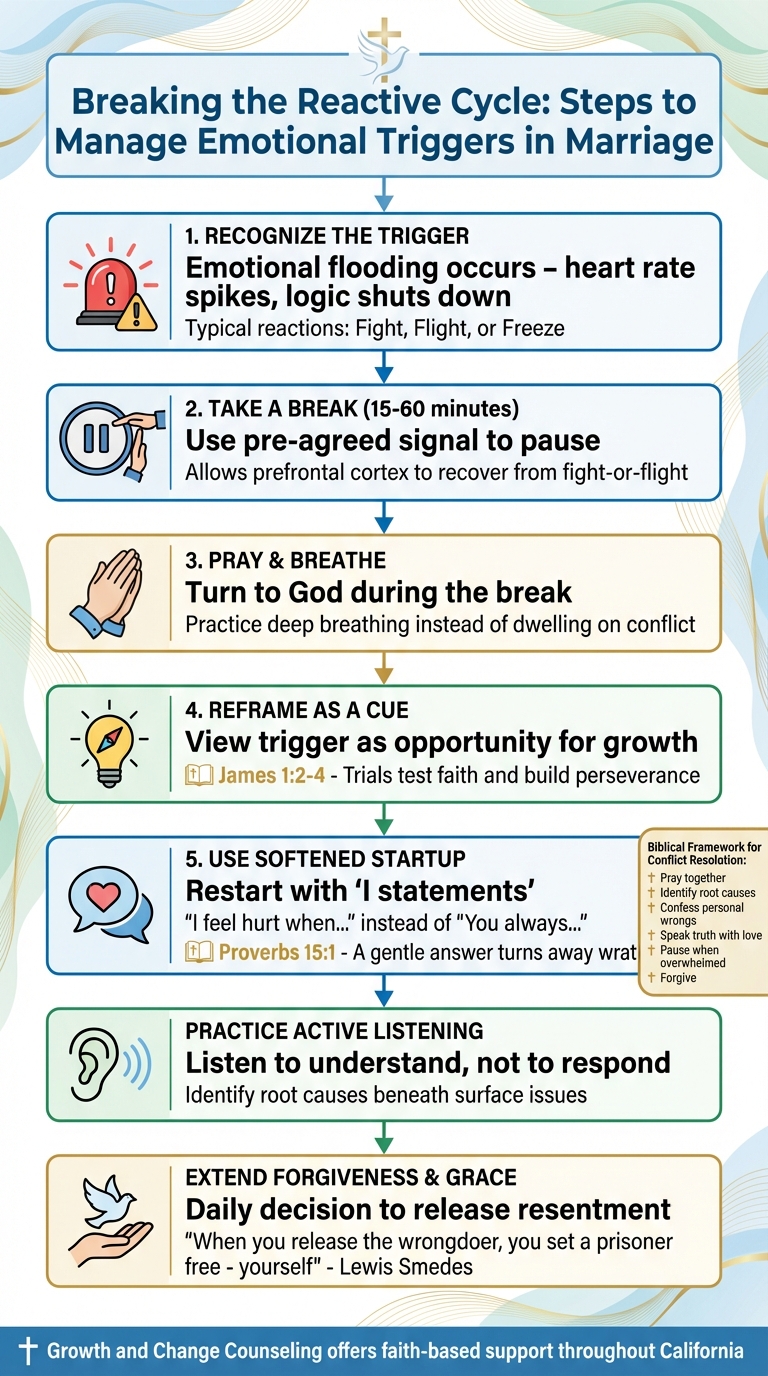
Breaking the Reactive Cycle: Christian Counseling Steps for Managing Emotional Triggers in Marriage
Christian counseling integrates biblical principles of forgiveness and grace with actionable strategies to help individuals and couples navigate emotional triggers.
Steps to Break the Reactive Cycle
One of the key approaches in Christian counseling is helping couples reframe emotional triggers as "cues" – opportunities to turn to God and adopt healthier responses instead of falling into destructive patterns[9]. When emotions escalate during conflicts and "emotional flooding" occurs, counselors often suggest taking a break of 15 to 60 minutes. This pause allows the brain’s prefrontal cortex to recover from the fight-or-flight response. Couples can use a pre-agreed signal, like a "T-sign" made with their hands or a simple phrase, to pause the discussion. During the break, they are encouraged to pray or practice deep breathing instead of dwelling on the conflict.
Another valuable technique is the "softened startup", where issues are raised gently using "I statements" (e.g., "I feel hurt when…"). This method helps prevent conflict from escalating and reflects the wisdom of Proverbs 15:1: "A gentle answer turns away wrath, but a harsh word stirs up anger"[2].
Counselors also guide couples through a biblical approach to resolving conflict. This framework includes praying together, identifying the root causes of issues, practicing active listening, confessing personal wrongs, speaking truthfully with love, pausing when emotions become overwhelming, and extending forgiveness. When triggers arise, couples are encouraged to thank God for the opportunity to grow through these challenges[9]. These strategies lay the groundwork for deeper forgiveness and grace, which are explored further below.
The Role of Forgiveness and Grace
Rebecca L. Schwarz, a Christian counselor, explains that forgiveness is not a one-time event but a daily decision to release resentment[15]. It’s essential to distinguish between forgiveness and reconciliation. Forgiveness is a personal choice to release someone from the debt of their wrongdoing, regardless of their response[6]. Reconciliation, on the other hand, requires cooperation and effort from both parties. Theologian Lewis Smedes eloquently describes forgiveness:
When you release the wrongdoer from the wrong, you cut a malignant tumor out of your inner life. You set a prisoner free, you discover the real prisoner was yourself[6].
Grace, in this context, means recognizing that both partners are on a journey of growth. It reflects how God relates to us, focusing on progress rather than excusing harmful behavior. Practically, grace might involve apologizing for one’s own unhealthy reactions – even when the other person initiated the conflict. This act of humility helps maintain spiritual integrity and fosters a healthier dynamic.
Counselors often recommend a three-part prayer exercise to nurture grace in marriage: first, thank God for the gift of marriage; second, humbly seek His guidance to become the spouse He desires; and third, pray for your spouse, asking God to bless them in their struggles[15]. These practices not only help couples manage emotional triggers but also strengthen their spiritual and emotional bond.
Support from Growth and Change Counseling
Growth and Change Counseling specializes in Christian counseling services designed to address emotional triggers and rebuild relationships. Their approach emphasizes relational intelligence, recognizing that many mental health challenges stem from relational breakdowns[1]. Founder John Kane explains:
What you believe about yourself defines and shapes all of your relationships![1]
For couples dealing with severe struggles, Growth and Change Counseling offers The Marriage Rescue Institute, an intensive 12-week program aimed at helping couples in crisis. This program addresses core issues like anxiety, depression, and isolation – factors that often fuel emotional triggers and reactive cycles. By combining practical communication techniques with faith-based principles, the program helps couples transition from crisis to stability[1]. Services are available in Campbell, CA; San Jose, CA; Los Angeles, CA; Roseville, CA; and via telehealth throughout California.
In addition to couples counseling, the practice provides individual therapy, family therapy, parent coaching, and treatments for anxiety, depression, addiction, trauma, and neurodiverse relationships. Through this comprehensive faith-based approach, couples gain not only tools for managing emotional triggers but also the foundation for lasting emotional and spiritual intimacy.
Building Long-Term Emotional Resilience Through Faith
Creating a strong, resilient foundation for your marriage starts with managing emotional triggers. Developing this resilience requires a combination of daily spiritual practices and professional guidance that nurtures both the heart and mind. Let’s look at some daily habits that can help reinforce this emotional strength.
Daily Practices for Emotional Healing
True emotional healing comes from consistent, intentional habits. One of the most impactful practices is learning to renew your thoughts, replacing past wounds and feelings of unforgiveness with faith. By anchoring yourself in faith, you can begin to reshape negative patterns, fostering a more fulfilling outlook that supports healthier relationships[1]. This doesn’t mean ignoring pain – it’s about inviting God into your healing process and allowing His presence to mend emotional wounds.
Shared spiritual practices are another cornerstone of resilience, echoing the biblical "cord of three strands" that symbolizes strength in unity[11][15]. When couples engage in joint activities like scripture reading and prayer, they cultivate both spiritual intimacy and emotional closeness. Memorizing specific Bible verses can provide guidance during challenging moments. For example, Proverbs 14:29 offers wisdom for managing a quick temper, while Colossians 3:13 encourages forgiveness and grace by reminding couples to make room for each other’s imperfections[7]. These verses aren’t just words to memorize – they serve as a practical guide for navigating daily interactions.
Regular check-ins with your spouse are another simple yet powerful habit. Asking questions like, “How can I support you this week?” or “What’s on your heart today?” can foster deeper connection and help both partners feel valued[15]. Setting aside a dedicated time each week to read and discuss a Bible passage together can also reinforce shared values and create space for honest, vulnerable conversations[15].
Combining Counseling and Faith for Growth
While daily practices lay the groundwork for resilience, professional counseling can take emotional healing to a deeper level by addressing the whole person. Christian counseling integrates psychological principles with theological truths to meet physical, mental, emotional, and spiritual needs[1]. Faith provides the strength to persevere, while counseling equips couples with practical tools to uncover and address root issues, such as unresolved trauma or distorted beliefs that can disrupt relationships[1]. Together, these approaches lead to lasting transformation rather than temporary relief.
One key focus of counseling is developing relational intelligence – the understanding that your behavior is rooted in personal responsibility before God, rather than being dictated by your partner’s actions[1][7]. As John Kane, LMFT, explains:
What you believe about yourself defines and shapes all of your relationships![1]
This shift in perspective encourages couples to move away from blame and toward personal growth. For marriages in crisis, programs like The Marriage Rescue Institute’s 12-week course tackle root causes instead of just addressing surface-level symptoms, helping couples break free from reactive patterns and embrace genuine care for one another[1].
Conclusion: Strengthening Marriages Through Faith and Counseling
Emotions don’t have to dictate the course of your marriage. By blending biblical wisdom with professional counseling, couples can find a meaningful path toward healing and deeper connection. These approaches can turn moments of conflict into opportunities for growth.
Seeing marriage as a sacred covenant, rather than merely a legal agreement, creates a solid foundation for weathering life’s challenges. As Lauren Bowman, Co-founder of Dwell, puts it:
Conflict is not the enemy! Conflict is an opportunity to deepen intimacy and create purpose in your marriage [11].
This mindset, coupled with practical tools like softened startups and well-timed breaks, can help you approach emotionally charged situations in a way that minimizes harm and fosters understanding.
Developing emotional resilience takes a combination of personal accountability and spiritual support. Christian counseling addresses every aspect of a person – mind, body, soul, and relationships – emphasizing how your self-perception influences your interactions with your spouse.
When you apply these principles, your marriage can become a reflection of Christ’s unconditional love, even during difficult times. By incorporating daily spiritual practices and seeking professional counseling, you can build a partnership rooted in faith and resilience. Growth and Change Counseling offers faith-based couples therapy throughout California, with in-person services in Campbell, San Jose, Los Angeles, and Roseville, as well as telehealth options for added flexibility.
Take the first step today – whether through prayer, better communication, or professional guidance – and move closer to the healing and intimacy that God intended for your marriage.
Common Questions for Growth and Change Counseling
How does Christian counseling help couples manage emotional triggers in marriage?
Christian counseling dives into the core of emotional triggers, helping couples uncover how past experiences, unmet expectations, or early family dynamics shape their reactions. It encourages individuals to see that responses like anger or withdrawal often stem from personal struggles rather than their partner’s actions. This understanding opens the door to greater empathy and self-awareness in relationships.
Rooted in Scripture, Christian counseling provides faith-based guidance for navigating conflict. Couples learn to embrace virtues like patience, humility, and forgiveness while replacing reactive patterns with healthier, biblically-aligned behaviors. Practical tools such as active listening, gentle communication, and taking moments to pray together help couples regulate emotions and build stronger connections.
At Growth and Change Counseling, the Marriage Rescue Institute offers an intensive 12-week program. This program blends biblical teachings with proven strategies to help couples rebuild trust, manage emotional triggers, and create a flourishing marriage.
What does the Bible teach about managing anger and resolving conflict in marriage?
The Bible provides timeless advice on managing anger and conflict in marriage, urging couples to navigate these challenges with grace and humility. Key teachings include being slow to anger (James 1:19-20), addressing disputes promptly (Ephesians 4:26-27), and seeking reconciliation with love and respect (Ephesians 4:15). These verses highlight that while anger is a natural human emotion, it should be handled in ways that strengthen, not strain, the marital bond.
Practical approaches inspired by Scripture include prayerful self-reflection to uncover the deeper reasons behind anger, gentle and honest communication to share emotions without assigning blame, and practicing forgiveness to foster healing and move forward together. By applying these biblical principles, couples can transform conflicts into moments of growth, reinforcing their commitment to one another. Growth and Change Counseling incorporates these faith-based teachings into its programs, guiding couples toward stronger, more trusting relationships built on mutual respect.
What simple daily habits can help couples strengthen their emotional connection in marriage?
Couples looking to deepen their emotional connection can try weaving a few thoughtful habits into their everyday routines. Begin by showing gratitude – acknowledge even the smallest acts of kindness. This simple practice nurtures a sense of appreciation and fosters a positive atmosphere.
Dedicate time to open and honest communication, where both partners can share their thoughts and feelings without fear of judgment. For couples who share a faith, praying together or participating in spiritual activities can create a deeper sense of unity.
Spending quality time together, free from distractions, allows for meaningful connection. Equally important is the act of forgiveness – learning to resolve conflicts and move forward without lingering resentment. These mindful efforts can build trust, strengthen understanding, and create a more resilient emotional bond in your marriage.
Related Blog Posts
- 5 Ways Faith Supports Emotional Healing in Marriage
- 5 Steps to Forgiveness in Christian Marriage
- Anger in Marriage: Christian Counseling Solutions
- How Christian Counseling Supports Family Healing
