When choosing a telehealth platform for therapy, the key consideration is HIPAA compliance. Platforms must protect client data, which includes signing a Business Associate Agreement (BAA) and integrating robust security features like encryption and user authentication. Standard Zoom doesn’t meet these requirements, while Zoom for Healthcare includes compliance tools but comes with high costs and lacks therapy-specific features. Therapy-focused platforms such as Doxy.me, SimplePractice, and TheraPlatform combine video sessions with tools like billing, scheduling, and clinical documentation, offering a streamlined solution for therapists. These platforms are often more cost-effective and user-friendly, catering specifically to the needs of mental health professionals.
Key Takeaways:
- Standard Zoom: Not HIPAA compliant; lacks necessary security and legal agreements.
- Zoom for Healthcare: HIPAA compliant with BAAs but expensive and missing therapy-specific tools.
- Therapy-Specific Platforms: Offer integrated features like EHR, billing, and secure communication at lower costs.
Quick Comparison:
| Feature | Standard Zoom | Zoom for Healthcare | Therapy-Specific Platforms |
|---|---|---|---|
| HIPAA Compliant | No | Yes (with BAA) | Yes (with BAA) |
| Cost | Free/Low | ~$200/month (min. 10 licenses) | $15–$75/month |
| Therapy Tools | No | No | Yes |
| Billing Integration | No | No | Yes |
| Client Portals | No | No | Yes |
Therapy-specific platforms are often the best choice for mental health practices due to their lower costs, ease of use, and integrated features that simplify compliance and daily operations.
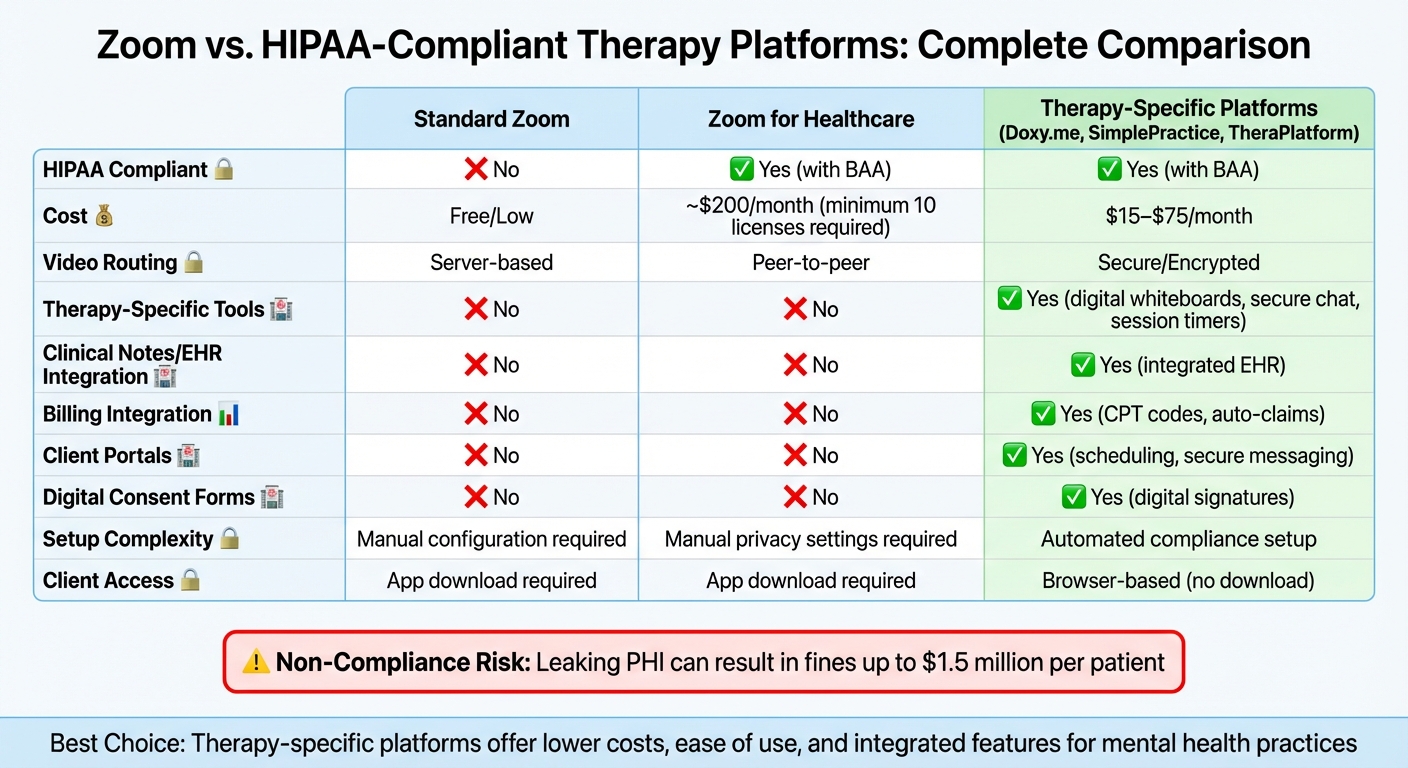
HIPAA-Compliant Telehealth Platforms Comparison: Zoom vs Therapy-Specific Solutions
HIPAA Compliance Requirements for Telehealth
What HIPAA Compliance Means
HIPAA compliance ensures the protection of Protected Health Information (PHI) through a combination of legal agreements and technical safeguards. A critical part of this process is the Business Associate Agreement (BAA) – a legal contract that requires vendors to take responsibility for safeguarding patient data. This agreement outlines security measures and breach notification protocols, creating a framework for compliance [7].
One common pitfall is the use of platforms like FaceTime for therapy sessions. While FaceTime employs strong encryption, it does not provide a BAA, making it unsuitable for HIPAA-compliant use [1]. Yip Fong from the Office for Civil Rights highlights the risks:
transmitted over the Internet, which remains vulnerable despite strong security measures [6].
Most video services require a signed BAA because they don’t qualify for the "conduit exception." The consequences of non-compliance are severe – leaking PHI can lead to fines of up to $1.5 million per patient [6]. Even sharing seemingly minor details, like confirming a patient’s call with a specialist, can constitute a breach.
Required Features for HIPAA-Compliant Platforms
To meet HIPAA standards, platforms must go beyond legal agreements and incorporate robust technical features. End-to-end encryption (E2EE) is essential, ensuring that data remains protected both during transmission and while stored on servers. This encryption prevents unauthorized access, keeping patient information secure.
Other critical features include:
- Strong access controls: These include unique user IDs, strong passwords, multi-factor authentication (MFA), and role-based access that limits session participation to authorized individuals.
- Audit controls: These track user activity and help maintain data integrity, offering an additional layer of protection for PHI.
It’s important to note that free or standard versions of popular platforms often lack the advanced security measures required for compliance. Therapists must upgrade to specialized "Healthcare" or "Business" plans to obtain a BAA and access features like password-protected meetings, waiting rooms, and restricted screen sharing. Additionally, cloud recording features should be disabled unless proper secure storage protocols are implemented. These steps are vital to avoiding costly fines and safeguarding patient trust.
Zoom Standard vs. Zoom for Healthcare
Standard Zoom Features and Limitations
The free version of Zoom isn’t designed for therapy sessions – it’s not HIPAA compliant and doesn’t include a Business Associate Agreement (BAA), which is a key requirement for handling protected health information. Without a BAA, the free version simply doesn’t meet the necessary standards for privacy and security.
While the standard Zoom platform does offer basic encryption, it falls short when it comes to the more stringent security measures needed in healthcare. Features like detailed audit logs, advanced access controls, and privacy settings tailored to healthcare are absent[1][8].
That’s where Zoom for Healthcare steps in, addressing these gaps with features specifically designed to comply with HIPAA requirements.
Zoom for Healthcare: Additional Features
Zoom for Healthcare is a subscription-based service crafted to meet the strict demands of HIPAA compliance. This version includes a BAA, end-to-end encryption, and robust user authentication. It also provides detailed audit logs that document all access and activity during video sessions, an essential feature for compliance and review[1][8].
The platform enhances security with advanced access controls, such as role-based permissions and strict user verification. Waiting rooms, for instance, ensure that only authorized individuals join a session by verifying their identity beforehand. The U.S. Department of Health and Human Services emphasizes the importance of such measures:
Providers that want additional privacy protections for telehealth while using video communication products should provide such services through technology vendors that are HIPAA compliant and will enter into HIPAA business associate agreements (BAAs). [3]
Despite these strengths, Zoom for Healthcare isn’t without its challenges, particularly for therapy practices.
Drawbacks of Using Zoom for Therapy
One major downside is the cost. Zoom for Healthcare starts at around $200 per month and requires a minimum of 10 licenses, making it a pricey option for smaller practices[11][13]. Additionally, it doesn’t integrate practice management tools, which can be a significant drawback for therapists. Dr. Bob Goldberg shared his frustrations with the platform’s customer support and costs:
It’s been over a week since I got a form email from them saying that someone would be back in touch with me "as soon as possible."[10]
The platform also lacks essential tools like clinical documentation systems, billing features, insurance claim processing, and payment collection capabilities[11][12][14]. This means therapists must rely on separate software for scheduling, charting, and handling payments, adding to their administrative workload.
These limitations highlight the gap between general telehealth platforms and those designed specifically for therapy. As Dr. Charmain F. Jackman points out:
For a small practice where telehealth is used primarily for individual, group or family therapy, Zoom would not be the best option from a financial perspective.[11]
Advantages of Therapy-Specific HIPAA Platforms
Therapy-Focused Tools and Features
Therapy-specific platforms simplify telehealth by seamlessly integrating video sessions with electronic health records. This means therapists can launch sessions with a single click while staying within HIPAA security guidelines. These platforms often include clinical tools tailored for therapy, such as digital whiteboards and secure chat features that enhance session engagement. Virtual waiting rooms let you admit clients when you’re ready, session timers help manage schedules, and blurred backgrounds ensure privacy is maintained. For group therapy, some platforms accommodate up to 15 participants and automatically generate progress notes and billing documents for each client[15].
Administrative tasks are also made easier. Automated appointment reminders via text or email can significantly reduce no-shows. Secure session links are generated automatically, and billing integration supports psychotherapy-specific CPT codes (e.g., 90837 for 60-minute sessions, 90834 for 45-minute sessions)[17]. This eliminates the hassle of transferring data between different systems, creating a smoother workflow while maintaining compliance with HIPAA standards.
Security and Compliance Features
Platforms like Doxy.me prioritize security and compliance by offering signed Business Associate Agreements (BAAs) even on basic plans[4]. Without a BAA, even encrypted platforms fall short of HIPAA compliance. As telehealth expert Dr. Marlene M. Maheu explains:
As business associates, software providers are required to ensure the confidentiality, integrity, and availability of electronic protected health information (ePHI) shared through their platform.[4]
These platforms employ 256-bit encryption to secure data both at rest and in transit. Features like automated intrusion detection, secure backups, and built-in audit trails ensure every session activity is tracked – meeting HIPAA requirements that often require manual setup on general platforms[4][1]. Additionally, many therapy-specific platforms operate entirely within a browser, eliminating the need for app downloads. This reduces the risk of data breaches linked to vulnerabilities in locally installed software[16].
Practice Management Integration
Therapy-focused platforms go beyond session tools by integrating full practice management features. Client portals allow patients to schedule appointments, access files, and send secure messages – all within one system[15]. After sessions, the platform can automatically create invoices, process payments, and securely store progress notes. These features are built into the same system used for video calls, ensuring everything is centralized and efficient[15][16][2].
This level of integration is a game-changer. As Let’s Talk Interactive points out:
Providers that utilize Zoom for virtual visits often find they’re missing many of the workflows needed to efficiently run their business.[2]
Therapy-specific platforms are often more budget-friendly than general telehealth tools like Zoom for Healthcare. Therapy Live, for example, offers plans ranging from $15 to $75 per month for full practice management[16]. Meanwhile, platforms like SimplePractice and TheraPlatform provide 30-day free trials without requiring a credit card[15][17]. These systems not only streamline day-to-day operations but also ensure patient health information (PHI) is safeguarded, making them a practical choice for modern therapy practices.
Zoom vs. HIPAA-Compliant Platforms: Side-by-Side Comparison
Video Conferencing Features Comparison
Standard Zoom falls short when it comes to telehealth needs. It doesn’t offer a Business Associate Agreement (BAA) and lacks the safeguards required for handling sensitive therapy sessions. While Zoom for Healthcare addresses compliance by using peer-to-peer routing – sending video directly between provider and patient – it still misses key features like integrated clinical tools. In contrast, therapy-specific platforms go a step further, combining video sessions with tools like electronic health records (EHR), insurance billing (e.g., CPT code 90834 for 45-minute sessions), and digital consent forms. Therapists using Zoom often juggle multiple systems for scheduling, documentation, and billing, whereas therapy-focused platforms simplify everything into a single, unified system.
| Feature | Standard Zoom | Zoom for Healthcare | Therapy-Focused Platforms |
|---|---|---|---|
| HIPAA Compliant | No | Yes (with BAA) | Yes (with BAA) |
| Video Routing | Server-based | Peer-to-peer | Secure/Encrypted |
| Clinical Notes | No | No | Yes (Integrated EHR) |
| Insurance Billing | No | No | Yes (CPT codes/Auto-claims) |
| Client Portal | No | No | Yes |
| Consent Forms | No | No | Yes (Digital signatures) |
Security and Compliance Comparison
HIPAA compliance hinges on having a signed BAA, whether through paid platforms like Zoom for Healthcare or free options like Doxy.me. However, compliance goes beyond just the BAA. Therapy-specific platforms often include features like built-in audit logs that automatically track session activity, a critical HIPAA requirement. General-purpose platforms like Zoom typically require manual setup for such safeguards, adding extra steps for therapists. These enhanced security measures not only ensure compliance but also streamline operations, offering better cost efficiency and scalability for practices.
Pricing and Scalability
The differences in pricing models and scalability are just as important as the technical features. Zoom for Healthcare doesn’t publicly list its pricing, requiring therapists to contact sales and commit to annual subscriptions. On the other hand, therapy-specific platforms are usually more transparent. For instance, Doxy.me offers a free HIPAA-compliant version with a signed BAA, while TheraPlatform provides a 30-day free trial without needing a credit card.
The real value of therapy-focused platforms lies in their ability to integrate essential tools. By bundling video conferencing with practice management features like billing, scheduling, and documentation, these platforms eliminate the need for multiple systems. This not only reduces costs but also saves time, allowing therapists to focus more on their clients and less on administrative tasks.
sbb-itb-596b85d
Ease of Use and Accessibility
Setup Process for Therapists
Getting started with Zoom for Healthcare can be a bit of a hassle. Therapists need to upgrade to a paid account and manually configure privacy settings like waiting rooms, encryption, and user authentication to ensure compliance [1][9]. For those not comfortable with technology, these extra steps can feel overwhelming and time-consuming.
On the other hand, therapy-specific platforms simplify this process by combining compliance and practice management into one streamlined system. Take SimplePractice, for example – used by over 250,000 practitioners as of April 2023. It integrates telehealth features directly into its Electronic Health Record (EHR) system [15]. This means therapists can start sessions directly from their practice calendar without needing additional logins [15]. The platform also automates tasks like appointment reminders, sending secure session links via text or email, and even includes built-in tools like session timers. All of this eliminates the need for tedious manual setup, making it far more user-friendly for busy practitioners.
Client Access Requirements
The experience for clients varies greatly depending on the platform. With Zoom, clients are required to download the app or manually input meeting credentials [9]. To maintain HIPAA compliance, therapists must enable multiple security layers, such as password-protected meetings and virtual waiting rooms [5].
Therapy-specific platforms take a much simpler approach. Clients receive secure appointment links directly via text or email, which they can use to join sessions through a browser-based client portal. No software downloads or separate logins are necessary [15]. This method significantly lowers the technical barriers, especially for clients who may not be tech-savvy or who access sessions from various devices.
Support and Training Resources
Support options are another area where the two platform types differ substantially. Zoom provides general technical troubleshooting but wasn’t originally built with telehealth workflows in mind [2]. Therapists using Zoom must manually integrate it with other systems for scheduling, billing, and documentation.
In contrast, therapy-specific platforms offer resources tailored to the unique needs of mental health professionals. SimplePractice provides a robust Help Center, product tutorials, and free resources to enhance both clinical and business expertise [15]. TheraPlatform goes a step further with on-demand video courses covering topics like insurance billing, telehealth appointment checklists, and state-specific practice guidelines [17]. Both platforms also offer 30-day free trials – no credit card required – allowing therapists to test the software risk-free [15][17]. Meanwhile, Zoom for Healthcare requires a one-year commitment and doesn’t publicly disclose pricing, leaving therapists to contact sales for details [2].
These differences highlight how therapy-specific platforms are designed to meet the unique demands of mental health professionals, offering a smoother experience for both therapists and their clients.
Choosing the Right Platform for Your Practice
Key Considerations for Choosing a Telehealth Platform
When selecting a telehealth platform, it’s essential to focus on a few key factors. First and foremost, ensure the platform provides a signed Business Associate Agreement (BAA) to meet HIPAA compliance standards [4]. Free platforms often do not meet these requirements, making them unsuitable for telehealth services. This compliance step is non-negotiable and forms the foundation for your decision-making.
Next, think about what your practice truly needs. Are you looking for a simple video conferencing tool, or do you need a comprehensive system that includes scheduling, billing, and documentation? For example, platforms like Zoom for Healthcare are great for video-only services but require additional practice management software. On the other hand, therapy-specific platforms bundle these features, offering an all-in-one solution. Ease of use should also be a priority – overly complex systems can create unnecessary challenges for both clinicians and clients.
Budget and commitment are other critical factors. Zoom for Healthcare often requires a one-year contract, and pricing details are typically not public (you’ll need to contact their sales team). Meanwhile, platforms like Doxy.me offer HIPAA-compliant options, including a free tier, which can be a smart starting point for solo practitioners or smaller practices. By carefully weighing these considerations, you can choose a platform that aligns with your clinical workflow and meets your clients’ needs.
How Growth and Change Counseling Uses Telehealth
Growth and Change Counseling exemplifies how to apply these considerations effectively. The practice uses secure, HIPAA-compliant telehealth platforms to ensure both privacy and efficiency in serving clients across California, including areas like Campbell, San Jose, Los Angeles, and Roseville. These platforms allow the practice to deliver services such as individual therapy, couples counseling through The Marriage Rescue Institute, family therapy, and other specialized treatments while maintaining strict privacy standards.
Telehealth also helps the practice overcome barriers that might prevent clients from attending in-person sessions, such as long distances or scheduling conflicts. This flexibility is particularly beneficial for programs like the 12-week Marriage Rescue Institute, where consistent weekly sessions are vital for couples working to rebuild their relationships. By focusing on compliance and user-friendliness, Growth and Change Counseling ensures that its online services maintain the same high standard of care as its in-office sessions.
Trying out Doxy: Free HIPAA Compliant Teletherapy Platform
FAQs
Why are therapy-specific platforms better suited for mental health practices than Zoom for Healthcare?
Therapy-specific platforms are purpose-built for mental health professionals, offering tools and features designed to meet the unique needs of counseling. These platforms come equipped with HIPAA-compliant safeguards, including end-to-end encryption, automatic audit logs, secure storage for session recordings, and a Business Associate Agreement (BAA) – all without requiring additional setup.
They also simplify day-to-day operations by integrating key features like intake forms, consent management, scheduling, billing, and compatibility with electronic health records (EHR). This allows therapists to handle client data, appointments, and payments within a single, secure platform, ensuring everything stays private and well-organized.
On top of that, therapy-specific platforms offer greater control during sessions. Features like customizable waiting rooms, participant permissions, and therapist-only breakout rooms for clinical exercises enhance the overall experience. For practices such as Growth and Change Counseling, these platforms are an efficient, secure, and user-friendly solution for teletherapy.
Why are therapy-specific platforms better for HIPAA compliance than general video conferencing tools?
Therapy-specific platforms prioritize HIPAA compliance, integrating safeguards to protect sensitive patient data. A key feature is the Business Associate Agreement (BAA) they sign with providers, which ensures shared legal responsibility for securing Protected Health Information (PHI). These platforms also include essential security measures such as end-to-end encryption, secure data storage, and detailed access controls, reducing the chances of data breaches.
On the other hand, general video conferencing tools like Zoom or FaceTime, while offering some encryption, often lack the comprehensive administrative and technical protections needed for HIPAA compliance. Without a signed BAA, these tools cannot provide the same level of security. By opting for dedicated platforms – like those used by Growth and Change Counseling for telehealth services throughout California – therapists create a safer, more compliant environment for virtual care.
What are the cost differences between using therapy-specific platforms and Zoom for HIPAA-compliant telehealth?
Therapy-specific platforms tend to cost more than Zoom’s basic plans, but they come packed with features tailored to the needs of mental health professionals. These platforms, like Doxy.me or TheraPlatform, typically include built-in HIPAA compliance along with tools for video conferencing, scheduling, billing, and client portals. Plans usually start at an affordable range of $29 to $39 per month.
On the other hand, Zoom’s standard plans, which range from free to $14.99 per month, lack the necessary features for HIPAA compliance. To use Zoom in a HIPAA-compliant manner, you’d need to upgrade to the Zoom for Healthcare plan, which comes at a hefty $200 per month – much higher than most therapy-specific options.
For practices like Growth and Change Counseling, opting for therapy-focused platforms strikes a balance between affordability and functionality. These platforms not only help ensure data security but also simplify administrative processes, making them a practical choice for telehealth services.
Common Teletherapy Questions at Growth and Change Counseling
- Ultimate Guide to Virtual Therapy for Addicted Couples
- Managing Boundaries in Addiction Recovery Telehealth
- Best Practices for Multicultural Telehealth Counseling
- Best Apps for Couples in Counseling
