Trauma-informed mindfulness tailors traditional mindfulness techniques to ensure emotional safety, especially for families coping with trauma. These practices focus on grounding, emotional regulation, and connection, helping families stay present without triggering stress responses. Key highlights include:
- Grounding Through Feet Sensations: Shift focus to physical sensations in the feet for calm and balance.
- Mindful Listening: Use sounds to anchor attention and improve emotional regulation.
- Observing Objects: Focus on everyday items to stay present and reduce stress.
- Gentle Mindful Walking: Combine movement with awareness to promote calmness.
- Mindful Eating: Turn meals into moments of connection by engaging the senses.
- Body Scan with Choice Anchors: Focus on neutral body areas to build comfort and control.
- Compassionate Emotion Check-In: Share feelings without judgment to strengthen family bonds.
These techniques are simple to integrate into daily life, offering safe, effective ways to manage stress and nurture family connections. Start small, stay consistent, and adapt each practice to your family’s comfort level.
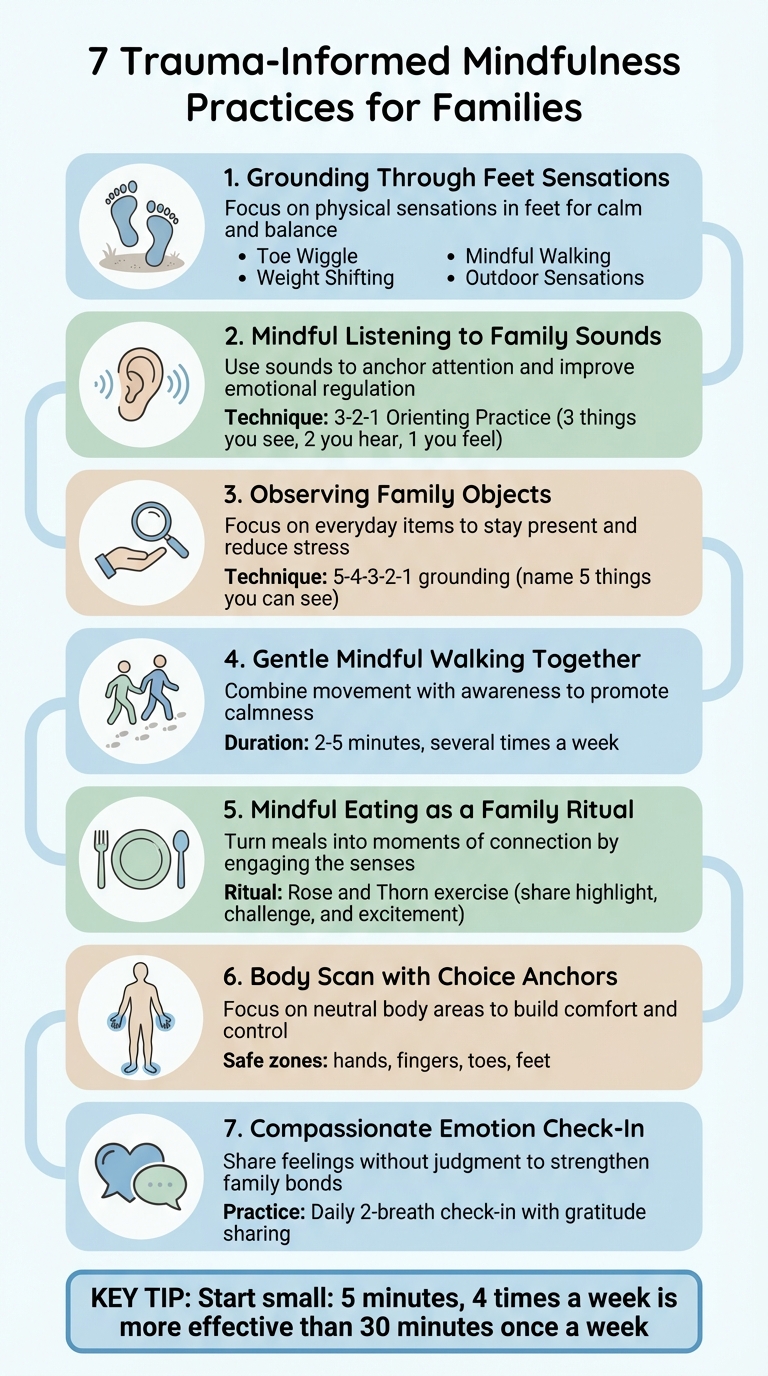
7 Trauma-Informed Mindfulness Practices for Families
Trauma Sensitive Mindfulness | Dr. David Treleaven
1. Grounding Through Feet Sensations
Focusing on the sensations in your feet can be a gentler alternative to traditional breath-based meditation, especially for trauma survivors who might find breathwork triggering. For some, concentrating on breathing may bring up flashbacks or feelings of being confined, but shifting attention to your feet can offer a sense of safety and calm [9]. When stress hormones like cortisol and adrenaline activate the fight-or-flight response, simply noticing how your feet connect with the ground can help restore a sense of balance [8]. Trauma therapist Brandy Chalmers, LPC, puts it this way:
"I wish more trauma survivors knew that if traditional mindfulness feels triggering, it doesn’t mean mindfulness isn’t for you – it just means your nervous system might need a different approach." [9]
This method works because your feet act as a physical anchor, pulling your attention into the present moment. By focusing on these sensations, you can redirect your mind away from intrusive thoughts and stay within your "window of tolerance" for stress [8]. The best part? You can practice this technique anywhere – standing in line, sitting at home, or even while out for a walk [8]. It’s a simple way to lay the groundwork for more advanced mindfulness practices.
Here are a few quick exercises you can try with your family:
- Toe Wiggle: Wiggle your toes and pay close attention to how each part of your foot feels as it touches the floor [10].
- Weight Shifting: Slowly shift your weight from the balls of your feet to your heels, noticing the change in pressure [10].
- Mindful Walking: Take slow, deliberate steps together, silently noting "left" and "right" as each foot moves [8].
- Outdoor Sensations: Walk barefoot on grass, sand, or any natural surface, and focus on the texture and temperature beneath your feet [8].
For younger children, make it fun by asking them to describe how the floor feels – smooth, soft, rough, or cool. This small adjustment can make the practice more engaging for them.
2. Mindful Listening to Family Sounds
For families navigating the challenges of trauma, tuning into everyday sounds can be a powerful way to bring attention back to the present moment. Alexandra Gellin, LAPC, a counselor at CHRIS 180, highlights that mindfulness practices like listening exercises can reduce anxiety and depression while improving emotional regulation [12]. What makes this approach so effective is its simplicity – it draws on something that’s always accessible: sound. By focusing on these auditory cues, families can transition naturally into structured exercises that deepen their sense of presence.
A simple way to start is by striking a chime or bell to signify a shared moment. This soft sound creates a sense of awareness without relying on repeated verbal reminders, making it easier to navigate transitions throughout the day [13]. For younger children, try a "Notice" meditation: close your eyes for 30 seconds and just listen. Afterward, each person can share what they heard, revealing how differently everyone experiences the same environment [13].
Another useful tool is the 3-2-1 Orienting Practice, which is particularly effective for calming anxious family members. In this exercise, identify three things you see, two things you hear, and one thing you feel. This sensory activity helps shift focus from internal worries to the external world [11]. Listening can also be woven into daily routines – whether it’s noticing the sound of the bristles during teeth brushing or paying attention to footsteps on a walk [3].
"If you’re staring at your phone while answering your child’s questions, you’re teaching them that fully listening isn’t that important." – Elisha Goldstein, Ph.D. and Stefanie Goldstein, Ph.D. [5]
For teens, the Mindful Listening Exchange is a great way to build trust and empathy. Set a timer for five minutes, allowing one person to speak without interruption while others simply listen. Then, switch roles [3]. These trauma-informed techniques not only create a safe space but also reinforce the value of being present. Research supports the importance of maintaining a healthy balance in family interactions, suggesting that a ratio of at least five positive interactions to every negative one is key to stable relationships [14]. These listening practices can help families shift toward connection and understanding, reducing conflict and strengthening bonds.
3. Observing Family Objects
Trauma has a way of pulling families into the past or making them worry about what’s ahead. But focusing on everyday objects can help everyone stay grounded in the present. Dr. Jason Linder explains:
"The essence of trauma is not based in the here-and-now; rather, it keeps us stuck in the past or constantly fearing the future. By practicing mindfulness, those of us who have experienced trauma can shift our perspective back to our present and heal from past experiences." [7]
This practice doesn’t require anything fancy – just simple items like a coin, a smooth stone, or even a small toy.
Start with an activity called "Know Your Object." Choose an item that’s easy to hold and examine. Encourage each family member to notice its details: the texture, markings, temperature, or weight [2]. This shared focus creates a calm, safe environment without anyone needing to discuss difficult emotions. You can also incorporate this mindfulness into everyday routines, like paying attention to the details of a meal or a favorite decoration in your home. These small moments help foster a sense of stability and connection [6].
When emotions run high, try the 5-4-3-2-1 grounding technique. It’s simple: name five things you can see in the room [15]. This quick exercise helps bring everyone back to the present when stress feels overwhelming. Parents who use and model this technique show their kids how to pause and manage intense emotions, building emotional regulation skills that can last a lifetime [7][12].
4. Gentle Mindful Walking Together
Mindful walking is a simple yet powerful way for families to stay present, especially when sitting still feels uncomfortable or unsafe. It combines movement with mindfulness, offering a gentle approach to staying grounded. As Thich Nhat Hanh beautifully said:
"Be aware of the contact between your feet and the earth. Walk as if you are kissing the earth with your feet." [11]
The practice is straightforward: focus on each step, feeling your feet move from heel to toe. This helps anchor everyone in the moment [4]. If possible, take your walk outdoors. The fresh air and natural surroundings can have a calming effect on the nervous system [6]. Even a short walk around the block can make a difference.
You can make the experience more engaging with a "Sensory Stop." Pause for a minute and have each family member name one thing they can see, hear, and feel [3]. For younger children, try something fun like counting steps or spotting interesting objects along the way.
What matters most is consistency, not how long you walk. Aim for brief, mindful walks – just 2 to 5 minutes – several times a week [11]. To deepen the practice, synchronize your breathing with your steps. For example, take two steps as you inhale and three steps as you exhale. This rhythm can help balance emotions [1].
If someone begins to feel overwhelmed, gently redirect their attention to another sensory detail, like the sound of a bird or the feel of a breeze. This keeps the focus on the present moment, creating a safe and supportive space for everyone [6][7].
sbb-itb-596b85d
5. Mindful Eating as a Family Ritual
Mealtimes provide a perfect chance to pause and truly connect, blending mindfulness with family bonding. By turning off devices and tuning into the moment, you can create a tech-free zone where everyone engages their senses – notice the colors on your plate, the textures in each bite, the aroma of the food, and the flavors that unfold. This practice transforms meals into more than just eating; it becomes a shared experience of presence and connection.
You can make this even more engaging with simple activities. Ask questions like, “What does that texture remind you of?” or “How do these flavors change when they’re combined?” These small, sensory-focused conversations help everyone stay rooted in the present, shifting attention away from daily stress or future concerns.
Consider introducing rituals that bring the family closer emotionally. For example, try the "Rose and Thorn" exercise. Each person shares a "rose" (a highlight of their day), a "thorn" (a challenge they faced), and a "bud" (something they’re excited about). This simple practice encourages openness and strengthens bonds. Another idea is a "Thank the Cook" ritual, where everyone expresses gratitude to whoever prepared the meal, fostering a cooperative and appreciative atmosphere.
Before diving into the meal, take a moment to breathe together. A short 4-7-8 breath exercise – inhale for 4 seconds, hold for 7, and exhale for 8 – can help everyone transition to a calmer state. Research suggests that even a brief 90-second pause like this can ease stress and reduce emotional reactivity [16]. These small, mindful habits can turn mealtime into a cherished family ritual.
6. Body Scan with Choice Anchors
A body scan helps bring attention to physical sensations, but for some, this practice can stir up distress – especially if areas like the chest, throat, or stomach are tied to traumatic memories [17].
To make this practice feel safer, you can adapt it by focusing on "choice anchors." These are neutral, non-triggering areas of the body, like your hands, fingers, or toes, that provide a sense of calm. Instead of sticking to a strict head-to-toe sequence, each participant is encouraged to focus on the area where they feel most at ease [17].
Using gentle, inviting language is key. For example, you might say, "Feel free to close your eyes, or keep them open – whatever feels best for you." Before starting, ask each person to choose a neutral anchor, like the sensation of their feet on the floor. It’s also helpful to offer an "out" option, such as pausing to name colors in the room or counting backward from ten, in case the experience becomes too intense [17]. This flexible method keeps everyone grounded and in control.
As Greater Good In Education explains:
"If unpleasant sensations arise, redirect your attention back to areas of comfort in your body – perhaps to your hands, fingers, toes, or wherever you feel most comfortable." [17]
For younger children, a playful tool like "Breathing Buddies" can make this practice more engaging. A weighted stuffed animal or a smooth stone placed on their belly can serve as a visual anchor. Watching it rise and fall as they breathe gives them a tangible focus, creating a sense of calm. This personalized approach not only builds trust but also empowers each family member to find what works best for their own comfort and nervous system. It’s a simple yet powerful way to nurture safety and encourage healing [17].
7. Compassionate Emotion Check-In
After grounding exercises, a compassionate emotion check-in helps reinforce a sense of safety and connection within family dynamics. This practice creates a supportive space where everyone can openly share their feelings without fear of judgment. It’s especially helpful for families recovering from trauma, as trauma often keeps individuals stuck in past pain or worried about the future. Focusing on the present moment allows families to rebuild deeper bonds.
Central to this practice is the idea of "holding space", which means listening without judgment and giving others the freedom to express their emotions fully. This mindful approach encourages emotional regulation by anchoring everyone in the present. When families make this a regular habit, they develop shared tools for navigating tough emotions together.
One effective way to do this is through a "Rose and Thorn" ritual, adapted to focus on emotional awareness. Each family member takes turns sharing a "rose" (a positive moment from their day), a "thorn" (a challenge they faced), and a "bud" (something they’re looking forward to). The twist? They also name the emotions tied to these experiences, which helps build emotional vocabulary and empathy across all ages. For a quicker alternative, gather for two slow breaths and ask, "What is one feeling I’m aware of right now?" followed by, "What is one thing I’m grateful for today?" This keeps the check-in simple yet meaningful. [3]
When someone shares a difficult emotion, like sadness or frustration, it’s crucial to validate their feelings. As Quality Start LA reminds us:
"it takes courage and strength to open up and bring those emotions forward, especially when our society can often promote an idea that struggling is a sign of failure." [7]
Pair validation with active listening – focusing on understanding rather than immediately jumping in to solve the problem. This approach reassures family members that their emotions are heard and respected, creating a safer environment for emotional expression.
For younger children, connecting physical sensations to their emotions can deepen mindfulness. For instance, encourage them to place a hand on their heart while saying, "May I be at ease." This simple gesture helps them recognize where emotions live in their bodies, anchoring them in the present. As Barbara Fredrickson explains:
"Love, as your body experiences it, is a micro-moment of connection shared with another." [5]
These daily check-ins not only strengthen emotional awareness but also nurture family relationships, fostering healing and connection over time.
How to Use These Practices in Family Therapy
To make mindfulness a lasting part of family life, start small – just 5 minutes is enough to establish a routine that sticks. Research highlights that practicing for 2–5 minutes, four times a week, is much more effective than cramming in a single 30-minute session once a week [11]. As certified mindfulness teacher Kara-Lee Ruotolo explains:
"Consistency over duration is key to building and maintaining a mindfulness practice" [11].
The aim is to create a rhythm that feels natural for your family.
You can seamlessly incorporate mindfulness into everyday activities. Try the 3-2-1 Orienting Practice during car rides, focus on mindful breathing while brushing teeth, or share the "Rose and Thorn" ritual at dinner. Even a quick 24-second dance party counts – every small moment of connection adds up [11].
As these practices take root, pay attention to how they influence your family dynamics. Notice any changes in reactivity, empathy, and focus – these shifts are meaningful signs of progress. Over time, you can extend the duration of these sessions or explore new exercises, like body scans, as everyone grows more comfortable.
For families dealing with trauma, flexibility is essential. Each member should have the freedom to participate in ways that feel safe to them – whether that means closing their eyes, staring at the floor, or simply listening. This sense of choice is especially important for those who have experienced trauma and may struggle with feelings of control [6].
Growth and Change Counseling provides family therapy and trauma recovery services across California. They offer in-person sessions in Campbell, San Jose, Los Angeles, and Roseville, as well as telehealth options. Their integrative approach ensures that your family’s unique needs are addressed with professional care. Alongside professional support, your own mindfulness practice plays a crucial role.
Set the tone by modeling emotional regulation – children learn by observing you. As Elisha Goldstein wisely notes:
"Looking within is where we believe raising a mindful family starts – with each of us learning how to pause, listen deeply to ourselves, and trust our own wisdom" [5].
Conclusion
Trauma-informed mindfulness offers a way to create safe, healing spaces within your family. By focusing on the present moment – where safety and emotional regulation truly take place – these seven practices help shift attention away from past pain or future anxieties. Over time, they can build a buffer against stress and strengthen the bonds within your home [7].
The beauty of these practices lies in their flexibility. There’s no need for a strict schedule; they can naturally fit into everyday routines like sharing a meal, driving to school, or even brushing teeth. Tailor them to suit your family’s unique needs and boundaries.
Experts emphasize the importance of supportive relationships in overcoming trauma:
"The most important factor in reducing the effects of trauma is that children and families have loving, supportive and encouraging adults who support them in times of need." – Quality Start LA [7]
Start small – try one practice this week and observe subtle changes in how your family reacts, empathizes, and connects with one another. As Connections Child and Family Center reminds us, "Healing is a gradual process, and mindfulness can serve as a guiding light on your journey to resilience and self-compassion" [4].
Remember, it’s not about doing these practices perfectly. What matters most is your willingness to slow down and truly see one another. Even small, imperfect efforts can transform ordinary moments into meaningful opportunities for calm and connection [3].
For families seeking more support, Growth and Change Counseling provides professional guidance through family therapy and other mental health services.
FAQs
What are the benefits of trauma-informed mindfulness for families?
Trauma-informed mindfulness empowers families to create a nurturing environment where stress and trauma can be managed more effectively. Simple activities like mindful breathing, body scans, or keeping a gratitude journal help family members observe their emotions without judgment. This practice encourages emotional balance and eases anxiety for both children and adults. Plus, these shared experiences build stronger connections, promote resilience, and cultivate a sense of security within the family.
Incorporating mindfulness into daily routines can also enhance focus, improve sleep, and boost overall emotional well-being. Activities like mindful walking or bubble-breathing serve as practical tools for navigating overwhelming emotions while deepening family relationships. For personalized guidance, Growth and Change Counseling offers family-centered therapy and trauma services to help integrate mindfulness into everyday life, paving the way for lasting emotional strength.
How can we start using trauma-informed mindfulness practices in our daily family routine?
The easiest way to bring trauma-informed mindfulness into your family’s daily life is to start small, stay consistent, and connect these practices to activities you already do. Begin with short exercises, like a 2–5 minute body scan or a quick "Five Senses" check-in. These brief moments are manageable and can help you build a steady routine over time.
Look for natural opportunities to include mindfulness in your day. It could be during breakfast, after brushing teeth, or even on the drive home. For instance, try a mindful eating pause before dinner or a grounding activity before bedtime. The key is consistency – aim for several short practices throughout the week. You can also keep things fresh by rotating who leads the activity, making it more engaging for everyone.
If you’re looking for extra guidance, Growth and Change Counseling provides family-focused therapy and parent coaching to help create mindfulness practices that fit your family’s specific needs.
How can I make sure mindfulness practices are safe and comfortable for my family?
To make mindfulness practices safe and supportive for everyone in your family, it’s important to take a trauma-informed approach. Start by creating a predictable routine – let everyone know when and where the practice will take place. Offer simple choices, like deciding whether to sit on a chair or the floor, to help each person feel a sense of control. Keep sessions short and age-appropriate, such as 2–3 minutes of mindful breathing or a body scan, and allow anyone to pause if they feel overwhelmed.
Pick a quiet, comfortable space with minimal distractions, and encourage everyone to sit or lie down in a way that feels secure to them. If someone seems uneasy or distressed, gently redirect them to a grounding activity, like naming things they can see, hear, or feel, or suggest taking a break from the practice. Always acknowledge their feelings with supportive words like, "It’s okay to feel that way."
For families dealing with trauma or specific needs, working with a professional therapist – such as those at Growth and Change Counseling – can help adapt mindfulness practices to suit your family’s unique situation.
Related Blog Posts
- Parent Coaching Checklist: 10 Essential Skills
- Mindfulness for Couples in Addiction Recovery
- How Trauma Impacts Parent-Child Relationships
- Trauma-Informed Family Therapy Techniques
