Betrayal in marriage deeply impacts trust, emotions, and faith. Whether caused by infidelity, dishonesty, or financial secrecy, the pain can feel overwhelming. However, healing is possible through biblical principles and intentional efforts. This article outlines key steps to rebuild trust, including:
- Repentance and Confession: Genuine acknowledgment of wrongdoing and a commitment to change.
- Forgiveness: A choice to release resentment, understanding that trust takes time to rebuild.
- Accountability and Transparency: Open communication, sharing routines, and seeking external support.
Statistics show that 75% of couples who approach restoration through faith and professional guidance experience healing. With tools like Christian counseling and programs like the Marriage Rescue Institute, couples can rebuild stronger, faith-centered relationships. Trust in God’s timing and grace is central to this journey.
Seven Powerful Principles to Restore Your Marriage After Betrayal
What Betrayal Does to a Marriage
Betrayal can feel like a wrecking ball to the foundation of a marriage, shattering trust and leaving behind a landscape of emotional and spiritual wreckage. When trust is broken, rebuilding isn’t just about patching up the cracks – it often requires starting from scratch. Let’s take a closer look at the different ways betrayal can manifest and the emotional and spiritual toll it takes.
Common Forms of Betrayal
When we think of betrayal in marriage, physical infidelity might be the first thing that comes to mind. But betrayal can take many forms, each just as damaging in its own way. Infidelity, for instance, isn’t limited to physical affairs – it can include emotional entanglements or addictive sexual behaviors. Dishonesty shows up when a spouse lies about their whereabouts, breaks promises, or leads a double life. Financial betrayal can be equally destructive, whether it’s hiding money, gambling away savings, or keeping secret accounts. Then there’s relational and emotional betrayal, which might involve abusive language, domestic violence, or mistreatment of children.
Often, these betrayals don’t come to light until something triggers their discovery. It might be a text message, an email, or even a social media exchange that reveals hidden truths. Sometimes, behavioral changes serve as red flags – like withdrawing from shared spiritual practices, avoiding close friends, or making unexplained changes to daily routines. Financial discrepancies, such as mysterious withdrawals or unaccounted-for income, can also expose deeper layers of deception.
How Betrayal Affects Your Emotions and Faith
The emotional aftermath of betrayal can feel like a tidal wave, leaving devastation in its wake. Marriage therapist Michele Weiner-Davis captures this pain with striking clarity:
"In some ways finding out about infidelity feels like learning about the death of a loved one. You are in shock. And you are grieving the loss of the dream you treasured of a loving marriage to a faithful partner."
The psychological toll is immense. Statistics show that one in three marriages in the United States experiences at least one instance of infidelity [8]. For the betrayed spouse, this trauma can manifest in countless ways – post-traumatic stress, anxiety, depression, insomnia, and even physical symptoms like stomach pain or nightmares. It’s not uncommon to feel trapped in a state of hypervigilance, where suspicion extends to everyone, from coworkers to close family members, and even trusted spiritual leaders. This constant state of distrust can spiral into self-doubt, making one question their own judgment, self-worth, and even their attractiveness.
The spiritual wounds run just as deep. Betrayal shakes the very core of faith, disrupting the sacred "one-flesh union" established before God. Many find themselves grappling with feelings of disconnection from their spiritual walk, burdened by a sense of "twisted guilt" – a belief that they somehow caused their partner’s unfaithfulness or failed in their relationship with God. For some, the pain even leads to anger toward God, as they wrestle with the question of why such suffering was allowed. Yet, even in these moments of despair, Scripture offers a lifeline: "The Lord is close to the brokenhearted and saves those who are crushed in spirit" (Psalm 34:18).
On the other side of the equation, the unfaithful spouse often carries their own weight of guilt and shame. The realization of the pain they’ve caused someone they once deeply loved can be overwhelming. Acknowledging these wounds – both emotional and spiritual – is a critical first step toward the healing process, a journey that Scripture promises is possible.
Biblical Steps for Rebuilding Trust
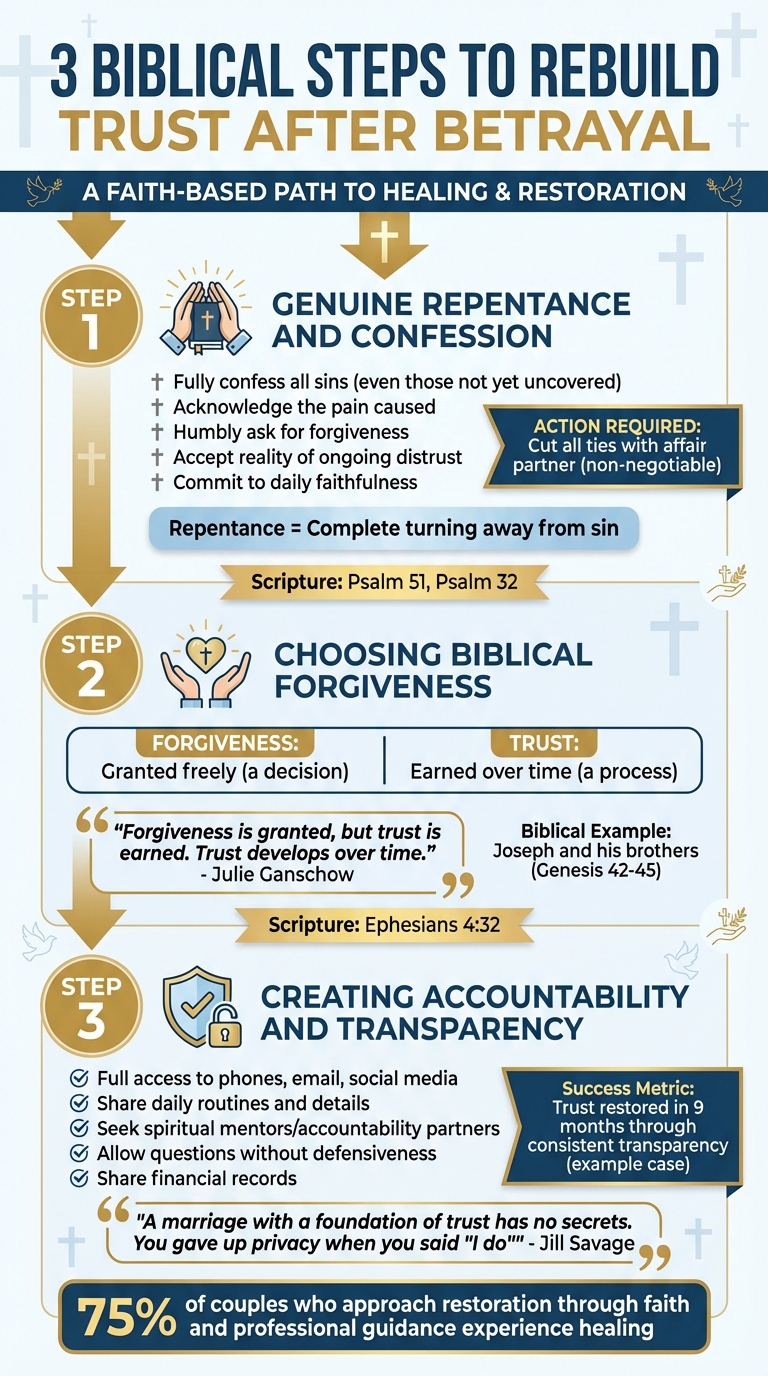
3 Biblical Steps to Rebuild Trust After Betrayal in Marriage
Rebuilding trust after betrayal is a challenging journey that requires intentional, faith-driven actions from both spouses. It’s not just about expressing regret – it’s about genuine transformation and a commitment to healing. The emotional scars left by betrayal run deep, but these three biblical steps provide a pathway to restore trust and rebuild the relationship.
Step 1: Genuine Repentance and Confession
True repentance goes beyond a simple "I’m sorry." In the New Testament, repentance signifies a complete turning away from sin – a change of heart that replaces self-centeredness with submission to Christ [9]. Betrayal in marriage is a violation of sacred vows made before God [4].
Repentance involves fully confessing all sins, even those not yet uncovered, acknowledging the pain caused, humbly asking for forgiveness, accepting the reality of ongoing distrust, and committing to daily faithfulness. Seeking guidance from mature Christians can provide essential accountability during this process [9].
For the unfaithful spouse, cutting all ties with the affair partner is non-negotiable. This separation should be clear and final, ideally occurring in the presence of a counselor or mentor to ensure accountability [4][10]. Psalms like Psalm 51 and Psalm 32 offer heartfelt examples of confession and seeking God’s restoration [4].
Once repentance is genuine, the next step is embracing forgiveness through a biblical lens.
Step 2: Choosing Biblical Forgiveness
Forgiveness is a decision, not simply an emotion. It’s about choosing to release the offender from the debt of their wrongdoing, mirroring the way God forgives us in our moments of guilt and shame [9][5]. Ephesians 4:32 reminds us: "Be kind and compassionate to one another, forgiving each other, just as in Christ God forgave you."
It’s important to distinguish forgiveness from trust. Forgiveness is granted freely, but trust takes time to rebuild. Julie Ganschow, Founder and Director of Reigning Grace Counseling Center, explains:
"Forgiveness is granted, but trust is earned. Trust is not an automatic given in reconciliation; it develops over time" [1].
While God forgives without requiring immediate trustworthiness, the betrayed spouse is encouraged to forgive, even if intimacy or vulnerability cannot yet be fully restored. Reconciliation is a gradual process that unfolds as the offending spouse demonstrates genuine change and selfless behavior over time [9]. The story of Joseph in Genesis 42–45 illustrates this dynamic – Joseph extended forgiveness, but full reconciliation awaited the evidence of his brothers’ transformation [9].
Step 3: Creating Accountability and Transparency
Rebuilding trust hinges on consistent and transparent actions over time. The repentant spouse must embrace accountability and willingly open their life to scrutiny. Practical measures include giving full access to devices like phones, email, and social media accounts to foster transparency and reduce suspicion [3][11]. Sharing daily routines and details can also help rebuild confidence and prevent misunderstandings [11].
One example highlights how a couple restored trust within nine months through consistent transparency, including sharing phone logs and financial records [11].
External accountability is equally critical. Seeking guidance from spiritual mentors, trusted Christian friends, or accountability partners can provide valuable support and help challenge old patterns [9][10][3]. The betrayed spouse should feel free to ask questions as they process their pain, while the repentant spouse responds with patience and understanding.
Jill Savage, Author and CEO of Hearts at Home, underscores this principle:
"A marriage with a foundation of trust has no secrets. Your spouse should have a ‘master key’ to every part of your life. Questions aren’t an invasion of privacy. You gave up privacy when you said ‘I do’" [11].
These steps lay the groundwork for a faith-centered healing process, paving the way for deeper marital restoration.
sbb-itb-596b85d
Strengthening Your Marriage Through Communication and Faith
Developing Honest Communication
Honest communication is a cornerstone for rebuilding a marriage after betrayal. By addressing pain with accountability and transparency, couples can transform wounds into opportunities for healing. This requires a shift in how conversations unfold. The spouse who caused harm must engage with their partner’s pain without resorting to excuses or defensiveness, as such reactions can prevent progress [12].
For the betrayed partner, using "I" statements can be a powerful tool. Phrases like "I feel deeply hurt" allow for emotional expression without provoking defensiveness. On the other hand, accusatory language often creates barriers instead of bridges [6]. Full disclosure is another critical step in reestablishing trust and ensuring honest communication [6].
One couple found success by committing to daily, open conversations and practicing complete transparency. Their journey serves as an example of how consistent communication can renew a relationship [11].
Incorporating daily rituals to connect emotionally can also strengthen bonds. Active listening – truly focusing on your partner, even when concerns are repeated – fosters understanding and empathy [2]. Couples should discuss behaviors that either support or hinder the healing process, creating honest feedback loops [12]. Vulnerability plays a key role here, breaking down emotional walls and aligning both partners as a team.
As you work toward open communication, remember to trust in God’s unwavering plan to restore and renew your relationship.
Trusting God’s Timing for Healing
While honest communication lays the groundwork, entrusting the healing process to God provides the ultimate foundation for restoration. When trust in a spouse is broken, shifting your primary trust to God offers stability. Unlike human trust, which takes time to rebuild, trust in God remains constant and unshakable. Pastor Kevin Backus puts it this way:
"The only Being that we can have absolute confidence in would be the Lord. That’s the only ironclad trust that we’ve got" [7].
Scripture offers reassurance during these times. Proverbs 3:5-6 encourages believers to trust in the Lord wholeheartedly, rather than relying on their own understanding. Psalm 46 reminds you that God is your refuge and strength, even when life feels overwhelming [4]. Isaiah 41:10 promises that He will uphold you with His righteous right hand, providing comfort and assurance [3][4].
These verses, along with pastoral guidance, highlight the importance of aligning your healing process with God’s timing. Counselors in West Virginia have observed that couples who ground their restoration in faith often experience renewed strength in their marriages [4].
Spending time together in prayer and scripture can further solidify this foundation. Inviting the Holy Spirit to work within your relationship creates a "threefold cord" that binds husband, wife, and God together [2]. By surrendering both your partner and the healing process to God, you acknowledge human limitations while embracing divine trustworthiness [5]. Through this surrender, many marriages emerge stronger than ever, rebuilt on a foundation of faith and grace [4].
Getting Professional Help with Biblical Guidance
How Christian Counseling Helps Restore Trust
Betrayal can leave trust in ruins, but Christian counseling offers a biblically grounded path to healing and restoration. By combining the perspectives of both spouses, the counselor’s guidance, and the wisdom of Scripture, this approach ensures the healing process is rooted in biblical principles rather than personal emotions [4].
The counseling process unfolds in three key phases. First, there’s immediate crisis intervention, which focuses on halting destructive behaviors and stabilizing the relationship. Next comes the recommitment phase, emphasizing deep, heartfelt repentance rather than surface-level apologies. Finally, long-term rebuilding incorporates accountability measures to help restore intimacy and trust [4]. This structured approach recognizes betrayal as more than just a mistake – it’s seen as a violation of a sacred vow, or what Scripture refers to as "perjury" [4].
One counselor, drawing on 27 years of experience, has witnessed trust successfully restored in over 1,800 marriages that faced betrayal [10]. As Jones highlights:
"As every biblical counselor must emphasize, there really is hope – and not only a possibility, but the gospel guarantees restoration if both partners will seek to follow Christ" [4].
Building on these biblical principles, the next section introduces a specialized program designed to bring accountability and transparency into the healing process.
The Marriage Rescue Institute Program
For couples in crisis, the Marriage Rescue Institute provides an intensive 12-week program that integrates biblical truth with practical steps for accountability. Offered through Growth and Change Counseling, this program goes beyond addressing surface behaviors, targeting deeper heart issues like lust, pride, and idolatry.
A key requirement of the program is an immediate and verifiable end to the affair, confirmed during a counselor-monitored call [4]. From there, couples establish clear boundaries in areas such as finances, time management, and communication to prevent further breaches of trust [7]. Radical transparency is another cornerstone of the program, with accountability measures focusing on three main areas: time use, physical location, and financial decisions [7].
The program is available in Campbell, CA, San Jose, CA, Los Angeles, CA, and Roseville, CA, with telehealth options for those located elsewhere in California. Individual therapy sessions with a Licensed Marriage and Family Therapist are priced at $200 for 45 minutes, while the Marriage Rescue Institute offers custom pricing, which is discussed during an initial strategy session.
Conclusion
Betrayal can break trust into pieces, but rebuilding is possible – and the Gospel assures us that restoration is within reach when both partners commit to Christ and the hard work of reconciliation[4]. In fact, a biblical counselor observed that 75% of troubled marriages found healing when couples genuinely sought Christ together[4]. Many of these marriages emerged stronger than they had ever been.
Healing from such deep pain requires more than time – it demands effort, faith, and intentional action. Applying biblical principles, staying accountable, and seeking professional guidance are key steps in this process. Trust doesn’t reappear overnight; it grows gradually, often starting with outside mediation and progressing to a place where mutual safety and connection are restored[13]. Celebrating these small victories along the way can sustain your hope through the journey.
Picture your marriage as a piece of metal repaired by welding. A properly welded joint becomes the strongest part of the entire structure[4][1]. Your marriage won’t look the same as it did before the betrayal, and that’s a good thing. Instead, you’re building something entirely new – strengthened by trials and reflecting Christ’s redemptive power in ways that are unmistakable.
When human trust falters, God’s character remains steadfast. Tanya, a pastor’s wife, beautifully expresses this truth:
"Praise God who really does redeem deep brokenness and makes them shine"[4].
Ultimately, your trust should rest not in your imperfect spouse but in a perfect, unfailing God. As Psalm 118:8 reminds us, “It is better to take refuge in the Lord than to trust in humans”[2][5].
If you’re finding it difficult to navigate this path alone, consider seeking support. Growth and Change Counseling provides biblically rooted guidance through individual therapy and the Marriage Rescue Institute program. Taking this step is a wise move toward the healing that God promises to those who pursue Him. Programs like the Marriage Rescue Institute demonstrate how faith and professional care can work hand in hand to rebuild trust and restore hope.
Finding Hope and Restoration with Growth and Change Counseling
How can couples rebuild trust and create transparency after betrayal?
Rebuilding trust after betrayal is no small feat – it demands dedication, patience, and consistent effort from both partners. For the person who was hurt, it’s natural to need time to process their emotions and decide when, or if, they feel ready to open up again. On the other hand, the person who broke the trust has to take full responsibility for their actions. This means showing genuine remorse, being transparent, and proving through consistent behavior that they’re committed to change.
Open communication and clear boundaries play a huge role in creating a safe space for healing. Transparency might involve sharing information openly, staying accountable for decisions, and following through on promises. It’s important to remember that trust isn’t rebuilt with words alone – it’s the consistent actions over time that truly make a difference. With patience, mutual effort, and a shared focus on healing, it’s possible for couples to not only restore their relationship but also build a deeper, more resilient connection.
How does forgiveness help rebuild trust after betrayal in a marriage?
Forgiveness plays a crucial role in rebuilding trust after betrayal in a marriage. It doesn’t mean erasing the pain or instantly mending the broken trust. Instead, it’s about making a deliberate choice to release feelings of resentment and offer understanding. This act paves the way for healing and creates an opportunity for reconciliation.
From a biblical standpoint, forgiveness is seen as vital for both spiritual and relational repair. While it doesn’t promise an instant restoration of trust, it lays the groundwork for rebuilding emotional bonds and fostering mutual understanding over time. By embracing forgiveness, couples can begin to move forward together, unburdened by the weight of past wounds.
How can Christian counseling help rebuild trust after betrayal in marriage?
Christian counseling offers couples a path to rebuild trust after betrayal by grounding the process in biblical principles such as repentance, forgiveness, and reconciliation. It encourages the partner who caused harm to take full accountability for their actions and show genuine efforts toward change. At the same time, it supports the betrayed partner in processing their emotions and approaching forgiveness at a pace that feels right for them.
By incorporating prayer, establishing healthy boundaries, and addressing deeper emotional pain, Christian counseling promotes both healing and spiritual growth. The approach highlights that trust isn’t restored overnight – it’s rebuilt step by step through consistent, trustworthy behavior and a shared reliance on God’s wisdom. This journey helps couples repair their relationship and move forward with a renewed sense of faith and connection.
Related Blog Posts
- Overcoming Trust Issues After Betrayal
- 5 Steps to Forgiveness in Christian Marriage
- Healing Intimacy After Sexual Addiction: Christian Insights
- How Forgiveness Heals Marital Betrayal
