In neurodiverse relationships, anger often stems from sensory overload, unmet needs, or miscommunication rather than intentional conflict. Traditional approaches to managing anger may not work well here due to differences in emotional processing, communication styles, and sensory sensitivities. This article highlights practical tools tailored for neurodiverse couples to handle anger effectively:
- Self-Regulation: Techniques like cold water splashes, paced breathing, and muscle relaxation help calm emotions before addressing conflicts.
- Co-Regulation: Partners work together to de-escalate stress, using shared signals or creating calming environments.
- Clear Communication: Direct, literal language reduces misunderstandings; tools like "feelings thermometers" and code words simplify emotional expression.
- Predictable Systems: Routines and calming spaces prevent sensory overload, while pre-planned conflict strategies help manage disagreements.
- Professional Support: Specialized therapy offers deeper solutions, focusing on emotional triggers and tailored strategies.
These approaches help neurodiverse couples navigate challenges and build stronger connections. Read on for detailed strategies and examples.
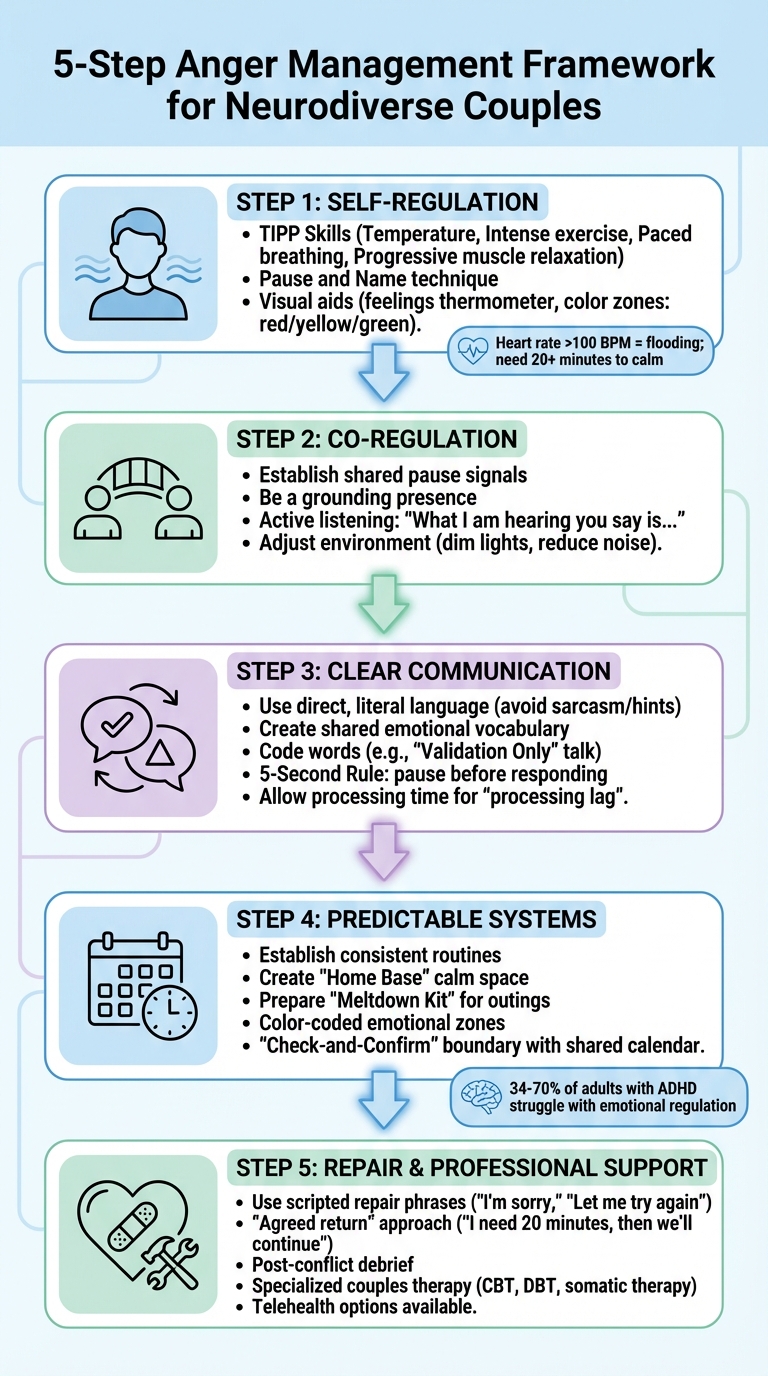
5-Step Anger Management Framework for Neurodiverse Couples
How to have a safe disagreement in your neurodiverse relationship
sbb-itb-596b85d
Regulating Emotions Before Addressing Conflict
When emotions run high, having a productive conversation becomes a steep challenge. Emotional dysregulation not only makes it harder to listen but also fuels misunderstandings. Rachel Burgreen, LCSW-S, a Gottman Method Couples Therapist, explains:
"When we are dysregulated our emotional intensity has increased, and we are having difficulty bringing emotions back down to a moderate level. When this happens we generally cannot effectively hear our partner, misinterpretations rise, and our ability to communicate effectively goes out the window!" [6]
For neurodiverse couples, this struggle can be even more intense. A heart rate exceeding 100 beats per minute is a telltale sign of physiological dysregulation, often referred to as "flooding" [6]. Attempting to resolve conflict in this state often backfires, making matters worse. The body requires at least 20 minutes for the stress hormone norepinephrine to dissipate and for the cardiovascular system to stabilize [6]. Rushing into discussions before both partners are calm can escalate arguments, leading to deeper rifts that demand significant repair later [7].
Self-Regulation Techniques
TIPP skills are a quick way to regain emotional balance. The acronym stands for:
- Temperature: Splashing cold water on your face can activate the "dive reflex", calming the nervous system.
- Intense exercise: Engaging in physical activity, like holding a plank for a minute, helps release built-up tension.
- Paced breathing: Slowing your breath can reduce stress.
- Progressive muscle relaxation: Tensing and relaxing muscles brings focus back to the body [6].
Sensory tools, such as essential oils, calming visuals, or fidget tools, can also help soothe the nervous system [6]. For neurodivergent individuals, the "Pause and Name" technique is particularly helpful. Simply understanding emotional cues before reacting can prevent impulsive responses [4]. Visual aids, like a "feelings thermometer" or color-coded zones (red, yellow, green), allow for real-time tracking of emotional states [1].
Once self-regulation is achieved, partners can move toward co-regulation.
Co-Regulation Strategies
After calming themselves, couples can use co-regulation to stabilize emotions together. This involves working as a team to reduce stress and step away from the conflict, creating space for repair [8]. Co-regulation is especially useful for couples with differing processing speeds. Establishing a shared signal to pause conversations when emotions spike can prevent further escalation [4].
Being a grounding presence is key – offering calm support without trying to "fix" or dismiss a partner’s feelings [4]. For instance, if one partner experiences sensory overload and withdraws or covers their ears, the other might dim the lights or reduce noise to create a more comfortable environment [4]. Using techniques like "What I am hearing you say is…" promotes active listening, ensuring both partners feel understood and reducing the risk of miscommunication [7].
These steps toward regulation set the stage for clearer, more effective communication, especially in neurodiverse relationships.
Communication Techniques for Neurodiverse Couples
Once emotions are under control, the next step is effective communication. For neurodiverse couples, this can look a little different. Many neurodivergent individuals process language in ways that may not align with their neurotypical partners. What might seem like a simple conversation to one partner could feel overwhelming to the other. By tailoring communication to each partner’s neurological style, couples can reduce confusion and avoid emotional overload. These personalized approaches build on emotional regulation and help foster clearer, more productive interactions.
Using Direct and Literal Language
Neurodivergent individuals often struggle with interpreting sarcasm, subtle tone shifts, or non-verbal emotional cues. Research from the University of St. Andrews highlights that autistic adults often prefer a "deliberate" communication style, which contrasts with the "intuitive" style common among neurotypical individuals [4][9]. In practice, this means that clear, straightforward language works better than relying on hints or implications.
As Leslie A. Sickels, LCSW, explains:
"The only way to know definitively what someone else’s needs are is by asking directly or the person stating them explicitly" [9].
For example, instead of saying, "I guess I’m just invisible", try, "I feel hurt that you didn’t respond when I asked for help" [1]. Similarly, replacing vague or accusatory phrases like "You’re always so loud" with "Please say that more gently; the volume is overwhelming" [14] can help eliminate guesswork and reduce the chance of misinterpretation.
It’s also helpful to avoid absolute terms like "always" or "never" during conflicts, as these can provoke defensiveness and create long-lasting negativity. A simple technique, like the 5-Second Rule, can make a big difference: when tensions rise, pause, take a deep breath, and count to five before responding [10]. This short pause gives your brain time to move from an impulsive reaction to a more thoughtful reply.
In addition to using clear language, developing a shared emotional vocabulary can further strengthen understanding between partners.
Creating Shared Emotional Vocabulary
Having a shared emotional vocabulary can be a game-changer for neurodiverse couples. This means creating specific words, signals, or tools that both partners can rely on to express emotions clearly. Visual aids, such as "feelings thermometers" or color-coded zones (e.g., green for "ready to talk", yellow for "frustrated/need care", and red for "overwhelmed/need space"), can help when emotions are running high [4].
Code words are another great tool. For instance, one partner might say, "I need a ‘Validation Only’ talk right now", to indicate they just want to be heard and aren’t looking for immediate solutions [4]. Psychologist Crystal I. Lee explains:
"Understanding that withdrawal during overwhelm is a coping mechanism, not rejection, helps maintain connection while respecting individual needs" [4].
It’s also important to acknowledge that neurodivergent partners may need extra time to process and articulate their emotions – a phenomenon known as "processing lag" [4][12]. Normalizing this need for additional time can prevent misunderstandings and ensure that both partners feel seen and heard. To reinforce clarity, following up verbal conversations with written summaries can help ensure that no key points are missed or forgotten [11][13].
Building Predictable Systems to Reduce Anger Triggers
Establishing predictable systems can help reduce anger triggers by creating a sense of emotional safety, especially for neurodiverse couples. When paired with self-regulation, co-regulation, and clear communication, these systems can prevent situations from escalating. For many neurodivergent individuals, uncertainty and sensory overload can cause dysregulation before they even realize it. By implementing consistent routines and setting clear boundaries, both partners can navigate their relationship with fewer surprises – keeping the nervous system from slipping into "fight or flight" mode.
Structured routines, calming environments, and pre-planned conflict strategies are key to minimizing potential triggers. Research indicates that between 34% and 70% of adults with ADHD experience challenges with emotional regulation [5].
Creating Routines and Calm Spaces
Routines offer a sense of stability that many neurodivergent individuals rely on to feel grounded. Simple structures – such as regular meal times, designated quiet hours, or shared routines to discuss logistics – can go a long way in reducing friction. Julie Hart from The Hart Centre points out that while routines are often comforting for neurodivergent individuals, their partners may sometimes feel restricted by the need for so much structure [3]. Striking a balance that works for both is essential.
One practical idea is to create a "Home Base" – a specific, low-stimulus space where a partner can go to reset their nervous system [15]. This could be a room with soft lighting, noise-canceling headphones, and minimal distractions. Understanding how sensory processing affects neurodiverse relationships can help in designing these spaces effectively. For outings, some couples prepare a "Meltdown Kit" that includes tools like fidget toys or calming apps to help manage sensory overload when away from home [15].
Another useful strategy is incorporating visual tools to simplify communication about emotional states. For example, color-coded zones – green for "safe", yellow for "rumbling", and red for "stop/meltdown" – allow partners to quickly convey how they’re feeling without needing to rely on complex verbal explanations [1]. These small but meaningful systems provide a foundation for managing conflicts more effectively.
Developing Conflict Response Plans
Even the best routines can’t eliminate conflict entirely. That’s why having a pre-planned conflict response strategy is so important. Couples should develop these plans together during calm moments, not during an argument. Start by identifying early warning signs of distress – often called the "rumbling stage." These might include behaviors like increased stimming, irritability, or withdrawal [15]. Recognizing these signs early gives both partners a chance to address the situation before it escalates.
One helpful approach is to externalize the problem. Rather than framing conflicts as "partner vs. partner", shift the perspective to "the couple vs. the ADHD pattern" or "the couple vs. the sensory trigger" [5]. Imago Relationship Therapists Shlomo and Rivka Slatkin suggest:
"When a ball drops: ‘What system failed?’ → tweak the system, not the person" [5].
Another effective tool is the "Check-and-Confirm" boundary. Instead of agreeing to requests on the spot, both partners consult a shared calendar or task board to avoid missed commitments that might lead to resentment [5].
Couples should also agree on a cool-down period – at least 20 minutes – to allow stress hormones to subside [6]. Afterward, conducting a post-conflict debrief can be incredibly valuable. Dr. K from Couples Therapy Inc. highlights the importance of having a customized protocol for handling meltdowns in neurodiverse relationships [15].
During a debrief, couples can reflect on questions like: What led to the rumbling stage? What strategies worked to de-escalate the situation? What could we do differently next time? These structured discussions turn challenges into opportunities for growth, helping to strengthen the relationship over time.
Post-Conflict Repair and Recovery
Repairing a relationship after conflict isn’t just about resolving the issue at hand – it’s about rebuilding connection. For neurodiverse couples, this means recognizing and respecting each partner’s unique ways of feeling safe and connected. The ability to repair effectively can be the difference between a relationship that thrives and one that struggles. In severe cases, intensive therapy for couples in crisis can provide the necessary structure to navigate deep-seated issues. In fact, research shows that marriages can endure challenges like criticism, defensiveness, stonewalling, and even contempt – if both partners learn how to repair effectively [17].
Making Repair a Routine Practice
Repair shouldn’t be reserved for the aftermath of major arguments. Instead, it should become a natural and regular part of your relationship. Small gestures can make a big impact: a heartfelt apology, a reassuring touch, or even a quick check-in can help prevent resentment from taking root. Dr. John Gottman highlights this idea, saying:
"The secret is learning the right kind of damage control. You may discover that your partner is more conciliatory during arguments than you realized – once you know what to listen for!" [14]
One helpful strategy is to use scripted repair phrases – pre-agreed statements that make it easier to reconnect during moments of tension. Phrases like "I’m sorry", "Let me try again", "Please say that more gently", or "I can see my part in this" provide a simple, low-pressure way to signal a desire to repair [14]. These phrases work because they’re predictable and don’t require improvisation when emotions are running high.
Giving Space for Processing
Effective repair also requires allowing time for processing, especially in neurodiverse relationships. One common challenge is the difference in how partners process conflict. Neurotypical individuals may crave immediate resolution to feel secure, while neurodivergent partners often need more time to sort through their emotions and thoughts before they can fully engage in resolving the issue [3]. Pushing for an immediate response can escalate tensions, leading to emotional shutdowns or further conflict.
This is where the "agreed return" approach comes in. Using a phrase like, "I’m feeling overwhelmed; I need 20 minutes, then we can continue", helps pause the conversation without abandoning it [5]. This reassures the waiting partner that the discussion is still a priority and will resume after a brief break.
During this pause, both partners can reflect on their feelings and needs. For neurotypical partners, practicing self-compassion techniques – like placing a hand on the heart or belly – can help shift from a defensive mindset to one that’s more nurturing and open [16]. Once both partners have had time to regulate their emotions, reconnecting becomes not only easier but also more meaningful.
The Role of Professional Support in Anger Management
When it comes to addressing the deeper, more complex layers of anger in relationships, professional support can make all the difference. While self-help strategies are helpful, they often fall short in situations where neurological differences shape how emotions are processed and expressed. Standard advice, typically tailored for neurotypical couples, may not effectively address these unique dynamics, making expert intervention a crucial step [3].
Specialized Couples Therapy for Neurodiverse Relationships
Specialized therapy dives into the root causes of emotional triggers, focusing on what John Kane, founder of Growth and Change Counseling, calls relational intelligence. This concept emphasizes expressing anger in ways that build intimacy rather than erode it [18]. As Kane puts it:
"Knowledge without practice rarely leads to lasting change." [18]
This approach goes beyond surface-level anger management, helping couples develop self- and co-regulation techniques that bridge the gap between their unique neurodiverse experiences. Growth and Change Counseling, for instance, targets the underlying causes of anger – like unmet needs, broken trust, sensory overload, and communication challenges – while teaching partners to translate their emotional processes into a shared language [1][4].
Programs like the Marriage Rescue Institute take this a step further with a 12-week intensive coaching model. Using evidence-based methods such as Cognitive Behavioral Therapy (CBT), Dialectical Behavior Therapy (DBT), and somatic therapy, they address both the emotional and physical aspects of anger. Couples learn practical tools, like structured dialogue techniques and "neurotype translation", which help each partner articulate their inner experiences in a way the other can understand [4][5]. These tailored strategies build on existing self-help methods, offering a deeper framework for managing conflict and fostering connection.
Telehealth Options for Accessibility
For many couples, logistical challenges like travel and scheduling can be significant barriers to seeking professional help. Telehealth services are changing that. Growth and Change Counseling, for example, provides remote therapy sessions across California, making professional support more accessible than ever [18]. These virtual sessions offer the same personalized, evidence-based care as in-person visits, allowing couples to focus on their relationship without the added stress of coordinating in-office appointments. This digital approach ensures that even the busiest partners can prioritize their emotional health and connection.
Conclusion
Dealing with anger in neurodiverse relationships isn’t about trying to change who you are – it’s about recognizing that anger often acts as a signal rather than a threat. For neurodivergent partners, frustration is frequently tied to sensory overload, unmet needs, or challenges with executive function, rather than a lack of love or commitment [1][5]. Shifting your perspective to see anger in this way can reshape how you approach it altogether. This idea forms the foundation of the strategies explored earlier.
When it comes to managing emotions, tools need to match how neurodiverse individuals process them. For example, using direct and literal language removes the guesswork. Tools like color-coded feelings thermometers can help when words fall short. Predictable routines reduce the executive function strain that often fuels irritability. And adopting a "team vs. the pattern" mindset can transform conflict from feeling like a personal attack into a shared challenge you can tackle together [2][5].
Traditional advice often falls short because it doesn’t consider the unique ways neurodiverse brains handle emotions. This oversight leaves many couples without strategies that truly work for their needs.
That’s where professional support can make a big difference. Specialized therapy can help partners understand each other’s inner worlds more clearly while teaching practical co-regulation techniques. Programs like Growth and Change Counseling’s 12-week Marriage Rescue Institute and telehealth options make it easier to access the care you need.
Neurodiverse couples can build strong, connected relationships. With the right tools, open communication, and, when needed, professional guidance, the effort can lead to a deeply rewarding partnership.
FAQs
How can neurodiverse couples create a calming space for managing anger together?
Creating a peaceful space can make a big difference for neurodiverse couples working through anger and learning to co-regulate. Start by addressing sensory triggers: dim overly bright lights, clear up clutter, and cut down on loud or distracting noises. Adding comforting touches, like a weighted blanket, soft textures, or calming scents like lavender, can help soothe the nervous system and promote a sense of security.
Visual tools can also make sharing emotions and needs much easier. Try using a color-coded chart, such as a "feelings thermometer", or a simple checklist of calming actions – things like deep breathing or taking sensory breaks. Keeping these tools in a consistent, easy-to-see spot can build predictability and reinforce emotional safety, both of which are crucial for neurodiverse relationships.
How can neurodiverse couples improve communication by building a shared emotional language?
Building a shared emotional language begins by recognizing that each partner may have their own way of expressing and interpreting emotions. Using clear and direct communication can help avoid confusion. For instance, instead of making vague or sarcastic comments, try something like, “I feel hurt when you don’t respond to my request for help.” This kind of straightforward expression promotes both clarity and emotional security.
Visual aids can also play a big role in improving emotional understanding. Tools like a color-coded chart or a “feelings thermometer” can make it easier to identify and communicate emotions quickly. Another idea is to create a shared notebook or document where you and your partner can list emotional terms, common triggers, and calming techniques that work for both of you. Taking time to regularly review and update this resource together keeps it meaningful and helps maintain open communication. These methods can go a long way in bridging emotional differences and easing tension in neurodiverse relationships.
How can professional support help neurodiverse couples manage anger effectively?
Professional help can make a huge difference for neurodiverse couples striving to manage anger and build a stronger relationship. Therapists who specialize in neurodiverse relationships can assist couples in pinpointing triggers, enhancing communication, and crafting strategies tailored to their unique needs. These strategies often take into account sensory sensitivities or processing differences, helping partners address challenges without letting anger take control.
At Growth and Change Counseling, programs like the Marriage Rescue Institute offer a focused 12-week coaching process aimed at rebuilding trust, deepening emotional bonds, and creating actionable plans for managing anger. Professional guidance also provides a neutral, supportive environment where both partners feel heard and empowered. Tools like calming techniques and regular check-ins become part of the process, promoting emotional safety and mutual understanding over time.
Related Blog Posts
- Emotional Intelligence for Neurodiverse Couples
- Understanding Emotional Cues in Neurodiverse Couples
- Q&A: Supporting Neurodiverse Couples with Mental Health Issues
- ADHD and Autism: Conflict Resolution Strategies
