I’d start with one goal your child chooses and five minutes of low-pressure practice. In a mixed-neurotype family, the aim is connection – not making everyone communicate the same way. Speech, gestures, pictures, and AAC all count.
Here’s how I’d put the article’s eight tips into action:
- Agree on adult responses. Make a shared plan for help, breaks, and conflict.
- Follow your child’s play. Join what they enjoy without taking over.
- Practice brief turns. Use simple games, and honor requests to stop.
- Support understanding emotional cues. Offer comfort and coping choices before solving problems.
- Show what comes next. Use pictures or words to explain routines.
- Rehearse useful messages. Practice joining, leaving, saying no, and asking for help.
- Plan for sensory and attention needs. Adjust noise, space, movement, and timing.
- Notice effort and repair conflict. Model apologies and offer ways to reconnect.
My starting rule: <u>participation stays optional</u>. Over 1–2 weeks, I’d note what helps, ask for your child’s feedback, and change one thing at a time. I’d measure communication, comfort, and self-advocacy – not eye contact or obedience.
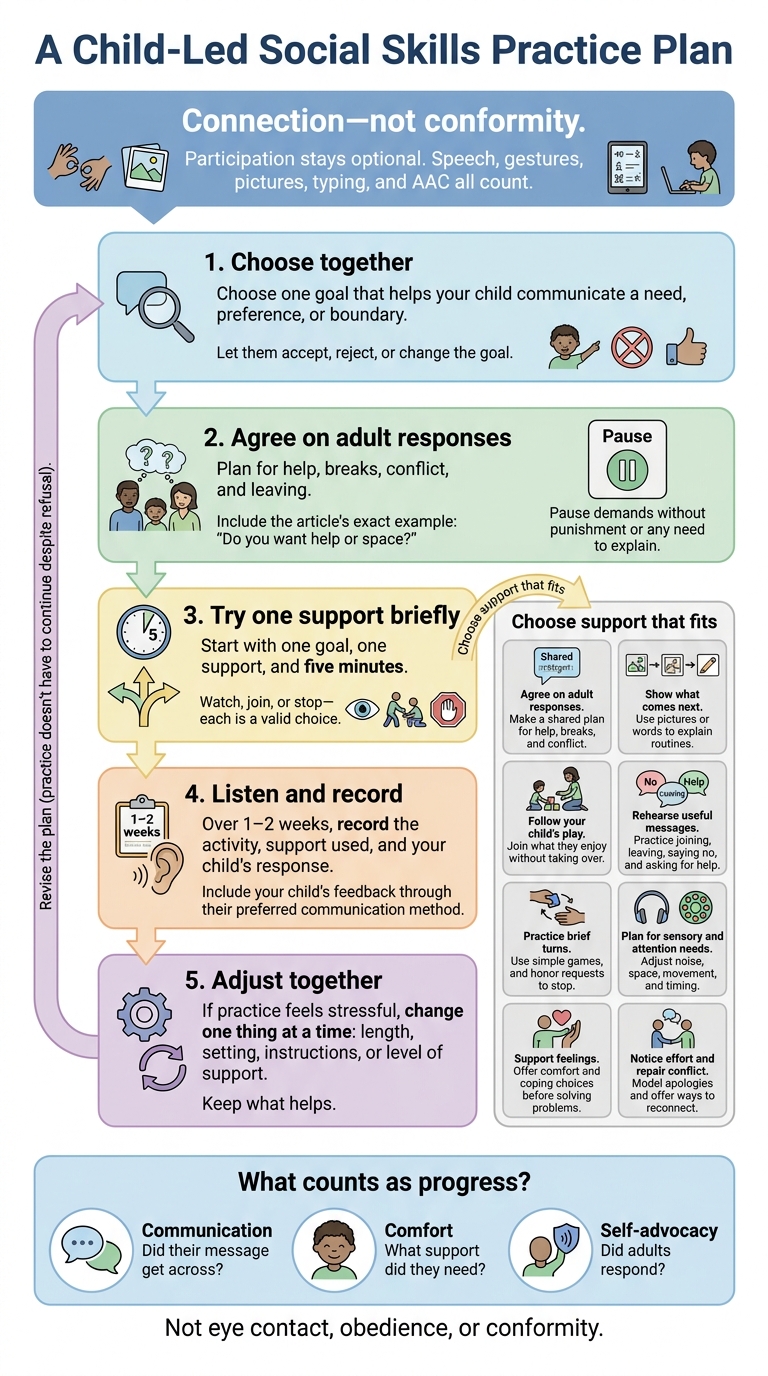
A Child-Led Social Skills Practice Plan
Neurodiversity-Affirming Approach to Developing Social Skills
sbb-itb-596b85d
Set Social Goals With Your Child
Choose a goal that addresses a problem your child faces – not one that just makes adults more comfortable. A communication goal helps your child express needs, preferences, or boundaries, or keep an interaction going. A compliance goal mainly measures obedience. Skip goals built around eye contact, forced sharing, or unwanted touch [5].
Ask what would make time with siblings or friends easier. Offer choices through the ways your child communicates most reliably: speech, gestures, pictures, typing, or AAC. Let them accept, reject, or change the goal. Focus on the message, not how it’s delivered. Treat each communication mode as equally valid, keep communication tools within reach, and respond without asking your child to repeat the message aloud. ASHA notes that AAC does not hinder speech development [7][8].
Work on the goal during everyday routines rather than setting aside a separate lesson. Caregiver coaching can help adults notice communication attempts, model responses, and give the child time to reply during those routines [3][4].
Review the goal regularly with your child. Track whether they got their message across, how much support they needed, and whether adults responded. If practice leads to more frustration, change the demands or setting instead of pushing harder. Once the goal reflects your child’s needs, agree with other caregivers on emotional growth and communication to respond consistently.
1. Agree on Caregiver Goals and Responses
Once the child’s goal is clear, adults need to agree on how they’ll respond.
Social Skill Supported
Predictable adult responses make repair easier. Use the same phrases with the child:
“Do you want help or space?” “I misunderstood,” “Can we try again?” “Let’s repair.”
After a conflict, take time to settle. Acknowledge what happened, ask what would help, and work toward repair without requiring an immediate apology.
Parent Strategy
Write a short plan that covers the activity sequence, choices, each adult’s role, and how to leave if needed. Decide who supports the child, who helps siblings, and who handles an early departure. Rotate these roles when practical.
Keep the plan visible alongside a visual schedule. This helps prevent one caregiver from enforcing something another has made optional.
Adjustments for Different Needs
Match the plan to the child’s stress signals. Agree on which prompts help and which add distress. Give one brief prompt, allow time to process it, and stop repeating directions if tension builds.
When signs of overload appear, use fewer words and reduce demands. Plan for a quiet space, sensory tools, and a clear exit path. Agree on a phrase adults can use when handing off support.
Try This: Keep Participation Optional
Choose one shared break signal:
A “Pause” card that anyone can point to or hold up.
Practice using it during a calm moment. The signal pauses demands without punishment or any need to explain. Watching, doing a parallel activity, or leaving early are valid options – not privileges children must earn.
2. Follow Your Child’s Lead in Play
Once you’ve agreed on an adult response plan, use play as a low-pressure way to practice it together.
Social Skill Supported
Play your child already enjoys can build shared attention and turn-taking. Joining in gives you both chances to notice, imitate, and respond to each other. Gestures, sounds, pointing, and augmentative and alternative communication (AAC) all count. Speech and eye contact aren’t required.[13][6] The goal is connection, not compliance.
Parent Strategy
Join for 3–5 minutes. Watch first, imitate one action, then pause.[11] Model one gesture, word, or turn without changing the activity. Keep comments brief rather than asking repeated questions. Never hold back a toy to get speech or eye contact.[9][10]
Adjustments for Different Needs
Keep play short when your child’s attention or energy is low. Reduce noise, avoid unexpected touch, or start farther away if being close feels uncomfortable. Some children enjoy movement; others prefer quiet, side-by-side play. Connection doesn’t have to look the same for every child.[9][12]
Try This: Keep Participation Optional
Offer one optional exchange during play, then wait several seconds.[11] Continue if your child shows interest with a gesture, sound, object exchange, or AAC message. If they turn away or decline, stop the invitation but leave their activity available. There’s no required number of turns.[9][10]
3. Practice Turns With Low-Pressure Games
Once simple play feels comfortable, try a short game with clear turns.
Social Skill Supported
Practice waiting, taking turns, requesting, and ending an interaction – one skill at a time. Begin with two players to keep waits short. Add others only when your child feels comfortable.[15][17]
Parent Strategy
Use short turn-taking phrases with gestures or My Turn, Your Turn, and Finished cards. Give your child ways to ask for help, another turn, or a stop through signs or communication devices. Respond promptly to these requests. Ask before using your child’s toy: taking turns doesn’t mean giving up ownership.[14][16]
Adjustments for Different Needs
Keep participation optional and reduce demands as needed. Try a larger, lighter ball for motor challenges or shorter turns for attention needs. Match the activity to your child’s energy and comfort, then build up gradually.
| Play format | Turn-taking focus | Useful adjustments |
|---|---|---|
| Shared-turn play | Taking turns and requesting another turn | Two players, short turns, and turn cards |
| Side-by-side play | Building comfort before exchanging turns | Separate materials and comfortable spacing |
| Rule-based games | Waiting, following rules, and stopping | One-step rules and a Finished card |
Pause rather than prompting harder if you notice distress, refusal, confusion, fatigue, escalating conflict, or unusual quietness.
Try This: Practice Brief Turns
Start with two brief ball rolls. Offer one roll, then invite a return roll.[14] If your child wants to keep the ball, use a second ball.
Try the same short-turn structure during board games, cleanup, or sibling play.
4. Help Children Express Feelings and Cope
Social Skill Supported
Turn-taking can bring up big feelings. Help children practice three skills: noticing feelings, naming them, and asking for support when emotions run high. These skills help them stay connected when playing, waiting, or sharing feels hard. Facial expressions, tone, and eye contact don’t reliably tell you how a child feels. Ask gently, and accept uncertainty or an answer you didn’t expect.[21][24]
Parent Strategy
Teach feeling words with books or drawings during calm moments. Make the boundary clear: anger is okay; hitting is not. When your child is upset, offer support before trying to solve the problem.[19][22] Later, praise their effort to cope – not just their calm behavior.[18]
Adjustments for Different Needs
Use your child’s usual way of communicating. A 1-to-10 scale can help them show how strong a feeling is. Some children may prefer three levels:
Calm, getting big, need a break.
Practice a chosen coping option while your child is calm:
Movement or quiet music.
Children may need different signals and types of support.[20][23]
Try This: Keep Participation Optional
Offer an optional Help / Quiet / Break card for moments of overload, and show how you’ll respond. Honor the request without asking for an emotion label, explanation, or eye contact. Accept silence or a choice not to use the card. Stay nearby and keep everyone safe.[25][26]
5. Use Visual Supports for Social Routines
Social Skill Supported
When transitions are hard for a child, visuals can show what comes next. Visual supports use pictures or words to make routines, choices, and transitions easier to follow. Social stories, also called social narratives, explain a situation, other people’s possible perspectives, and possible responses. Use them to offer context and a few acceptable options – not a script to follow.
Parent Strategy
Make a three-step playdate schedule:
Arrival and choice → play → cleanup and goodbye.
Keep a break or exit option visible the whole time. Review the schedule before the visit while your child is calm, and explain that the plan may change.
| Tool | Purpose | Ideal use |
|---|---|---|
| Visual schedule | Shows a sequence from beginning to end | A whole playdate or outing |
| First-then card | Shows two brief, concrete actions | One transition |
| Social story | Explains context, perspectives, and possible responses | An unfamiliar or hard-to-read situation |
Pick the tool that makes the routine clearer. You don’t need all three. Seeing the routine can make it easier to practice the words and boundaries that go with it.
Adjustments for Different Needs
Choose photos, simple drawings, or written words based on each child’s preferences. Siblings don’t need matching formats. Keep visuals uncluttered, and let your child move or revise them rather than quizzing them.
After the event, talk about what helped once everyone is calm. Update unclear pictures, inaccurate steps, or missing options.
Try This: Show What Comes Next
Offer the visual on paper or a phone, or explain the sequence verbally. Accept your child’s choice to skip it. During the playdate, use it to preview the next transition:
“Next is cleanup, then goodbye.”
Its job is to support understanding and choice, not performance.
6. Rehearse Conversations, Boundaries, and Help Requests
After practicing turn-taking and coping skills, work on starting, keeping up, and ending conversations. Visual cues can help your child practice words and actions in short, repeated sessions.
Social Skill Supported
Choose one situation your child faces at home, school, or play. Spend a few minutes practicing with toys, drawings, role-play, or a familiar routine. Work on joining, responding, and ending one skill at a time.[30][31]
Parent Strategy
In your mixed-neurotype family, practice shared phrases so caregivers respond consistently. Rehearse two ways to join and one way to leave. Your child can use speech, gestures, pictures, or a speech-generating device. Include one yes and one no, along with ways to refuse, ask for space, and seek help.[27][28][29]
To practice joining, your child could bring a related toy or use this prompt:
Can I play?
For leaving:
I’m finished.
For help-seeking:
I need help.
When you ask whether your child wants to continue or stop, honor their answer.[27][28][29]
Adjustments for Different Needs
Start with one or two steps, and give your child time to respond. Siblings should practice waiting, accepting refusal, and respecting different ways of communicating, too. Don’t require eye contact or ask your child to suppress movement.
Take practice to school or a familiar playground. Agree on wording with caregivers and identify a trusted adult your child can turn to. For hurtful teasing, rehearse moving away and asking for help – not just coming up with a clever reply.[29][32]
Try This: Keep Participation Optional
Let your child choose puppets, drawing, watching you model, or skipping practice. Stop if they show distress, and try a simpler version later. Track whether your child communicated a need or got help.[29][33]
7. Plan Around Sensory and Attention Needs
After practicing turns and conversation, reduce sensory load so your child can use those skills comfortably.
Social Skill Supported
The goal is comfortable participation in turn-taking, listening, requesting help, and repairing misunderstandings.
A child might join from the edge of the activity, use headphones, move while listening, or communicate through speech, signs, gestures, or AAC.
Success means participating comfortably, not performing in a neurotypical way. The setup matters as much as the skill.
Parent Strategy
Shape the activity so your child can stay engaged long enough to practice a social skill. Pick a short practice time when your child is rested and regulated. Start with 5–10 minutes.
Reduce competing input: lower the volume, turn off unnecessary screens, clear clutter, limit crowding, and give a warning before changes or touch.[34] Give one direction, then pause.
Adjustments for Different Needs
Match supports to your child’s sensory and attention needs:
For sound sensitivity, offer headphones or ear defenders and choose a quieter room. For visual sensitivity or distractibility, reduce clutter, soften lighting, and seat the child away from busy doorways. For movement-seeking or attention differences, add brief movement breaks, different seating, or an active role such as carrying game pieces.
If your child becomes overwhelmed, offer a quiet space, a comfort item, water, and a clearly taught break signal.[35][37][38]
| Practice setting | Advantages | Limitations and safeguards |
|---|---|---|
| Home | Predictable surroundings for practicing turns and help requests. | Limited variety. Change one variable at a time, and let your child stop. |
| Sibling play | Frequent practice with waiting, turn-taking, help requests, and repairing misunderstandings. | Get both children’s consent. Keep practice age-appropriate; adults handle caregiving and regulation. |
| Community | Practice social skills with varied people and routines. | Higher sensory load. Preview the setting, bring supports, and find a quiet area or exit. |
Try This: Keep Participation Optional
Offer two acceptable choices, giving each equal value:
Quiet play or movement-based play.
Agree on a break location and signal before starting. Set a timer for about five minutes. Let your child stop sooner, watch instead of play, or take a break when needed.[36] Afterward, note what helped and change one thing next time.
8. Recognize Effort and Repair After Conflict
Social Skill Supported
After a conflict, move from practicing skills to repairing the relationship. Notice when your child asks for help, respects boundaries, or returns after a break. Name the effort and how it helped, rather than praising eye contact or hiding distress. If your child prefers less attention, keep encouragement brief and private.[41][42]
Parent Strategy
Wait until everyone is calm enough to communicate.[44] Then state your part plainly and model a short apology:
I interrupted you. I’m sorry. Would you like to try again or take space?
Adjustments for Different Needs
Give your child time to respond through writing, drawing, gestures, or AAC. Keep communication tools within reach and allow time to process. Apply the same boundary to every sibling: no one has to accept touch, conversation, or participation. Tailor support to each child, and don’t treat a delayed response as defiance.[42]
Try This: Keep Participation Optional
In a calm moment, agree on ways to offer reconnection after conflict. Options might include a message, sitting nearby without talking, or having a conversation later.[41] Ask what would make another attempt easier, then change one thing together. If conflict keeps repeating or you’re unsure about safety, seek family therapy or parent coaching.[39][40][43] Get help immediately if anyone is unsafe.
Conclusion: Start Small and Adjust Together
After practice and repair, step back and look for small gains in communication, self-advocacy, and comfortable participation. Predictable routines, flexible practice, and consistent caregiver responses help social growth.
This week, choose one goal and one support to try for five minutes. Agree on how adults will respond before you begin so your child doesn’t face conflicting responses. Use that short trial to learn what your child tolerates, prefers, and uses successfully.
For the next 1–2 weeks, record the activity, the support used, and your child’s response. Include their feedback through their preferred communication method. If practice feels stressful, change just one thing at a time: the length, setting, instructions, or level of support.
Measure connection, communication, and self-advocacy – not conformity. A useful plan helps your child express preferences, get support, and participate comfortably. Keep what helps, and use your child’s response to guide the next step.
FAQs
How can I tell social anxiety from sensory overload?
The key is to identify what’s triggering your child’s distress. Social anxiety usually involves interacting with others or worrying about how others judge them. Sensory overload, on the other hand, comes from too much input, such as noise, bright lights, or textures.
Both can lead to agitation, anxiety, or shutdowns. Headphones, dim lighting, or a quiet place to retreat can help your child manage sensory triggers.
If you’re unsure what’s triggering your child’s reactions, Growth and Change Counseling offers parent coaching and family therapy to help you develop personalized strategies.
How do I balance siblings’ different social needs?
Set aside one-on-one time with each child so no one feels left out when caregiving calls for extra attention [1]. Help each child take part in their own way with sensory-friendly, structured communication: quiet breaks, visual supports, and “no interruptions” rules [1].
Keep routines predictable, but leave room for changes. Use family check-ins to adjust routines around each child’s sensory and energy needs [2].
How can I get school staff to support my child’s social goals?
Connect with school staff early and stay in touch. Tell teachers, the school psychologist, and other relevant staff about your child’s needs and what works at home. This helps everyone coordinate classroom support.
Use a daily or weekly home–school checklist to track progress, and bring notes, evaluations, and records to IEP or 504 plan meetings. If communication breaks down, ask a neutral school professional, such as the school psychologist or guidance counselor, to help mediate.
Related Parenting Resources | Growth and Change Counseling
- Parenting Stress: Solutions for Neurodiverse Families
- Age-Appropriate Independence Skills for Neurodiverse Kids
- Research: Communication in Mixed-Neurotype Families
- Parenting Tips for Neurodiverse Families: Building Support
