Parenting a neurodivergent child can feel overwhelming, but understanding their needs and building a support system can make a big difference. From creating sensory-friendly spaces to fostering sibling connections, this guide offers practical strategies to help your family thrive.
Key takeaways:
- Understand your child’s needs: Recognize sensory triggers, focus on strengths, and use tools like visual schedules or calm-down spaces.
- Create structure at home: Design sensory-friendly environments, simplify routines, and reduce clutter to lower stress.
- Build external support: Partner with schools, join community groups, and seek professional guidance to lighten the load.
- Improve family dynamics: Encourage teamwork, validate emotions, and address sibling concerns with empathy and clarity.
Parenting a neurodiverse child isn’t about perfection—it’s a journey of emotional growth for neurodiverse couples and families – it’s about creating a supportive environment where everyone feels valued.
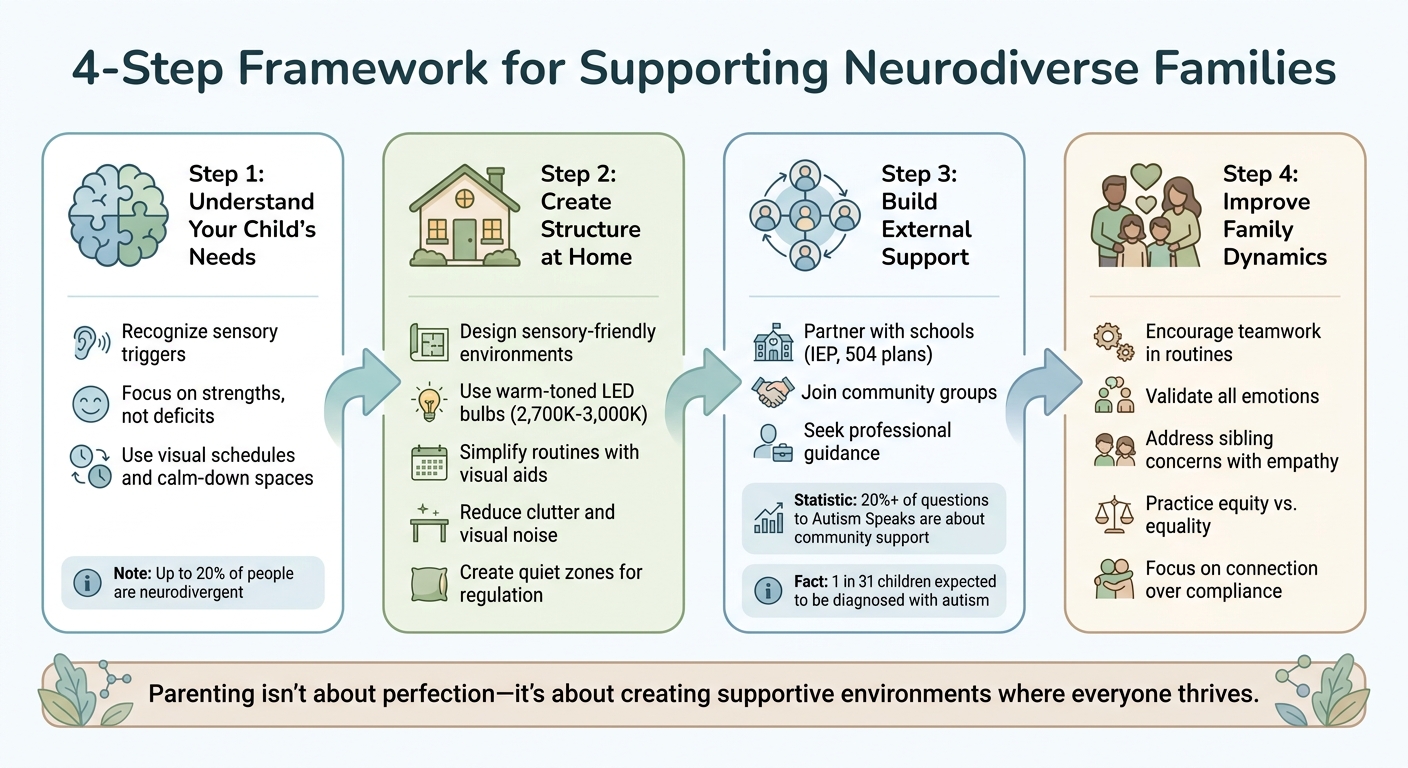
4-Step Framework for Supporting Neurodiverse Families
Hold On Tight: 5 Must-Know Tips for Parenting Neurodivergent Children
sbb-itb-596b85d
Understanding Your Child’s Neurodiverse Profile
Getting to know how your child processes the world is a key step in creating the right support systems for neurodiverse families. This isn’t about focusing on what they can’t do – it’s about understanding how they experience things like sensory input, social interactions, and the demands of daily life. As Taylor Alley from Tulip Tree Counseling puts it:
"Your child is not broken. Your child deserves support because support helps humans thrive, not because your child has failed." [1]
Identifying Neurodivergent Traits and Processing Styles
Start by noticing how your child reacts in different environments. For instance, do they cover their ears in noisy places? Does a certain fabric cause immediate discomfort? These behaviors might point to sensory processing differences. Keeping track of triggers – like sudden schedule changes, loud noises, or bright lights – can help you understand whether your child is overwhelmed rather than simply being "difficult."
Executive functioning challenges are another area to watch. If your child struggles with tasks like getting ready for school, they might benefit from tools that make abstract concepts easier to grasp. Instead of verbal instructions, try visual aids like schedules, timers, or "first-then" boards. You can also create a calm-down space stocked with sensory tools like weighted blankets, noise-canceling headphones, or fidget toys. This can offer them a safe retreat when things feel too overwhelming.
Once you’ve identified triggers and challenges, it’s equally important to focus on what makes your child shine.
Focusing on Strengths and Abilities
Shift your attention to your child’s strengths. Maybe they can spend hours building complex structures or have an incredible memory for facts about space. These aren’t distractions – they’re examples of hyperfocus, which can be a tremendous strength. Studies suggest that up to 20% of people are neurodivergent, and many excel in areas like pattern recognition, logical thinking, and creative problem-solving [2].
Each day, try to pinpoint one strength that has nothing to do with following instructions. It could be their curiosity, persistence, or straightforward honesty. Use these strengths to make challenges more engaging. For example, if they love dinosaurs but find reading difficult, introduce dinosaur-themed books. When children feel understood and supported, their strengths can help unlock their creativity and memory [2]. As Alley reminds us:
"Strengths are not a distraction: They are a foundation" [1]
Creating a Predictable Home Environment
Once you’ve identified your child’s specific needs, the next step is to make home a true sanctuary. By thoughtfully adjusting your space and daily routines, you can help reduce anxiety and create a sense of stability. These small but intentional changes are part of a larger effort to build a supportive, stress-free environment. Pediatric Occupational Therapist Elizabeth Kidney explains:
"A sensory friendly home supports regulation while also teaching children and parents how to meet sensory needs in ways that are safe, functional, and accessible." [3]
Designing Sensory-Friendly Spaces
Let’s start with lighting. Fluorescent lights can be overwhelming for some children, so replacing them with warm-toned LED bulbs (2,700K–3,000K) can make a big difference [4]. Smart bulbs with dimming options add even more flexibility to adjust lighting as needed.
Sound can also play a major role. Thick rugs, heavy curtains, or acoustic panels can help soften echoes and block sudden noises. Adding a white-noise machine or an indoor fountain can provide a steady, calming background sound that many neurodivergent children find soothing [4].
Consider creating a "quiet zone" where your child can retreat when they feel overwhelmed. This doesn’t have to be a separate room – something as simple as a play tent tucked into a corner or a modular play couch can work beautifully [3]. Equip this space with tools like weighted blankets (around 10% of your child’s body weight), weighted stuffed animals, or sensory-friendly seating like an indoor swing or wobble chair. For children who need movement to self-regulate, small trampolines are a great addition [3].
Tidy up visual clutter by using closed storage options like cabinets or labeled baskets instead of open shelving. Reducing "visual noise" can help create a more calming and organized environment.
As Hiral Gandhi from Autism Connect says:
"Sensory-friendly design isn’t about strict rules – it’s about flexibility… creating spaces that adapt with you, not against you." [4]
Once your physical space feels calming and supportive, the next step is to create a consistent daily routine.
Setting Up Daily Routines
An organized environment pairs perfectly with structured daily routines. Predictability can be just as comforting as a well-designed space. Visual schedules, timers, and offering limited choices can help create a sense of stability while also encouraging your child’s independence.
For children with ADHD, breaking tasks into shorter, more manageable intervals can help maintain focus [5].
Incorporate "heavy work" activities into the day – things like pushing a laundry basket, wiping down tables, or carrying groceries. These tasks provide proprioceptive input, which can be calming and grounding [3]. Present these activities as part of a team effort rather than a chore list. Occupational Therapist Jessica Ravineala emphasizes:
"Sensory tools are a need, not a reward." [5]
Finally, remember that flexibility is key. Not every day will go as planned, and that’s perfectly okay. The goal is to create a foundation of calm and consistency that you can adapt to your family’s needs.
Building External Support Networks
Even the most organized and supportive home can benefit from external connections. Partnering with schools, community groups, and professionals can enhance your family’s overall well-being.
According to Autism Speaks, more than 20% of the questions they receive are about community-based support, such as peer and parent groups [6]. This aligns with the statistics: about 1 in 31 children are expected to be diagnosed with autism over the next decade, and nearly 80% of neurodiverse adults currently live with a family caregiver [7]. As Autism Speaks highlights:
"Finding community matters. It creates a sense of purpose, provides a means to build social connections, and offers a support network." [6]
Working with Schools and Community Resources
Your child’s school can be a key partner in providing support. Ask specific questions about accommodations for disabilities, handling sensory needs, and available support systems. Depending on your child’s requirements, an IEP, 504 plan, or EHC can provide structured assistance.
Keep communication open by sharing successful strategies from home. For example, you can inform teachers about known triggers and calming techniques, such as visual aids, planned breaks, or the "10-second rule" (pausing 10 seconds before prompting to allow processing time). If you suspect developmental delays before your child starts kindergarten, you can self-refer for a "Child Find" evaluation through your local public school system.
Beyond schools, community resources can help reduce feelings of isolation and connect you with families navigating similar experiences. Reach out to organizations like the Autism Response Team (ART) or use online directories to locate local support options. For example, the "Making Authentic Friendships" app (a fee-based service) uses geolocation to connect individuals with nearby peers, while platforms like MyAutismTeam are tailored for parents. Many organizations provide both free, flexible "drop-in" groups and fee-based "closed" groups with regular participants [6].
By combining school and community resources, you can build a stronger support system for your family.
Working with Professional Support Services
Professional services can offer customized strategies to address your family’s specific needs. These experts can reinforce routines at home and in the community while providing tailored solutions. Family therapists and parent coaches, such as those at Growth and Change Counseling, specialize in communication strategies, behavior management, and mental health concerns like autism and depression, anxiety, or trauma. Many also focus on neurodiversity-affirming care and Pathological Demand Avoidance (PDA).
Growth and Change Counseling provides family therapy, parent coaching, individual therapy, and specialized support for neurodiverse relationships. Their services are available in Campbell, San Jose, Los Angeles, and Roseville, CA, as well as through telehealth across California. LMFT sessions are $200 for 45 minutes, with sliding-scale rates starting at $100 through AMFT.
When looking for a provider, use directories to filter options by age group, location, and area of expertise. Many clinics offer free 15-minute consultations to help you decide if they’re the right fit. Some accept Medicaid or commercial insurance, but always confirm coverage beforehand to avoid unexpected costs.
Improving Family Dynamics and Sibling Relationships
Balancing the needs of neurodiverse children can be tough. The aim isn’t to create a perfectly harmonious household but to build an environment where every family member feels valued and understood. Studies show that about 1 in 5 to 6 children experience variations in brain development, such as ADHD, autism, or dyslexia [8].
At the heart of cooperation lies connection – not just compliance. Occupational therapist Jessica Ravineala explains it well:
"Compliance without connection may look ‘successful’ from the outside, but it doesn’t build the skills or confidence a child needs for long-term well-being." [5]
When children feel emotionally secure, they’re more likely to collaborate. Co-regulation – sharing calm before tackling problems – can strengthen these connections. This approach ties back to the importance of creating structured and understanding environments.
Creating Family Routines Together
Involving kids in planning family routines can build a sense of ownership and teamwork. Instead of insisting on immediate compliance with chores or transitions, try using inclusive phrases like, “Let’s work together to put things back in their spots.”
It’s also important to adjust expectations. For instance, if a child with ADHD struggles to sit through a 45-minute dinner, allow for shorter participation with a movement break. Shifting your mindset from “How do I make them do this?” to “What support does my child need to succeed?” can make shared moments, like mealtime, more enjoyable for everyone.
Encouraging autonomy is another key strategy. Let kids choose between two weather-appropriate outfits or offer alternatives when an activity feels overwhelming. When siblings have conflicting needs – like one preferring quiet while the other enjoys background music – acknowledge both preferences and say, “You like quiet spaces, and your sister loves music. Let’s figure out a way that works for both.”
Visual aids such as family whiteboards, magnetic calendars, or pictogram charts can help everyone stay on the same page with daily routines and responsibilities. Transition tools like the Time Timer app can also signal when one activity ends and another begins. These collaborative strategies can help strengthen sibling relationships over time.
Supporting Sibling Bonds
Siblings of autistic children may sometimes feel confused, guilty, or even resentful – especially in public or at school, where certain behaviors might attract attention [9]. It’s crucial to validate all emotions by saying things like, “It’s okay to feel upset.”
Explaining the difference between equity and equality can also help. The ADHD Centre offers a helpful way to frame it:
"Your brother needs extra help starting homework because his brain works differently. You have different needs, so we help you in ways that make sense for you." [10]
This approach helps siblings understand that support is tailored to meet individual needs, not distributed equally.
Shared activities like puzzles, cooking, or building LEGOs can create moments of connection without sparking rivalry. Additionally, having dedicated sensory zones for each child to self-regulate can make a big difference. These spaces might include items like noise-canceling headphones, weighted blankets, or sensory bins. Visual emotion charts or simple hand signals can also help kids who struggle to verbalize their feelings during conflicts.
Finally, practicing repair after tough moments builds resilience within the family. Reconnecting after a meltdown or argument – whether through deep belly breathing, using stress balls, or practicing calming techniques together – can foster empathy and understanding. As psychologist Ross Greene wisely puts it:
"Kids do well when they can." [5]
Conclusion
Raising a neurodiverse child calls for understanding, adaptability, and a strong sense of connection. The strategies outlined here emphasize recognizing your child’s unique needs, creating a stable and predictable home environment, building a network of external support, and fostering close family relationships. Studies have consistently shown that social support plays a key role in improving caregiver well-being and adjustment in families with autistic children [1].
The goal is to navigate challenges in a way that feels manageable. As Taylor Alley, A-LPC/MHSP from Tulip Tree Counseling, puts it:
"Support does not remove the hard parts, and it can make the hard parts more survivable" [1]
This underscores the importance of accepting practical help, connecting with other parents who share similar experiences, and prioritizing your own mental health alongside your child’s. These personal steps can make it easier to access professional guidance when situations become more complex.
Professional support is often invaluable in neurodiverse parenting. Experts can help shift the focus from attempting to "fix" your child to creating environments where your entire family can thrive. Growth and Change Counseling offers various services, including family therapy, parent coaching, and specialized support for neurodiverse relationships across California. They provide in-person sessions in Campbell, San Jose, Los Angeles, and Roseville, as well as telehealth options throughout the state.
It’s important to remember that rest isn’t something you earn by being a perfect parent – it’s essential for staying grounded and effective. Whether it’s confiding in a trusted friend, joining a parent group, or working with a therapist, finding ways to reduce isolation is crucial. This highlights just how vital external support is for both you and your family.
FAQs
How can I identify my child’s sensory triggers?
To figure out what might be triggering your child’s sensory responses, pay close attention to how they react to different situations and environments. For example, if they cover their ears, cry, or engage in self-soothing actions like rocking or hand-flapping, these could be signs of overstimulation. Look for patterns – do certain sounds, textures, sights, or smells seem to set them off?
You can also try setting up a sensory-friendly area at home. This could include soft lighting, comfortable seating, or noise-canceling headphones – anything that helps them feel more at ease. Offering calming tools like fidget toys or weighted blankets can not only help them regulate but also give you more insight into their preferences and needs.
What should I include in a calm-down space at home?
A calm-down space works best when it includes a quiet area with comfortable seating – think bean bags or large pillows – and soothing tools like stress balls, fidget toys, or sensory objects. You can also add resources such as books or posters that guide breathing exercises, like box breathing or rainbow breathing. To further support self-regulation for everyone, include calming activities like coloring sheets or relaxation-themed books.
When should we ask the school for an IEP or 504 plan?
If your child requires specific support or accommodations beyond what regular education offers – particularly if their learning or behavior is being noticeably impacted – you should consider requesting an IEP or 504 plan. Working closely with the school as early as possible can help ensure the necessary resources are in place to meet your child’s individual needs.
Related Blog Posts
- 5 Ways to Support Your Neurodiverse Partner
- Ultimate Guide to Routines for Neurodiverse Families
- Parenting Stress: Solutions for Neurodiverse Families
- ADHD Parenting Tips for Neurodiverse Families
