When a child has an intense outburst, it can be hard to tell if it’s a tantrum or a meltdown. The difference matters because each needs a different response. Here’s what you need to know:
- Tantrums are intentional and goal-driven. The child wants something (like a toy or attention) and is trying to get it through their behavior. They still have some control and may pause to check your reaction.
- Meltdowns are involuntary and caused by sensory or emotional overwhelm. The child loses all control and can’t stop until their nervous system calms down. These happen with or without an audience.
Quick Overview:
- Tantrums: Driven by frustration or a denied request. Best handled by setting boundaries and avoiding reinforcement.
- Meltdowns: Triggered by sensory overload or stress. Focus on calming the environment and offering support.
Understanding these differences can help you respond in ways that reduce stress for both you and your child.
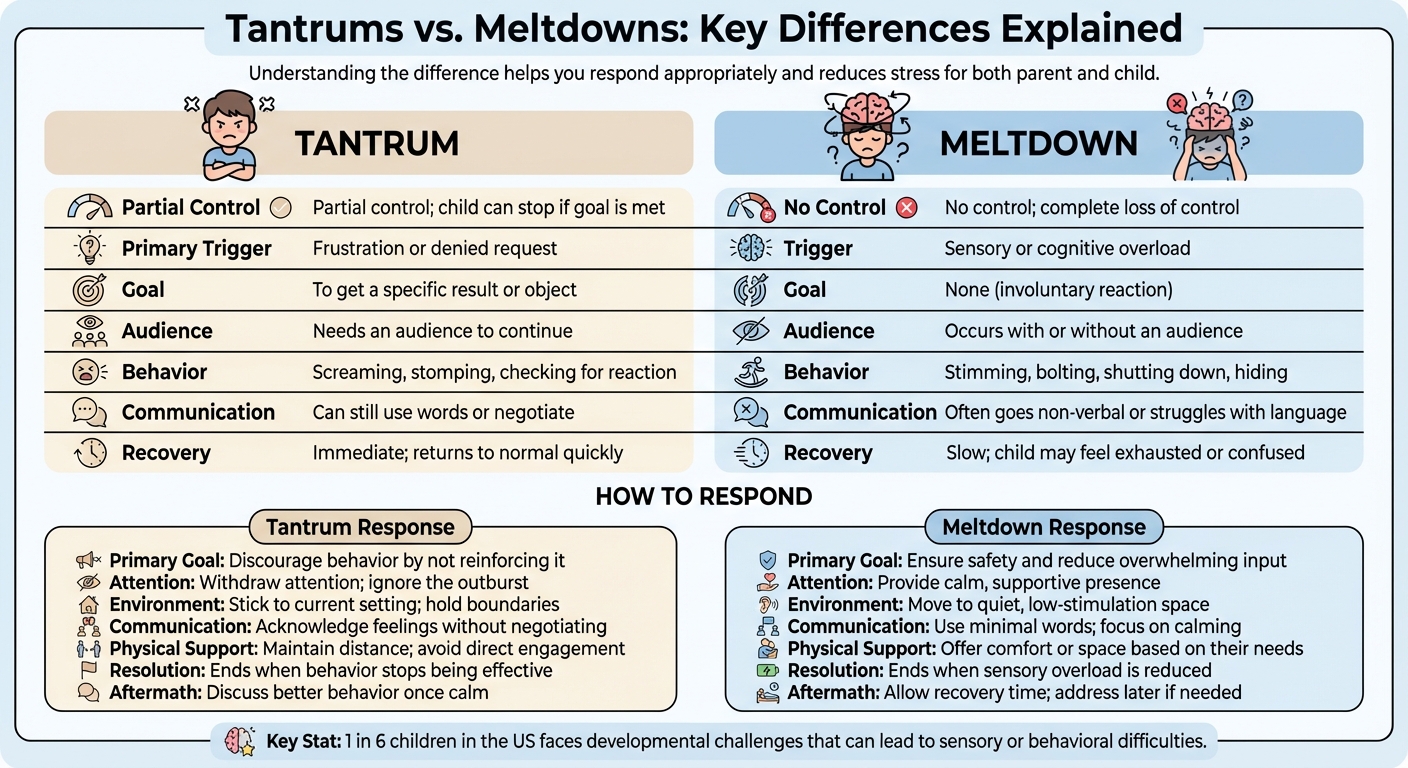
Tantrums vs Meltdowns: Key Differences and Response Strategies
Meltdowns vs Tantrums: Know the Difference and How to Handle Them
Understanding Goal-Driven Tantrums at Growth and Change Counseling
A tantrum is an emotional outburst that kids use as a tool to get what they want – whether it’s a toy, extra screen time, or simply your attention. Amori Mikami, Associate Professor at the University of British Columbia, explains it this way:
"The temper tantrum is a tactic to try and see if that will work to get what he or she wants." [6]
During these moments, children are still in control of their actions and are trying to communicate their needs, even if it’s through dramatic behavior. Tantrums are a normal part of growing up, especially during the "terrible twos." At this stage, toddlers and preschoolers often don’t have the words or self-regulation skills to deal with their big emotions.
How to Recognize a Tantrum
One key sign of a tantrum is how children check for your reaction. They might pause crying to look at you, stop screaming briefly, or ramp up their behavior when they notice you’re paying attention. Typical actions during a tantrum include yelling, crying, stomping, throwing things, or even collapsing to the floor. The Child Mind Institute highlights this important point:
"A tantrum is likely to subside if no one is paying attention to it."
Spotting these behaviors can help you understand how tantrums differ from meltdowns, which are driven by entirely different factors.
What Causes Tantrums
Tantrums often arise from frustration – whether it’s unmet needs, a craving for attention, or trying to avoid something unpleasant. Steven Dickstein, MD, a Child and Adolescent Psychiatrist, puts it into perspective:
"Anger, of course, is the No. 1 emotion that causes children to lose their heads and blow up – think of it as the kid version of road rage." [3]
Children who frequently throw tantrums may be struggling with skills like impulse control, problem-solving, or patience. They may also resort to tantrums because they’ve learned they work – if a tantrum has gotten them what they wanted in the past, they’re likely to try it again. [7] Understanding these causes is key to grasping why tantrums are not the same as meltdowns, which we’ll cover next.
What Are Meltdowns?
Meltdowns are not deliberate actions but rather a neurological response to overwhelming stimuli. Unlike tantrums, which are purposeful behaviors aimed at achieving a specific goal, a meltdown is an involuntary reaction. Dr. Tony Ebel, DC, CPPFC, CCWP, clarifies this distinction:
"If a tantrum is a behavioral choice to act out, a meltdown is a neurological event marked by complete loss of control." [8]
During a meltdown, the brain’s ability to regulate emotions and behavior shuts down, leading to an uncontrollable reaction. This isn’t about defiance or manipulation – it’s a neurological overload where the brain essentially "short-circuits" due to overstimulation.
How to Recognize a Meltdown
One way to differentiate a meltdown from a tantrum is that meltdowns happen regardless of whether someone is watching. While tantrums are often attention-seeking, meltdowns can occur even when a child is alone. They often involve physical outbursts such as screaming, kicking, or even complete withdrawal into silence.
Meltdowns usually start with a "rumble stage", which includes early warning signs. These might look like increased stimming behaviors (e.g., rocking or hand-flapping), covering ears or eyes, physical tension, flushed cheeks, rapid breathing, or verbal protests. Spotting these early signals is important because they offer a window of opportunity to intervene before the meltdown fully develops. Recognizing these signs also helps in identifying the triggers that contribute to such episodes.
What Triggers Meltdowns
Once the signs of a meltdown are identified, the next step is understanding what causes them. Meltdowns are usually triggered by sensory or emotional overload, not by a desire to achieve a specific outcome. External triggers can include loud noises, bright or flickering lights, crowded environments, strong smells, or uncomfortable textures like scratchy clothing. Internal factors – such as hunger, fatigue, or accumulated stress – can also play a role.
Research involving 32 autistic adults sheds light on the internal experience of a meltdown. Participants described it as a loss of cognitive clarity, an overwhelming sense of fear or anger, and a feeling of being "flooded" with uncontrollable emotions. In the United States, about 1 in 6 children faces developmental challenges that can lead to sensory or behavioral difficulties, making meltdowns more common than many realize. These episodes can last 20 minutes or more as the body works to recover from the intense surge of stress hormones [8].
sbb-itb-596b85d
Main Differences Between Tantrums and Meltdowns
Tantrums and meltdowns may look similar on the surface, but they are fundamentally different in both cause and behavior. Tantrums involve some level of control – children can often stop if they achieve their goal. On the other hand, meltdowns represent a total, involuntary loss of control triggered by sensory or emotional overload.
Another key distinction? Tantrums thrive on an audience. Children often gauge reactions and may stop if ignored. Meltdowns, however, are internal events that occur regardless of whether anyone is paying attention.
Tantrums are goal-driven, usually aimed at achieving something specific. Meltdowns, in contrast, are not about achieving a result – they’re a reaction to overwhelming stimuli or emotions.
Side-by-Side Comparison Table
| Feature | Tantrum | Meltdown |
|---|---|---|
| Level of Control | Partial; child can stop if goal is met | None; complete loss of control |
| Primary Trigger | Frustration or denied request | Sensory or cognitive overload |
| Goal | To get a specific result or object | None (involuntary reaction) |
| Audience | Needs an audience to continue | Occurs with or without an audience |
| Behavior | Screaming, stomping, checking for reaction | Stimming, bolting, shutting down, hiding |
| Communication | Can still use words or negotiate | Often goes non-verbal or struggles with language |
| Recovery | Immediate; returns to normal quickly | Slow; child may feel exhausted or confused |
This breakdown highlights why it’s so important to distinguish between the two. Each requires a different approach.
Why Understanding These Differences Helps
Knowing whether your child is having a tantrum or a meltdown can make all the difference in how you respond. For example, treating a meltdown like a tantrum – by using discipline or ignoring it – can worsen the situation and increase your child’s distress. On the flip side, misinterpreting a tantrum as a meltdown could unintentionally reward the behavior by giving attention or meeting their demands.
How to Respond to Tantrums and Meltdowns
When it comes to handling tantrums and meltdowns, the approach you choose can make all the difference. Treating a meltdown like a tantrum – by ignoring it or enforcing consequences – can intensify your child’s distress. On the flip side, giving in to a tantrum teaches your child that outbursts are an effective way to get what they want. This creates what experts call a "vicious cycle" of learned behavior that’s hard to break [3].
"Tantrums and meltdowns are like fevers – they can be triggered by so many different problems that we can’t make them stop until we understand what’s triggering them."
- Steven Dickstein, MD [3]
How to Handle Tantrums
Tantrums often thrive on attention and negotiation, so the goal is to avoid reinforcing the behavior while teaching better ways to express needs. Start by acknowledging your child’s feelings without giving in. For example, you might say, "I know you want that toy, but we’re not buying it today" [4]. This validates their emotions while maintaining the boundary.
Using "planned ignoring" can be highly effective. Since tantrums usually need an audience to persist, withdrawing your attention can help the behavior fade naturally [3]. Stay calm, avoid engaging with the outburst, and once your child has calmed down, praise them specifically when they communicate their needs in a better way. Over time, this helps build healthier habits [4].
When the tantrum is over, discuss what happened and explore better options for the future. Be clear about expectations and consequences, and remain consistent. If a tantrum works even occasionally, the cycle will continue. Meltdowns, however, require a completely different approach focused on support and reducing sensory overload.
How to Handle Meltdowns
Meltdowns aren’t about discipline – they’re a sign that your child’s nervous system is overwhelmed, triggering a fight-or-flight response. In these moments, they’ve lost control, and your priority should be to ensure their safety and reduce the sensory input that’s overwhelming them [4].
Start by minimizing stimulation: dim the lights, turn off loud noises, or move your child to a quieter space [4]. A calm, safe area – like a quiet room or a designated corner at home – can help them retreat from the chaos. Keep verbal communication brief, as their ability to process information may be limited during a meltdown.
Offer empathy and support rather than consequences. Recognize that meltdowns are beyond their control and can leave them feeling embarrassed or upset [4]. Some children may want physical comfort, like a hug, while others may need space – pay attention to what they seem to need in the moment. After the meltdown, allow your child time to recover. They may feel physically drained or even need to sleep [4]. Avoid discussing the incident until they’ve fully regained their composure.
Response Strategies Comparison Table
Here’s a side-by-side comparison of how to approach tantrums versus meltdowns:
| Strategy | Tantrum Response | Meltdown Response |
|---|---|---|
| Primary Goal | Discourage the behavior by not reinforcing it | Ensure safety and reduce overwhelming input |
| Attention | Withdraw attention; ignore the outburst | Provide a calm, supportive presence |
| Environment | Stick to the current setting; hold boundaries | Move to a quiet, low-stimulation space |
| Communication | Acknowledge feelings without negotiating | Use minimal words; focus on calming |
| Physical Support | Maintain distance; avoid direct engagement | Offer comfort or space based on their needs |
| Resolution | Ends when the behavior stops being effective | Ends when sensory overload is reduced |
| Aftermath | Discuss better behavior once calm | Allow recovery time; address later if needed |
Conclusion
Main Points to Remember
Knowing whether your child is experiencing a tantrum or a meltdown can completely change how you handle the situation. Tantrums are goal-oriented behaviors – your child wants something and uses the outburst as a way to achieve that goal. They still have some control over their actions and may even glance at you to gauge your reaction. The best approach here is to set firm boundaries, practice planned ignoring, and avoid reinforcing the behavior [4][5].
Meltdowns, on the other hand, are a different story. These are involuntary responses where your child’s nervous system goes into fight-or-flight mode. They lose control entirely, and discipline won’t work because their body needs time to process the adrenaline surge. Your role is to minimize sensory input, create a safe environment, and offer calm, empathetic support while they ride out the wave [2].
The recovery process also varies. After a tantrum, kids usually bounce back quickly once the conflict ends. Meltdowns, however, leave them drained – both physically and emotionally. Recovery might take a while, and sometimes they may even need to sleep to fully reset [1][2]. Recognizing these differences not only helps you respond appropriately but also strengthens your relationship with your child by reducing unnecessary frustration.
Getting Professional Help
If your child’s outbursts are frequent, dangerous, or continue past the preschool years, it may be time to consult a professional [2][3]. Studies show that over 75% of children with severe temper outbursts meet the clinical criteria for ADHD. Frequent meltdowns can also be linked to conditions like autism, anxiety, sensory processing issues, or undiagnosed learning challenges [3].
Growth and Change Counseling (https://johnmarkkane.com) provides parent coaching and specialized support for neurodiverse families across California. Their services can help you pinpoint triggers, craft effective strategies, and address any underlying challenges your child may face. With professional guidance, you can break the cycle of escalating conflicts and build a more supportive, understanding relationship with your child.
FAQs
What should I do if I’m not sure whether it’s a tantrum or a meltdown?
To figure out whether it’s a tantrum or a meltdown, pay attention to the cause and how much control your child seems to have. Tantrums usually happen when a child is frustrated or trying to get something they want. These are intentional actions – like yelling or crying – meant to influence a situation or get a specific response. Meltdowns, on the other hand, are a reaction to sensory overload or overwhelming emotions. They’re not something the child can control and typically only end when the child naturally calms down or the situation around them changes.
How can I prevent meltdowns by spotting early warning signs?
To help avoid meltdowns, keep an eye out for signs that your child might be feeling overwhelmed. These could include behaviors like agitation, pulling away from others, or covering their ears or eyes. Common triggers often include things like sensory overload, frustration, or unexpected changes in their routine. You can reduce these triggers by minimizing loud noises or bright lights and providing a calm space or sensory tools to help them manage their emotions. Paying attention to their signals early and responding promptly can make a noticeable difference.
When should I seek professional help for frequent outbursts?
If frequent outbursts are intense, persistent, or difficult to handle – especially when tied to sensory overload or emotional overwhelm – it’s crucial to seek professional help. This becomes even more important if you feel unequipped to provide the necessary support on your own. A professional can help identify underlying issues and create strategies to better manage these behaviors.
Related Blog Posts
- How Couples Manage Anger During Parenting Conflicts
- Parenting with ADHD: Sensory Overload Solutions
- Understanding Digital Burnout in Neurodiverse Kids
- ADHD Parenting: Emotional Regulation Strategies
