When kids struggle to express emotions, it often leads to frustration – for them and for you. Expanding your child’s emotional vocabulary can help them manage feelings better and reduce behavioral challenges. This is especially important for neurodiverse children who may find it harder to articulate what they’re feeling.
Here are 7 tools that can help your child understand and express emotions more clearly:
- Emotion Cards: Visual cards with facial expressions and words make it easier for kids to identify and communicate feelings.
- Feelings Wheel: A visual chart that organizes emotions into categories, helping kids pinpoint specific feelings like "frustrated" instead of just "angry."
- Proloquo2Go App: A communication app with symbols and customizable features for kids who struggle with verbal expression.
- Ladder Pictures: Scales that show the intensity of emotions, helping kids recognize and manage escalating feelings.
- Body Maps: Diagrams that link emotions to physical sensations, teaching kids how feelings manifest in their bodies.
- Luvbug App: A gamified learning app with activities that teach emotional concepts through interactive play.
- TouchChat App: A communication tool with symbols and custom features for building emotional vocabulary.
These tools work in different ways – some focus on visuals, others on interactive apps – but all aim to make emotions more understandable and manageable for kids. Whether through simple daily check-ins or structured activities, these resources can fit into your routine and help your child gain confidence in expressing how they feel.
Episode 206: Practical Tools for Building an Emotional Vocabulary
1. Emotion Cards
Emotion cards use pictures of facial expressions to connect inner feelings with specific words. They act as a visual tool for kids who may struggle to express emotions verbally. Instead of trying to find the right words when overwhelmed, your child can simply point to a card. At Growth and Change Counseling, emotion cards are often suggested to help children expand their emotional vocabulary.
"Visual aids provide an accessible way to bridge this gap, promoting both emotional awareness and language development."
– Hennah Bagalan, Writer and Researcher, Goally [2]
The brain processes images and emotions in the same area, making pictures easier to understand during moments of distress than spoken words [9]. Some decks feature up to 52 different feeling words with synonyms, helping kids go beyond basics like "happy", "sad", or "mad" [8]. You can even find themed cards tailored to your child’s interests, which can make the experience more engaging [15, 17]. This straightforward approach makes it easy to include emotion cards in everyday life.
Ease of Integration into Daily Routines
Adding emotion cards to your daily routine doesn’t have to feel like extra work. For example, you can start a daily check-in by asking your child to pick a card that matches how they’re feeling. Keep a laminated set in a "calm down corner" so your child can use them when they’re too upset to talk. Another idea is to create an emotions board with Velcro strips, allowing your child to complete the sentence: "I am feeling… because…" These methods are especially helpful for neurodiverse children, supporting both communication and emotional understanding.
Besides fitting easily into everyday life, emotion cards are a great way to help kids build a stronger emotional vocabulary.
Effectiveness in Building Emotional Vocabulary
As Printable Parents explains:
"Naming it makes emotions feel more normal. Children can understand – ‘Oh, what I’m experiencing is actually a thing with a name. I can name it like a cat or a truck or a banana.’"
– Printable Parents [9]
For children on the autism spectrum, who may have difficulty interpreting social cues, emotion cards can be paired with question cards to encourage reflection on how their actions influence others’ feelings. Another fun activity is a game where someone covers their mouth, and your child guesses emotions by focusing only on the eyes and eyebrows. This helps them learn to recognize emotions in a new way.
Using Emotion Cards for Your Child at Growth and Change Counseling
The Feelings Wheel organizes emotions into layers, starting with core feelings like "sad", "mad", or "joyful" at the center and expanding outward into more specific terms. For example, a child might realize they’re feeling "resentful" or "frustrated" instead of just "angry" [11][12]. This design helps kids explore their emotions more deeply and serves as a foundation for engaging, visually-based tools.
Visual Appeal and Engagement
Many versions of the Feelings Wheel use Zones of Regulation color-coding: Blue for low energy, Green for calm, Yellow for heightened energy, and Red for intense energy [13]. This system connects emotions with physical energy levels. Adding emojis and descriptive words makes it easier for non-verbal children to express themselves by pointing to visual cues [11][16]. The concept is rooted in Robert Plutchik‘s 1980 model, which identified eight primary emotions – joy, sadness, anger, fear, trust, disgust, surprise, and anticipation. These form the basis for most modern wheels [13].
Suitability for Neurodiverse Children
Barbara (Blaze) Lazarony, LMFT, explains the value of visual tools like the Feelings Wheel:
"Visual aids, such as the Feelings Wheel, support the processing of emotions, particularly for neurodivergent individuals, by making abstract feelings more concrete and accessible." – Barbara (Blaze) Lazarony, LMFT [17]
The wheel is especially helpful for children with alexithymia, a difficulty in identifying emotions often associated with autism or ADHD [17]. It also aids children who struggle with interoception, helping them connect physical sensations like a tight chest or butterflies in the stomach to specific emotions [13][15]. While most people rely on just a few basic emotional labels, research shows that humans can actually distinguish up to 27 different emotions [15].
Ease of Integration into Daily Routines
The Feelings Wheel fits easily into everyday life. For example, you can use it during check-ins at the start or end of the day, asking your child to identify how they’re feeling [15][6]. Introduce the tool during calm moments for the best results [11][13]. Parents can model its use by labeling their own emotions, showing kids that all feelings are okay [14][16]. Another strategy is linking emotions to physical sensations. You might ask, "When you’re angry, do your hands feel tight?" and then guide them to the wheel [13][16]. These practices make emotional communication more natural, especially for neurodiverse children.
Effectiveness in Building Emotional Vocabulary
Helping kids name their emotions activates the prefrontal cortex, which supports reflection and self-regulation, while reducing activity in the amygdala, the brain’s emotional center [17]. As Understood.org explains:
"When kids don’t have the words, they might show their feelings through behavior. That can be a frustrating experience for everyone." – Understood.org [11]
Research shows that a richer emotional vocabulary helps children manage their feelings better, often leading to fewer behavioral challenges [1]. Encourage your child to practice using sentence starters like "Right now, I feel [emotion] because [reason]" to develop emotional storytelling skills [17]. Regular use of tools like the Feelings Wheel can significantly improve emotional regulation over time.
3. Proloquo2Go App
Proloquo2Go is an Augmentative and Alternative Communication (AAC) app designed for children who face communication challenges. It uses the Crescendo™ Vocabulary system, which is rooted in research and includes 200–400 core words (making up 80% of daily speech) along with over 10,000 additional words for more specific needs [18][19].
Visual Appeal and Engagement
This app boasts a library of 25,000 symbols and even allows users to upload personal photos to better express emotions [18][19]. It also features over 100 natural voices, which can make the experience more engaging for children. With 23 pre-set grid sizes, the interface can be adjusted to suit a child’s fine-motor and visual requirements while maintaining consistent button placement. Research highlights how this consistency is especially beneficial for children with autism or motor challenges [18][19]. These thoughtful design elements cater to a variety of neurodevelopmental needs.
Suitability for Neurodiverse Children
Proloquo2Go’s customizable features make it a strong tool for building emotional vocabulary. Speech therapist Mr. Anthony highlights the app’s adaptability:
"Proloquo2go offers a real-time adaptable interface to meet immediate needs." [19]
The Progressive Language feature is particularly helpful, as it gradually introduces new words to avoid overwhelming children who may struggle with too many options [18][19]. The app is widely used by children with conditions such as autism, Down syndrome, cerebral palsy, and Angelman syndrome. Its popularity is reflected in its 4.8-star rating on the Apple App Store, based on nearly 12,000 reviews [19].
Ease of Integration into Daily Routines
Proloquo2Go is designed to fit seamlessly into everyday life. It works on iPhone, iPad, and Apple Watch, making it accessible for families on the go [19]. Parents are encouraged to model communication by using the app themselves, showing children how to select and use emotion words in real-world situations [18]. Features like customizable grid sizes, consistent button placement, and bilingual support (covering English, Spanish, French, and Dutch) make it versatile for different language and motor needs [18][19]. For children with fine-motor challenges, the option to use paging buttons instead of swiping can make navigation easier [18][19].
Effectiveness in Building Emotional Vocabulary
Studies report a 40% improvement in communication skills among neurodiverse children who use apps like Proloquo2Go [20]. One parent shared their experience:
"It has helped my son a lot he doesn’t get frustrated no more when you cannot understand what he says or to others."
– Suziecue2, Parent of a child with Down Syndrome [19]
The app is priced at $249.99 for iOS and $124.99 for Mac, with a 50% discount available for educational institutions purchasing 20 or more licenses [18][19]. While the cost may seem high, many families consider it a valuable investment for reducing frustration and fostering better communication skills.
4. Ladder Pictures
Ladder Pictures, sometimes called emotion thermometers or intensity scales, are a creative tool for visualizing emotional intensity. These vertical charts illustrate how feelings range from mild to extreme, offering a clear progression. For instance, instead of simply labeling a child as "mad", a Ladder Picture might show the journey from mild annoyance to full-blown rage. This kind of visual aid makes abstract emotions easier to grasp, much like the metaphor of emotions as passing clouds described by Thich Nhat Hanh [21].
Visual Appeal and Engagement
Ladder Pictures use simple yet engaging illustrations to break down complex emotions. Each step on the ladder pairs a descriptive emotion word with a matching facial expression or scenario, creating a clear link between the feeling and its visual representation. Research shows that the human brain processes visuals about 60,000 times faster than text, and visual aids can enhance learning by up to 400% when compared to text-based methods [22]. For children, particularly younger ones, this means emotional concepts become easier to understand and less intimidating.
Suitability for Neurodiverse Children
These tools are especially helpful for neurodiverse children, such as those on the autism spectrum or nonverbal learners. Visual aids like Ladder Pictures provide an accessible way to express emotions, promoting both emotional understanding and language development. The ladder format also highlights how small feelings can grow if left unaddressed, giving children a practical strategy for recognizing and managing their emotions early on.
Ease of Integration into Daily Routines
Parents can easily weave Ladder Pictures into everyday life. For example, during daily check-ins, a child can point to the rung that best matches their current mood. In stressful moments, the ladder becomes a hands-on guide – parents can describe cues like a raised voice or clenched fists and encourage the child to identify their feelings. Hanging the ladder in a calm-down space further reinforces its use, making it a go-to resource for emotional regulation.
Effectiveness in Building Emotional Vocabulary
Mary Sheedy Kurcinka, Ed.D., highlights the importance of tools like Ladder Pictures in helping children articulate their emotions, noting:
"The frequency of fights, meltdowns, and power struggles drops drastically when a child can articulate what he is feeling and needing" [3].
Expanding a child’s emotional vocabulary not only reduces behavioral challenges but also helps them better understand what triggers their emotions, paving the way for personal growth.
sbb-itb-596b85d
5. Body Maps
Body maps are visual tools that link emotions to physical sensations in the body. They are based on interoception – our ability to sense internal body signals, like a racing heart or a knot in the stomach [24]. For neurodiverse children, who might find it challenging to connect abstract emotional labels to their feelings, body maps offer a more concrete and physical way to understand emotions. Similar to emotion cards and feelings wheels, they help expand emotional vocabulary in a hands-on way.
Visual Appeal and Engagement
Body maps are naturally engaging for children due to their visual and interactive nature. Researchers have identified 13 emotions and mapped them to specific body parts, using warm colors to show increased activity and cool colors to represent decreased activity [24]. Kids can also personalize their maps by adding stickers, drawings, or other creative elements, making the activity both fun and multi-sensory.
A Tool Tailored for Neurodiverse Children
Body maps are particularly helpful for neurodiverse children, such as those with autism or ADHD, who often face difficulties with interoception [36, 24]. For children who have trouble expressing themselves verbally or who experience language delays, body maps provide a non-verbal way to communicate their feelings. For instance, instead of asking a child to name an emotion like "anxiety", parents can guide them to describe physical sensations such as "tight", "warm", or "shaky." Hennah Bagalan, a writer and researcher at Goally, highlights the value of this tool:
"It’s a simple but powerful tool that visually represents emotions in different parts of the body" [24].
By focusing on physical sensations, body maps create a bridge between emotions and their physical manifestations, making it easier for children to understand and express their feelings.
Easy to Use in Everyday Life
Body maps can seamlessly fit into daily routines, from morning check-ins to bedtime conversations. Parents might start with simple prompts like, "What do you feel in your chest? Your stomach? Your head?" Modeling is also key – parents can share their own experiences, saying something like, "My shoulders feel tense because I’m worried about work." This not only normalizes the process but also helps children see how emotions can show up in different ways. For example, sadness might feel like a heavy chest one day and an upset stomach the next [25]. Using open-ended, "wondering" language – like "I wonder if your tummy feels like it has butterflies?" – encourages children to reflect on their sensations [3].
This approach reinforces emotional awareness by connecting physical sensations to feelings, helping children tune into their bodies during everyday moments.
Building Emotional Vocabulary and Self-Regulation
Research indicates that when children learn to recognize their body’s signals and associate them with emotions, they become better at managing their feelings [24]. By identifying subtle emotions – like mild frustration – before they escalate, body maps lay the groundwork for emotional regulation [4, 37]. Emily Devlin, MSW, LICSW at Mightier, explains:
"Helping kids make the connection between their emotions and their bodies can be difficult. It is important for kids to be able to understand their physiological cues and understand their bodies’ responses to triggers…" [23].
This kind of awareness allows children to spot emotional changes early, giving them time to use coping strategies before situations spiral out of control. Body maps, along with other tools, empower kids to articulate their emotions and take charge of their emotional well-being.
6. Luvbug App
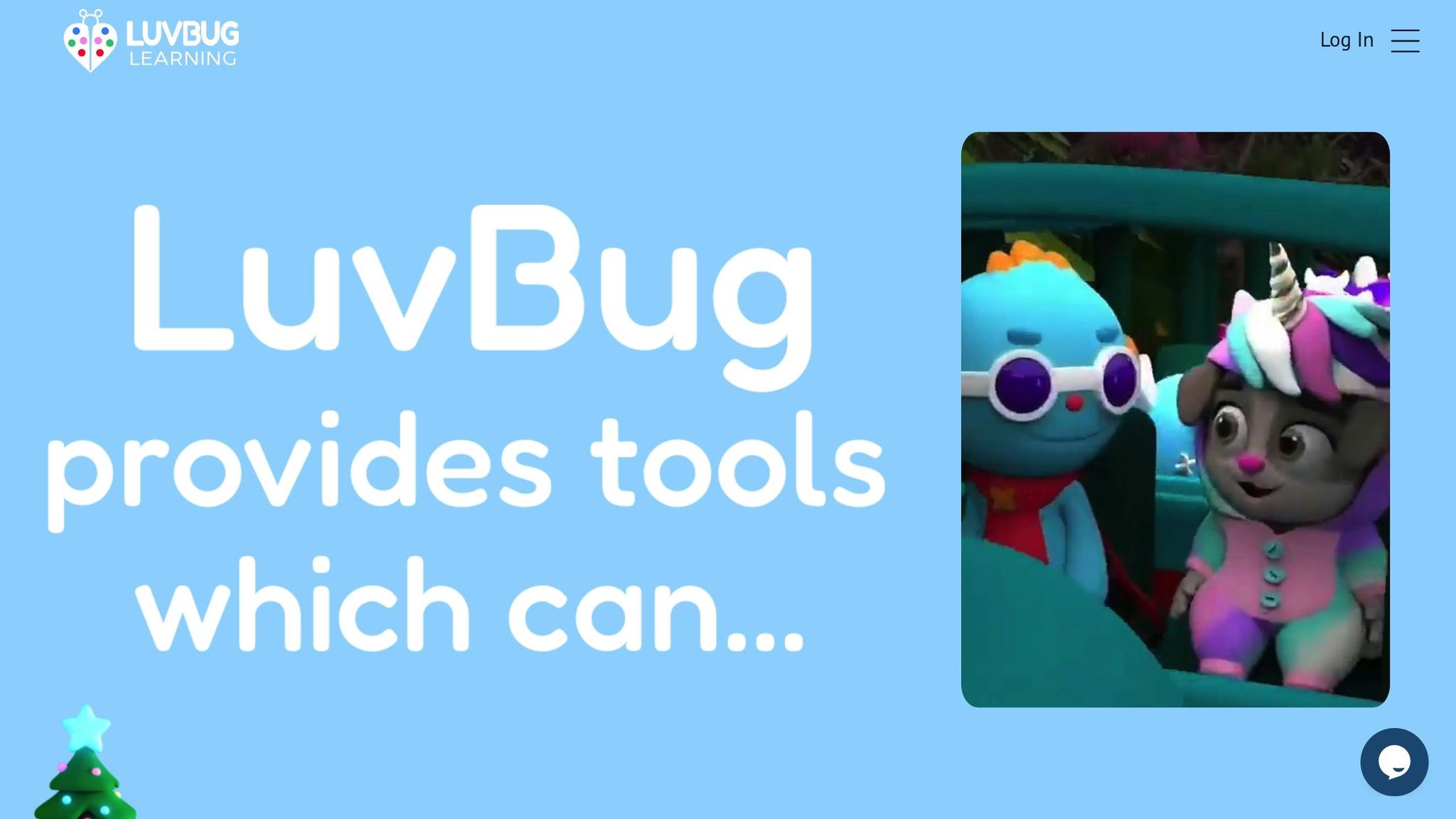
The Luvbug App blends gaming with emotional learning, creating a vibrant and immersive experience for kids. Through 3D villages and colorful worlds, children engage with a 25-level Learning Path guided by Violet, a digital chaperone. This path includes over 1,000 science-backed activities, games, and videos, all aimed at expanding emotional understanding [26][28].
Visual Appeal and Engagement
The app’s eye-catching graphics and lively colors pull young learners into its world. To keep kids actively involved, gameplay pauses every 45 to 75 seconds for "Learning Questions", ensuring they interact with the content rather than just passively watch [28][31]. Angela L., a teacher and mom, shares:
"The games are stunning with relevant content. Having my girls learn while playing is ideal for a full-time teacher and mom" [28].
Beyond its visual appeal, the app includes features designed with neurodiverse children in mind.
Support for Neurodiverse Learners
Created with insights from child psychiatrists, educational psychologists, and behavior technicians, Luvbug is tailored to meet the needs of children with social and learning differences [29]. The app ensures accessibility by offering content that is both written and read aloud, making it suitable for non-readers, children with hearing challenges, and those with dyslexia [26][27]. Parents can adjust difficulty levels across nine age-based stages through a dashboard, while the spiral curriculum helps kids build on previous lessons. This progression moves beyond basic emotions like happiness and anger to more complex feelings such as frustration, envy, and even animosity [26][30].
Easy Integration into Daily Life
The app’s parent dashboard makes it simple to integrate into family routines. Parents can set daily screen time limits and use "bedtime settings" to disable the app during specific hours [32][34]. Notifications about achievements allow parents to discuss new emotional concepts with their kids [26][27]. Susan M., a parent, notes:
"LuvBug has become a part of the bedtime ritual" [28].
The dashboard also tracks the emotional concepts being learned, helping parents weave these terms into everyday conversations. Subscription options include $9.99 per month, $95.99 annually (with promotional rates as low as $59.99), or a lifetime membership for $149.00 [26].
Expanding Emotional Vocabulary
Luvbug addresses a common challenge: many children can only identify three basic emotions – happy, sad, and angry [30]. By embedding emotional learning into a gaming environment, the app helps bridge this gap. Page M., a father of four, explains:
"LuvBug embeds learning into gaming! … They become emotionally connected to the games, and the learning exists within the social currency of the games" [28].
The platform is ad-free, with no external social media links or unapproved in-app purchases, creating a safe space for independent learning. Special education teachers have also highlighted its usefulness in teaching life and social skills to children with diverse needs [33].
7. TouchChat App
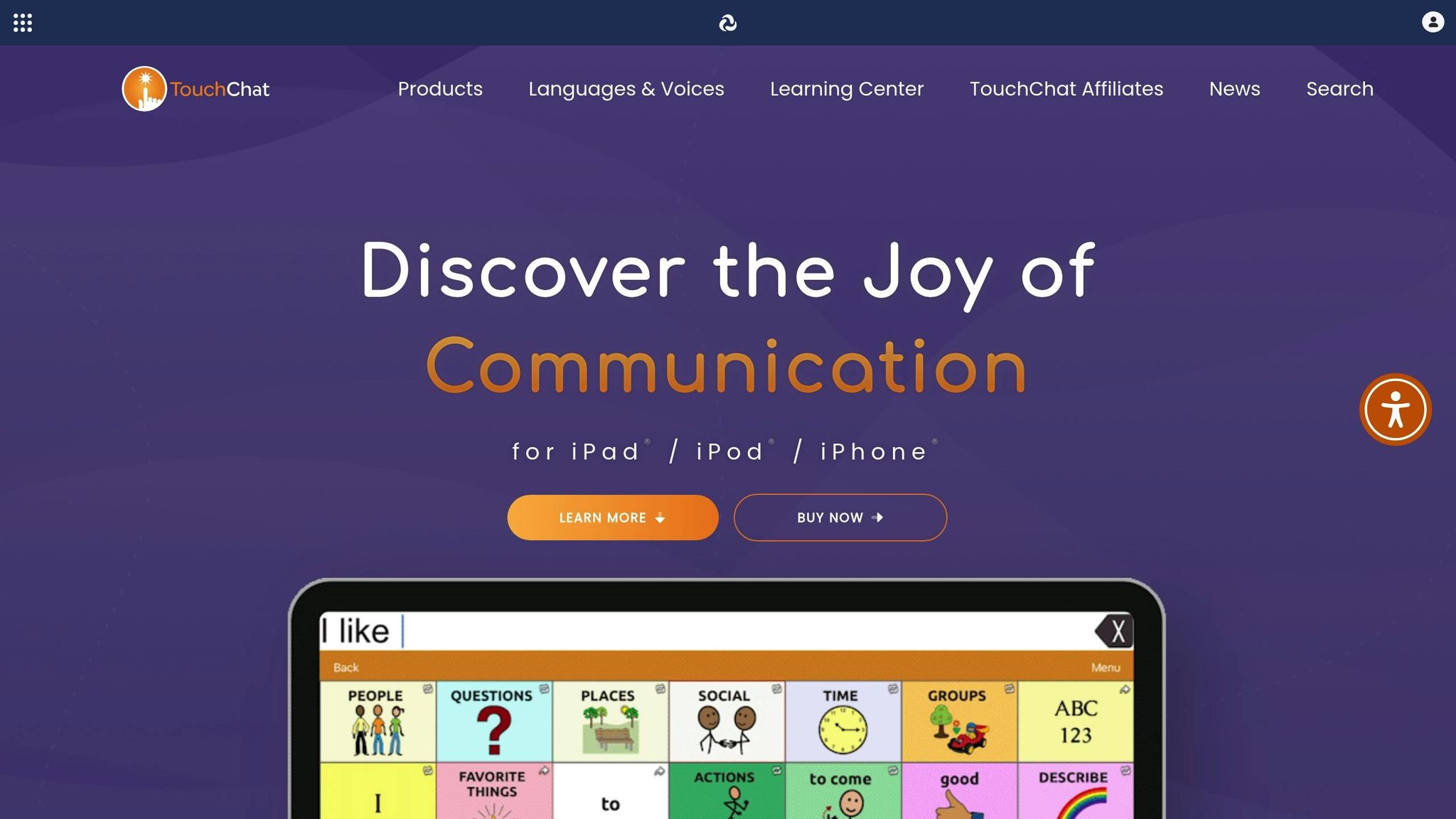
TouchChat transforms standard iPads and iPhones into powerful communication tools, offering nearly 40,000 SymbolStix® symbols to help children connect images with complex emotions [36]. Parents can also use the built-in camera to capture personalized photos – such as a child’s facial expressions or family members – to create custom emotion buttons. These features make it easier for neurodiverse children to visually link images to their feelings.
Suitability for Neurodiverse Children
The app is designed with neurodiverse needs in mind, offering features like head tracking, switch scanning, and adjustable touch timing to assist children with motor challenges [35]. Its WordPower™ series and tailored page sets, such as "Communication Journey: Aphasia", support a gradual learning process, moving from basic core words to more specific emotional vocabulary.
Ease of Integration into Daily Routines
TouchChat supports iOS Split View, allowing children to use the app alongside other applications. This makes it simple to comment on photos or ask questions about homework without switching screens [35]. Sharing is also seamless, with options to send messages via iMessage, email, or social media. Automatic cloud backups to iCloud, Google Drive, or Dropbox ensure that data is always safe. Additionally, the built-in Word Finder tool helps parents quickly locate specific emotion words during everyday conversations.
Effectiveness in Building Emotional Vocabulary
The app’s features are designed to enhance emotional vocabulary in meaningful ways. A February 2026 update introduced AI Image Generation, enabling parents to create custom symbols for abstract emotions not included in the standard library [36]. Another key resource is the Talk-About-AAC curriculum, available as a $59.99 in-app purchase, which focuses on developing expressive language skills using essential core vocabulary.
TouchChat is priced between $299.99 and $399.99, depending on the bundle, with additional vocabulary packages available for purchase. While the cost is on the higher side, its advanced features make it a valuable tool for teaching complex emotional vocabulary. The app has a 3.9/5 star rating on the Apple App Store. Users praise its well-organized vocabulary and versatility, though some mention the price and occasional freezing as drawbacks.
Tool Comparison Table
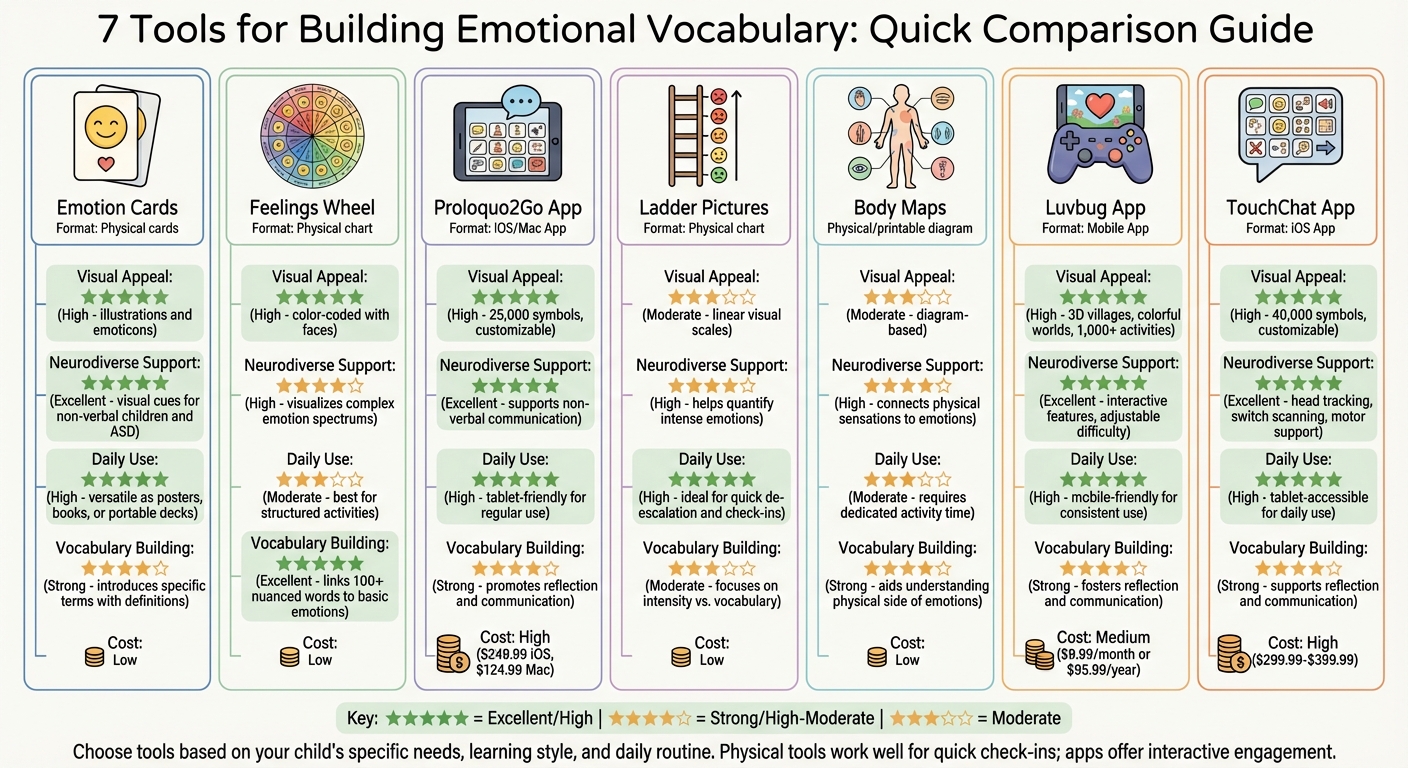
Comparison of 7 Emotional Vocabulary Tools for Neurodiverse Children
Selecting the right tool depends on your child’s specific needs. Factors like visual design, support for neurodiverse children, ease of use, and vocabulary-building potential all play a role in making the best choice.
Here’s a quick comparison of several tools, highlighting their key features:
| Tool | Visual Appeal | Suitability for Neurodiverse Children | Ease of Daily Use | Effectiveness in Building Vocabulary |
|---|---|---|---|---|
| Emotion Cards | High (illustrations and emoticons) | Excellent; provides visual cues for non-verbal children and those with ASD [7] | High; versatile as posters, books, or portable decks [7] | Strong; introduces specific terms with child-friendly definitions [7][1] |
| Feelings Wheel | High (color-coded with faces) | High; visualizes complex emotion spectrums [5][6] | Moderate; works best for structured activities [6] | Excellent; links 100+ nuanced words to basic emotions [1] |
| Proloquo2Go App | High | Excellent; supports non-verbal communication with interactive tools [10][5] | High; tablet-friendly for regular use [10] | Strong; promotes reflection and effective communication [5] |
| Ladder Pictures | Moderate (linear visual scales) | High; helps quantify intense emotions like anger [7] | High; ideal for quick de-escalation and check-ins [7] | Moderate; focuses on intensity rather than vocabulary expansion [7] |
| Body Maps | Moderate (diagram-based) | High; connects physical sensations to emotional terms [1] | Moderate; requires dedicated activity time [1] | Strong; aids in understanding the physical side of emotions [1] |
| Luvbug App | High | Excellent; interactive features for non-verbal communication [10][5] | High; mobile-friendly for consistent use [10] | Strong; fosters reflection and communication skills [5] |
| TouchChat App | High | Excellent; interactive features for non-verbal communication [10][5] | High; tablet-accessible for daily use [10] | Strong; supports reflection and effective communication [5] |
Each tool addresses different aspects of emotional learning, making it easier to find one that suits your child’s needs.
For daily routines, Emotion Cards and the Feelings Wheel shine due to their simplicity and lack of tech requirements. They’re perfect for moments like morning check-ins, car rides, or bedtime chats [6][2][4].
For kids who respond well to digital tools, apps like Proloquo2Go, Luvbug, and TouchChat provide interactive, engaging ways to build emotional awareness.
If your child benefits from linking emotions to physical sensations, Body Maps offer a creative way to explore this connection. Meanwhile, Ladder Pictures are great for helping kids measure the intensity of big feelings, like anger or frustration [7][1]. For older children ready to dive into a richer emotional vocabulary, the Feelings Wheel is a fantastic resource, offering a broad range of terms beyond simple labels like "happy" or "sad" [1].
Conclusion
Helping neurodiverse children build an emotional vocabulary gives them the ability to better understand themselves and connect with others. Tools like emotion cards and feelings wheels work as visual aids, bridging communication gaps when words aren’t enough. Interactive apps such as Proloquo2Go, Luvbug, and TouchChat encourage kids to explore and express their emotions in engaging ways. Meanwhile, body maps and ladder pictures help children link feelings to physical sensations and gauge their intensity levels, offering a clearer understanding of their emotional experiences [2]. These strategies not only expand their vocabulary but also prepare them to handle everyday emotional challenges.
Research shows that children with a stronger grasp of emotional language are often better at regulating their emotions, which contributes to a greater sense of well-being. Mary Sheedy Kurcinka Ed.D. and Lynn Jessen M.A. emphasize this point:
"The frequency of fights, meltdowns and power struggles drops drastically when a child can articulate what he is feeling and needing" [3].
To make these strategies part of your routine, integrate them into daily moments – whether it’s during morning check-ins or bedtime chats. Practice during calm periods to build skills gradually, rather than waiting for high-stress situations. Share your own emotions openly to model the behavior, and use playful activities to keep the learning process light and engaging.
If you’re looking for additional guidance, Growth and Change Counseling offers parent coaching and therapy services designed to support emotional development. These services are available in Campbell, San Jose, Los Angeles, and Roseville, CA, as well as through telehealth across California. Whether you’re navigating neurodiverse relationships, family challenges, or specific behaviors, professional support can provide tailored strategies and reassurance.
Take small steps, stay consistent, and watch as your child’s emotional awareness and confidence grow.
FAQs
Which tool should I start with for my child?
Building your child’s emotional vocabulary is a fantastic first step in helping them understand and express their feelings. Start by introducing specific words like frustrated, overwhelmed, or nervous in your daily conversations. By doing this, you give them the tools to identify and talk about their emotions more clearly. Integrating these words into everyday activities not only strengthens their understanding but also lays the groundwork for better emotional awareness and management.
How do I use these tools during a meltdown?
During moments of emotional overwhelm, tools like visual aids and sensory items can play a big role in helping kids manage their feelings. A Feelings Wheel or an emotion thermometer can make it easier for children to identify and express what they’re experiencing. Sensory kits or calming visuals can also create a more soothing atmosphere, easing sensory overload while encouraging emotional understanding. When used consistently, these tools provide a sense of support during challenging times.
How long until I see better emotion words and fewer behaviors?
With regular practice, you might see your child using more words to express emotions and displaying fewer challenging behaviors within weeks or months. The pace of progress often depends on the strategies you implement, like using visual aids, engaging in activities that build emotional vocabulary, and consistently modeling the behavior you want to encourage. Remember, patience and persistence are key since every child develops at their own pace.
Related Blog Posts
- Emotional Intelligence for Neurodiverse Couples
- Top Strategies for Emotional Regulation in Neurodiverse Couples
- How Storytelling Helps Neurodiverse Kids Understand Emotions
- ADHD Parenting: Emotional Regulation Strategies
