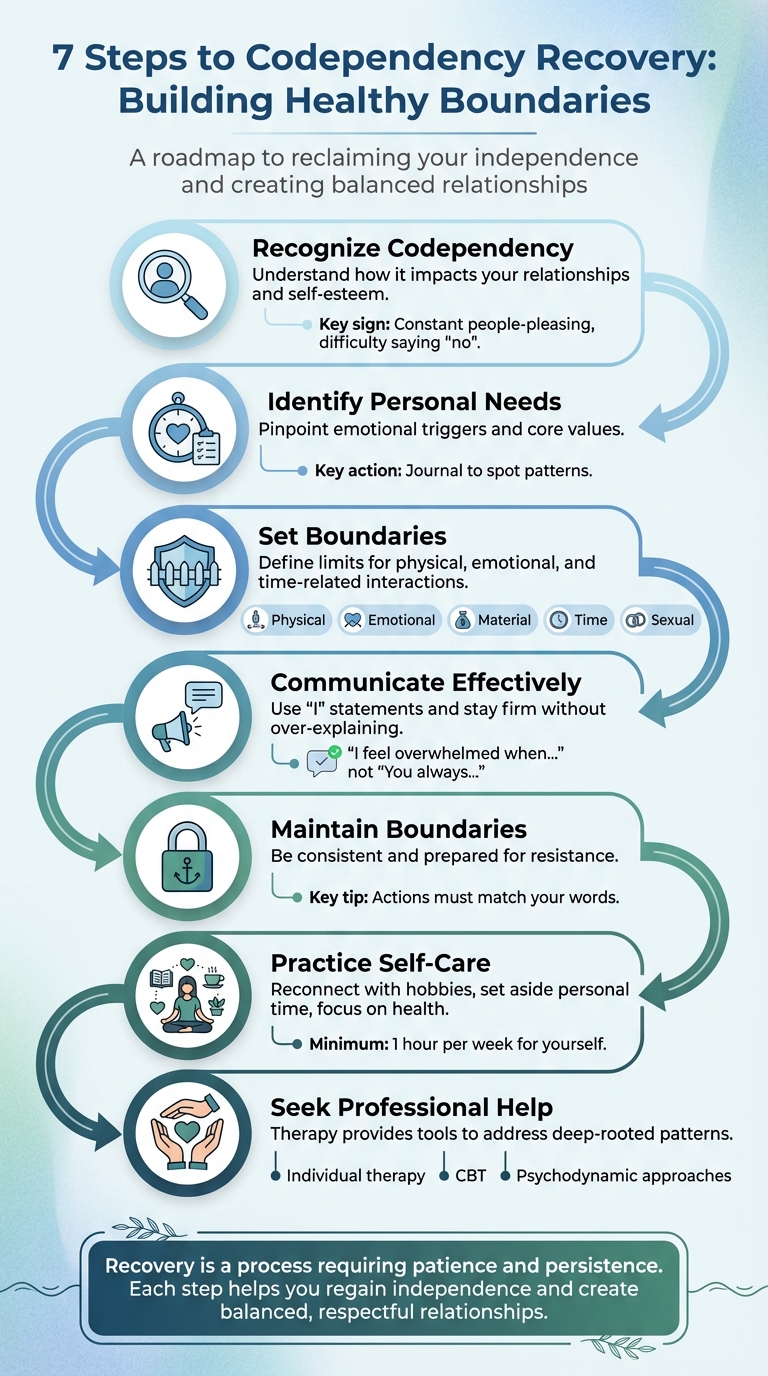
Codependency happens when you prioritize someone else’s needs over your own, often losing your sense of self in the process. This pattern can lead to unhealthy relationships, emotional exhaustion, and chronic anxiety. The solution? Setting healthy boundaries. Here’s a quick breakdown:
- Recognize Codependency: Understand how it impacts your relationships and self-esteem.
- Identify Personal Needs: Pinpoint emotional triggers and core values.
- Set Boundaries: Clearly define limits for physical, emotional, and time-related interactions.
- Communicate Effectively: Use "I" statements and stay firm without over-explaining.
- Maintain Boundaries: Be consistent and prepared for resistance.
- Practice Self-Care: Reconnect with hobbies, set aside personal time, and focus on mental and physical health.
- Seek Professional Help: Therapy can provide tools to address deep-rooted patterns and enforce boundaries.
Recovery is a process, requiring patience and persistence. Each step helps you regain independence and create balanced, respectful relationships.
7 Steps to Recover from Codependency and Build Healthy Boundaries
What Codependency Is and How It Affects You
Defining Codependency
Codependency isn’t just about caring too much – it’s about losing yourself in someone else’s life. It means prioritizing another person’s needs so much that your own fade into the background. Therapist Darlene Lancer puts it this way: "A codependent is a person who can’t function from his or her innate self and instead organizes thinking and behavior around a substance, process, or other person(s)" [9].
This often shows up as constant people-pleasing, struggling to say "no", low self-esteem, and a need to "fix" others. You might find yourself monitoring someone’s moods or taking on responsibilities that aren’t yours [8].
Codependency often has its roots in childhood. Many people who develop these tendencies grew up in homes where dysfunction was the norm – whether that meant emotional suppression, a parent battling addiction, or chronic illness [8]. In these environments, kids learn that their worth comes from taking care of others, not from simply being themselves. Insecure or anxious attachment styles can also contribute, leading to a craving for closeness alongside a fear of abandonment in adult relationships [8].
Interestingly, a 2017 study revealed that 45% of people with codependent traits also met the criteria for Borderline Personality Disorder, while only 14.5% were diagnosed with Dependent Personality Disorder [9].
Recognizing these patterns helps explain how codependency throws relationships out of balance over time.
How Codependency Damages Relationships
Codependency doesn’t just affect you – it reshapes your relationships, often in unhealthy ways. It creates a lopsided dynamic where one person does all the emotional heavy lifting while the other avoids responsibility. This imbalance can slowly drain both partners. As therapist Lori Hollander explains: "When a couple enters therapy and it’s clear that one partner’s needs are being subjugated to the other’s needs, the relationship is codependent … One partner is on the ‘selfish’ side, while the other is on the ‘selfless’ side" [10].
This dynamic leads to resentment, emotional exhaustion, and poor communication. You might feel like you’re always "on call" to solve problems or keep things running smoothly, leaving no time for yourself [1]. Meanwhile, your partner may sidestep accountability – whether it’s avoiding financial responsibilities, brushing off their behavior, or even relying on you to handle serious issues like legal troubles [11].
The emotional cost is steep. Codependency often brings chronic anxiety, depression, shame, and a loss of identity [1]. When you define yourself entirely by someone else’s needs, your own goals, interests, and sense of self vanish. That’s why boundaries are so critical. Think of boundaries as "invisible lines" that protect your values and limits [3]. They’re essential for breaking the cycle of one-sided giving and allowing both people to stand as individuals with their own responsibilities and needs [7].
These patterns highlight how vital it is to set boundaries and reclaim your sense of self to restore balance in your relationships.
7 Boundaries You Need to Feel Safe in Codependency Recovery
How to Identify Your Personal Needs and Limits
Understanding your needs, values, and triggers is essential for setting boundaries that truly work for you. Self-awareness lays the foundation for recognizing what you need and what you can’t tolerate.
Identifying Your Emotional Triggers
Emotional triggers often pull you into old codependent patterns, like feeling overly responsible for someone else’s emotions or rushing to fix their problems[13]. You might even notice physical signs – tightness in your chest, a sense of exhaustion – when someone close to you is upset.
These reactions often stem from hypervigilance, where you’re constantly on edge, scanning for potential conflict[13]. Triggers can include fears of abandonment, the need for approval, or the worry of disappointing others[21, 22]. If you feel drained, anxious, or resentful in a relationship, it’s often a sign that things are out of balance[13][1].
When you notice yourself being triggered, take a moment to pause. Ask yourself: What do I want to do right now? How can I honor my needs in this moment?[6]. This small pause disrupts automatic, knee-jerk reactions and gives you a chance to respond in a way that aligns with your well-being. Reflecting on questions like How do I want to be treated? or What do I value? can also help you better understand your limits[4]. Journaling can be an excellent tool for spotting patterns and identifying situations that require boundaries[6].
Once you’ve pinpointed your triggers, the next step is to define the values that shape your boundaries.
Defining Your Personal Values
Your values act as your internal guide, helping you understand where to draw the line. Boundaries are essentially the invisible markers that protect what matters most to you[3]. For example, if respect or honesty is a core value, any situation that compromises these principles signals the need for a boundary.
Recovery often involves rediscovering personal values that were overshadowed by codependent behaviors[1, 5]. Start by asking yourself questions like: What brings me joy? What are my goals? What qualities do I value in a healthy relationship?[5, 8]. Traits like kindness or reliability can serve as benchmarks for assessing your relationships[6].
A practical way to stay connected to your values is by identifying three daily needs, such as quiet time, rest, or emotional support. This practice helps you tune into your inner voice and recognize when your needs aren’t being met[6]. Pay close attention to feelings of resentment or exhaustion – these emotions often signal that a core value is being compromised and a boundary is needed[1, 5]. As Dr. Sharon Martin, LCSW, explains:
"Knowing and respecting ourselves reflect healthy self-esteem"[4].
How to Set and Communicate Healthy Boundaries
Once you’ve identified your needs and values, the next step is figuring out how to apply that understanding in your daily life. This awareness helps you define your limits and communicate them clearly, ensuring your interactions align with what you’re comfortable with. Setting boundaries is about deciding what’s acceptable to you and making those decisions known.
Setting Clear Boundaries
Good boundaries are both specific and practical. Start by pinpointing areas in your life where limits are necessary. These might include:
- Physical boundaries: This could mean preferring a handshake over a hug.
- Emotional boundaries: Protecting your sense of comfort and emotional well-being.
- Material boundaries: Setting rules around money or personal belongings.
- Time boundaries: Managing your schedule by saying no to activities that drain you.
- Sexual boundaries: Clearly defining consent.
For example, a time boundary might look like declining a party invitation to focus on rest, while a physical boundary could involve asking for personal space in crowded situations.
It’s also important to separate your responsibilities from those of others. You’re not obligated to fix everyone’s problems or be available all the time. By recognizing what’s outside your control, you can avoid taking on unnecessary burdens. Reflect on what behaviors frustrate you and what brings you peace – this will guide where you need boundaries the most.
Start small. Practice setting boundaries in low-pressure situations to build your confidence. For instance, calmly responding to mild criticism or declining a casual invitation can prepare you for larger challenges. Keep in mind that boundaries fall on a spectrum: rigid boundaries might push people away, while overly loose ones can lead to oversharing or burnout. Healthy boundaries strike a middle ground, helping you stay connected to others without losing your sense of self. This balance is key to protecting your well-being.
Once your boundaries are clear, the next step is learning how to communicate them effectively.
Communicating Your Boundaries
When expressing your boundaries, use "I" statements to focus on your feelings and needs. For example, say, "I feel overwhelmed when…" instead of blaming statements like, "You always…" which can put others on the defensive.
Be direct and specific. Instead of saying something vague like, "I need more space", try, "I won’t answer texts after 10 PM because I need to rest." For more serious situations, using an “if/then” approach can help. For example: “I’m not willing to be interrupted while working. If interruptions continue, I’ll need to step away.”
Michelle Farris, LMFT, provides a clear example:
"I’m not willing to let you yell at me. If we can talk without yelling, I’ll keep talking, but if not, I need to leave."
Avoid over-explaining or apologizing for your boundaries. Long explanations can weaken your stance and invite pushback. Instead, stay calm and concise. It’s also helpful to express care while maintaining your limits. For instance, you might say, "I love you and want to work through this, but I’m not okay with being spoken to in that way."
Be prepared for some resistance. People who are used to you not having boundaries may push back or try to make you feel guilty. Stay focused on your needs and consistently enforce your limits. This consistency is essential for ensuring that your boundaries are respected and for maintaining your progress.
How to Maintain Boundaries and Handle Challenges
Once you’ve established and communicated your boundaries, the real challenge begins: maintaining them. Sticking to your limits, especially when faced with resistance, requires firmness and consistency – even when others react negatively or try to make you feel guilty.
Staying Consistent with Your Boundaries
Your actions must align with your words. As Rekha Shrivastava, M.S., CH, CRC, from Cognitive Healing, puts it:
"If your behavior does not match the boundaries you are setting, it will not work. Your behavior must be congruent with your boundaries." [14]
Think about this: if you say you won’t respond to texts after 10 PM but keep doing so, your words lose their weight. Consistency is everything. Each time you enforce a boundary, you reinforce your own confidence and others’ respect for it. To ease into this, start with smaller, low-stakes boundaries and build from there.
Timing also matters. Avoid setting or reinforcing boundaries when emotions are running high. Anger or frustration can lead to long, unproductive arguments or personal attacks that derail your efforts. Instead, wait until you’ve calmed down, then restate your boundary clearly and calmly.
Next, let’s tackle how to deal with resistance from others.
Handling Resistance from Others
Once you stand firm on your boundaries, expect some pushback. Guilt trips, silent treatments, or even outright anger are common reactions when you start asserting limits. When faced with this, avoid falling into the trap of Justifying, Arguing, Defending, or Explaining (often called the JADE method). Keep your response short and neutral. A simple “I’m sorry you feel that way” can help you hold your ground without escalating the situation.
As Joyce McLeod Henley, MSW, LCSW, CEAP, SAP, advises:
"I suggest you only set the boundary when you are ready. The hard part will come when you have to stick to the boundary." [11]
It’s also important to follow through on any consequences you’ve set. For instance, if you say, “If you keep interrupting me, I’ll leave the room,” you need to leave if the behavior continues. Empty threats weaken your stance and make your boundaries seem negotiable. And remember, you’re not responsible for how others react to your boundaries – that’s their responsibility to manage. In fact, enforcing boundaries can sometimes be a wake-up call for others, encouraging them to reflect on their own behavior.
After dealing with resistance, take time to care for yourself. Lean on trusted friends or support systems to recharge and stay grounded.
sbb-itb-596b85d
Building Independence and Practicing Self-Care
Recovering from codependency is about rediscovering your ability to make choices rooted in your own values while still maintaining healthy relationships [15][16]. Many individuals in codependent relationships often experience a "loss of self", where they lose touch with their own desires, interests, and even their identity outside of their roles as a partner, parent, or friend [4][17]. Rebuilding a strong sense of self is essential for maintaining the boundaries you’ve worked hard to establish, ensuring lasting progress.
As Michelle Farris, LMFT, explains:
"Self-care doesn’t mean being selfish it means your needs count too." [23]
Self-care is a vital step in reclaiming your identity and sense of worth [2][24]. Studies show that mindfulness can play a significant role in reducing anxiety and enhancing emotional well-being, which are common challenges during recovery from codependency [12].
Developing Independence Through Personal Interests
One way to rebuild a sense of independence is by reconnecting with activities that once brought you joy [20]. Did you used to love painting, hiking, or diving into a good book? Revisiting these interests – or discovering new ones – can help you establish an identity that isn’t tied to your relationships [19][21].
Meaghan Rice, PsyD, LPC, from Talkspace, suggests expanding your social circle and exploring new passions:
"Put certain time frames on how long you associate with one particular person, create space to include a diversified rotation of people, embark on new passions, hobbies, and interests to distract attention, and seek professional help if the hurdle feels too great." [12]
Set aside at least one hour a week for something that’s just for you – whether it’s learning a new skill, taking a cooking class, or simply enjoying some quiet time alone [24]. These moments of self-focus become milestones in your recovery, reminding you that you are complete on your own [19][21]. Even small daily decisions, like picking what to eat or watch, can gradually build your confidence and sense of self-reliance [22].
These personal pursuits are the foundation for weaving self-care into your everyday life.
Adding Self-Care to Your Daily Routine
As you regain independence, it’s important to establish routines that nurture both your mental and physical health. Self-care during recovery involves redirecting your time and energy toward yourself [2][24]. Start your day with a simple five-minute check-in to acknowledge your feelings and needs [24]. Focus on essentials like getting enough sleep, eating well, and incorporating activities like pilates or nature walks into your week [4][16].
When you feel overwhelmed or tempted to rescue someone, try the TIPP method: splash cold water on your face, engage in intense physical activity, practice paced breathing, or use progressive muscle relaxation to calm your nervous system [24]. Deep breathing and journaling can also help you stay present and recognize when you’re slipping back into people-pleasing habits [15][17].
Spending intentional time alone – whether meditating, journaling, or simply recharging – can give you the space to reflect on your thoughts and values without outside influences [16]. This practice strengthens emotional independence and reduces the need for external validation [16][18]. You might even start a "letting go" journal, where each day you jot down one thing you’re releasing – be it someone else’s decision, an uncontrollable outcome, or a responsibility that isn’t truly yours [6].
These steps can help you build a life that prioritizes your well-being and reinforces your sense of self.
How Professional Support Helps Codependency Recovery
As mentioned earlier, setting boundaries is a cornerstone of overcoming codependency. Professional support plays a key role in helping you understand and implement these limits. While self-care fosters independence, therapy goes deeper, uncovering how early life experiences may have shaped codependent tendencies. Many of these patterns stem from childhood, influencing how you connect with others. Therapists help you identify these roots, offering clarity on why you might depend on others or feel drawn to partners you aim to "fix."
Professional guidance also helps you confront denial and navigate complex emotions. These behaviors may have once shielded you from pain but now act as barriers to personal growth. One clinician puts it this way:
"Many adults discover that codependent patterns were once protective, but eventually become limiting. Healing begins when you can see these patterns clearly and treat yourself with compassion."
This compassionate approach is vital, especially when codependency is accompanied by harsh self-criticism or low self-esteem. Therapy provides a safe environment to address these challenges, helping you shift from a caretaking role to a healthier form of support – one that honors your needs as much as those of others.
The next step is translating these insights into actionable skills for setting boundaries.
How Therapy Helps You Set Boundaries
Therapy bridges the gap between understanding codependency and actively setting boundaries. Therapists use specific techniques to help you establish and maintain healthier limits. They guide you in identifying behaviors like over-functioning or enabling, often linking these patterns back to family dynamics or past experiences. This process sheds light on why setting boundaries can feel uncomfortable or why saying "no" might trigger guilt.
A key part of this journey is communication training. Therapists coach you on expressing your needs, desires, and emotions clearly and respectfully, while also remaining open to others. Role-playing exercises in therapy sessions can help you practice saying "no" or defining your limits in real-world scenarios. Additionally, therapists encourage using "I" statements to reinforce your sense of self and autonomy.
Another essential element is learning to set and enforce consequences when boundaries are crossed. This accountability is especially important when others push back against your new limits. Many therapists use a combination of CBT (Cognitive Behavioral Therapy) and psychodynamic approaches to address both current behaviors and the deeper issues rooted in your past.
Growth and Change Counseling Services

Growth and Change Counseling offers specialized therapy to address codependency and help you develop healthier boundaries. Their skilled therapists focus on uncovering the origins of codependent patterns, whether they stem from childhood trauma, emotional neglect, or difficult family dynamics. Sessions emphasize assertive communication, self-compassion, and building the confidence needed to uphold boundaries in your relationships.
Therapy is available with Licensed Marriage and Family Therapists (LMFTs) for $200 per 45-minute session or with Associate Marriage and Family Therapists (AMFTs) for $150 per 45-minute session. Sliding scale options start at $100. Services are offered in Campbell, San Jose, Los Angeles, and Roseville, CA, as well as through telehealth for clients across California. The practice uses a tailored, solutions-focused approach to address your unique needs, whether you’re also dealing with anxiety, depression, or trauma alongside codependency.
With consistent therapy and practice, many clients notice meaningful changes in their relational patterns within just a few months.
Adjusting Your Boundaries as You Progress
As you move forward, it’s essential to revisit and adapt your boundaries. What feels appropriate during the early stages of recovery might not suit your needs months later. For instance, if you find yourself frequently feeling victimized or angry, it’s a sign to reassess your limits [11]. Similarly, if a relationship consistently drains you instead of uplifting you, it’s time to make adjustments [1]. Pay close attention to your emotional and physical reactions – feelings like suffocation, unease, or intrusion often signal that a boundary has been crossed and needs reinforcement [14].
Take time to regularly evaluate your needs. If you notice old habits creeping back, such as people-pleasing or taking on responsibilities that aren’t yours, it’s a good moment to pause, detach, and reset [6]. As your confidence and self-awareness grow, you’ll likely become more attuned to behaviors or situations you once tolerated, signaling the need for stronger or more assertive boundaries [14].
Below, we’ll explore how to establish initial boundaries and refine them as you progress.
Early Recovery: Setting Your First Boundaries
In the early stages of recovery, firm boundaries are crucial to protect your well-being and halt enabling behaviors. This might include saying no to covering a loved one’s legal or transportation expenses or refusing to shield them from the consequences of their actions [11]. The focus here is learning to say "no" without guilt, creating a protective barrier against exploitation and mistreatment [14]. It’s also about stepping back from over-functioning and recognizing that you can’t save or fix others. As Joyce McLeod Henley, MSW, LCSW, CEAP, SAP, explains:
"The next time you feel like a victim, you may need to check and see if you need to set another boundary" [11].
Once you successfully enforce one boundary, it often becomes easier to set and maintain others.
Long-Term Recovery: Refining Your Boundaries
In long-term recovery, the focus shifts from strict limits to boundaries that allow for connection while still safeguarding your emotional health. This phase is about developing a strong sense of self while remaining engaged with others [5]. Over time, boundaries become more like filters, helping you protect your emotional space without absorbing others’ feelings [5]. The key is finding balance. As Rekha Shrivastava, M.S., CH, CRC, puts it:
"The goal in recovery is to have healthy boundaries, not too rigid and not too loose" [14].
Detachment also plays a significant role in this stage – learning to stay emotionally steady even when others act out [6]. As your boundaries evolve, they strike a balance between intimacy and self-protection, remaining firm on core values while allowing for spontaneity and creativity in relationships [5]. This flexibility helps you maintain your individuality while fostering meaningful connections [14].
Conclusion
Setting healthy boundaries is a key step in breaking free from codependency. These boundaries safeguard your emotional health, help prevent burnout, and allow you to rediscover your sense of self. They also transform relationships, fostering mutual respect and trust instead of one-sided dynamics. Over time, this process boosts your self-esteem as you come to recognize and honor your own worth.
Recovery is a journey, not a quick fix. There will be hurdles, and slipping back into old habits is part of the process. What’s important is staying committed, treating yourself with kindness during setbacks, and understanding that maintaining boundaries takes consistent effort. Each boundary you establish strengthens your confidence and reinforces your path toward lasting change.
Professional support can be invaluable in this journey. A therapist can help you address deeper patterns, teach assertive communication skills, and provide tools to maintain your progress. Therapy offers a space to explore the root causes of codependency and develop practical strategies for setting and upholding boundaries.
As Darlene Lancer, JD, LMFT, wisely states:
"Healthy boundaries are essential in recovery from codependency. They both build and reflect self-esteem." [5]
Every boundary you create lays the groundwork for healthier, more balanced relationships. Be patient and persistent – each step forward brings you closer to the life you deserve.
FAQs
How can I tell if I’m in a codependent relationship?
Identifying a codependent relationship means recognizing certain patterns in how you interact with others. For instance, you might find yourself constantly putting someone else’s needs ahead of your own, struggling to set boundaries, or feeling like you’re responsible for their emotions and actions. These behaviors often come with a fear of abandonment, low self-worth, or a deep need for approval – sometimes tied to unresolved past experiences or trauma.
You might also feel emotionally drained, resentful, or overly focused on caregiving while ignoring your own needs. Often, one person in the relationship takes on the role of caretaker, while the other becomes heavily dependent on that support. Spotting these dynamics is a vital first step toward creating healthier boundaries and building more balanced, supportive relationships.
What are some practical steps to set healthy boundaries during codependency recovery?
Establishing boundaries is a key part of maintaining emotional balance and fostering stronger connections with others. Here are some actionable steps to help you begin:
- Take time to reflect on your needs: Think about what truly matters to you. Pinpointing situations that cause discomfort or stress can guide you in defining your boundaries.
- Express yourself with clarity and respect: Share your limits openly and calmly. Being direct and honest about what you can or cannot accept helps others understand where you stand.
- Learn to say "no" when necessary: It’s perfectly fine to prioritize your mental and emotional health, even if it feels awkward at first.
- Start with simpler situations: Begin by setting boundaries in less complicated scenarios. As you grow more confident, you can tackle more challenging dynamics.
Setting boundaries is a gradual process that requires both practice and patience. With time, these steps can lead to healthier, more fulfilling relationships.
How can therapy support recovery from codependency?
Therapy offers a meaningful way to tackle codependency by helping people recognize and shift unhealthy relationship patterns. It creates a safe space to dig into the underlying causes of these behaviors, which might stem from things like low self-worth, fear of being abandoned, or a tendency to prioritize others above oneself.
Using methods like cognitive-behavioral therapy, therapy sessions focus on boosting self-awareness, strengthening self-esteem, and teaching practical strategies for establishing and maintaining healthy boundaries. It also encourages individuals to reconnect with their own needs and develop a clearer sense of identity – an essential step toward building balanced and rewarding relationships. With a therapist’s guidance, people can break free from codependency and form healthier, more independent connections.
Related Blog Posts
- Trust-Building Exercises for Couples in Recovery
- Boundaries for Addiction Recovery and Healthy Love
- Boundaries for Couples in Addiction Recovery
- 7 Ways to Support a Partner in Recovery Without Losing Yourself
