Porn addiction can deeply harm marriages, but recovery is possible with the right approach. It disrupts trust, emotional intimacy, and physical connection, often leading to higher divorce rates and emotional distress for both partners. Here’s what you need to know:
- Impact on Marriages: Porn addiction undermines trust, weakens emotional bonds, and reduces sexual satisfaction. It’s linked to higher divorce rates and feelings of betrayal.
- Emotional Damage: A non-addicted spouse may experience low self-esteem, anxiety, and distress, often comparing the impact to infidelity.
- Recovery Options: Therapy, particularly couples therapy and individual counseling, can help rebuild trust and address compulsive behaviors. Structured programs and communication strategies also play a key role.
Recovery takes time and effort from both partners, but professional guidance can help couples rebuild their relationship and restore intimacy.
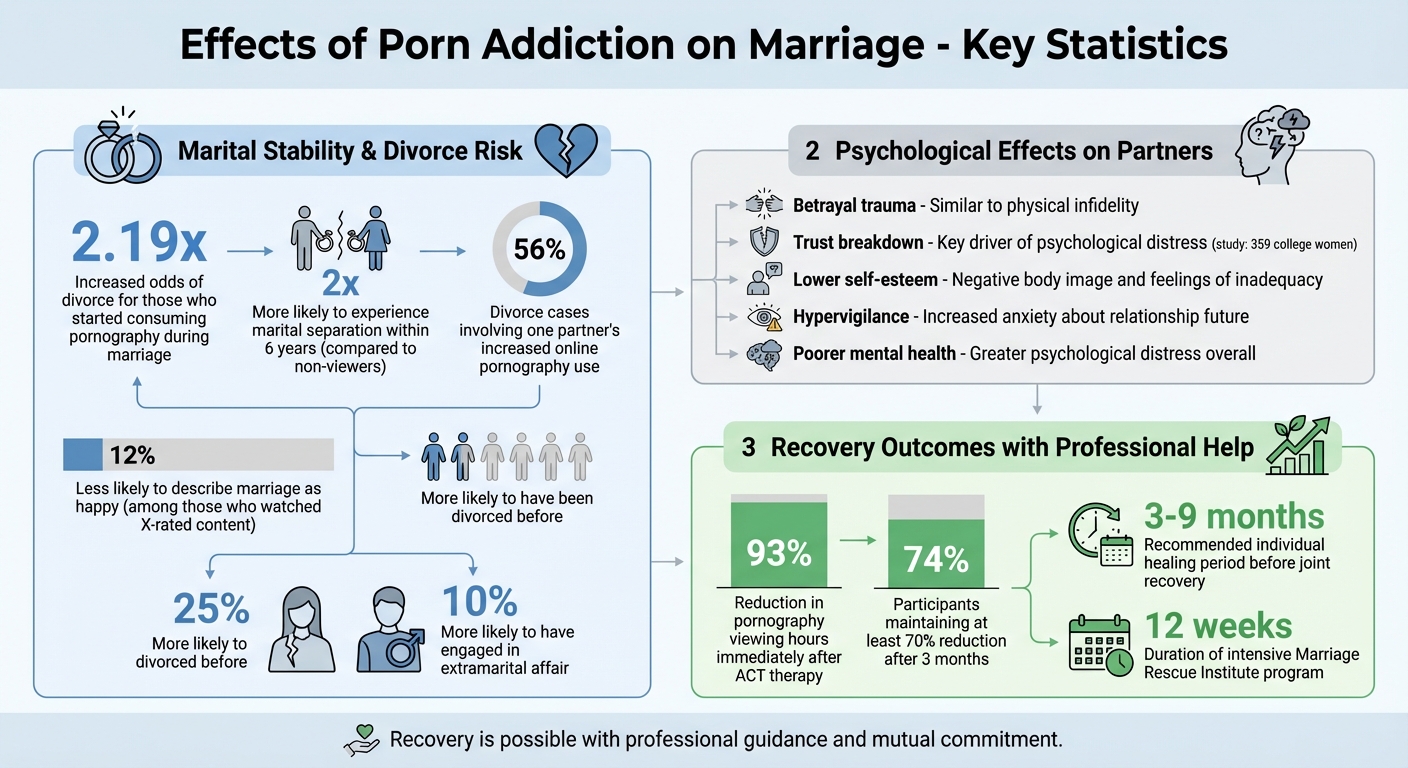
Impact of Porn Addiction on Marriage: Key Statistics and Recovery Outcomes
How to Rebuild Trust in Your Marriage After Your P*rn Addiction
How Porn Addiction Damages Marital Stability
Porn addiction can severely strain marriages by undermining trust, commitment, and communication – key pillars of any strong relationship. This erosion often leads to measurable consequences, including higher divorce rates and a decline in emotional and physical intimacy.
Higher Divorce Rates
Studies reveal that pornography addiction significantly increases the likelihood of divorce. Married Americans who started consuming pornography during their marriage faced nearly double the risk of divorce, with an odds ratio of 2.19 [5]. Additionally, couples where one partner viewed pornography were more than twice as likely to experience a marital separation within six years compared to non-viewers [6].
Divorce attorneys have also noted the impact of pornography on marital stability. In fact, 56% of divorce cases involved one partner’s increased use of online pornography [4]. The effect is particularly pronounced among younger couples and even those who initially reported high levels of marital satisfaction [5]. Furthermore, individuals who had watched an X-rated movie in the past year were 12% less likely to describe their marriage as happy, 25% more likely to have been divorced before, and 10% more likely to have engaged in an extramarital affair [4]. Beyond the rising risk of separation, these patterns erode the emotional connection couples rely on daily.
Loss of Emotional and Physical Connection
Porn addiction doesn’t just threaten a marriage’s stability – it also chips away at the emotional and physical bonds that hold it together. It’s often associated with lower commitment to a partner, reduced importance placed on the marriage, decreased interest in sexual activity with one’s spouse, and lower overall sexual satisfaction [3][4]. Frequent use of pornography has also been linked to negative communication patterns and emotional withdrawal, further straining the relationship [4].
Megan K. Maas, Ph.D., from Michigan State University, explains the emotional toll:
"The act of secretly using pornography, hiding it, and feeling guilty about it, may make the other partner feel inadequate and that the user is emotionally withdrawn." [4]
This secrecy and withdrawal can create a vicious cycle where the addicted partner becomes less emotionally present, deepening the rift in the relationship. For many, this behavior feels like a betrayal of the marriage’s exclusivity, causing harm regardless of how often it occurs [4].
Emotional Harm to the Non-Addicted Spouse
Pornography addiction doesn’t just strain the relationship – it leaves lasting emotional scars on the non-addicted spouse. The psychological impact often mirrors the pain of infidelity, deeply affecting mental health and self-esteem.
Betrayal and Broken Trust
Pornography addiction goes beyond disrupting marital stability; it strikes at the core of personal trust. Discovering a spouse’s addiction can feel like a devastating betrayal, shaking the foundation of the relationship. Dr. Kim Buck, a therapist with expertise in this field, describes the experience:
"The discovery of a spouse’s pornography addiction is often a traumatic event that can shatter trust and intimacy within a marriage. It’s not just about the addiction but the sense of betrayal that cuts deep." [8]
Research involving 359 young adult college women highlights that relationship trust is a key factor connecting a partner’s pornography use to the psychological distress of the non-addicted spouse [7]. In essence, it’s the breakdown of trust that drives much of the emotional suffering. Many affected spouses report feelings and behaviors similar to those who have endured physical infidelity. Researchers even refer to this phenomenon as "pornography distress" [4]. This sense of betrayal often leads to hypervigilance, where the non-addicted spouse becomes overly alert to their partner’s actions, accompanied by heightened anxiety about the future of the relationship [8].
Damage to Self-Worth and Body Image
The emotional fallout doesn’t stop at trust issues. Pornography addiction often leaves the non-addicted spouse questioning their own worth and physical attractiveness. Many report seeing themselves and their bodies in a negative light after learning of their partner’s addiction, particularly in cases where the use is one-sided [4]. This can lead to feelings of being less desirable and struggling with inadequacy and low self-esteem [4].
The psychological effects extend beyond the relationship itself. High levels of perceived partner pornography use are linked to greater psychological distress and poorer overall mental health for the non-addicted spouse [7]. These emotional wounds can linger, making recovery even more challenging.
sbb-itb-596b85d
Recovery Options for Affected Couples
Porn addiction can deeply strain marriages, leaving emotional scars that require careful healing. Therapy, when approached with structure and intention, has been shown to reduce the frequency and intensity of compulsive behaviors while addressing both personal and relationship challenges [2]. This combined focus lays the foundation for meaningful recovery for both individuals and couples.
How Couples Therapy Helps
Couples therapy takes a unique approach by treating the relationship itself as a central part of the recovery process, rather than focusing solely on stopping the addictive behavior [1]. Research by Spencer T. Zitzman and Mark H. Butler highlights that "conjoint marital therapy is recommended as a useful component in treating compulsive pornography consumption" [1].
This form of therapy fosters what experts call "mutual softening" between partners, helping to reduce the hostility and defensiveness that often accompany feelings of betrayal. Guided sessions aim to rebuild trust and strengthen emotional bonds, leading to noticeable improvements in marital confidence [1]. Techniques such as Cognitive Behavioral Therapy (CBT) help the addicted partner challenge harmful thought patterns and develop healthier ways to cope with emotional triggers [2]. Meanwhile, Acceptance and Commitment Therapy (ACT) encourages aligning behaviors with personal and shared marital values [2].
For couples experiencing severe challenges, intensive programs like the 12-week Marriage Rescue Institute offered by Growth and Change Counseling provide a structured path forward. These programs combine the tools of couples therapy with clear accountability measures to promote lasting recovery [1].
Personal and Relationship Healing Strategies
While couples therapy plays a vital role, individual therapy is equally important. Research suggests that dedicating 3–9 months to personal healing before diving into joint recovery can make a significant difference [9]. During this time, the addicted partner works on addressing underlying issues such as anxiety, depression, or trauma that may fuel their compulsive behaviors [9] [10]. On the other hand, the non-addicted partner focuses on processing betrayal trauma and establishing healthy boundaries [9] [12].
Key strategies for healing include setting clear boundaries, using "I" statements to foster open communication, and prioritizing self-care [9] [10] [12] [13]. Licensed therapist Jeremy Mast emphasizes that clear boundaries not only protect emotional well-being but also empower partners to communicate their needs effectively [9].
Beyond addressing the addiction itself, recovery involves rebuilding connections on multiple levels – emotional, recreational, intellectual, social, and even spiritual [11]. By focusing on these areas, couples can work toward a more balanced and fulfilling relationship.
Conclusion: Rebuilding Marriages After Porn Addiction
Porn addiction can deeply strain marriages, but recovery is possible with the right approach and professional guidance. Studies show that psychotherapy, especially Acceptance and Commitment Therapy (ACT), can lead to substantial improvements. One study reported a 93% reduction in pornography viewing hours immediately after treatment, with 74% of participants maintaining at least a 70% reduction three months later [15].
The recovery process combines personal responsibility with mutual support. Experts emphasize the importance of "mutual softening" – a shift where both partners become less defensive and more open to reconnecting emotionally [1][14]. Rebuilding trust, restoring intimacy, and creating a stable foundation are key steps in this journey.
Professional help plays a crucial role in this process. Conjoint marital therapy, for instance, helps couples identify critical moments for intervention, fostering recovery and reducing the risk of relapse [1][14]. For more severe cases, intensive programs like the 12-week Marriage Rescue Institute offer structured guidance to navigate crises effectively.
Recovery requires time, effort, and patience from both partners. The non-addicted spouse may need time to process feelings of betrayal and set healthy boundaries, while the addicted partner focuses on addressing the root causes of their behavior. Together, they can rebuild the emotional and intellectual bonds that form the core of a resilient marriage.
With therapeutic support, couples can overcome the challenges of pornography addiction and renew their relationships. The key is to seek help early and commit wholeheartedly to the recovery process.
FAQs
How can couples rebuild trust after a partner’s porn addiction is discovered?
Rebuilding trust after uncovering a partner’s struggle with porn addiction takes time, patience, and a shared commitment to healing. Therapy can be an invaluable tool in this process, offering a space for couples to work on transparency, understanding, and emotional reconnection. With professional support, both partners can address feelings of betrayal and begin the journey toward mutual recovery.
Honest conversations about emotions, needs, and boundaries are crucial for fostering a sense of safety and bridging any emotional gaps. Exploring deeper issues, such as attachment struggles or dissatisfaction within the relationship, can also help pave the way for meaningful progress. With consistent effort and the right support, couples can work toward rebuilding trust and restoring intimacy.
How does porn addiction affect the emotional well-being of the non-addicted spouse in a marriage?
Porn addiction can deeply affect the emotional well-being of the non-addicted spouse, often leaving them grappling with feelings of betrayal, mistrust, and insecurity. Many partners describe a sense of emotional turmoil and dissatisfaction within the relationship, often stemming from seeing their partner’s pornography use as a sign of neglect or even a breach of trust.
These emotions can show up as anger, sadness, or feelings of inadequacy, which may lead to growing emotional distance and tension in the marriage. Over time, this strain can weaken trust and intimacy between partners. Turning to professional support, such as couples therapy, can be a crucial step in addressing these issues, rebuilding trust, and fostering a healthier relationship dynamic.
What types of therapy work best for overcoming porn addiction in marriage?
The most effective ways to tackle porn addiction within a marriage often involve a mix of couples counseling and proven individual therapy methods like Acceptance and Commitment Therapy (ACT). Couples counseling focuses on rebuilding trust, improving communication, and addressing how the addiction affects the relationship dynamic.
Meanwhile, ACT helps individuals develop better psychological flexibility, manage compulsive behaviors, and reduce their reliance on pornography. When combined, these two approaches – personalized therapy and joint counseling – can provide a powerful framework for recovery while also reinforcing the connection between partners.
Common Questions About Healing with Growth and Change Counseling
- How Addiction Impacts Marital Stability
- Restoring Trust in Marriage After Addiction
- How Betrayal Trauma Impacts Partners of Addicts
- Healing Intimacy After Sexual Addiction: Christian Insights
