Building a strong connection with neurodivergent children often requires intentional, tailored activities that respect their unique ways of experiencing the world. From sensory play to structured routines, small daily actions can nurture trust and understanding. Here’s a quick summary of effective strategies:
- Sensory Play: Activities like tactile bins, water play, and "heavy work" exercises help with sensory processing and deepen parent-child interaction.
- Interest-Based Activities: Engage in hobbies or topics your child loves, like trains, animals, or space, to create shared experiences.
- Routine-Based Bonding: Predictable schedules and visual aids reduce stress and create consistent moments for connection.
- Creative Expression: Art, music, and DIY projects offer non-verbal ways to explore emotions and strengthen bonds.
- Nature Activities: Outdoor time, such as walks or scavenger hunts, provides a calming environment for shared exploration.
- Parent Coaching: Professional guidance can enhance communication and deepen your relationship through targeted strategies.
Focus on quality time, not quantity. Simple, meaningful interactions – like listening, participating in their favorite activities, or using visual tools and routines – can create a supportive, secure environment where your child feels valued and understood.
387- Bonding Activities: Effective, Practical Relationship-Building Ideas for ADHD Families
Sensory-Focused Bonding Activities
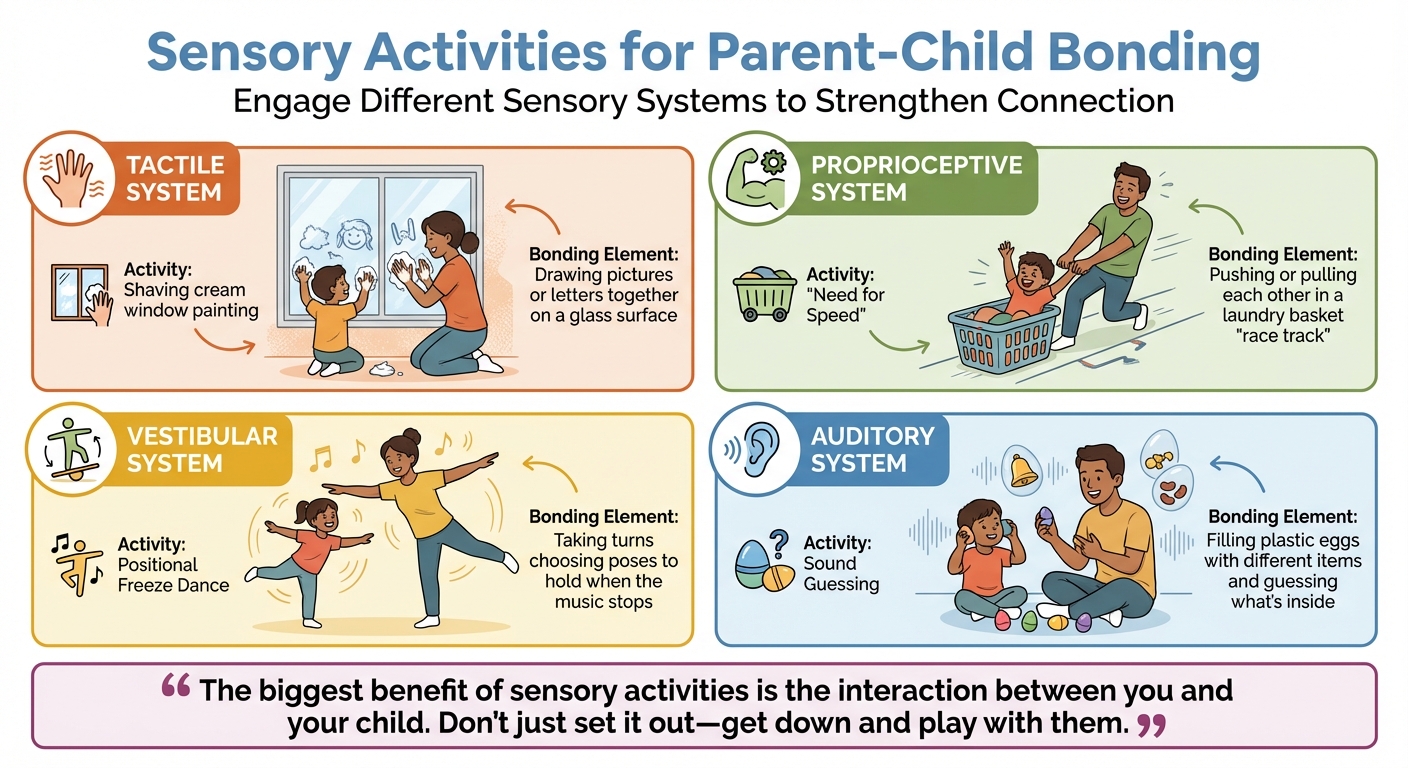
Sensory Activities for Parent-Child Bonding in Neurodivergent Families
Sensory play offers neurodivergent children a way to develop sensory processing, motor skills, and self-regulation, while also laying the groundwork for stronger connections with their caregivers [9][11][12]. When parents actively join in these activities, the bond deepens far more than when they simply set up the play and step aside.
"Often times the biggest benefit of sensory activities is the interaction between you and your child. Don’t just set it out in front of them–get down and play with them." – Hopebridge Autism Therapy Center [12]
Focusing on specific sensory systems can make these activities even more impactful. For instance, tactile experiences, like exploring textured bins, engage the sense of touch, which is highly developed in infants [9]. Proprioceptive activities, such as "heavy work" (e.g., pushing a weighted laundry basket), help children become more aware of their muscles and movements [8][11]. Similarly, deep pressure activities – like wrapping a child snugly in a heavy blanket or creating a "pillow sandwich" – can provide a sense of calm and security [8][9].
Sensory Play Ideas
Simple yet engaging sensory play can work wonders for bonding and development:
- Textured bins: Fill plastic containers with materials like dry rice, beans, water beads, or kinetic sand. Hide small toys or treasures for kids to find using their hands or tongs [8][9][12]. For younger children who might mouth objects, opt for edible materials like pudding for finger painting or bins filled with cooked pasta or mashed avocado [11][12].
- Water play: Set up a pouring station with containers, funnels, and droppers. Add food coloring to explore color mixing while improving hand-eye coordination [12]. This activity naturally encourages turn-taking and conversation.
- Tactile art projects: Create "textured paint" by mixing regular paint with salt, flour, or sugar. Families can work together on murals, gradually experimenting with brushes, fingers, and hands as comfort with textures grows [10].
Here’s a quick look at how sensory activities can foster connection:
| Sensory System | Activity Example | Bonding Element |
|---|---|---|
| Tactile | Shaving cream window painting | Drawing pictures or letters together on a glass surface [12] |
| Proprioceptive | "Need for Speed" | Pushing or pulling each other in a laundry basket "race track" [11] |
| Vestibular | Positional Freeze Dance | Taking turns choosing poses to hold when the music stops [10] |
| Auditory | Sound Guessing | Filling plastic eggs with different items and guessing what’s inside [10] |
These activities not only engage children but also create opportunities for shared joy and connection, paving the way for a supportive environment. The next section will dive into how to create sensory-friendly spaces.
Setting Up a Sensory-Friendly Space
Creating a sensory-friendly space can provide a calming retreat for children. Start by designating a quiet corner with soft or natural lighting – fluorescent lights can feel harsh and overstimulating [9][13]. Include comfort items like weighted blankets, compression garments, or soft pillows to help children feel secure [9][13].
Managing sound is equally important. Indoor tents can help absorb noise and reduce echoes [6]. Noise-blocking earmuffs or white noise machines can also mask distracting sounds [9]. For visual sensitivities, use light-filtering shades or provide a hat with a brim to shield eyes from bright overhead lighting [9].
Adding calming scents to the space can enhance focus and relaxation. Try incorporating scented markers, scratch-and-sniff stickers, or scented playdough [9][11]. Keep the area clutter-free by limiting toys to just two or three options to avoid overwhelming the child [6][13]. Finally, include movement options like mini trampolines, rocking horses, or textured mats to support different self-regulation needs [9][13].
Activities Based on Your Child’s Interests
Neurodivergent children often develop intense interests in specific topics – be it trains, dinosaurs, video games, or astronomy. These passions can serve as bridges to deeper connections, creating opportunities to teach focus while sharing joy [1]. When parents take the time to understand and engage with these interests, they establish a shared language that makes bonding feel natural and enjoyable.
Let your child take the lead; the quality of your interaction matters more than the amount of time spent together [14]. Even a short session of fully engaged play centered on their favorite topic can be more meaningful than hours of distracted interaction. Allowing your child to guide the activity – whether by teaching you something or collaborating on a project – turns their enthusiasm into a rewarding connection [4]. Below are some practical ideas to help you connect with your child based on their interests.
Shared Hobby Projects
Turning your child’s interests into collaborative projects can transform their passion into shared fun. For example, if your child loves trains, many neurodivergent children enjoy construction-based play, such as designing and assembling track layouts, more than traditional pretend play [16]. Work together to organize tracks by color or create complex routes, following their preferred way of playing.
"The style of play that a child chooses to engage in is the right way to play for them." – Makena Wood, B.Sc. Neuroscience student, Building Brains [16]
For kids who adore animals, try rock stacking by collecting rocks during walks and building animal shapes or towers at home [10]. If construction fascinates them, you can dive into toothpick engineering, creating 3D structures or animals using toothpicks and marshmallows [10]. LEGO sets, model kits, and sculpture projects are also excellent options; they encourage spatial reasoning and fine motor skills while giving you both a shared goal [7][15].
You can also plan themed outings that align with their interests. For a child fascinated by emergency vehicles, a visit to a fire station could be thrilling. Space enthusiasts might enjoy a trip to a planetarium [2]. Many zoos and aquariums now offer sensory-friendly events or are Certified Autism Centers, making these outings more accessible and enjoyable [2].
Storytelling and Role-Playing Games
Imaginative play, rooted in your child’s favorite themes, is another way to build social skills and connection. Puppet shows are particularly effective because they allow children to express emotions through a character, which can feel less intimidating than direct interaction [5]. You can act out familiar characters or family situations, providing a safe space for your child to practice social skills, much like supporting neurodiverse couples with mental health issues requires tailored strategies and clear communication.
If your child finds open-ended prompts challenging, model a response first, then invite them to continue [17]. You can also use closed-ended questions or "would you rather" scenarios during role-play to make the activity less overwhelming [17]. Another fun idea is flashlight stories: turn off the lights, pass a flashlight around, and have each person holding it add to a shared story [4]. Or try chalk towns, where you use driveway chalk to create an imaginary town, and each family member designs their own house or store [4].
When setting up role-playing activities, keep toy options limited to 2 or 3 items to avoid overstimulation [6]. Visual aids like photos, drawings, or objects can help your child follow along with the story [6]. Most importantly, practice the "Stop, Look, and Listen" approach – give your child the time they need to process and respond instead of rushing into the play [6].
"Joyful connection is the super glue of families." – Jim and Lynne Jackson, Founders of Connected Families [4]
Routine-Based Activities
Sensory and interest-based activities are great for sparking interaction, but routines bring a sense of stability that strengthens those connections. Neurodivergent children often feel more secure when they know what to expect. Predictable routines not only ease anxiety but also create dependable moments for bonding. Whether it’s sharing breakfast, reading a bedtime story, or playing a quick game after homework, these consistent rituals become comforting touchpoints in your day-to-day life [18][20].
One way to make routines effective is by establishing "anchors", like mealtimes or bedtime, to break tasks into smaller, manageable steps [20]. Consistency is key – on average, it takes about 2 to 4 weeks of repetition before a routine becomes second nature [20].
"Routines may feel small, but they build the scaffolding that helps children rise into their potential." – Dr. Mona Delahooke, Child Psychologist [18]
Visual Schedules for Daily Activities
Visual schedules are a game-changer for making time and tasks more concrete. These tools act as a bridge for kids who might struggle with verbal instructions or transitions [21][22]. Instead of constantly reminding your child what’s next, the schedule lets you step into a more supportive role, offering encouragement when tasks are completed.
There are different types of visual schedules to suit your child’s developmental stage:
- Object Schedules: Use physical items, like a spoon to signify mealtime or a toothbrush for brushing teeth. These work well for younger children or those with limited language skills [19][22].
- Picture Schedules: Incorporate photos or icons that your child can match and remove as they complete activities [21][22].
- Written Schedules: For children who can read, a written checklist provides clear guidance for independent use [19].
- First/Then Boards: These are particularly helpful for tasks your child resists. For example, you could show a picture of homework (First) followed by a favorite toy (Then) to encourage cooperation [22][23].
A real-life example? A family with a 6-year-old named Jordan, who has autism, used a laminated visual schedule to ease morning transitions. The schedule outlined six steps – from waking up to packing a bag – with icons for each task. After two weeks of consistent use and reward stickers, Jordan began following the routine independently, reducing morning stress and strengthening family connections and emotional growth [18].
"Visual schedules empower children to take ownership of their daily routine, enabling them to complete tasks independently and build life skills." – Karla Pretorius, M. Psych and Nanette Botha, BEd, Autism Parenting Magazine [21]
Start with just 2–3 tasks and gradually add more as your child gains confidence [19][22]. Use real photos to make the schedule relatable [21], and spend a few minutes each morning reviewing it together. Encourage your child to physically move or remove icons as they complete tasks, creating a sense of accomplishment [19][22]. Pair the schedule with timers and give 2–5 minute warnings before transitions to help your child adjust [19][20].
For unexpected changes, introduce a "change card" or a question mark icon to signal a shift in plans. This simple tool helps your child anticipate and adapt to changes without feeling overwhelmed [18][20][21].
Games with Clear Rules
Structured games can extend the benefits of routines into playtime, offering a safe and predictable way for neurodivergent children to practice social skills. Clear rules remove ambiguity, making it easier for children to focus on turn-taking, cooperation, and understanding social cues [2][7].
Board games are a fantastic choice for fostering patience and cognitive skills. Pick games that align with your child’s interests – like trivia for fact-lovers or cooperative games that encourage teamwork [2][7]. Physical games such as cornhole, tag, or jump rope not only burn energy but also help build motor skills [2][3]. For younger kids or those needing extra connection, "I Love You Rituals" incorporate eye contact, touch, and playfulness to strengthen bonds during transitions [7].
To make games even more effective, use visual timers to show the passage of time and give brief warnings before transitions [20]. Alternate between parent-led activities and games to create positive associations with routines [19]. Including "choice time" within the schedule allows your child to exercise some autonomy while staying within a structured framework [18]. Combining the predictability of routines with the joy of play creates a strong foundation for connection and growth.
These structured routines and activities pave the way for more creative expressions that deepen family bonds.
sbb-itb-596b85d
Creative Expression Activities
Creative activities can be a great outlet for neurodivergent children, especially those who feel more comfortable expressing themselves through art, music, or hands-on projects rather than words. These activities not only tap into their visual thinking abilities but also provide a relaxed, non-verbal way to explore emotions and build connections. By offering alternative pathways for communication, creative projects can strengthen bonds and open up new ways to understand each other.
"For neurodivergent children, putting emotions into words can sometimes feel overwhelming. [Creative play] offers a safe, structured space for nonverbal emotional expression." – BestLife Counseling [25]
Beyond emotional expression, creative projects can also help with sensory regulation. For instance, music can improve focus and bring a sense of calm, making it easier for children to navigate noisy or overwhelming environments [8]. Similarly, art projects that involve different textures give kids the chance to explore tactile sensations at their own pace [10]. The key is to follow your child’s preferences and adjust materials to suit their sensory needs. This might mean opting for digital drawing apps instead of messy paints or choosing soft, comforting materials over sticky or rough ones.
Art and Music Projects
Collaborative art projects are a great starting point because they take the pressure off perfection. You could encourage your child to sketch how they’re feeling or draw a memorable family moment [5]. Another idea is group drawing, where family members take turns adding to a shared picture without speaking. This activity encourages everyone to observe and respond to each other’s ideas visually rather than verbally [5].
For kids who enjoy tactile experiences, textured paint or similar materials can be a fun way to explore. If your child loves to move, try an activity like Emotions Freeze Dance. Play some music and dance together, then pause the music and call out an emotion like "excited" or "curious." Everyone freezes in a pose that represents that feeling [5].
Music projects are equally engaging and can be incredibly meaningful. You could create DIY instruments using items from around the house – fill bottles or plastic eggs with rice to make maracas, turn cardboard tubes with beads into rain sticks, or use cardboard boxes as drums [24][8]. Another fun idea is to collaborate on a shared music video or curate a digital playlist of favorite songs. These activities allow you to connect through rhythm and sound without relying heavily on words.
"Music is a magical gateway to cherished moments and building bonds." – Circle Care Services [7]
Simple DIY and Craft Projects
If your child prefers hands-on activities, crafts offer another way to spark creativity and connection.
One idea is to design a family crest that represents your core values and strengths [5]. You could also make friendship bracelets or paint small objects like flower pots or picture frames to use around the house. For something more interactive, try building 3D shapes with soft materials like marshmallows and toothpicks – this can also help practice fine motor skills [10].
To keep craft sessions manageable, limit the number of materials available, as this can help avoid overwhelm [6]. For kids who need more physical input, incorporate tasks like pushing a cart of supplies or carrying heavier materials to provide proprioceptive feedback [8]. Using tools like visual task plans or "Now and Next" boards can also help children stay focused and understand the steps involved in a project [6].
If your child has sensitivities to certain textures, it’s easy to swap out materials. For example, if playdough or slime feels unpleasant, try using alternatives like cardboard, feathers, or scarves for imaginative play [6][7]. Tailoring the experience to your child’s comfort level ensures they can fully enjoy the activity while exploring their creative side.
Nature-Based Activities
Just like indoor sensory and creative projects, nature-based activities create opportunities for parents and children to bond through shared experiences. Nature provides soothing sounds that help reduce sensory overload, lower cortisol levels, and improve mood [27]. Beyond its calming effects, spending time outdoors sparks curiosity and encourages exploration, offering families a chance to connect in a setting free from the demands of daily life.
"The natural world encourages curiosity, exploration, and presence – all of which are crucial for building emotional intimacy." This connection is equally vital for emotional intelligence in neurodiverse couples navigating family dynamics with the help of marriage counseling. – Helene Timpone, LCSW, Parent Cooperative Community [27]
Walking side-by-side during outdoor activities can make conversations feel more natural, especially for children who find direct eye contact challenging [27]. Tackling a hiking trail together or adapting to unexpected weather fosters a sense of shared achievement and resilience [27]. Outdoor activities that involve heavy work – like pushing, pulling, or lifting – can also improve body awareness and balance, which is particularly helpful for children with sensory processing difficulties [8]. These experiences complement indoor bonding activities by adding a refreshing change of scenery.
Modified Outdoor Activities
Consider nature walks, scavenger hunts for leaves or rocks, rock stacking, or puddle jumping to engage your child’s visual, tactile, and motor skills [15][26]. For children prone to wandering, use a stroller or wagon on paved paths, or choose fenced playgrounds for secure exploration [2]. If your child benefits from heavy work activities, include tasks like pushing a grocery cart, stacking rocks, or doing push-ups to help them regulate their nervous system [8][10]. For kids sensitive to noise or large crowds, bring along noise-canceling headphones or a sensory kit to manage overstimulation [15]. You can also bring a favorite toy outside to create a comforting bridge between familiar and new experiences [26]. For a cozy outdoor activity, set up an inflatable pool filled with blankets and pillows as a base for cloud watching or stargazing [2].
Mindful Nature Time
In addition to active play, mindful time in nature encourages stillness and sensory engagement. Activities like watching clouds, listening to bird calls, or collecting natural objects allow children to explore at their own pace without the need for strict rules or constant conversation. Try sound hide-and-seek – listening for and identifying different nature sounds – or practice deep breathing while sitting under a tree [10]. Exploring textures, such as tree bark, smooth stones, or soft grass, can also provide a calming sensory experience. If your child benefits from structure, visual schedules or timers can help ease transitions between activities and reduce anxiety [1]. Many zoos, aquariums, and planetariums are Certified Autism Centers, offering sensory-friendly nights or special headsets to make outings more enjoyable for families [2].
Parent Coaching and Support Services
Parent coaching takes the idea of shared activities a step further, focusing on refining everyday interactions to deepen the connection between parents and their children.
The Value of Parent Coaching
Parent coaching fills the gaps that generic parenting advice often misses, shifting families away from constant correction and toward practices that emphasize emotional connection and safety [28]. Coaches provide feedback and demonstrate strategies to help parents recognize nonverbal cues, allowing for more empathetic responses rather than jumping straight into problem-solving [25][28].
"A strong parent-child bond isn’t built in one big moment; it’s formed through small, repeated experiences that help a child feel safe, seen, and understood." – Life Enrichment Counseling Center [28]
These coaching sessions are tailored to your child’s specific needs. For instance, coaches might recommend toys with particular textures or introduce weighted objects to help children express emotions [25]. Research shows that a 12-week program of structured, adult-guided play can significantly enhance symbolic and social play for children with autism [25]. The strategies are personalized based on your child’s age, temperament, and developmental stage, ensuring that bonding activities fit seamlessly into your daily routine.
Practical techniques like "Special Time" – a daily 10-to-15-minute session where your child takes the lead while you follow without directing – and "Name It to Tame It", which helps children label their emotions to reduce emotional overwhelm, are just a few examples of what you might learn [28]. These approaches create a foundation for exploring more specialized services available in your area.
Growth and Change Counseling Services

Growth and Change Counseling provides a range of services, including parent coaching, individual therapy, and family therapy, to support families across California. Their parent coaching focuses on empowering you to take the lead in therapeutic play, using child-directed techniques and helping develop an emotional vocabulary [25]. This guidance ensures that bonding activities align with your child’s neurological strengths [25].
With locations in Campbell, San Jose, Los Angeles, and Roseville, CA, as well as telehealth options statewide, their services are accessible and flexible. Whether you’re looking for help establishing visual schedules, incorporating daily "I Love You Rituals", or improving your active listening skills to better align with your child’s communication style, their solutions-focused approach is customized to meet your family’s unique needs. By integrating coaching into your daily routine, you can nurture your child’s strengths while reinforcing the bond you share.
Bonding Activities for Neurodivergent Families at Growth and Change
Strengthening your bond with a neurodivergent child doesn’t call for elaborate plans or grand efforts. Studies highlight that quality time often outweighs the sheer amount of time spent together [14]. Small, meaningful actions – like truly listening, acknowledging emotions, and participating in activities your child loves – can create an atmosphere where they feel safe, valued, and understood [1].
Connecting through your child’s interests using visual tools and responsive interactions not only enhances trust but also supports brain development and improves social skills. Research suggests that children raised in families with strong emotional ties are more likely to thrive, developing a sense of purpose, healthy relationships, and self-acceptance [14]. These everyday moments naturally evolve into routines and creative activities that deepen your connection even further.
The activities shared in this article – whether sensory play, routine-based games, or creative projects – are designed to fit effortlessly into daily life. Predictable routines offer clarity and reduce stress, while joyful interactions act as a powerful adhesive, helping families navigate challenges together [4].
"Joyful connection is the super glue of families." – Jim and Lynne Jackson, Founders of Connected Families [4]
To make these practices a lasting part of your family life, consider building on them with professional guidance. Growth and Change Counseling offers personalized parent coaching, family therapy, and individual therapy across California, including telehealth options, to help tailor these bonding strategies to your unique needs. This expert support can provide the tools and structure to turn everyday moments into meaningful, lasting connections.
FAQs
How can I create sensory play activities that meet my child’s unique needs?
To design sensory play activities that cater to your child’s unique needs, start by paying close attention to their sensory preferences and sensitivities. Children who are neurodivergent, including those with autism or sensory processing differences, often react to stimuli in distinct ways. For instance, some might find loud noises or rough textures overwhelming, while others actively seek out sensations like deep pressure or movement.
Once you understand what your child responds to, you can tailor activities accordingly. If they are touch-sensitive, consider introducing soft materials like Play-Doh or smooth fabrics into their playtime. On the other hand, if they thrive on sensory input, activities such as jumping on a trampoline, swinging, or squeezing a stress ball can be both engaging and calming. Techniques like using a weighted blanket for deep pressure can also promote relaxation.
Incorporating your child’s favorite activities or interests into sensory play can make it more enjoyable and effective. If you’re unsure where to start or want additional ideas, reaching out to a therapist or specialist can help you develop strategies to support your child’s sensory and emotional needs.
How can I use my child’s special interests to create meaningful bonding experiences?
Using your child’s specific interests as part of bonding activities can be a wonderful way to strengthen your relationship while encouraging communication. For instance, if your child is fascinated by fire trucks, you might plan a visit to a local fire station or play a pretend game featuring emergency vehicles. These kinds of activities create shared moments that feel enjoyable and natural.
You can also weave their interests into everyday routines. This could mean cooking meals inspired by their favorite characters, crafting art projects that reflect their passions, or telling stories that include their favorite topics. These small but meaningful efforts not only deepen your connection but also support their social and emotional development in a setting where they feel at ease.
By acknowledging and celebrating your child’s unique interests, you help build a positive atmosphere of trust and connection, making your time together more engaging and rewarding for both of you.
How do visual schedules help neurodivergent children with daily routines?
Visual schedules are an excellent way to help neurodivergent children manage their daily routines with more ease and confidence. By using pictures, symbols, or photos to represent activities, these schedules create a clear and predictable structure. This can reduce feelings of anxiety and make transitions between tasks much smoother. They also give children a better understanding of what’s coming next, fostering a sense of security and building independence.
For children with autism, ADHD, or sensory processing challenges, visual schedules act as steady reminders that complement verbal instructions. They can be tailored to fit each child’s unique needs – whether through printed charts, picture cards, or digital formats – and work well in both home and school environments. This method not only improves communication but also reduces uncertainty, creating a more positive and productive daily experience.
Related Blog Posts
- 5 Ways to Support Your Neurodiverse Partner
- Ultimate Guide to Routines for Neurodiverse Families
- Parenting Stress: Solutions for Neurodiverse Families
- ADHD Parenting Tips for Neurodiverse Families
