Humility is the key to saving and strengthening your marriage. It shifts focus from pride and blame to understanding, forgiveness, and love. By prioritizing your partner’s needs, admitting mistakes, and communicating openly, you can rebuild trust and connection. Here’s what you need to know:
- Why humility matters: Pride creates distance, while humility fosters reconciliation and healing.
- Biblical principles: Scriptures like Philippians 2:3-4 and Colossians 3:12-13 emphasize selflessness, forgiveness, and mutual respect in marriage.
- Practical steps: Practice quick apologies, empathic listening, and daily acts of service. Use prayer and self-reflection to identify and overcome prideful habits.
- Conflict resolution: Approach disagreements with understanding, not the need to win. Focus on unity and peaceful communication.
- Counseling support: Professional guidance, like Growth and Change Counseling’s 12-week Marriage Rescue Institute, helps address deeper issues and build lasting habits.
Taking small, consistent steps toward humility can transform your relationship. Whether it’s through personal effort or seeking counseling, the path to restoration begins with a humble heart.
The Power And Necessity Of Humility In Marriage
What the Bible Says About Humility in Marriage
The Bible highlights humility as the foundation for healing and strengthening marriages. Choosing humility over pride aligns with God’s purpose for relationships, inviting His grace into your life and home.
Key Scripture Passages on Humility
Philippians 2:3-4 addresses one of the core causes of marital conflict: "Do nothing out of selfish ambition or vain conceit. Rather, in humility value others above yourselves, not looking to your own interests but each of you to the interests of the others." This passage encourages you to prioritize your spouse’s needs over the desire to win arguments. The verses that follow, Philippians 2:5-8, point to Jesus as the ultimate example of humility. He "emptied Himself" and became a servant, showing that true strength in marriage comes through sacrifice, not control.
Colossians 3:12-13 calls believers to "clothe yourselves with compassion, kindness, humility, gentleness and patience. Bear with each other and forgive one another if any of you has a grievance against someone. Forgive as the Lord forgave you." This isn’t a one-time act. It’s a daily commitment to wear humility like an outfit you intentionally put on each morning. Similarly, Ephesians 5:21 urges couples to "submit to one another out of reverence for Christ", emphasizing mutual respect and service instead of seeking dominance.
James 4:6 offers a sobering reminder: "God opposes the proud but gives grace to the humble." Francis Chan underscores this truth, warning, "God actively fights against the proud person. Can you imagine anything worse than fighting God?" [1]. Pride in marriage not only creates distance between you and your spouse but also invites opposition from God. Romans 12:3 provides practical wisdom, reminding us not to think too highly of ourselves. This perspective helps you see your own role in conflicts rather than placing all the blame on your partner.
These passages reveal how humility doesn’t just ease tension – it creates space for forgiveness and healing in your marriage.
How Humility Enables Forgiveness
Forgiveness is impossible without humility. It requires acknowledging your own need for grace and being willing to let go of pride. James 5:16 encourages believers to confess their faults to one another, while Luke 6:42 challenges you to remove the "log" from your own eye before addressing the "speck" in your spouse’s.
Humility shifts your perspective, reminding you that you’re not morally superior to your partner. When you accept your own flaws and failures, it becomes easier to extend grace and forgiveness. As the BibleHub Topical Encyclopedia explains, "Humility allows love to flourish by removing pride and self-centeredness, which can hinder genuine connection and understanding" [6]. Proverbs 15:1 also offers practical advice for handling conflict: "A soft answer turns away wrath, but a harsh word stirs up anger." A humble heart naturally responds with gentleness, prioritizing reconciliation over being right.
The Bible also provides powerful examples of humility that can inspire and guide us in our marriages.
Biblical Examples of Humility in Relationships
Jesus’ life offers the ultimate model of humility. Despite His divine status, He washed His disciples’ feet and sacrificed Himself for others. This same attitude of servanthood can transform a struggling marriage – choosing to serve your spouse even when you feel justified in demanding change.
Take Reisha’s story from 2014. Instead of seeking personal vindication, she chose to follow God’s design for marriage, and her obedience turned her relationship around [1]. Her choice shows that humility isn’t about how you feel; it’s about committing to God’s principles, even when your instincts push you toward self-defense or retaliation.
Research on more than 250 deeply religious married couples from diverse backgrounds found that pride was consistently identified as the biggest internal barrier to a healthy marriage [7]. One participant, Jing, explained, "When you are humble and regard [ourselves] as imperfect, we can tolerate each other. If you are pride[ful] and look down on the other [person], you will have a bad relationship" [7]. The couples who experienced healing were those who focused on changing themselves rather than trying to force change in their spouse [8].
These biblical teachings and real-life insights underscore how humility can reshape marital dynamics, laying the groundwork for practical steps to come.
How to Practice Humility in Your Marriage
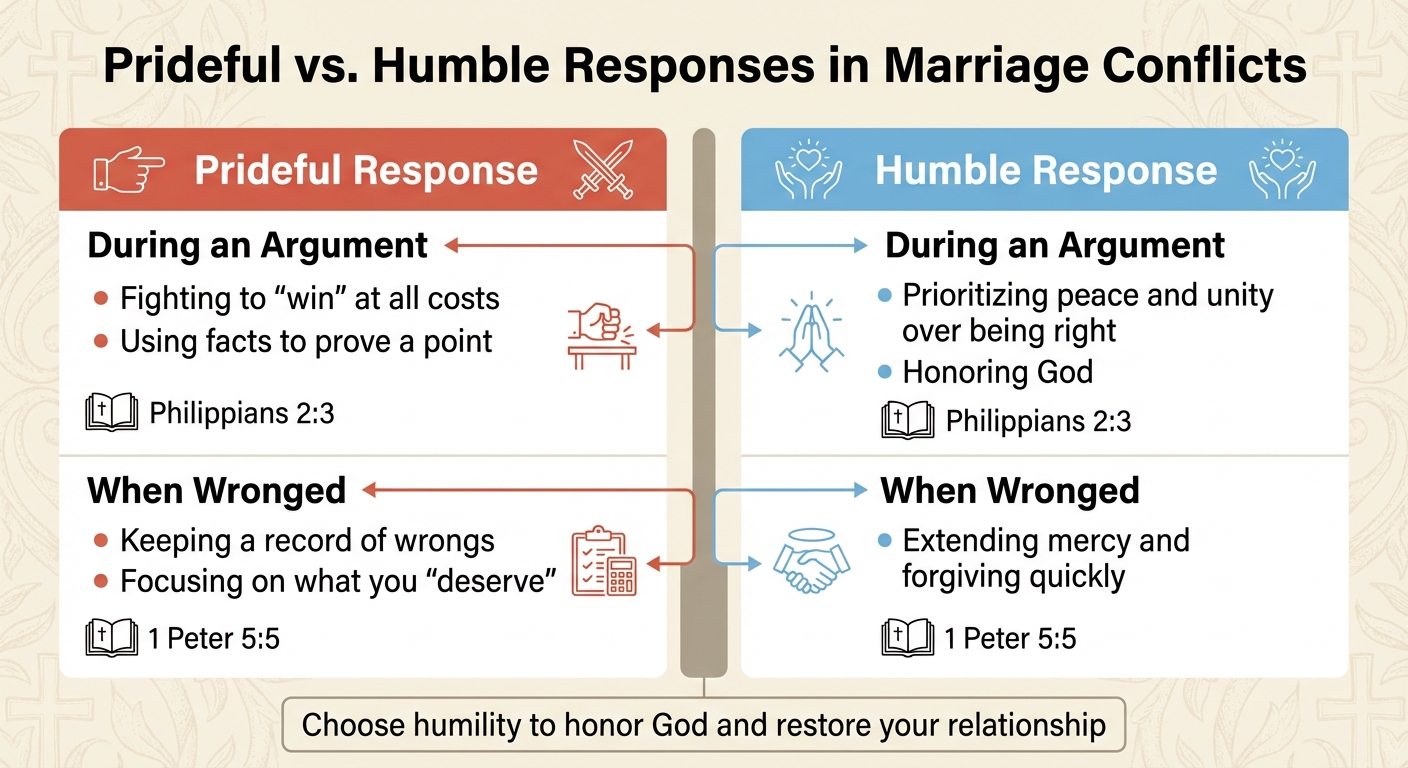
Prideful vs Humble Responses in Marriage Conflicts
Understanding biblical humility is one thing; living it out in your marriage daily is another. Humility isn’t just a feeling that comes and goes – it’s a conscious, daily decision you make with your spouse. Couples who find success in rebuilding their relationships shift their focus from trying to change their partner to working on themselves. Let’s explore how to turn biblical principles into practical habits that can strengthen your marriage.
Daily Habits That Build Humility
Humility begins with self-awareness. Pay attention to your reactions, especially during moments of frustration or unmet expectations. These moments often reveal pride. Instead of reacting defensively, use them as opportunities to intentionally practice humility. Aaron Smith, host of the Marriage After God Podcast, explains:
"Pride separates us from relationships, while humility makes it possible for those who want to be in relationship with us to draw near to us" [4].
One way to build humility is through quick reconciliation. Apologize promptly and follow up with a reassuring action. Pastor Kevin A. Thompson emphasizes the importance of communication in marriage:
"If communication stops, the marriage suffocates because communication is the oxygen of marriage" [3].
Another key habit is prioritizing service over self-interest. Look for ways to meet your spouse’s needs without waiting for them to serve you first. This doesn’t mean becoming passive or losing your sense of self. True humility is rooted in confidence – it’s about choosing to put your partner’s needs first out of love, not fear or weakness.
You can also guard your mindset by being mindful of what influences you. Spend more time in Scripture and prayer than consuming media that promotes self-centeredness or independence [1]. These small, intentional choices help cultivate a heart of humility.
Using Prayer and Reflection
Prayer is a powerful expression of humility. By praying, you acknowledge your dependence on God. Aaron Smith explains:
"It’s an act of humility to pray for your spouse… and to go to God and say, ‘I need you.’ That’s a humble thing to do" [4].
Pray specifically for a humble heart and for your spouse’s well-being. Avoid vague prayers; instead, ask God to reveal areas of pride in your life and give you the grace to respond differently. Self-reflection is equally important. Take time to identify negative beliefs, fears, or unforgiveness that might be affecting your marriage [5]. John Kane, LMFT, underscores this idea:
"What you believe about yourself defines and shapes all of your relationships!" [5].
During disagreements, pay attention to your internal reactions. If you feel the urge to "win" an argument, pause and reflect on whether pride is driving your response. Francis Chan offers a sobering reminder:
"God actively fights against the proud person… God fights for the humble. He pours out His grace upon the humble" [1].
Choosing humility doesn’t just benefit your marriage – it aligns you with God’s grace. Regularly ask your spouse for feedback to hold yourself accountable and continue growing in humility.
Responding Humbly During Conflicts
Conflict doesn’t have to tear your marriage apart. In fact, it can become an opportunity to grow closer – if you respond with humility. Speaking with clarity, kindness, and respect is key. Humility means listening to understand rather than preparing a defense.
Practice empathic listening by focusing on validating your spouse’s feelings without jumping in with counterarguments. Take a moment to pause and fully hear their perspective. This approach shifts the goal from being understood to understanding your partner [2].
Here’s how humility can reshape your approach to conflict:
| Conflict Scenario | Prideful Response | Humble Response | Biblical Reference |
|---|---|---|---|
| During an Argument | Fighting to "win" at all costs; using facts to prove a point | Prioritizing peace and unity over being right; honoring God | Philippians 2:3 |
| When Wronged | Keeping a record of wrongs; focusing on what you "deserve" | Extending mercy and forgiving quickly | 1 Peter 5:5 |
The ultimate goal is to honor God and restore your relationship – not just to win an argument. After apologizing or confessing a mistake, consider the “hug rule.” A simple physical gesture, like a hug, can quickly rebuild emotional connection [4].
sbb-itb-596b85d
How Counseling Supports Marriage Restoration
Sometimes, practicing humility on your own just isn’t enough – especially when deep-seated issues linger. Professional counseling offers the guidance and accountability necessary to tackle these challenges and rebuild your marriage from the ground up. Let’s explore how professional support can deepen humility and help restore your relationship.
How Counseling Builds Humility
Therapy creates a safe space where you can face personal struggles head-on. Vulnerability is often the key to meaningful growth. As John Mark Kane, LMFT and founder of Growth and Change Counseling, explains:
"It is in this place of vulnerability that we can admit our struggles, face our true selves, and then grow to become all that we are meant to be!" [5]
Counselors encourage openness, empathy during disagreements, and honest feedback – all of which nurture relational awareness. This process often reveals hidden issues, such as unresolved trauma or negative thought patterns, that may contribute to prideful behaviors. With regular sessions and tailored exercises, you’ll begin to replace unhealthy habits with new, humble patterns of interaction. These changes align with biblical principles, helping you live out humility in your daily life.
The Marriage Rescue Institute Program
For couples in crisis – whether due to infidelity, constant conflict, or emotional disconnection – specialized help is available. Growth and Change Counseling offers The Marriage Rescue Institute, a 12-week intensive program designed specifically for marriages on the brink.
John Mark Kane, LMFT, describes the program’s purpose:
"The Marriage Rescue Institute, our 12 week marriage program is designed to restore marriages in crisis." [5]
This program takes a results-driven approach, combining therapeutic methods like Emotion Focused Couples Therapy (EFT), Cognitive Behavioral Therapy (CBT), Attachment Theory, and EMDR. These tools are used to help couples identify and transform harmful thought patterns, rebuild trust, and create new habits rooted in humility and mutual respect. It’s a hands-on process that equips couples to move from emotional isolation to genuine connection. As Jamula Taylor, LMFT, points out:
"Sometimes the best thing may be the hardest thing for you to do. But it is in our discomfort that we find the strength for the greatest growth and change in our lives!" [5]
Services at Growth and Change Counseling
Growth and Change Counseling offers a variety of programs tailored to meet individual and relational needs. Beyond The Marriage Rescue Institute, they provide individual, family, and couples therapy, available both in person and via telehealth across California. They also specialize in areas like anxiety, depression, addiction, trauma, and neurodiverse relationships, including support for couples navigating High Functioning ASD/Asperger’s.
Their services are available in Campbell, CA; San Jose, CA; Los Angeles, CA; and Roseville, CA, with telehealth options for broader accessibility. Individual therapy sessions with a Licensed Marriage and Family Therapist (LMFT) cost $200 for 45 minutes, while sessions with an Associate Marriage and Family Therapist (AMFT) are $150. Sliding scale options start at $100. Pricing for The Marriage Rescue Institute program is determined during an initial strategy session.
The practice takes a solutions-focused approach, blending psychological techniques with Christian principles for clients who request it. Their guiding belief is simple:
"We don’t believe in staying the same. We believe in getting better!" [5]
Overcoming Barriers to Humility
Understanding the value of humility is one thing, but putting it into practice can feel like climbing a mountain. Old habits and lingering emotional wounds often block the path. The first step toward meaningful change in your marriage is recognizing these obstacles. Let’s dive into some common barriers and explore ways to move past them.
Recognizing and Releasing Resentment
Resentment has a way of building up over time, clouding how you see your partner and your relationship[10]. Maybe you find yourself replaying old arguments, feeling like you’re walking on eggshells, or assuming the worst about your spouse’s intentions[10]. To break free, it’s crucial to pinpoint specific hurts instead of letting them morph into a vague sense of bitterness. Try journaling about one particular grievance and ask yourself: What exactly hurts? What assumptions am I making? What do I need to feel acknowledged?[10]. This process can help you express your feelings without turning to blame.
Another helpful exercise is creating a "positive list" – write down at least five things you genuinely appreciate about your partner and keep adding to it over time[10]. This can shift your mindset and counterbalance negative thoughts. Holding onto resentment doesn’t just hurt your relationship; it primarily weighs you down[11]. Choosing forgiveness can be a powerful way to heal and move forward.
Facing the Fear of Vulnerability
For many, vulnerability feels like a risk rather than a strength. But as Jamula Taylor, LMFT, reminds us:
"Courage is not the absence of fear but taking action in spite of our fear." [5]
When you shy away from vulnerability, you might be trying to shield yourself from rejection or judgment. Unfortunately, this self-protection often leads to emotional distance. Humility, on the other hand, requires enough confidence to prioritize your partner’s needs without feeling threatened[2]. Vulnerability doesn’t mean perfection – it means being honest about where you’re struggling.
Start small: hold back defensive reactions and focus on truly listening to understand your partner’s perspective, rather than preparing your counterargument[2]. Choosing to put your partner’s needs first is a way to express love, not a reflection of your worth. If the idea of vulnerability feels overwhelming, consider working with a counselor. Seeking help shows your dedication to strengthening your marriage[2].
Breaking Old Patterns of Pride
Pride often sneaks into relationships in the form of defensiveness, shifting blame, or the need to win every argument[1]. Maybe you’ve noticed a competitive mindset that turns disagreements into battles, or perhaps you struggle with a "know-it-all" attitude that makes it hard to accept feedback[2]. Pay attention to those moments when you feel your emotions flare up – those are often signs of pride. Take a moment to pause and reflect before reacting.
Francis Chan offers a sobering perspective on the dangers of pride:
"God actively fights against the proud person… Nothing is better than having God’s grace lavished upon you, and nothing could be worse than facing God’s opposition." [1]
Instead of letting pride dictate your responses, work on cultivating a spirit that’s open to growth. Regularly ask your spouse how you can better meet their needs[2]. Embracing a routine of confession and repentance – both with God and your partner – can be a powerful way to remind yourself of your dependence on grace[9]. These small, consistent steps can help dismantle the pride that blocks true humility.
Conclusion
As Kevin A. Thompson wisely puts it, "Humility is the foundation upon which every healthy marriage is built. It is the most important quality to save your marriage" [3]. This guide has explored how humility fosters reconciliation, encourages self-reflection instead of blame, and makes you more approachable to your spouse. Without it, communication breaks down, and the connection between partners weakens.
Humility isn’t a one-time decision – it’s something you choose daily. This means practicing empathetic listening, showing gratitude regularly, apologizing quickly, and being open to honest feedback. Ask your partner how you can better meet their needs, and during disagreements, prioritize understanding over the need to be right. When personal efforts don’t seem to be enough, seeking professional guidance can be a powerful next step.
If you find yourself stuck, outside support can make all the difference. Growth and Change Counseling offers a 12-week Marriage Rescue Institute program specifically designed to help couples in crisis. This program focuses on rebuilding relational skills and addressing deeper issues that pride often hides.
Your marriage is worth the effort. Humility is the key to unlocking healing and growth. Whether it’s a simple apology, an open-hearted conversation, or reaching out for professional help, take that first step toward lasting change today.
FAQs
How does humility help improve communication in marriage?
Humility plays a crucial role in nurturing healthier communication within a marriage. When you’re open to recognizing your own shortcomings, listening without judgment, and putting your partner’s needs ahead of your own, it creates a safe environment for honest and open conversations. Letting go of pride reduces the chances of becoming defensive or argumentative, paving the way for understanding and empathy to take the lead.
By embracing humility, it becomes easier to own up to mistakes, seek forgiveness, and work together on solutions instead of focusing on who’s right. This mindset encourages empathetic listening, steering discussions toward mutual respect and deeper connection. For couples striving to rebuild their relationship, humility can be a cornerstone for restoring trust and fostering emotional closeness.
For those seeking support, Growth and Change Counseling offers a 12-week couples coaching program designed to help partners cultivate humility-based communication skills and replace harmful patterns with caring, constructive dialogue.
How can I practice humility in my daily life, especially in my marriage?
Practicing humility every day involves simple, intentional choices that gradually shape your mindset. Start with moments of prayer or quiet reflection, emphasizing gratitude and recognizing where pride might have taken root. This practice can help you realign your perspective and stay open to personal growth.
A meaningful way to cultivate humility is by listening to your spouse with full attention. Resist the urge to interrupt or assume you’re always correct. Instead, show understanding by summarizing their thoughts and acknowledging their emotions. Small acts of service also go a long way – whether it’s cooking a meal, offering a kind word, or lending a hand with daily tasks. These gestures encourage a spirit of generosity and connection.
If maintaining humility feels challenging, seeking guidance can make a difference. Counseling services, such as those offered by Growth and Change Counseling through The Marriage Rescue Institute, provide practical tools and support to help couples nurture humility and strengthen their bond.
How can counseling help couples embrace humility to restore their marriage?
Counseling offers a supportive environment where couples can confront issues like pride and work toward developing humility – an essential ingredient for a thriving relationship. Therapists guide partners to identify and break unhelpful patterns, such as selfish tendencies or unfair assumptions, replacing them with understanding, respect, and effective communication. Tools like active listening and "I-statements" encourage couples to own their mistakes and focus on meeting each other’s needs.
For those seeking faith-based counseling, biblical teachings on humility – like those found in Philippians 2:3-8 – often play a central role. These principles inspire a mindset of grace and service. Practical exercises, including forgiveness practices and shared moments of reflection, help rebuild trust and release lingering resentment. With a counselor’s guidance, couples can nurture the humility that strengthens their bond and deepens emotional connection.
Related Blog Posts
- 5 Steps to Forgiveness in Christian Marriage
- How to Use Scripture for Conflict Resolution in Marriage
- Prayer and Forgiveness in Marriage Restoration
- 7 Biblical Steps for Resolving Marriage Conflicts
