When parenting disagreements arise, anger can quickly take over, clouding judgment and escalating tension. Here’s what you need to know:
- Anger often masks deeper emotions like fear, sadness, or feeling undervalued.
- Triggers include stressors like sleep deprivation, financial worries, or unresolved past experiences.
- Physical signs of anger include a racing pulse, clenched fists, or tightness in the jaw.
- Effective strategies include breathing techniques, taking timeouts, and using "I" statements to express feelings without blame.
- Healthy communication focuses on respect, avoiding criticism, and addressing the root of conflicts.
- Professional support like couples counseling or parent coaching can help tackle persistent issues and improve emotional regulation.
The goal isn’t to avoid conflict but to handle it constructively, creating a more positive environment for your family.
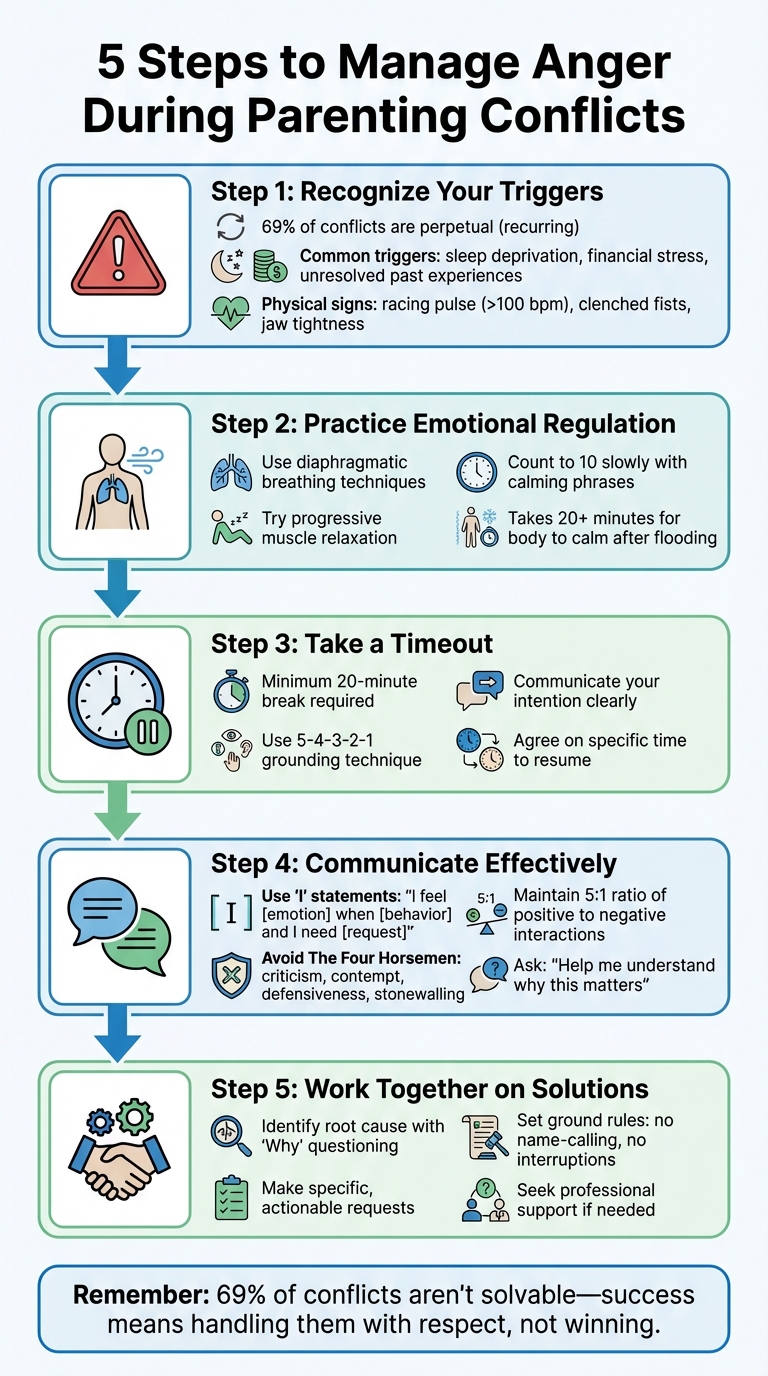
5-Step Process for Managing Anger During Parenting Conflicts
Recognizing Triggers and Warning Signs
Common Triggers in Parenting Disagreements
Parenting arguments often go beyond surface-level issues like bedtime routines or screen time rules. These disagreements frequently stem from deeper unmet emotional needs – feeling unseen, unheard, or undervalued in the relationship [8]. For instance, a debate about how much TV your child should watch might actually reflect differing parenting values or philosophies.
Studies reveal that 69% of conflicts are perpetual, meaning they arise from lasting differences [8]. These differences might show up as opposing views on whether to prioritize safety or encourage adventure, or in divergent approaches to discipline.
External factors also play a big role. Stressors like sleep deprivation, work pressures, financial concerns, or major life changes (like becoming new parents) can lower your ability to stay calm [8]. What might feel manageable on a good day could suddenly seem overwhelming when stress levels are high.
These external pressures can amplify emotional responses, especially when they interact with unresolved past experiences. Sometimes, these triggers tap into what experts call "enduring vulnerabilities" – emotional wounds from the past that resurface in the present. Take, for example, a case study from the Gottman Institute: A father reacted with intense anger when his child got stung by a bee. Upon reflection, this response was tied to feelings of neglect from his own childhood. As Master Certified Gottman Therapist Robert Navarra puts it:
"Enduring vulnerabilities are events that create an emotional wound that can be activated and re-lived in real time. The past becomes the present in those moments." [7]
Understanding these triggers can help you become more aware of your own emotional signals, paving the way for healthier responses.
Identifying Your Personal Signs of Anger
Before anger takes full control, your body sends out early warning signs. These physical cues might include a racing pulse (often above 100 beats per minute), a pounding heart, clenched fists or teeth, tightness in your shoulders or jaw, or a sensation of heat or flushing [9]. These signals indicate you’re entering a "flooding" state, where emotional reactions override logical thinking [1].
Behavioral cues also offer insight. The Gottman Institute highlights "The Four Horsemen" – criticism, contempt, defensiveness, and stonewalling – as key predictors of relationship troubles, with an accuracy rate of over 90% [8]. Actions like rolling your eyes or withdrawing from the conversation can escalate conflict further.
Anger often serves as a mask for deeper, more vulnerable emotions. When you feel anger rising, it can help to pause and ask yourself: "Am I actually feeling disappointed? Worried about my child’s safety? Unappreciated in this relationship?" Pinpointing the real emotion beneath the anger can open the door to more constructive and empathetic communication.
Physiologically, it takes at least 20 minutes for the body to calm down after reaching a flooded state [7]. If your heart is racing and your thoughts are spiraling, stepping away for a short break might be the best way to prevent the situation from escalating.
How Arguing in Front of Your Kids Affects Them and What to Do About It
Practicing Emotional Regulation Techniques
Understanding your anger triggers and physical reactions is just the beginning. The next step is learning how to manage those emotions in a way that allows you to respond thoughtfully rather than react impulsively. These techniques aren’t about pushing your feelings aside – they’re about creating a buffer between your emotions and your actions, giving you room to think and communicate effectively.
Using Breathing and Grounding Techniques
When anger starts to build, diaphragmatic breathing can help calm your body and mind. Place one hand on your chest and the other on your stomach. Breathe in slowly through your nose, letting your stomach rise while keeping your chest steady. Then, exhale slowly through your mouth. This method counteracts the shallow breathing that often accompanies heightened emotions [11].
As you breathe, try counting to ten slowly and repeating a calming phrase like, “I can handle this calmly” or “This isn’t personal.” These affirmations can help bring back rational thinking. Psychotherapist Jill Ceder explains:
"Mindful parenting means that you bring your conscious attention to what’s happening, instead of getting hijacked by your emotions." [10]
Progressive muscle relaxation is another effective tool. Start by tensing a muscle group for five seconds, then release. Work your way from your toes to your jaw, focusing on releasing tension in each area. You can also visualize a calming scene or imagine your anger as a wave that rises and falls, eventually fading away [10][11].
If staying calm feels impossible, try the "fake calm" approach. Even if you don’t feel calm inside, speak slowly and deliberately in a calm tone, and move with intention. This not only helps regulate your own emotional state but also sets a calming example for your children:
"Staying cool in the heat of the moment also encourages children to become calm, rather than having their parent’s anger further fuel their fire. Calm often leads to calm." [5]
And if none of these seem to work, it might be time to step away for a structured timeout.
Taking a Timeout to Reset
Sometimes, stepping back is the best way to regain control. A timeout isn’t about avoiding the issue – it’s about giving yourself the chance to shift from an emotional reaction to a more thoughtful response [6][12].
To make this effective, agree on a minimum 20-minute break [2][13]. Walking away without explanation can come across as dismissive, so be clear about your intentions. For example, you might say, “I’m feeling too upset to talk right now. I need a break to calm down, and we can revisit this in 20 minutes.”
Therapist Tiara Lipps from Stanford Couples Counseling underscores the importance of this approach:
"A healthy time-out is at least 20 minutes, agreed upon, and includes a plan to return to the conversation." [2]
During your timeout, avoid dwelling on the conflict – it will only keep your body in a heightened state of stress. Instead, focus on something calming. Watch a funny video, read a book, or try the 5-4-3-2-1 grounding technique: identify 5 things you see, 4 you can touch, 3 you hear, 2 you smell, and 1 you taste [13].
Use this break to check in with yourself. What’s really driving your anger? Are you feeling hurt, unimportant, or worried? Recognizing these deeper emotions can help you communicate more effectively when you return to the conversation. Make sure to agree on a specific time to resume the discussion – whether it’s in 20 minutes or later when both of you are ready [9][13].
Improving Communication During Conflicts
Once you’ve managed to calm yourself, the next step in resolving conflicts is effective communication. Choosing words that reflect your deeper emotions – like sadness or hurt – rather than reacting with frustration is crucial [1]. Studies highlight that healthy relationships maintain a balance of at least 5 positive interactions for every 1 negative interaction, even during disagreements [2]. Psychologist Dr. John Gottman underscores the importance of a gentle approach when initiating these conversations:
"Softening your start-up may save you a lot of trouble, even when there is an issue to be rectified" [16].
Starting a discussion calmly and respectfully can set the tone for a more productive exchange. Techniques such as using ‘I’ statements and asking thoughtful questions can help keep the conversation constructive.
Using ‘I’ Statements to Express Feelings
When emotions are running high, "you" statements can easily put the other person on the defensive, making it harder to solve the problem [1][2]. Instead, try framing your concerns with the "I feel [emotion] when [specific behavior] and I need [specific request]" structure [1][16].
For instance, instead of saying, "You never help with bedtime", you could say, "I feel overwhelmed when I handle bedtime alone and need your support." This approach shifts the focus from blaming the other person to sharing your own experience, fostering understanding rather than conflict [1][15]. Be clear and specific about what you want to change – vague requests like "be more sensitive" don’t provide a clear path for improvement [4].
Avoiding Escalation Through Respectful Communication
Certain behaviors, like criticism and defensiveness – often referred to as "The Four Horsemen" – can quickly escalate conflicts and are strong predictors of relationship breakdowns, with over 90% accuracy [1][15][8]. To avoid this, set ground rules for disagreements: no name-calling, no interruptions, and no bringing up old issues from more than 48 hours ago [2][17].
When faced with an upset partner, try asking, "Help me understand why this matters", instead of assuming negative intentions [2][17]. Therapist Tiara Lipps from Stanford Couples Counseling emphasizes:
"Fighting fairly doesn’t mean repressing emotions – it means expressing them in a way your partner can hear" [2].
This approach builds a foundation of respect, making future conversations easier and more productive. On the other hand, aggressive communication can lead to fear and avoidance, further straining the relationship [4].
sbb-itb-596b85d
Working Together to Solve Problems
Once you’ve managed to calm your emotions, the next step is working together to resolve the conflict. This means going beyond surface-level disagreements – like bedtime routines or screen time limits – and addressing the deeper issues fueling the tension. Therapist Tiara Lipps from Stanford Couples Counseling puts it this way:
"Underneath each fight lies a deeper emotional cycle. Maybe one partner feels ignored and lashes out, while the other feels attacked and shuts down. That cycle is the real problem – not the dishes." [2]
Often, conflicts are less about the immediate argument and more about underlying feelings. The goal isn’t to eliminate all disagreements but to handle them with care and mutual respect. Recognizing this can help you pinpoint the real source of the issue.
Identifying the Root of the Conflict
Most arguments, especially in parenting, aren’t truly about the specific situation at hand. For instance, a fight over who forgot to pack the kids’ lunches might actually stem from one partner feeling undervalued or overwhelmed.
To get to the heart of the issue, try the "Why" questioning technique. Ask, "Why is this upsetting us?" and follow up with, "And why does that bother us so much?" Keep peeling back the layers until you identify the core emotion. Timing is key – wait until emotions have settled to have this conversation, as heightened feelings can make it harder to think clearly. Once you’ve uncovered the root cause, you can move toward solving the problem together.
Brainstorming and Agreeing on Solutions
When the real issue becomes clear, it’s time to collaborate on solutions. Start by setting some ground rules: avoid name-calling, interruptions, or bringing up past grievances. Stick to one issue at a time to keep the discussion focused and productive.
Make specific and actionable requests. Instead of vague statements like "I wish you’d help more", try something concrete, such as, "Can you handle bath time on Tuesdays and Thursdays?" Be clear about what changes you’d like to see and what you’re willing to do to support those changes.
If things start to get heated, take a 20-minute break to cool down and regain perspective. Remember, strong relationships tend to maintain a balance of at least five positive interactions for every negative one [2]. Once you’ve agreed on a solution, both partners need to commit to following through. This builds trust and helps you tackle future conflicts more effectively together.
Establishing Family Routines and Boundaries
Once you’ve tackled conflict resolution, the next step is setting up clear family routines. When both partners agree on household rules, it minimizes misunderstandings and resentment. A consistent structure helps align expectations and keeps potential conflicts at bay.
Creating Aligned Parenting Rules
Start by reflecting on your parenting goals. Think about the specific issues you want to address, the outcomes you’re aiming for, and the steps you can take to get there. When you sit down with your partner, focus on making requests that are clear and actionable. For instance, instead of saying, "I wish you’d help more with the kids", try something like, "Can we agree that screen time ends at 7:30 p.m. on school nights?" This approach keeps the conversation centered on practical solutions.
When raising concerns, it’s helpful to come prepared with at least one potential solution. If inconsistent routines are causing friction, suggest a simple plan – like setting a fixed screen time cutoff at 7:30 p.m. – to create a shared routine and reduce confusion. Remember, both perspectives matter. While differences are inevitable, aim to find small areas of agreement that make both partners feel heard and respected.
Seeking Professional Support
Once you’ve established effective self-management and open communication, professional guidance can take your efforts to the next level. Therapy isn’t just for couples on the verge of separation – it can be a proactive step toward strengthening your relationship. Seeking support early can make a big difference, helping you address unresolved anger before it chips away at your connection [2][3].
Couples Counseling for Conflict Resolution
Therapists can help you dig beneath surface-level disagreements – like bedtime routines or screen time limits – and uncover the emotional patterns fueling your conflicts. For example, one partner might feel ignored and react with anger, while the other feels attacked and withdraws [2]. Recognizing these cycles is the first step to breaking them.
Counseling provides tools for managing anger in healthier ways. A therapist can help shift conversations from blame to vulnerability, encouraging you to express feelings instead of accusations. For instance, instead of saying, "You never back me up", you might learn to say, "I feel overwhelmed and dismissed when I don’t feel heard" [2][3]. This approach fosters understanding and reinforces the emotional regulation and communication skills you’ve been working on.
For couples facing parenting conflicts, specialized programs like Growth and Change Counseling offer tailored support. One example is The Marriage Rescue Institute, a 12-week intensive program designed for couples in challenging situations. Services are available in Campbell, San Jose, Los Angeles, and Roseville, as well as via telehealth for clients across California. Individual therapy sessions with a Licensed Marriage and Family Therapist cost $200 for 45 minutes, with sliding scale options starting at $100 for those with financial need.
Parent Coaching for Practical Guidance
Parent coaching focuses on actionable strategies for tackling specific challenges, like defiance, homework struggles, or bedtime battles. Coaches trained in methods such as Parent-Child Interaction Therapy (PCIT) or Parent Management Training (PMT) provide tools you can start using right away [19].
Research backs this up. The PROSPER project (2002–2012), which studied 415 rural families, found that parents who used anger management techniques during their child’s 6th-grade year saw reduced parent-child conflict by 9th grade and improved problem-solving behaviors by 11th grade [14]. Learning to manage your emotions now can have a lasting, positive impact on your family dynamic.
Moving Forward with Growth and Change Counseling
Handling anger during parenting conflicts often starts with rethinking how you react to disagreements. Anger is usually a cover for deeper emotions like feeling let down or undervalued. By recognizing this, you can move from placing blame to approaching situations with curiosity and understanding [1]. The real hurdle lies in breaking free from the recurring conflict patterns that can lead to destructive interactions [2].
The strategies discussed here – identifying triggers, managing emotions, using "I" statements, and fostering teamwork – work together to disrupt these cycles. Even small adjustments, like paraphrasing your partner’s words to show you’ve heard them, can prevent conflicts from spiraling out of control.
Interestingly, research shows that 69% of relationship challenges aren’t solvable. These often stem from personality differences or core needs that require ongoing, respectful dialogue rather than a quick fix [18]. Success in these situations isn’t about “winning” an argument. It’s about handling recurring issues with kindness and respect, steering clear of criticism and shutting down communication.
Your children are always observing, and they pick up on how you manage anger and resolve conflicts. They learn emotional regulation by watching you navigate frustration and repair relationships. Psychologist Dan Wile captures this reality perfectly:
"When choosing a long-term partner, you will inevitably be choosing a particular set of unresolvable problems" [18].
The real choice is whether you’ll face those challenges as opponents or as a united team.
If self-help approaches don’t seem to be enough – if conflicts persist or anger feels overwhelming – professional support can provide valuable tools and guidance. Couples counseling or parent coaching can help you reconnect and create a healthier family environment. Seeking assistance early, before resentment takes root, can make a significant difference. By applying these tools consistently, you can foster a more positive emotional space for your family. For additional support, consider exploring the couples counseling and parent coaching services offered by Growth and Change Counseling at Growth and Change Counseling.
FAQs
How can couples understand the emotions behind their anger during parenting disagreements?
Parenting conflicts can often bring out anger, but beneath that anger usually lie deeper emotions like fear, sadness, or even shame. The first step to addressing it? Take a moment to pause and reflect on what’s really fueling your anger. Ask yourself, “What need isn’t being met right now?” For instance, frustration over a chaotic bedtime routine might actually come from feeling undervalued or completely overwhelmed.
Once you’ve pinpointed the emotion, try to label it in a neutral, non-judgmental way. For example, you might say, “I feel hurt when my efforts seem unnoticed” or “I feel scared that I’m not doing enough as a parent.” When you’re ready, share these feelings with your partner using calm “I” statements. This small shift in communication can move the conversation away from blame and toward understanding, encouraging empathy and teamwork.
If working through these emotions feels overwhelming, Growth and Change Counseling can help. Through The Marriage Rescue Institute, they offer couples counseling designed to break the cycle of anger and address the deeper emotions driving parenting struggles. Their solutions-focused approach aims to help couples reconnect and work through challenges together.
How can couples stay calm and manage anger during parenting disagreements?
When parenting disagreements spark anger, it’s crucial to hit pause and regain your composure before diving back into the conversation. A quick time-out can work wonders – step away for a few minutes, take deep breaths, and count slowly to help ease your body’s stress response. This simple reset allows you to refocus and avoid reacting impulsively.
Once you’ve calmed down, consider activities like deep breathing, taking a short walk, or gentle stretches to release any lingering tension. Take a moment to identify the emotions driving your anger – whether it’s frustration, fear, or something else – and use "I-statements" to express how you feel. For example, saying, "I feel overwhelmed when…" can keep the conversation focused and constructive. Speaking in a calm, measured tone can also help defuse tension and steer the discussion toward a more productive outcome.
If you’re looking for extra support, Growth and Change Counseling offers expert services through The Marriage Rescue Institute, as well as parent coaching to help build lasting emotional regulation skills.
When should couples seek professional help for parenting disagreements?
Couples might want to think about seeking professional guidance when parenting disagreements become too frequent, overly heated, or start to take a toll on their relationship or their children’s well-being. Some signs to pay attention to include constant arguments that never seem to get resolved, struggles to stay calm during disagreements, or using harsh discipline methods that negatively affect the kids.
When communication repeatedly breaks down – whether through blame, criticism, or shutting each other out – or when self-help approaches just aren’t cutting it anymore, a therapist can step in to help. They can identify the deeper issues at play and provide practical tools for managing emotions and improving how you communicate with each other. Professional help becomes even more critical if the conflict is impacting your children’s behavior or emotional health, or if one or both partners feel stuck, hopeless, or uncertain about the future of the relationship.
Growth and Change Counseling offers tailored support for couples through The Marriage Rescue Institute. They also provide parent coaching and family therapy to help couples rebuild trust, enhance communication, and develop a healthier approach to parenting together.
Related Blog Posts
- Managing Anger During Addiction Recovery in Marriage
- Anger in Marriage: Christian Counseling Solutions
- Q&A: Managing Anger and Communication in Marriage
- Top 5 Techniques for High-Conflict Couples
